Genetic Information
Gene & Transcript Details
| ID | Status | Details |
|---|---|---|
| NM_024675.4 | MANE Select | 4008 nt | 154–3714 |
| NM_024675.3 | RefSeq Select | 4069 nt | 201–3761 |
Variant Details
Clinical & Population Data
Population Frequency
gnomADClinVar
OpenThe PALB2 c.109C>A (p.Arg37Ser) variant has been reported in the published literature in individuals with breast cancer (PMIDs: 29522266 (2018), 28194609 (2017)). Functional studies indicate this variant has mild to neutral effect on PALB2 DNA repair activity (PMIDs: 33964450 (2021), 31636395 (2020)). The frequency of this variant in the general population, 0.000016 (4/251456 chromosomes (Genome Aggregation Database, http://gnomad.broadinstitute.org)), is uninformative in the assessment of its pathogenicity. Analysis of this variant using bioinformatics tools for the prediction of the effect of amino acid changes on protein structure and function yielded predictions that this variant is damaging. Based on the available information, we are unable to determine the clinical significance of this variant.
This missense variant replaces arginine with serine at codon 37 of the PALB2 protein. Computational prediction suggests that this variant may not impact protein structure and function. Two functional studies have reported that this variant does not impact BRCA1 function in homology-directed repair assays (PMID: 31636395, 33964450). This variant has been reported in an individual affected with breast cancer (PMID: 28194609) and a suspected hereditary breast and ovarian cancer family (PMID: 29522266). This variant has been identified in 4/251456 chromosomes in the general population by the Genome Aggregation Database (gnomAD). The available evidence is insufficient to determine the role of this variant in disease conclusively. Therefore, this variant is classified as a Variant of Uncertain Significance.
Variant summary: PALB2 c.109C>A (p.Arg37Ser) results in a non-conservative amino acid change located in the coiled coil domain (Boonen_2020) of the encoded protein sequence. Algorithms developed to predict the effect of missense changes on protein structure and function are either unavailable or do not agree on the potential impact of this missense change. Consensus agreement among computation tools predict no significant impact on normal splicing. However, these predictions have yet to be confirmed by functional studies. The variant allele was found at a frequency of 1.6e-05 in 251456 control chromosomes. The available data on variant occurrences in the general population are insufficient to allow any conclusion about variant significance. c.109C>A has been observed in individual(s) affected with ER positive, HER negative breast cancer (Lerner-Ellis_2017). These report(s) do not provide unequivocal conclusions about association of the variant with Hereditary Breast And Ovarian Cancer Syndrome. At least two publications report primary experimental evidence evaluating an impact on protein function (Wiltshire_2020, Brnich_2021 and reviewed in Boonen_2020). These results showed no damaging effect of this variant on homology directed repair activity (Wiltshire_2019) and an intermediate assay read out on homology directed repair function (Brnich_2021). The following publications have been ascertained in the context of this evaluation (PMID: 33195396, 33964450, 28194609, 31636395). ClinVar contains an entry for this variant (Variation ID: 185108). Based on the evidence outlined above, the variant was classified as uncertain significance.
This variant is considered likely benign. This variant is strongly associated with less severe personal and family histories of cancer, typical for individuals without pathogenic variants in this gene [PMID: 25085752].
The p.R37S variant (also known as c.109C>A), located in coding exon 3 of the PALB2 gene, results from a C to A substitution at nucleotide position 109. This variant impacts the first base pair of coding exon 3. The arginine at codon 37 is replaced by serine, an amino acid with dissimilar properties. This alteration was found to be functionally normal in DNA-repair assays (Wiltshire T et al. Genet. Med. 2020 03;22:622-632; Brnich SE et al. J Mol Diagn. 2021 07;23:847-864). This amino acid position is highly conserved in available vertebrate species. In addition, the in silico prediction for this alteration is inconclusive. Based on the available evidence, the clinical significance of this variant remains unclear.
"This variant has been reported in ClinVar as Uncertain significance (12 clinical laboratories) and as Likely benign (1 clinical laboratories) and as Uncertain Significance by ClinGen Hereditary Breast, Ovarian and Pancreatic Cancer Variant Curation Expert Panel, ClinGen expert panel."
COSMIC Somatic Evidence
Open
Functional Impact & Domains
Functional Domain
Error in OpenAI Consolidation. OncoKB: PALB2R37SPALB2R37SSomaticNCBI Gene:79728|Show additional gene information Variant OverviewPALB2, a scaffolding protein involved in DNA repair, is altered in various cancers.The PALB2 R37S mutation has not specifically been reviewed by the OncoKB team. While PALB2 R37H is likely neutral, the oncogenic effect of PALB2 R37S is unknown.Hide mutation effect description The PALB2 R37S mutation has not specifically been reviewed by the OncoKB team. However, the mutation effect description for PALB2 R37H, an alternate allele of PALB2 R37S, is: The PALB2 R37H mutation lies on the N-terminal coiled-coil motif of the PALB2 protein responsible for BRCA1 binding. Ectopic expression of the R37H mutation in 293T cells did not affect endogenous BRCA1 interactions, and only modestly reduced homologous recombination efficiency when overexpressed in PALB2-depleted cells. In addition, expression of the R37H mutation in PALB2-deficient cells had no effect on ionizing radiation-induced foci formation compared to wild type PALB2 (PMID: 28319063). JAX-CKB: PALB2 R37S lies within the DNA-binding, and BRCA1 and RAD51-interacting regions of the Palb2 protein (UniProt.org). R37S results in homology-directed DNA repair similar to wild-type Palb2 in cultured cells (PMID: 31636395, PMID: 33964450), and therefore, is predicted to have no effect on Palb2 protein function.
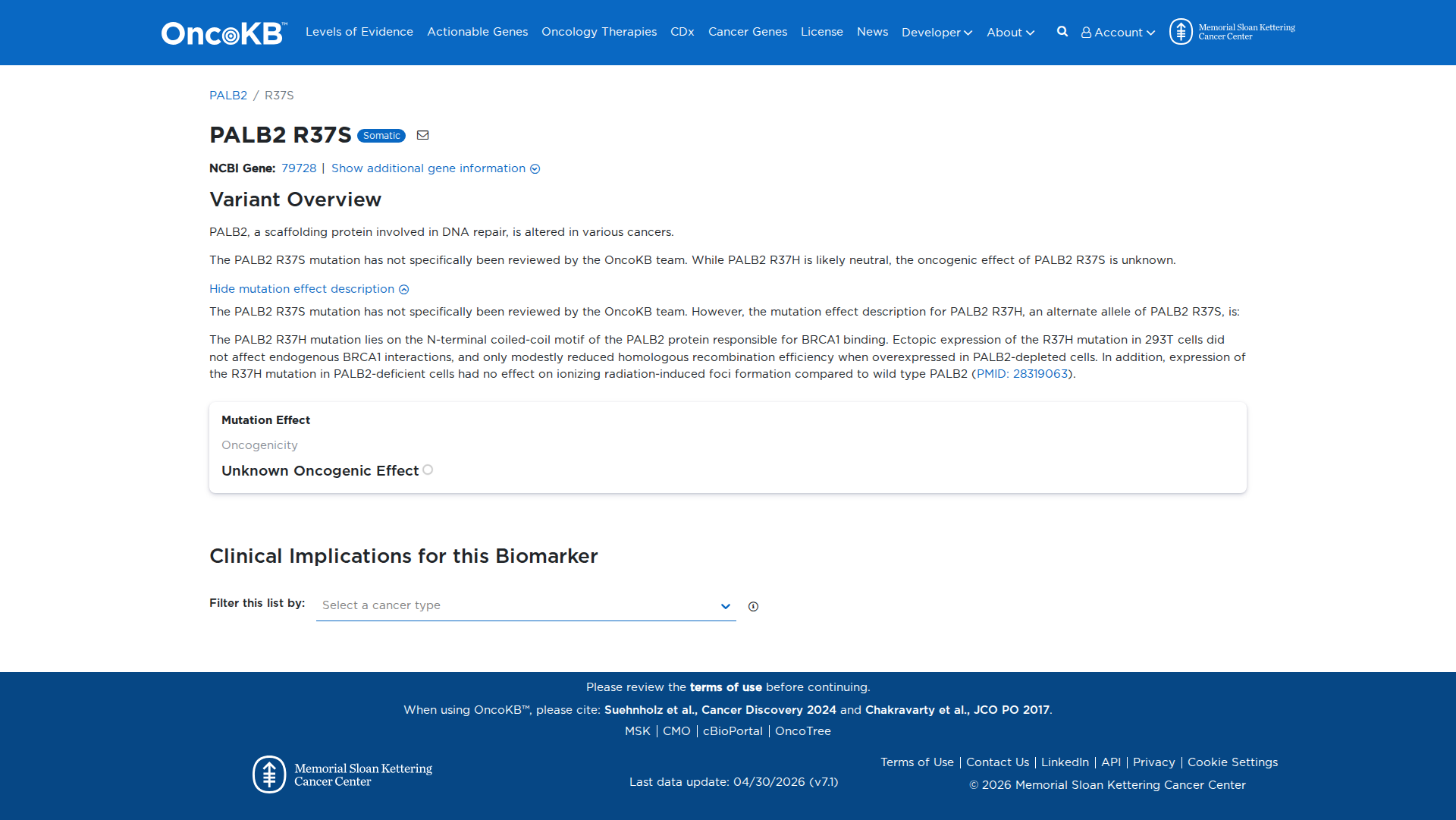
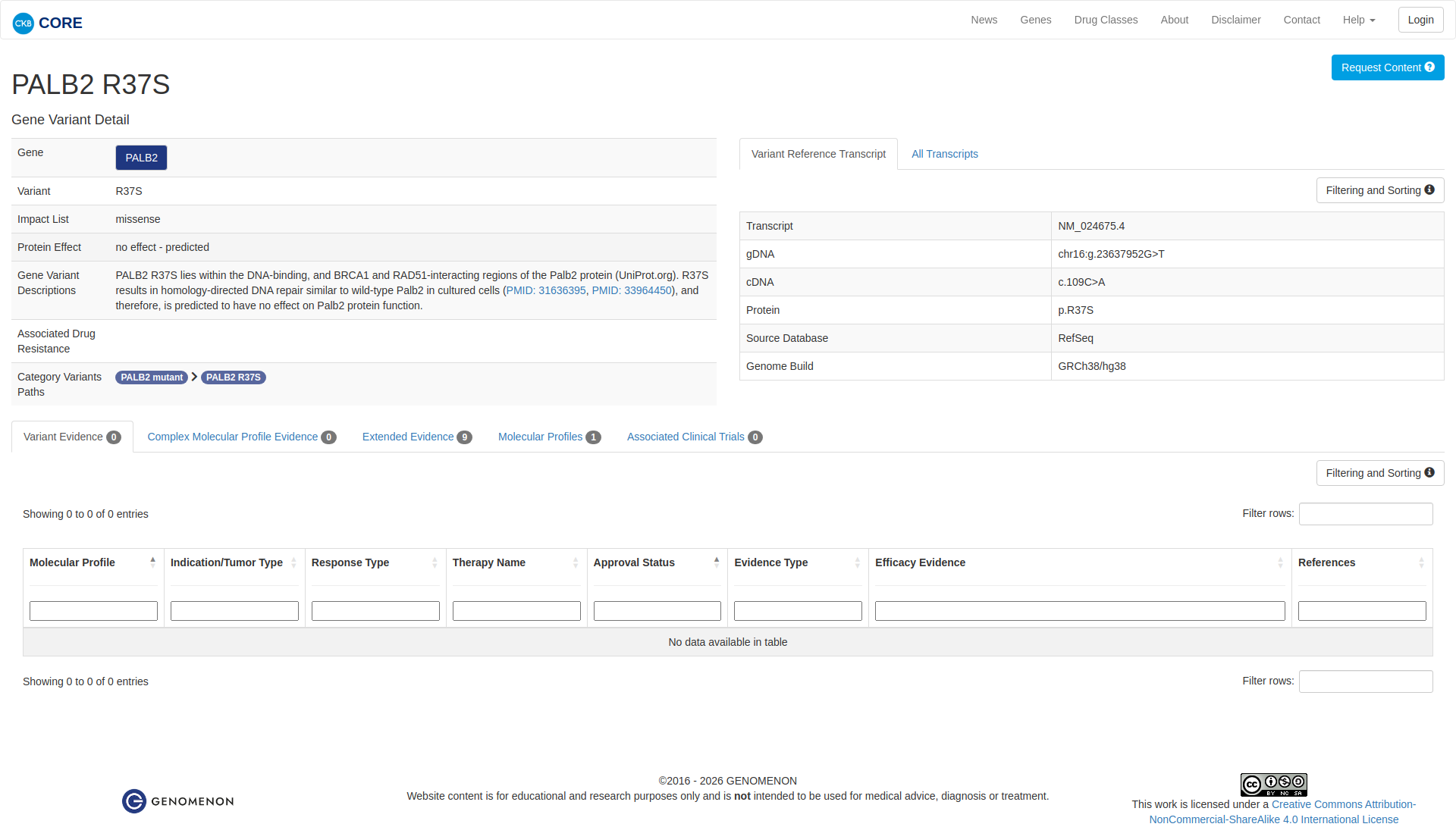
Click on previews to view full database entries. External databases may require institutional access.
Computational Analysis
Pathogenicity Predictions
SpliceAISpliceAI Scores
Window: ±500bp| Effect Type | Score | Position |
|---|---|---|
| Acceptor Loss (AL) | 0.01 | -11 bp |
| Donor Loss (DL) | 0.0 | -150 bp |
| Acceptor Gain (AG) | 0.06 | -2 bp |
| Donor Gain (DG) | 0.0 | -102 bp |
VCEP Guidelines
Applied ACMG/AMP Criteria (VCEP Specific)
PS3 (Unknown (Pre-LLM))
From pre-LLM assessment (LLM Failed)
PM2 (Unknown (Pre-LLM))
From pre-LLM assessment (LLM Failed)
BP4 (Unknown (Pre-LLM))
From pre-LLM assessment (LLM Failed)