Genetic Information
Gene & Transcript Details
| ID | Status | Details |
|---|---|---|
| NM_000546.3 | Alternative | 2640 nt | 252–1433 |
| NM_000546.5 | RefSeq Select | 2591 nt | 203–1384 |
| NM_000546.6 | MANE Select | 2512 nt | 143–1324 |
| NM_000546.4 | Alternative | 2586 nt | 198–1379 |
| NM_000546.2 | Alternative | 2629 nt | 252–1433 |
Variant Details
Clinical & Population Data
Population Frequency
gnomADClinVar
OpenThis variant is considered pathogenic. Functional studies indicate this variant impacts protein function [PMID: 9704930, 9704931, 27754743]. This variant is expected to disrupt protein structure [Myriad internal data]. This variant has been reported in multiple individuals with clinical features of gene-specific disease [PMID: 8649785].
The p.L344P pathogenic mutation (also known as c.1031T>C), located in coding exon 9 of the TP53 gene, results from a T to C substitution at nucleotide position 1031. The leucine at codon 344 is replaced by proline, an amino acid with some similar properties. This alteration occurs at a well-characterized residue involved in the tetramerization of the p53 protein (Mateu and Fersht, EMBO J. 1998 May; 17(10):2748-58). This alteration has been identified in families meeting clinical criteria for Li-Fraumeni syndrome with a tumor spectrum including osteosarcomas, leiomyosarcomas, and early onset breast cancer (Petitjean A et al. IARC TP53 database [version R17, November 2013]. Hum Mutat. 2007 Jun;28(6):622-9;Varley J et al., Oncogene 1996 Jun; 12(11):2437-42 ). Evidence from both functional and structural analyses indicate that this alteration is structurally unstable and unable to form tetramers (Ishioka C et al., Oncogene 1995 Apr; 10(8):1485-92; Davison T et al., Oncogene 1998 Aug; 17(5):651-6). Additional functional studies conducted in both yeast and mammalian cells have demonstrated that this alteration produces a protein that cannot activate transcription, is defective in DNA binding, suppression of cell growth, and induction of apoptosis (Monti P et al., Mol. Cancer Res. 2011 Mar; 9(3):271-9. Malcikova Jet al., Biol. Chem. ; 391(2-3):197-205; Lomax M et al., Oncogene 1998 Aug; 17(5):643-9). Based on the available evidence, p.L344P is classified as a pathogenic mutation.
This sequence change replaces leucine, which is neutral and non-polar, with proline, which is neutral and non-polar, at codon 344 of the TP53 protein (p.Leu344Pro). This variant is not present in population databases (gnomAD no frequency). This missense change has been observed in individuals with Li-Fraumeni syndrome (PMID: 8649785, 17606709, 20522432). ClinVar contains an entry for this variant (Variation ID: 12375). Invitae Evidence Modeling incorporating data from in vitro experimental studies (PMID: 12826609, 29979965, 30224644) indicates that this missense variant is expected to disrupt TP53 function with a positive predictive value of 97.5%. Experimental studies have shown that this missense change affects TP53 function (PMID: 10064694, 17606709, 20128691). For these reasons, this variant has been classified as Pathogenic.
"This variant has been reported in ClinVar as Pathogenic (3 clinical laboratories) and as Likely pathogenic (2 clinical laboratories) and as Likely Pathogenic by ClinGen TP53 Variant Curation Expert Panel, ClinGen expert panel."
COSMIC Somatic Evidence
Open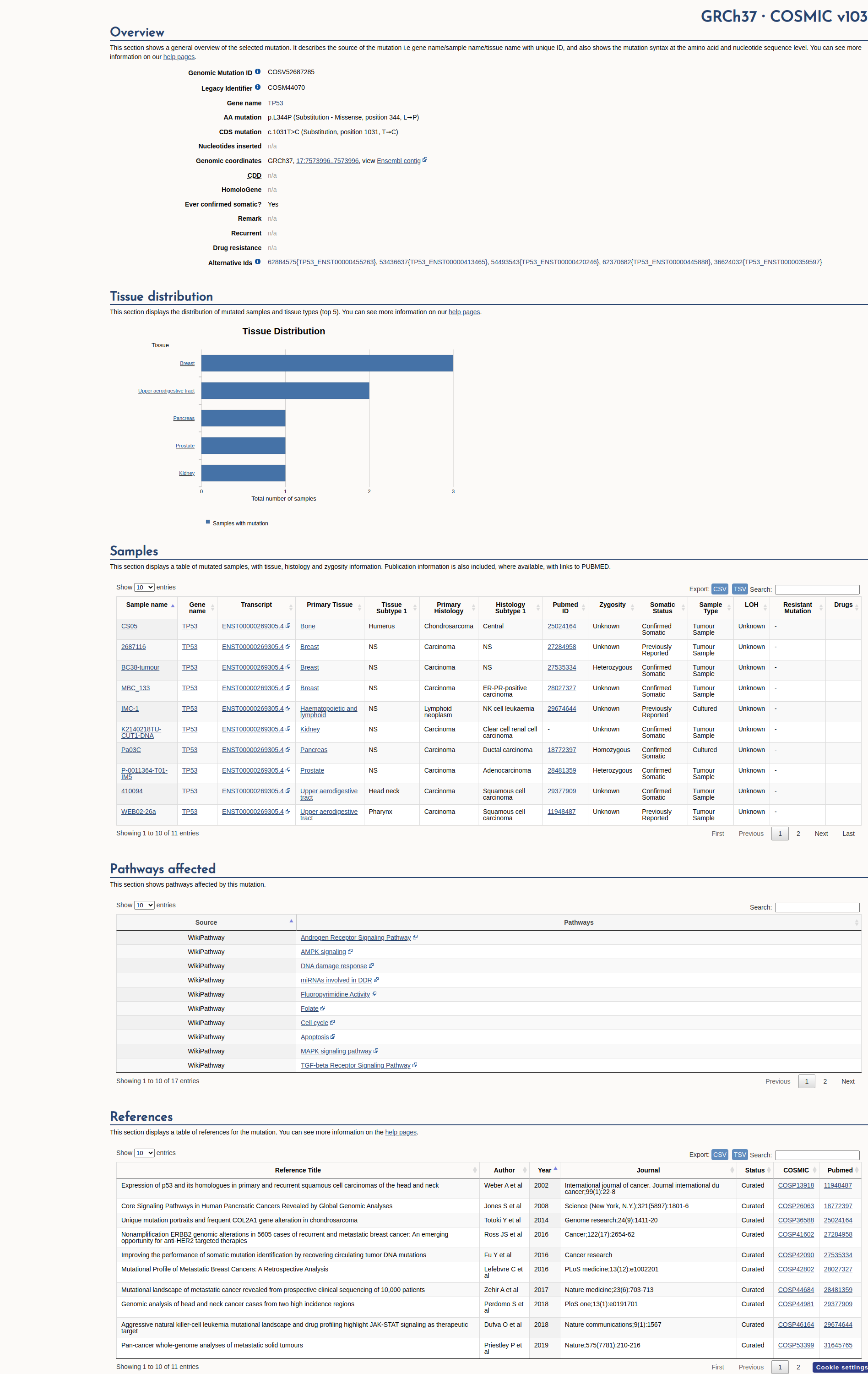
Functional Impact & Domains
Functional Domain
Error in OpenAI Consolidation. OncoKB: TP53L344PTP53L344PSomaticNCBI Gene:7157|Show additional gene information Variant OverviewTP53, a tumor suppressor in the DNA damage pathway, is the most frequently mutated gene in cancer.The TP53 L344P mutation is likely oncogenic.Hide mutation effect description The TP53 L344P mutation is located in the protein's oligomerization domain. This mutation has been found in Li-Fraumeni syndromes (PMID: 9704930). In vitro and structural studies have demonstrated that this mutation is inactivating, as evidenced by the mutant's inability to oligomerize and form TP53 tetramers, leading to decreased transactivation of TP53 target genes, decreased TP53 acetylation and decreased recruitment of p300 in the mutant compared to wildtype (PMID: 19454241, 19106109, 20978130). JAX-CKB: TP53 L344P lies within the tetramerization domain of the Tp53 protein (PMID: 20978130). L344P results in decreased Tp53 tetramerization and transcriptional activity, reduced expression of Tp53 target genes, and demonstrates partial colony suppression ability in cell culture (PMID: 19454241, PMID: 9125151, PMID: 20080630).
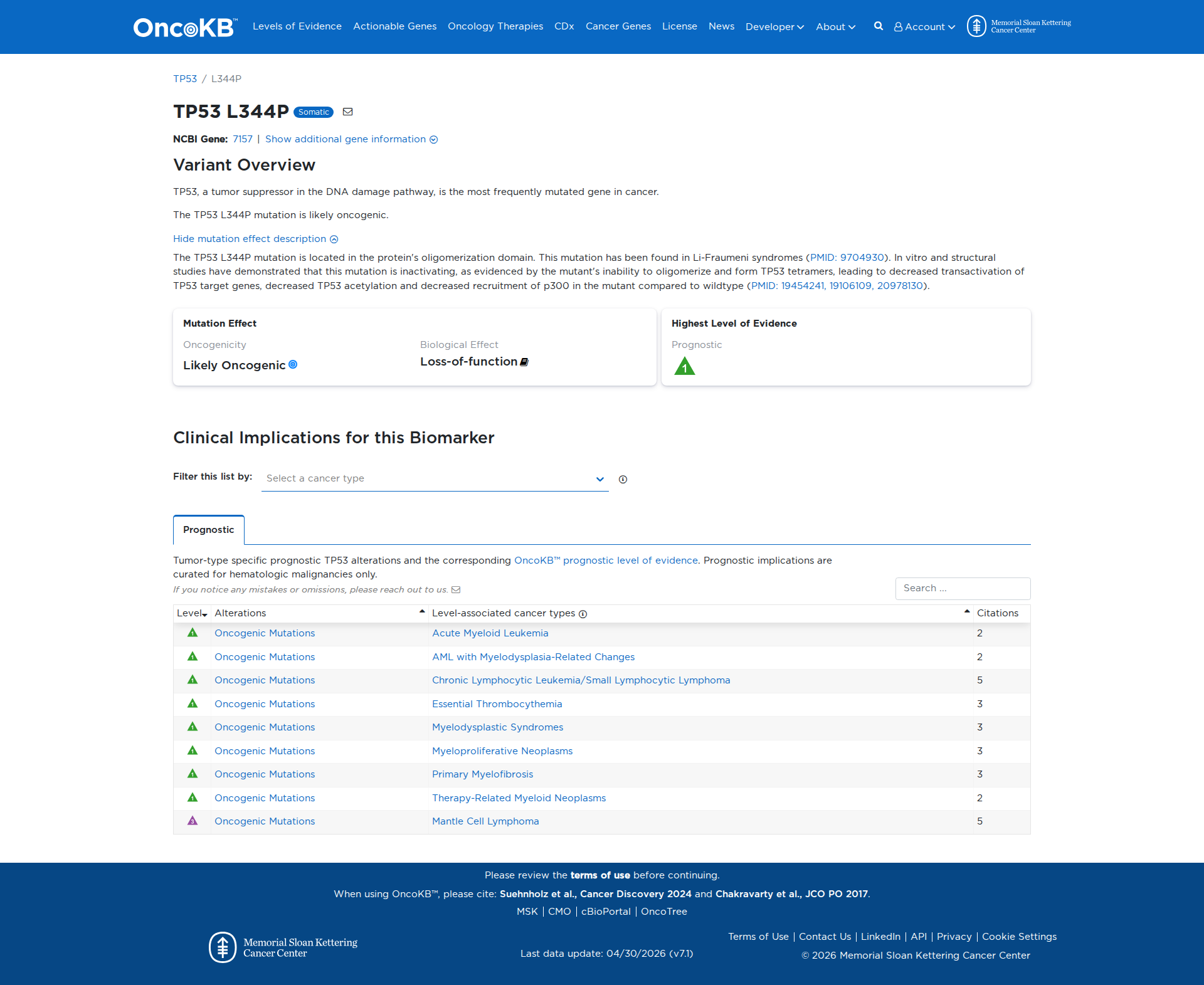
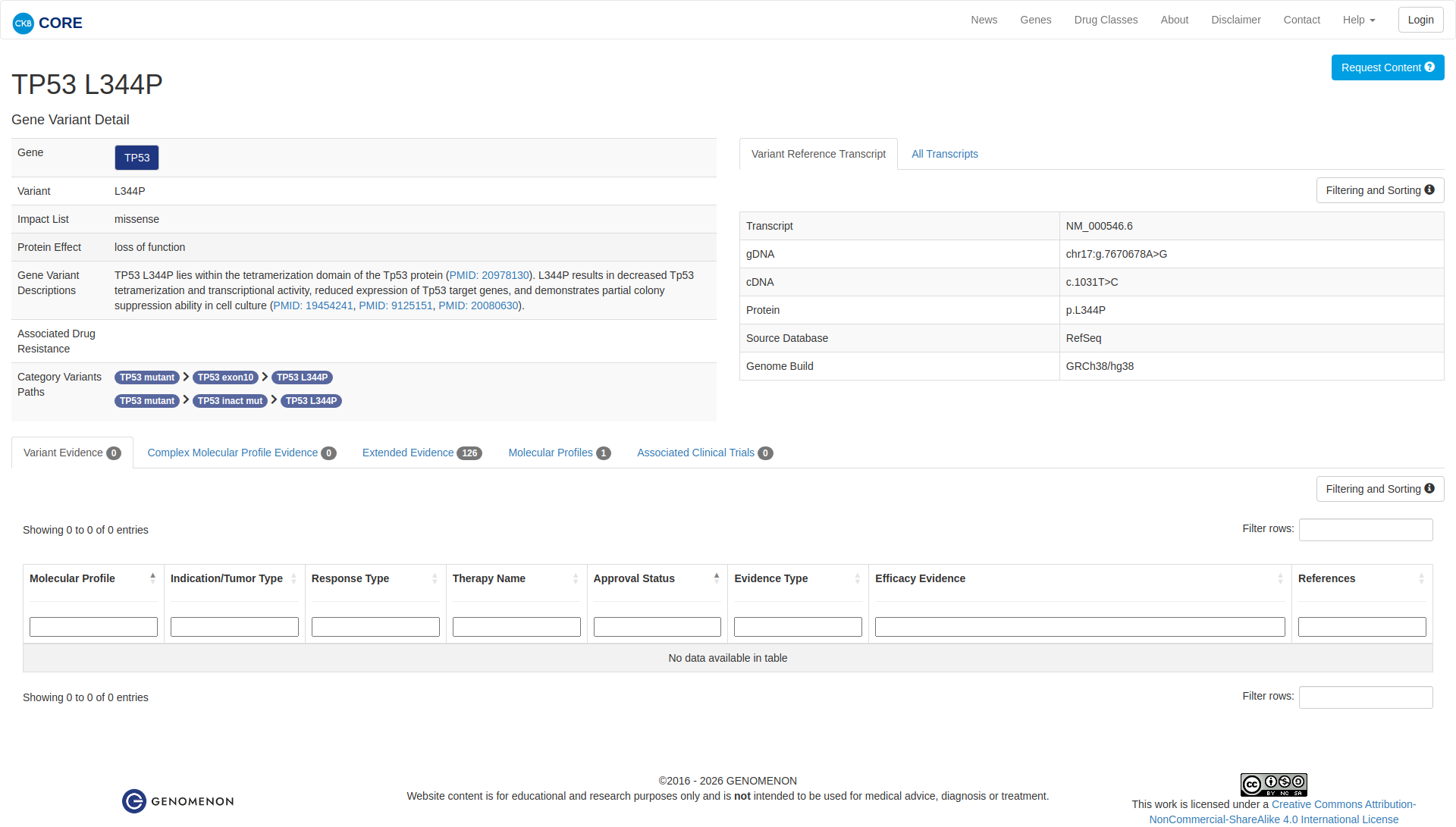
Click on previews to view full database entries. External databases may require institutional access.
Computational Analysis
Pathogenicity Predictions
SpliceAISpliceAI Scores
Window: ±500bp| Effect Type | Score | Position |
|---|---|---|
| Acceptor Loss (AL) | 0.0 | 81 bp |
| Donor Loss (DL) | 0.0 | -69 bp |
| Acceptor Gain (AG) | 0.0 | -268 bp |
| Donor Gain (DG) | 0.0 | 172 bp |
VCEP Guidelines
Applied ACMG/AMP Criteria (VCEP Specific)
PS3 (Unknown (Pre-LLM))
From pre-LLM assessment (LLM Failed)
PM2 (Unknown (Pre-LLM))
From pre-LLM assessment (LLM Failed)
PP5 (Unknown (Pre-LLM))
From pre-LLM assessment (LLM Failed)
BP4 (Unknown (Pre-LLM))
From pre-LLM assessment (LLM Failed)