Genetic Information
Gene & Transcript Details
| ID | Status | Details |
|---|---|---|
| NM_000546.3 | Alternative | 2640 nt | 252–1433 |
| NM_000546.5 | RefSeq Select | 2591 nt | 203–1384 |
| NM_000546.6 | MANE Select | 2512 nt | 143–1324 |
| NM_000546.4 | Alternative | 2586 nt | 198–1379 |
| NM_000546.2 | Alternative | 2629 nt | 252–1433 |
Variant Details
Clinical & Population Data
Population Frequency
gnomADClinVar
OpenThis alteration is classified as likely benign based on a combination of the following: seen in unaffected individuals, population frequency, intact protein function, lack of segregation with disease, co-occurrence, RNA analysis, in silico models, amino acid conservation, lack of disease association in case-control studies, and/or the mechanism of disease or impacted region is inconsistent with a known cause of pathogenicity.
This sequence change replaces cysteine, which is neutral and slightly polar, with serine, which is neutral and polar, at codon 124 of the TP53 protein (p.Cys124Ser). This variant is present in population databases (rs730881997, gnomAD 0.01%). This variant has not been reported in the literature in individuals affected with TP53-related conditions. ClinVar contains an entry for this variant (Variation ID: 182926). Invitae Evidence Modeling incorporating data from in vitro experimental studies (PMID: 12826609, 29979965, 30224644) indicates that this missense variant is not expected to disrupt TP53 function with a negative predictive value of 97.5%. Experimental studies have shown that this missense change does not substantially affect TP53 function (PMID: 12826609, 25584637, 29979965, 30224644). In summary, the available evidence is currently insufficient to determine the role of this variant in disease. Therefore, it has been classified as a Variant of Uncertain Significance.
This missense variant replaces cysteine with serine at codon 124 of the TP53 protein. Computational predictions are inconsistent for impact on protein structure and function. Experimental studies have shown that this variant does not impact function in yeast-based transcriptional transactivation assays (PMID:12826609), or in human cell growth suppression and proliferation assays (PMID:29979965, 30224644). To our knowledge, this variant has not been reported in individuals affected with TP53-related disorders in the literature. This variant has been reported somatic in 4 tumors at cancerhotspots.org. This variant has been identified in 3/282252 chromosomes in the general population by the Genome Aggregation Database (gnomAD). The available evidence is insufficient to determine the role of this variant in disease conclusively. Therefore, this variant is classified as a Variant of Uncertain Significance.
"This variant has been reported in ClinVar as Likely benign (1 clinical laboratories) and as Uncertain significance (3 clinical laboratories) and as Likely Benign by ClinGen TP53 Variant Curation Expert Panel, ClinGen expert panel."
COSMIC Somatic Evidence
Open
Functional Impact & Domains
Functional Domain
Error in OpenAI Consolidation. OncoKB: TP53C124STP53C124SSomaticNCBI Gene:7157|Show additional gene information Variant OverviewTP53, a tumor suppressor in the DNA damage pathway, is the most frequently mutated gene in cancer.The TP53 C124S mutation has not specifically been reviewed by the OncoKB team. However, TP53 C124R is likely oncogenic, and therefore TP53 C124S is considered likely oncogenic.Hide mutation effect description The TP53 C124S mutation has not specifically been reviewed by the OncoKB team. However, the mutation effect description for TP53 C124R, an alternate allele of TP53 C124S, is: The TP53 C124R mutation is located in the DNA binding domain of the protein. Expression of this mutation in a yeast functional assay demonstrated that it is likely inactivating (PMID: 9115587) JAX-CKB: TP53 C124S lies within the DNA-binding domain of the Tp53 protein (PMID: 15510160). C124S results in induction of p21 similar to wild-type Tp53 in culture (PMID: 34679713) but is predicted to confer a gain of function to the Tp53 protein as demonstrated by enhanced DNA-binding capacity in cell culture (PMID: 12034820).

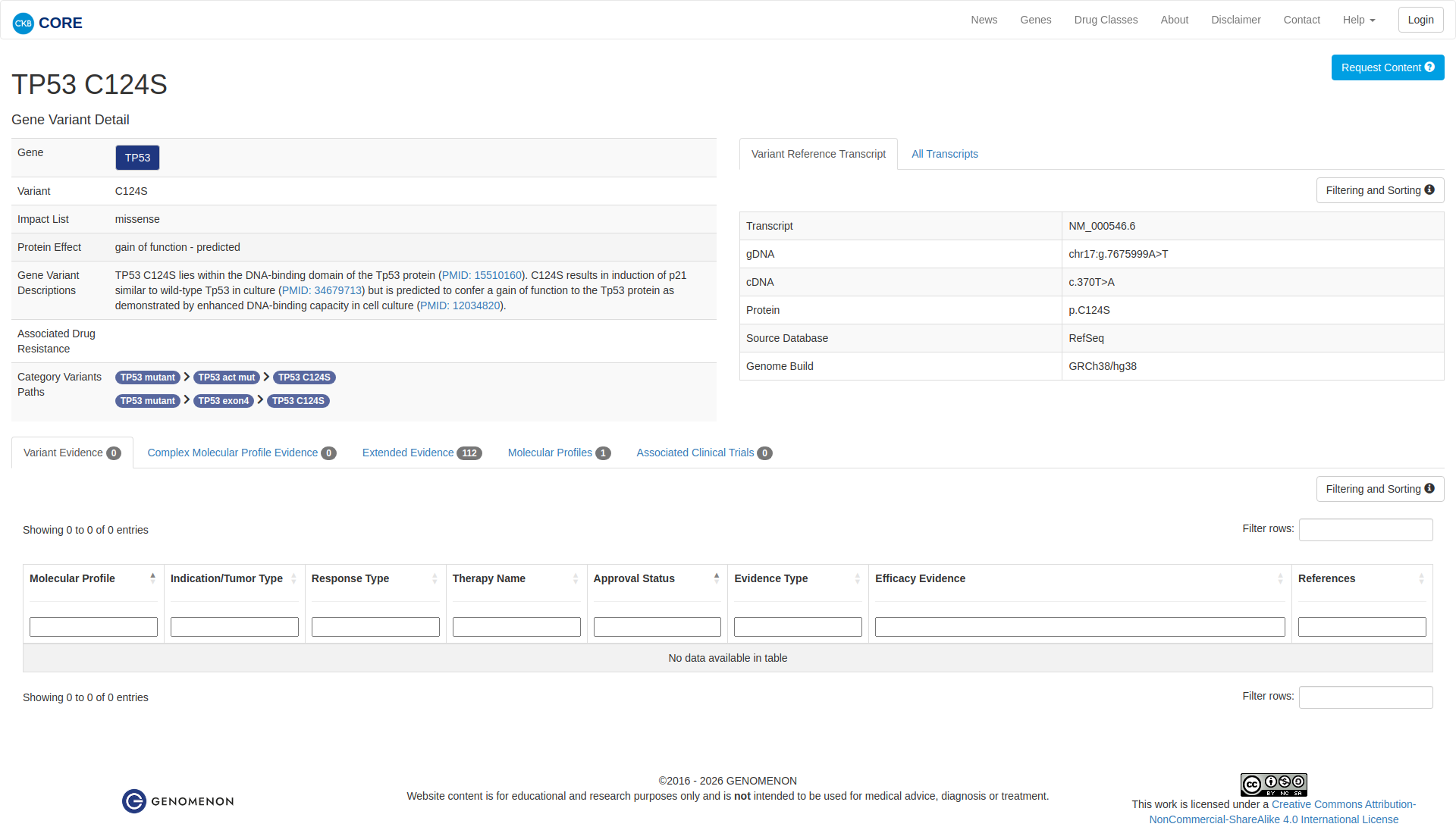
Click on previews to view full database entries. External databases may require institutional access.
Computational Analysis
Pathogenicity Predictions
SpliceAISpliceAI Scores
Window: ±500bp| Effect Type | Score | Position |
|---|---|---|
| Acceptor Loss (AL) | 0.0 | 254 bp |
| Donor Loss (DL) | 0.01 | -114 bp |
| Acceptor Gain (AG) | 0.02 | 69 bp |
| Donor Gain (DG) | 0.01 | 7 bp |
VCEP Guidelines
Applied ACMG/AMP Criteria (VCEP Specific)
PS3 (Unknown (Pre-LLM))
From pre-LLM assessment (LLM Failed)
PM2 (Unknown (Pre-LLM))
From pre-LLM assessment (LLM Failed)
BP4 (Unknown (Pre-LLM))
From pre-LLM assessment (LLM Failed)