Genetic Information
Gene & Transcript Details
| ID | Status | Details |
|---|---|---|
| NM_007194.4 | MANE Select | 1844 nt | 59–1690 |
| NM_007194.3 | Alternative | 1862 nt | 73–1704 |
Variant Details
Clinical & Population Data
Population Frequency
gnomADClinVar
OpenThe CHEK2 c.906A>C (p.Glu302Asp) variant has been reported in the published literature in individuals with breast and/or ovarian cancer (PMIDs: 30613976 (2019), 29522266 (2018)) and colorectal cancer (PMID: 33298767 (2021)). A yeast-based functional study indicates this variant has an intermediate impact on CHEK2 DNA repair activity (PMID: 30851065 (2019)). The frequency of this variant in the general population, 0.000059 (6/101258 chromosomes (Genome Aggregation Database, http://gnomad.broadinstitute.org)), is uninformative in the assessment of its pathogenicity. Analysis of this variant using bioinformatics tools for the prediction of the effect of amino acid changes on protein structure and function yielded predictions that this variant is damaging. Based on the available information, we are unable to determine the clinical significance of this variant.
The p.E302D variant (also known as c.906A>C), located in coding exon 7 of the CHEK2 gene, results from an A to C substitution at nucleotide position 906. The glutamic acid at codon 302 is replaced by aspartic acid, an amino acid with highly similar properties. This alteration was detected in 1/5589 German BRCA1/2-negative probands diagnosed with breast cancer (Hauke J et al. Cancer Med, 2018 Apr;7:1349-1358). This alteration behaved as semi-functional in an in vivo, yeast-based growth rate assay (Delimitsou A et al. Hum Mutat, 2019 05;40:631-648). This alteration has also been reported in 2/1197 individuals from Greece, Romania, and Turkey undergoing evaluation for inherited cancer predisposition (Tsaousis GN et al. BMC Cancer, 2019 Jun;19:535). This amino acid position is highly conserved in available vertebrate species. In addition, the in silico prediction for this alteration is inconclusive. Based on the available evidence, the clinical significance of this variant remains unclear.
Variant summary: CHEK2 c.906A>C (p.Glu302Asp) results in a conservative amino acid change in the encoded protein sequence. Algorithms developed to predict the effect of missense changes on protein structure and function are either unavailable or do not agree on the potential impact of this missense change. Consensus agreement among computation tools predict no significant impact on normal splicing. However, these predictions have yet to be confirmed by functional studies. The variant allele was found at a frequency of 3e-05 in 202734 control chromosomes. c.906A>C has been observed in individual(s) affected with various cancers, without strong evidence for causality (example, Tsaousis_2019, Rizzolo_2019, Bucalo_2023, Quezada_2018, Marks_2021, Rocca_2024, Hauke_2018). These report(s) do not provide unequivocal conclusions about association of the variant with CHEK2-related conditions. At least one publication reports experimental evidence evaluating an impact on protein function. The most pronounced variant effect results in 10%-<30% of normal activity in an in vitro KAP1 phosphorylation assay (example, Stolarova_2023). In another study, yeast growth was slightly (but not significantly) reduced in the presence of this variant when cells were treated with a DNA-damaging agent (Delimitsou_2019). The following publications have been ascertained in the context of this evaluation (PMID: 37262986, 30613976, 31159747, 30851065, 35643632, 37725924, 32906215, 31658756, 37449874, 38115798, 39594831, 30262796, 33298767, 39590369, 34326862, 29522266). ClinVar contains an entry for this variant (Variation ID: 128087). Based on the evidence outlined above, the variant was classified as VUS-possibly pathogenic.
This sequence change replaces glutamic acid, which is acidic and polar, with aspartic acid, which is acidic and polar, at codon 302 of the CHEK2 protein (p.Glu302Asp). This variant is present in population databases (rs587780190, gnomAD 0.007%). This missense change has been observed in individual(s) with CHEK2-related conditions (PMID: 29522266, 30613976, 31159747, 37449874). This variant is also known as c.1035A>C p.Glu345Asp. ClinVar contains an entry for this variant (Variation ID: 128087). An algorithm developed to predict the effect of missense changes on protein structure and function (PolyPhen-2) suggests that this variant is likely to be disruptive. Experimental studies are conflicting or provide insufficient evidence to determine the effect of this variant on CHEK2 function (PMID: 37449874). In summary, the available evidence is currently insufficient to determine the role of this variant in disease. Therefore, it has been classified as a Variant of Uncertain Significance.
"This variant has been reported in ClinVar as Uncertain significance (12 clinical laboratories)."
COSMIC Somatic Evidence
Open
Functional Impact & Domains
Functional Domain
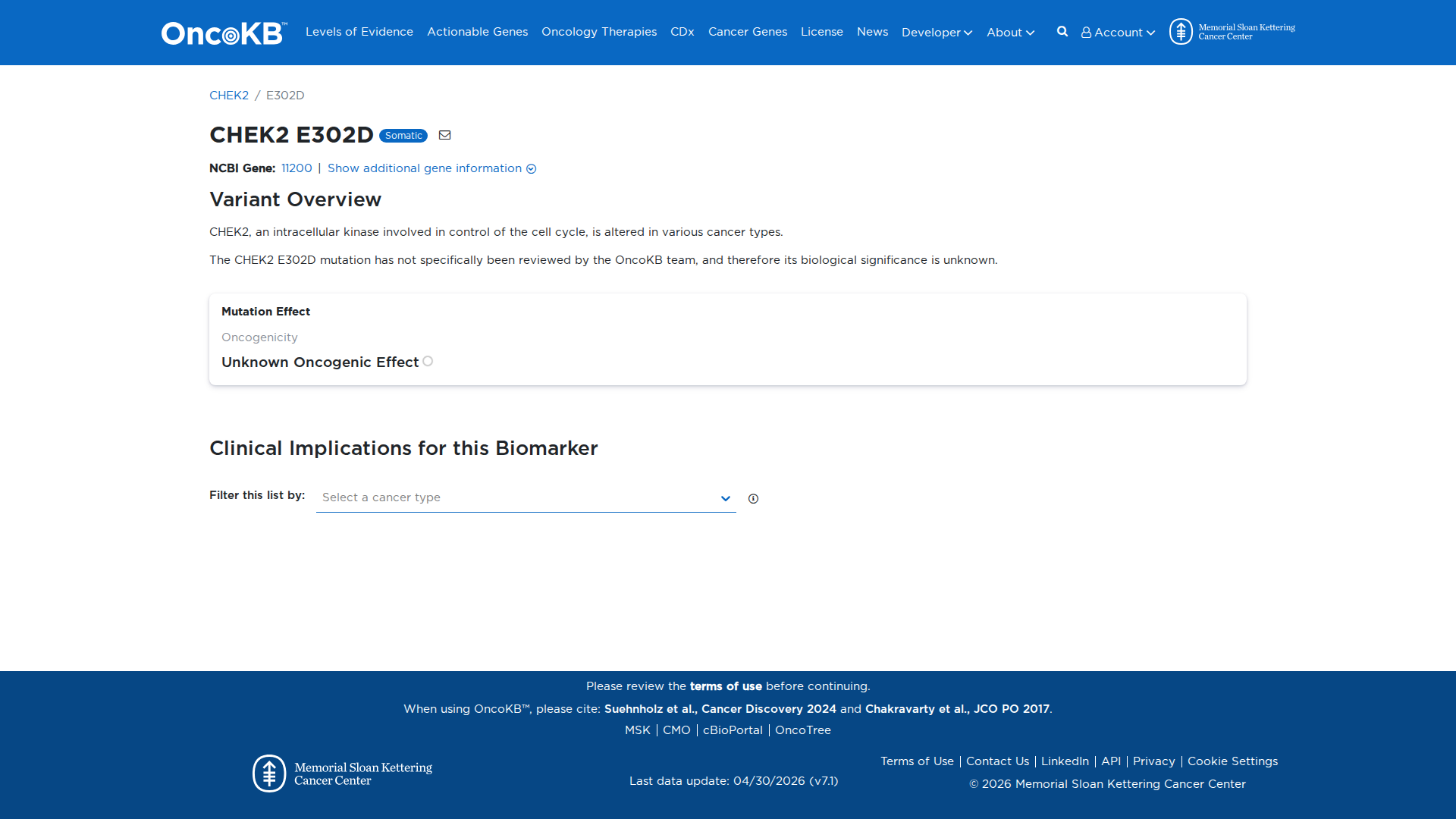
Error in OpenAI Consolidation. OncoKB: CHEK2E302DCHEK2E302DSomaticNCBI Gene:11200|Show additional gene information Variant OverviewCHEK2, an intracellular kinase involved in control of the cell cycle, is altered in various cancer types.The CHEK2 E302D mutation has not specifically been reviewed by the OncoKB team, and therefore its biological significance is unknown. JAX-CKB: No results found

Click on previews to view full database entries. External databases may require institutional access.
Computational Analysis
Pathogenicity Predictions
SpliceAISpliceAI Scores
Window: ±500bp| Effect Type | Score | Position |
|---|---|---|
| Acceptor Loss (AL) | 0.01 | 59 bp |
| Donor Loss (DL) | 0.01 | -2 bp |
| Acceptor Gain (AG) | 0.0 | -194 bp |
| Donor Gain (DG) | 0.0 | -272 bp |
VCEP Guidelines
Applied ACMG/AMP Criteria (VCEP Specific)
PM2 (Unknown (Pre-LLM))
From pre-LLM assessment (LLM Failed)
BP4 (Unknown (Pre-LLM))
From pre-LLM assessment (LLM Failed)