Genetic Information
Gene & Transcript Details
| ID | Status | Details |
|---|---|---|
| NM_001354609.2 | Alternative | 9687 nt | 227–2530 |
| NM_001354609.1 | Alternative | 9702 nt | 226–2529 |
Variant Details
Clinical & Population Data
Population Frequency
gnomADClinVar
OpenThis sequence change replaces phenylalanine with leucine at codon 247 of the BRAF protein (p.Phe247Leu). The phenylalanine residue is highly conserved and there is a small physicochemical difference between phenylalanine and leucine. This variant is not present in population databases (ExAC no frequency). This missense change has been observed in individuals with clinical features consistent with a RASopathy (PMID: 28512244; Invitae). ClinVar contains an entry for this variant (Variation ID: 55793). Algorithms developed to predict the effect of missense changes on protein structure and function (SIFT, PolyPhen-2, Align-GVGD) all suggest that this variant is likely to be tolerated. For these reasons, this variant has been classified as Pathogenic.
The c.741T>G (p.Phe247Leu) variant in BRAF has been reported in the literature as a confirmed and unconfirmed de novo occurrence in 2 patients with clinical features of a RASopathy (PM6, PS2, PS4_Supporting; GeneDx internal data; GTR Lab ID 26957; SCV000077236.10). In vitro functional studies provide some evidence that the p.Phe247Leu variant may impact protein function (PS3; PMID: 28512244). Furthermore, the variant is in a location that has been defined by the ClinGen RASopathy Expert Panel to be a mutational hotspot or domain of BRAF (PM1; PMID 29493581). This variant was absent from large population studies (PM2; gnomAD, http://gnomad.broadinstitute.org). The variant is located in the BRAF gene, which has been defined by the ClinGen RASopathy Expert Panel as a gene with a low rate of benign missense variants and pathogenic missense variants are common (PP2; PMID: 29493581). Computational prediction tools and conservation analysis suggest that the p.Phe247Leu variant may impact the protein (PP3). In summary, this variant meets criteria to be classified as pathogenic for RASopathies in an autosomal dominant manner. Rasopathy-specific ACMG/AMP criteria applied (PMID:29493581): PM6, PS2, PS3, PM1, PM2, PP2, PP3, PS4_Supporting.
"This variant has been reported in ClinVar as Likely pathogenic (1 clinical laboratories) and as Pathogenic (3 clinical laboratories) and as Pathogenic by ClinGen RASopathy Variant Curation Expert Panel expert panel."
COSMIC Somatic Evidence
Open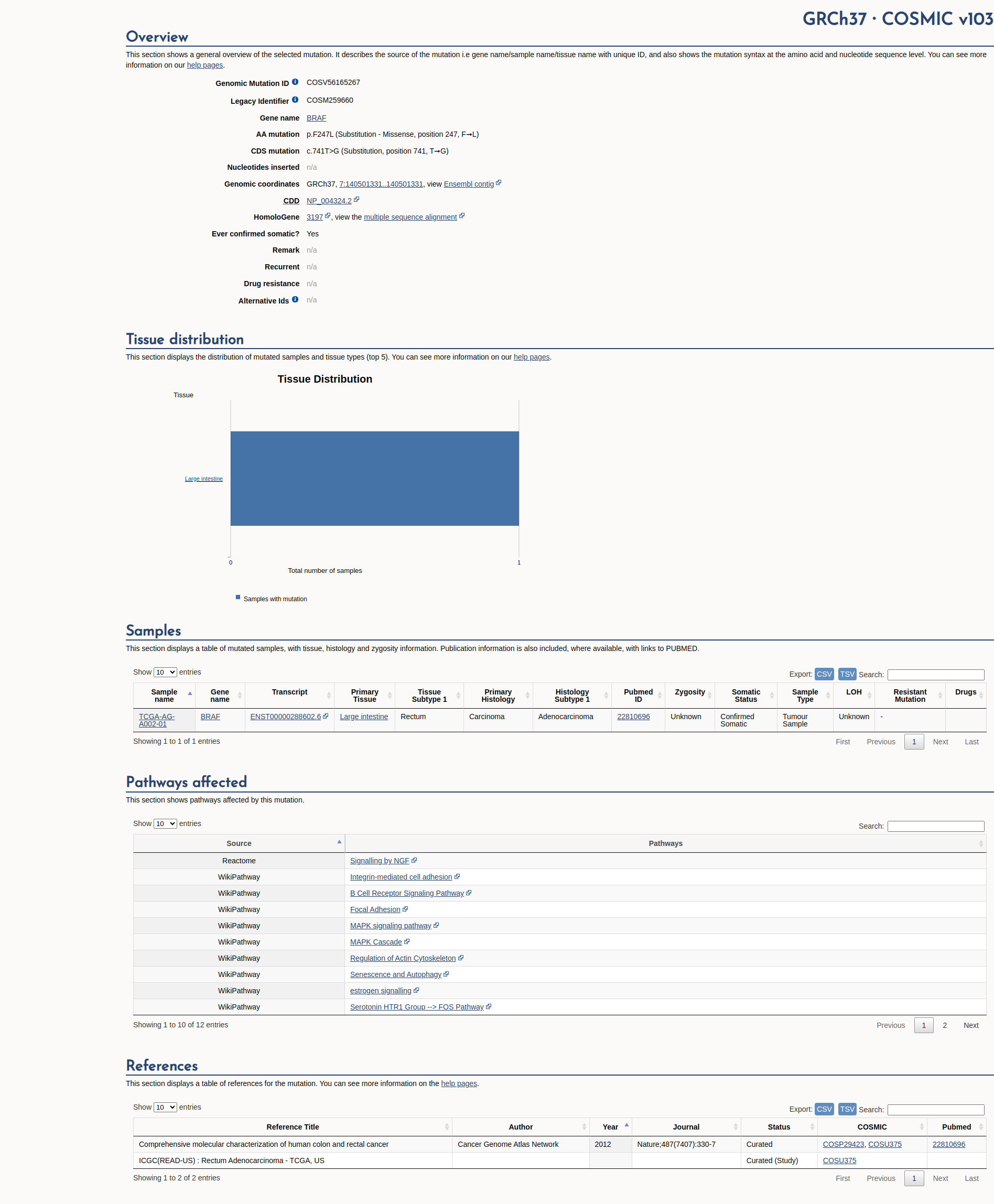
Functional Impact & Domains
Functional Domain
Error in OpenAI Consolidation. OncoKB: BRAFF247LBRAFF247LSomaticNCBI Gene:673|Show additional gene information Variant OverviewBRAF, an intracellular kinase, is frequently mutated in melanoma, thyroid and lung cancers among others.The BRAF F247L mutation is likely oncogenic.Hide mutation effect description The class III BRAF F247L mutation is located in the RAS binding and kinase autoinhibitory domain of the BRAF protein (PMID: 31515458). This mutation has been found in colorectal cancers, among others (PMID: 31515458). In vitro studies have demonstrated that this mutation is activating as measured by increased downstream signaling compared to wildtype (PMID: 28512244, 29533785). A patient with metastatic colorectal cancer harboring BRAF F247L was treated with a combination therapy of FOLFIRI plus cetuximab and demonstrated a complete response with a progression-free survival of 12.6 months (PMID: 31515458). JAX-CKB: BRAF F247L lies within the phorbol-ester/DAG-type zinc finger domain of the Braf protein (UniProt.org). F247L confers a gain of function to Braf, as indicated by activation of downstream MAPK signaling and is transforming in cultured cells (PMID: 28512244, PMID: 29533785).


Click on previews to view full database entries. External databases may require institutional access.
Computational Analysis
Pathogenicity Predictions
SpliceAISpliceAI Scores
Window: ±500bp| Effect Type | Score | Position |
|---|---|---|
| Acceptor Loss (AL) | 0.08 | -19 bp |
| Donor Loss (DL) | 0.0 | 30 bp |
| Acceptor Gain (AG) | 0.0 | 29 bp |
| Donor Gain (DG) | 0.0 | -119 bp |
VCEP Guidelines
Applied ACMG/AMP Criteria (VCEP Specific)
PS3 (Unknown (Pre-LLM))
From pre-LLM assessment (LLM Failed)
PM2 (Unknown (Pre-LLM))
From pre-LLM assessment (LLM Failed)
PP5 (Unknown (Pre-LLM))
From pre-LLM assessment (LLM Failed)
BP4 (Unknown (Pre-LLM))
From pre-LLM assessment (LLM Failed)