Genetic Information
Gene & Transcript Details
| ID | Status | Details |
|---|---|---|
| NM_024675.4 | MANE Select | 4008 nt | 154–3714 |
| NM_024675.3 | RefSeq Select | 4069 nt | 201–3761 |
Variant Details
Clinical & Population Data
Population Frequency
gnomADClinVar
OpenVariant summary: PALB2 c.514_517delTCTG (p.Ser172GlyfsX4) results in a premature termination codon, predicted to cause a truncation of the encoded protein or absence of the protein due to nonsense mediated decay, which are commonly known mechanisms for disease. The variant was absent in 251460 control chromosomes (gnomAD). c.514_517delTCTG has been reported in the literature in at least one young patient with HER2-amplified breast cancer, a patient with prostate cancer and a breast cancer patient (Eccles_2016, Momozawa_2020, Zhou_2020). These data indicate that the variant may be associated with disease. In a cell based functional assays, compared to wild-type the variant was found to have a relative HR (homologous recombination) efficiency of 8.55% and in PARPi sensitive assays, a PARPi resistance of 13.87% (Boonen_2019). Two other ClinVar submitters (evaluation after 2014) cite the variant as pathogenic. Based on the evidence outlined above, the variant was classified as pathogenic.
This variant deletes 4 nucleotides in exon 4 of the PALB2 gene, creating a frameshift and premature translation stop signal. This variant is expected to result in an absent or non-functional protein product. A functional study reported that a protein frameshift variant at serine 172 abolished stable protein expression and PALB2 function in a homology-directed repair assay (PMID: 31757951). This variant has been reported in an individual affected with breast cancer (PMID: 26681682) and in a breast cancer case-control study in 1/16501 cases and absent in 5890 unaffected individuals (PMID: 32339256). This variant also has been reported in a prostate cancer case-control study in 1/7636 cases and absent in 12366 unaffected individuals (PMID: 31214711). This variant has not been identified in the general population by the Genome Aggregation Database (gnomAD). Loss of PALB2 function is a known mechanism of disease. Based on the available evidence, this variant is classified as Pathogenic.
This sequence change creates a premature translational stop signal (p.Ser172Glyfs*4) in the PALB2 gene. It is expected to result in an absent or disrupted protein product. Loss-of-function variants in PALB2 are known to be pathogenic (PMID: 17200668, 17200671, 17200672, 24136930, 25099575). This variant is not present in population databases (gnomAD no frequency). This variant has not been reported in the literature in individuals affected with PALB2-related conditions. ClinVar contains an entry for this variant (Variation ID: 461007). For these reasons, this variant has been classified as Pathogenic.
"This variant has been reported in ClinVar as Pathogenic (5 clinical laboratories) and as Pathogenic by ClinGen Hereditary Breast, Ovarian and Pancreatic Cancer Variant Curation Expert Panel, ClinGen expert panel."
COSMIC Somatic Evidence
Open
Functional Impact & Domains
Functional Domain
Error in OpenAI Consolidation. OncoKB: PALB2S172Gfs*4PALB2S172Gfs*4SomaticNCBI Gene:79728|Show additional gene information Variant OverviewPALB2, a scaffolding protein involved in DNA repair, is altered in various cancers.The PALB2 S172Gfs*4 is a truncating mutation in a tumor suppressor gene, and therefore is likely oncogenic.Hide mutation effect description The mutation effect description for truncating mutations in PALB2 is: PALB2 truncating mutations can form several forms of C-terminally truncated PALB2 protein and are found in breast cancers. As such, PALB2 is considered a rare breast cancer susceptibility gene. In patient studies, PALB2 truncation mutations were shown to significantly increase the risk of breast cancer, with similar risks for estrogen receptor-positive and -negative breast cancer. PALB2 truncation mutations have also been found in cases of hereditary male breast cancer (PMID: 28858227, 18053174, 25529982, 29484706, 28279176, 28779002). JAX-CKB: No results found
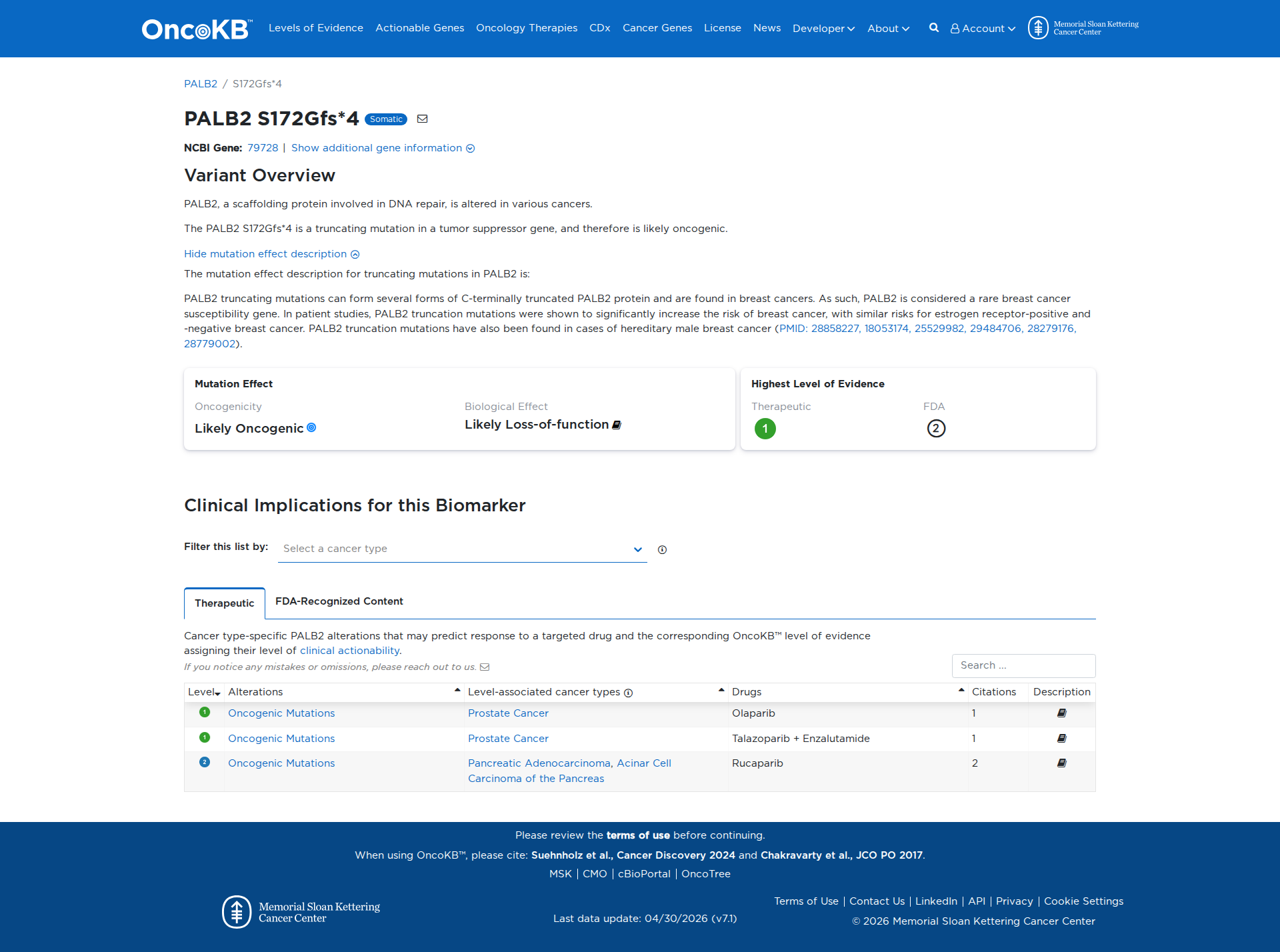
Click on previews to view full database entries. External databases may require institutional access.
Computational Analysis
Pathogenicity Predictions
SpliceAISpliceAI Scores
Window: ±500bp| Effect Type | Score | Position |
|---|---|---|
| Acceptor Loss (AL) | 0.0 | 306 bp |
| Donor Loss (DL) | 0.0 | -176 bp |
| Acceptor Gain (AG) | 0.02 | 125 bp |
| Donor Gain (DG) | 0.04 | 125 bp |
VCEP Guidelines
Applied ACMG/AMP Criteria (VCEP Specific)
PVS1 (Unknown (Pre-LLM))
From pre-LLM assessment (LLM Failed)
PS3 (Unknown (Pre-LLM))
From pre-LLM assessment (LLM Failed)
PM2 (Unknown (Pre-LLM))
From pre-LLM assessment (LLM Failed)
PP5 (Unknown (Pre-LLM))
From pre-LLM assessment (LLM Failed)