Genetic Information
Gene & Transcript Details
| ID | Status | Details |
|---|---|---|
| NM_000059.4 | MANE Select | 11954 nt | 200–10456 |
| NM_000059.2 | Alternative | 11386 nt | 228–10484 |
| NM_000059.3 | RefSeq Select | 11386 nt | 228–10484 |
Variant Details
Clinical & Population Data
Population Frequency
gnomADClinVar
OpenThis missense variant replaces serine with tryptophan at codon 2670 of the BRCA2 protein. Computational prediction suggests that this variant may have deleterious impact on protein structure and function (internally defined REVEL score threshold >= 0.7, PMID: 27666373). An RNA study reported that this variant caused leaky out-of-frame skipping of exon 18 in a minigene splicing assay (PMID: 28339459). This variant has been reported in an individual affected with breast cancer and several suspected hereditary breast and ovarian cancer families (PMID: 28664449, 29752822, 34597585). This variant has been observed to cosegregate with disease in multiple families with a likelihood ratio for pathogenicity of 819.97 (PMID: 34597585). This variant has not been identified in the general population by the Genome Aggregation Database (gnomAD). Based on the available evidence, this variant is classified as Likely Pathogenic.
This sequence change replaces Serine with Tryptophan at codon 2670 of the BRCA2 protein. This variant is not present in the population databases (rs80359035, gnomAD no frequency) but is described in mutation database ClinVar (VCV000489785.28). This missense change has been observed in individual(s) with a personal and/or family history of breast and/or ovarian cancer (PMID:28664449, 29752822). Advanced modeling of protein sequence and biophysical properties indicates that this missense variant is expected to disrupt BRCA2 protein function. Studies have shown that this variant is associated with altered splicing, but the impact on the resulting protein product is unknown (PMID:28339459 This suggests that this residue is clinically significant, and that variants that disrupt this residue are likely to be disease-causing. In summary, the currently available evidence indicates that the variant is pathogenic, but additional data are needed to prove that conclusively. Based on the classification criteria set by the ACMG and AMP (PMID:25741868) this variant has been classified as likely pathogenic.
The p.S2670W variant (also known as c.8009C>G), located in coding exon 17 of the BRCA2 gene, results from a C to G substitution at nucleotide position 8009. The serine at codon 2670 is replaced by tryptophan, an amino acid with highly dissimilar properties. This amino acid position is highly conserved through mammals but not in all available vertebrate species. RNA studies have shown this variant to result in an incomplete splicing impact, resulting in a transcript which skips exon 17 that is expected to result in loss-of-function (Ambry internal data; Fraile-Bethencourt E et al. Front Genet, 2019 May;10:503; Fraile-Bethencourt E et al. PLoS Genet, 2017 Mar;13:e1006691). This alteration was classified as pathogenic in a multifactorial model of variant interpretation that incorporates co-segregation, family history, co-occurrence, and tumor pathology data (Caputo SM et al. Am J Hum Genet, 2021 Oct;108:1907-1923). This variant was deleterious in a drug sensitivity protein functional assay (Ikegami M et al. Nat Commun, 2020 May;11:2573). Based on internal structural analysis, S2670W is structurally deleterious. The variant is highly destabilizing to the local structure (Yang H et al. Science, 2002 Sep;297:1837-48) In addition, this alteration is predicted to be deleterious by in silico analysis. This variant is considered to be rare based on population cohorts in the Genome Aggregation Database (gnomAD). Based on the majority of available evidence to date, this variant is likely to be pathogenic.
This sequence change replaces serine, which is neutral and polar, with tryptophan, which is neutral and slightly polar, at codon 2670 of the BRCA2 protein (p.Ser2670Trp). This variant is not present in population databases (gnomAD no frequency). This missense change has been observed in individual(s) with a personal and/or family history of breast and/or ovarian cancer (PMID: 28664449, 29752822). ClinVar contains an entry for this variant (Variation ID: 489785). Based on a multifactorial likelihood algorithm using genetic, in silico, and/or statistical data, this variant has been determined to have a high probability of being pathogenic (PMID: 34597585). Studies have shown that this missense change is associated with altered splicing (PMID: 28339459). This variant disrupts the p.Ser2670 amino acid residue in BRCA2. Other variant(s) that disrupt this residue have been determined to be pathogenic (PMID: 19043619, 23096355, 24735155, 26250392, 29394989). This suggests that this residue is clinically significant, and that variants that disrupt this residue are likely to be disease-causing. For these reasons, this variant has been classified as Pathogenic.
"This variant has been reported in ClinVar as Likely pathogenic (3 clinical laboratories) and as Pathogenic (1 clinical laboratories) and as Uncertain significance (1 clinical laboratories) and as Pathogenic by ClinGen ENIGMA BRCA1 and BRCA2 Variant Curation Expert Panel, ClinGen expert panel."
COSMIC Somatic Evidence
Open
Functional Impact & Domains
Functional Domain
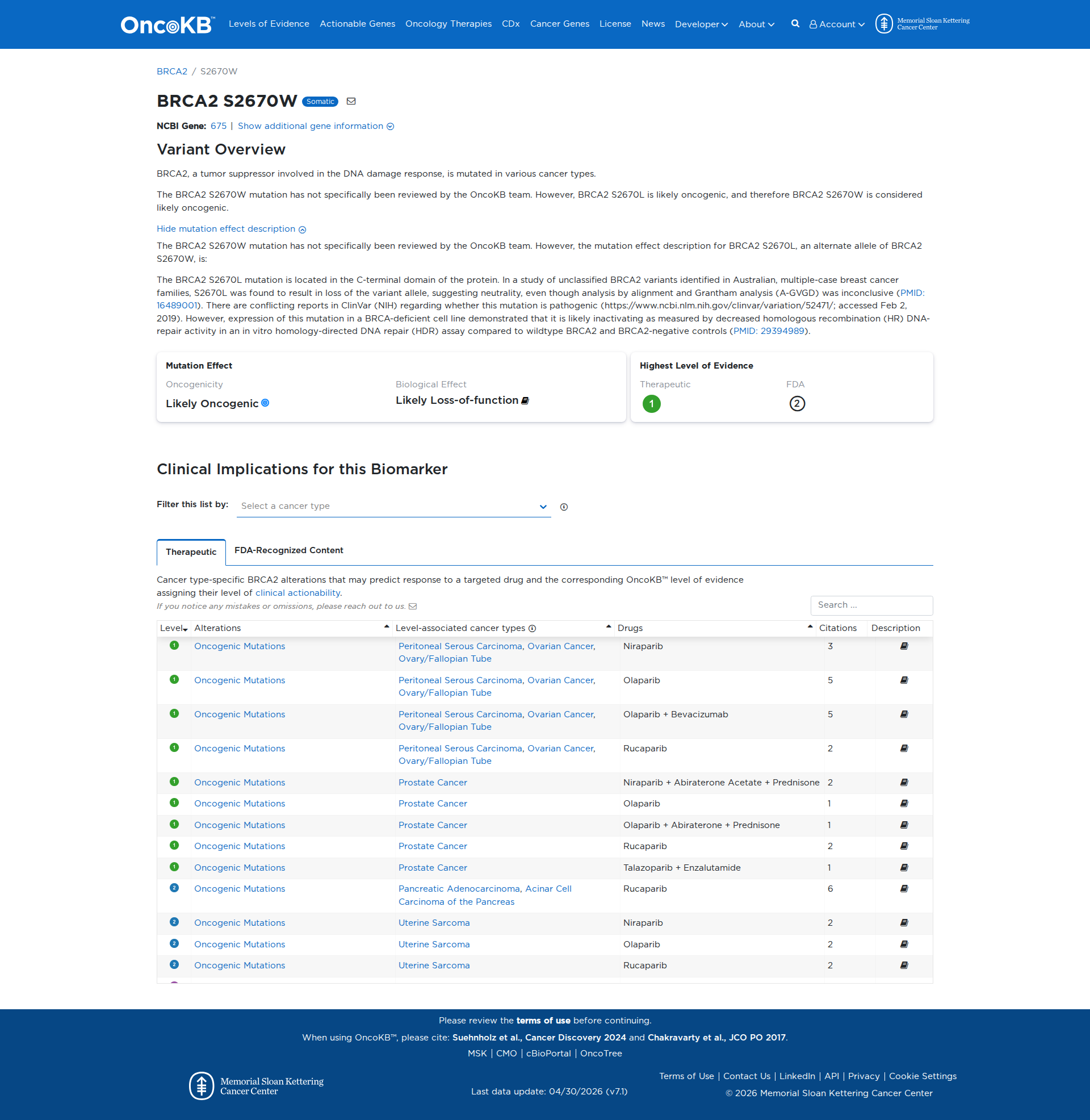
Error in OpenAI Consolidation. OncoKB: BRCA2S2670WBRCA2S2670WSomaticNCBI Gene:675|Show additional gene information Variant OverviewBRCA2, a tumor suppressor involved in the DNA damage response, is mutated in various cancer types.The BRCA2 S2670W mutation has not specifically been reviewed by the OncoKB team. However, BRCA2 S2670L is likely oncogenic, and therefore BRCA2 S2670W is considered likely oncogenic.Hide mutation effect description The BRCA2 S2670W mutation has not specifically been reviewed by the OncoKB team. However, the mutation effect description for BRCA2 S2670L, an alternate allele of BRCA2 S2670W, is: The BRCA2 S2670L mutation is located in the C-terminal domain of the protein. In a study of unclassified BRCA2 variants identified in Australian, multiple-case breast cancer families, S2670L was found to result in loss of the variant allele, suggesting neutrality, even though analysis by alignment and Grantham analysis (A-GVGD) was inconclusive (PMID: 16489001). There are conflicting reports in ClinVar (NIH) regarding whether this mutation is pathogenic (https://www.ncbi.nlm.nih.gov/clinvar/variation/52471/; accessed Feb 2, 2019). However, expression of this mutation in a BRCA-deficient cell line demonstrated that it is likely inactivating as measured by decreased homologous recombination (HR) DNA-repair activity in an in vitro homology-directed DNA repair (HDR) assay compared to wildtype BRCA2 and BRCA2-negative controls (PMID: 29394989). JAX-CKB: No results found
Click on previews to view full database entries. External databases may require institutional access.
Computational Analysis
Pathogenicity Predictions
SpliceAISpliceAI Scores
Window: ±500bp| Effect Type | Score | Position |
|---|---|---|
| Acceptor Loss (AL) | 0.03 | -32 bp |
| Donor Loss (DL) | 0.02 | 322 bp |
| Acceptor Gain (AG) | 0.01 | 159 bp |
| Donor Gain (DG) | 0.0 | -32 bp |
VCEP Guidelines
Applied ACMG/AMP Criteria (VCEP Specific)
PS3 (Unknown (Pre-LLM))
From pre-LLM assessment (LLM Failed)
PM2 (Unknown (Pre-LLM))
From pre-LLM assessment (LLM Failed)
PP5 (Unknown (Pre-LLM))
From pre-LLM assessment (LLM Failed)
BP4 (Unknown (Pre-LLM))
From pre-LLM assessment (LLM Failed)