Genetic Information
Gene & Transcript Details
| ID | Status | Details |
|---|---|---|
| NM_000059.4 | MANE Select | 11954 nt | 200–10456 |
| NM_000059.2 | Alternative | 11386 nt | 228–10484 |
| NM_000059.3 | RefSeq Select | 11386 nt | 228–10484 |
Variant Details
Clinical & Population Data
Population Frequency
gnomADClinVar
OpenVariant summary: BRCA2 c.8242G>A (p.Gly2748Ser) results in a non-conservative amino acid change located in the BRCA2, OB1 domain (IPR015187) of the encoded protein sequence. Five of five in-silico tools predict a damaging effect of the variant on protein function. The variant allele was found at a frequency of 1.2e-05 in 249070 control chromosomes. To our knowledge, no occurrence of c.8242G>A in individuals affected with Hereditary Breast And Ovarian Cancer Syndrome has been reported. At least one publication reports HDR experimental evidence evaluating an impact on protein function (Richardson_2021). The study assigned PS3 code for this variant (PS3 was applied only when the upper 95% CI is <1.66.). HDR assays qualify as a recognized gold standard on the basis of updated guidance provided by the ClinGen Sequence Variant Interpretation (SVI) working group. This working group has recommended strong functional evidence (ACMG PS3) as sufficient weightage for categorization as likely pathogenic (Tavtigian_2018). The following publications have been ascertained in the context of this evaluation (PMID: 35736817, 33609447). ClinVar contains an entry for this variant (Variation ID: 409429). Based on the evidence outlined above, the variant was classified as likely pathogenic.
This missense variant replaces glycine with serine at codon 2748 of the BRCA2 protein. Computational prediction suggests that this variant may have deleterious impact on protein structure and function (internally defined REVEL score threshold >= 0.7, PMID: 27666373). Functional studies have shown the resulting protein to be defective in homology-directed DNA repair assays in mammalian cells (PMID: 33609447, 35736817). This variant has been detected in individuals affected with BRCA2-associated cancers and relevant family history (Color internal data). A different variant affecting the same codon, c.8243G>A (p.Gly2748Asp), is considered to be disease-causing (ClinVar Variation ID: 52535), suggesting that Gly at this position is important for the protein function. This variant has been identified in 3/249070 chromosomes in the general population by the Genome Aggregation Database (gnomAD). Based on the available evidence, this variant is classified as Likely Pathogenic.
The p.G2748S variant (also known as c.8242G>A), located in coding exon 17 of the BRCA2 gene, results from a G to A substitution at nucleotide position 8242. The glycine at codon 2748 is replaced by serine, an amino acid with similar properties. This variant was non-functional in a homology-directed DNA repair (HDR) assay (Richardson ME et al. Am J Hum Genet, 2021 03;108:458-468; Hu C et al. Am J Hum Genet. 2024 Mar;111(3):584-593). A saturation genome editing-based study using a haploid cell-survival assay demonstrates that this nucleotide substitution is non-functional (Huang H et al. Nature. 2025 Feb;638(8050):528-537). Another saturation genome editing-based study using a humanized mouse embryonic stem cell line assay of drug response and survival reports the functional impact of this variant as uncertain (Sahu S et al. Nature. 2025 Feb;638(8050):538-545). This alteration is also predicted to destabilize the local structure and disrupt the protein binding ability of BRCA2 (Yang H et al. Science 2002 Sep;297:1837-48; Marston NJ et al. Mol. Cell. Biol. 1999 Jul;19:4633-42; Ambry internal data). This amino acid position is highly conserved in available vertebrate species. In addition, this alteration is predicted to be deleterious by in silico analysis. Based on the majority of available evidence to date, this variant is likely to be pathogenic.
The BRCA2 c.8242G>A (p.Gly2748Ser) variant has been reported in the published literature to be damaging to BRCA2 protein function (PMID: 33609447 (2021), 35736817 (2022), 39779857 (2025)). The frequency of this variant in the general population (Genome Aggregation Database, http://gnomad.broadinstitute.org) is uninformative in the assessment of its pathogenicity. Analysis of this variant using bioinformatics tools for the prediction of the effect of amino acid changes on protein structure and function yielded predictions that this variant is damaging. Based on the available information, this variant is classified as likely pathogenic.
This sequence change replaces glycine, which is neutral and non-polar, with serine, which is neutral and polar, at codon 2748 of the BRCA2 protein (p.Gly2748Ser). This variant is present in population databases (rs56371528, gnomAD 0.006%). This variant has not been reported in the literature in individuals affected with BRCA2-related conditions. ClinVar contains an entry for this variant (Variation ID: 409429). Invitae Evidence Modeling incorporating data from in vitro experimental studies (PMID: 33609447) indicates that this missense variant is expected to disrupt BRCA2 function with a positive predictive value of 95%. Experimental studies have shown that this missense change affects BRCA2 function (PMID: 35736817). This variant disrupts the p.Gly2748 amino acid residue in BRCA2. Other variant(s) that disrupt this residue have been determined to be pathogenic (PMID: 15026808, 17924331, 18451181, 21671020, 22711857, 23108138, 23328489, 25146914). This suggests that this residue is clinically significant, and that variants that disrupt this residue are likely to be disease-causing. In summary, the currently available evidence indicates that the variant is pathogenic, but additional data are needed to prove that conclusively. Therefore, this variant has been classified as Likely Pathogenic.
"This variant has been reported in ClinVar as Pathogenic (1 clinical laboratories) and as Likely pathogenic (7 clinical laboratories) and as likely pathogenic (1 clinical laboratories) and as Uncertain Significance by ClinGen ENIGMA BRCA1 and BRCA2 Variant Curation Expert Panel, ClinGen expert panel."
COSMIC Somatic Evidence
Open
Functional Impact & Domains
Functional Domain
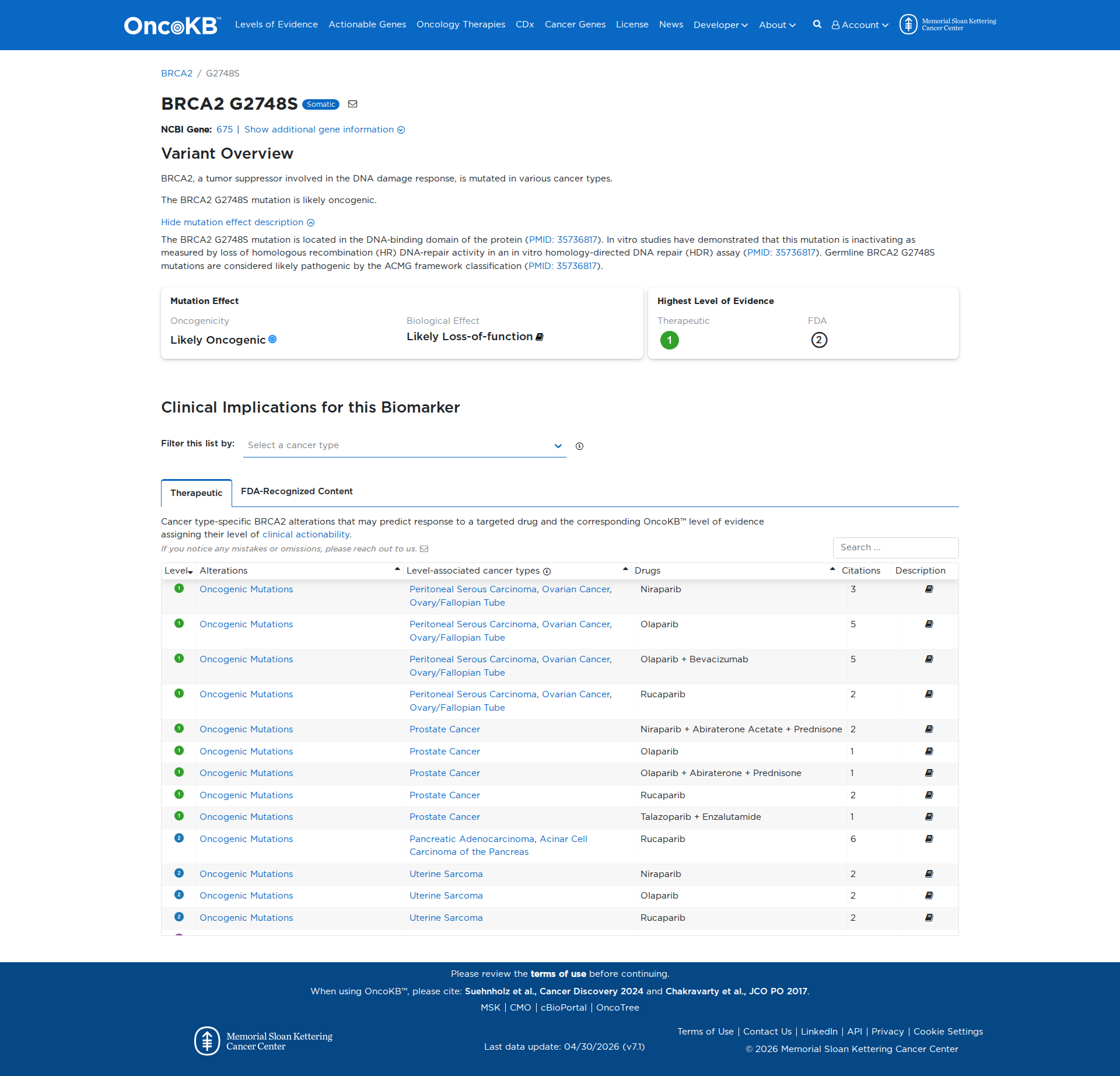
Error in OpenAI Consolidation. OncoKB: BRCA2G2748SBRCA2G2748SSomaticNCBI Gene:675|Show additional gene information Variant OverviewBRCA2, a tumor suppressor involved in the DNA damage response, is mutated in various cancer types.The BRCA2 G2748S mutation is likely oncogenic.Hide mutation effect description The BRCA2 G2748S mutation is located in the DNA-binding domain of the protein (PMID: 35736817). In vitro studies have demonstrated that this mutation is inactivating as measured by loss of homologous recombination (HR) DNA-repair activity in an in vitro homology-directed DNA repair (HDR) assay (PMID: 35736817). Germline BRCA2 G2748S mutations are considered likely pathogenic by the ACMG framework classification (PMID: 35736817). JAX-CKB: No results found
Click on previews to view full database entries. External databases may require institutional access.
Computational Analysis
Pathogenicity Predictions
SpliceAISpliceAI Scores
Window: ±500bp| Effect Type | Score | Position |
|---|---|---|
| Acceptor Loss (AL) | 0.01 | -265 bp |
| Donor Loss (DL) | 0.06 | 89 bp |
| Acceptor Gain (AG) | 0.0 | 28 bp |
| Donor Gain (DG) | 0.0 | -68 bp |
VCEP Guidelines
Applied ACMG/AMP Criteria (VCEP Specific)
PS3 (Unknown (Pre-LLM))
From pre-LLM assessment (LLM Failed)
PM2 (Unknown (Pre-LLM))
From pre-LLM assessment (LLM Failed)
PP5 (Unknown (Pre-LLM))
From pre-LLM assessment (LLM Failed)
BP4 (Unknown (Pre-LLM))
From pre-LLM assessment (LLM Failed)