Genetic Information
Gene & Transcript Details
| ID | Status | Details |
|---|---|---|
| NM_007294.4 | MANE Select | 7088 nt | 114–5705 |
| NM_007294.2 | Alternative | 7191 nt | 201–5792 |
| NM_007294.3 | RefSeq Select | 7224 nt | 233–5824 |
Variant Details
Clinical & Population Data
Population Frequency
gnomADClinVar
OpenThis variant inserts 8 nucleotides in exon 9 of the BRCA1 gene, creating a frameshift and premature translation stop signal. This variant is expected to result in the absence of functional full-length protein product, but to our knowledge, functional assays have not been performed. This variant has not been identified in the general population by the Genome Aggregation Database (gnomAD). Truncation variants in the vicinity of exons 8 and 9 have been reported in three individuals affected with high-risk breast cancer and/or ovarian cancer (PMID: 12203997, 12815604, 15642173, 33649982) and in a suspected hereditary breast and ovarian cancer family (PMID: 8764110). In one study, an exon 9 frameshift variant (c.594_597del) has been observed in compound heterozygosity with a known pathogenic missense variant, in an individual diagnosed with Fanconi anemia (PMID: 25472942). This truncation variant was inherited from the mother, who was personally affected with ovarian cancer at age 50 with a positive family history of disease. This presentation suggests that the exon 9 variant contributed to the development of disease. However, two splicing variants c.591C>T and c.594-2A>C that have been demonstrated to cause a premature translation stop signal and have been reported in individuals affected with breast and ovarian cancer, as well as in healthy unaffected individuals (PMID: 16211554, 19892845, 25639900, 27008870). The case-control, health history, tumor pathology and segregation data for the c.594-2A>C variant either indicate that this variant is not pathogenic or that pathogenicity is inconclusive (PMID: 25639900, 27008870). In these carriers, there is a relative increase in the skipping of exons 8 and 9 by pre-mRNA splicing that is expected to cause a small in-frame deletion of 41 amino acids from the reference protein (1884 amino acids) (PMID: 19892845, 27008870). An interpretation of these findings is that a BRCA1 mRNA isoform lacking exons 8 and 9 is normally produced and is functional. This alternate mRNA isoform is expected to be refractory to frameshift, nonsense and splicing defective variants found in exons 8 and 9 (PMID: 27008870). RNA studies have confirmed the appearance of the skipping of exons 8 and 9 in the majority of individuals tested, however, the degree of expression also appears to be highly variable in individuals (PMID: 24569164, 27008870, 28905878, 32133419). Taken together, the available evidence suggests that the expected deleterious effects of this c.615_622dup variant and other truncation variants occurring in exons 8 and 9 could be ameliorated by the expression of the mRNA isoform lacking exons 8 and 9 that retains normal BRCA1 function. Because of the uncertain clinical consequences of this variant, it is classified as a Variant of Uncertain Significance.
In summary, the available evidence is currently insufficient to determine the role of this variant in disease. Therefore, it has been classified as a Variant of Uncertain Significance. ClinVar contains an entry for this variant (Variation ID: 926510). This variant has not been reported in the literature in individuals affected with BRCA1-related conditions. This variant is not present in population databases (gnomAD no frequency). This sequence change creates a premature translational stop signal (p.Thr208Asnfs*29) in the BRCA1 gene. Loss-of-function variants in BRCA1 are expected to be pathogenic (PMID: 20104584). However, an in-frame BRCA1 isoform lacking exons 8 and 9 (also known as exons 9 and 10) is highly expressed in blood from unaffected individuals and in normal breast tissue; this isoform may retain protein function and could functionally rescue loss-of-function variants within exons 8-9 (PMID: 24569164).
"This variant has been reported in ClinVar as Uncertain significance (3 clinical laboratories) and as Uncertain Significance by ClinGen ENIGMA BRCA1 and BRCA2 Variant Curation Expert Panel, ClinGen expert panel."
COSMIC Somatic Evidence
Open
Functional Impact & Domains
Functional Domain
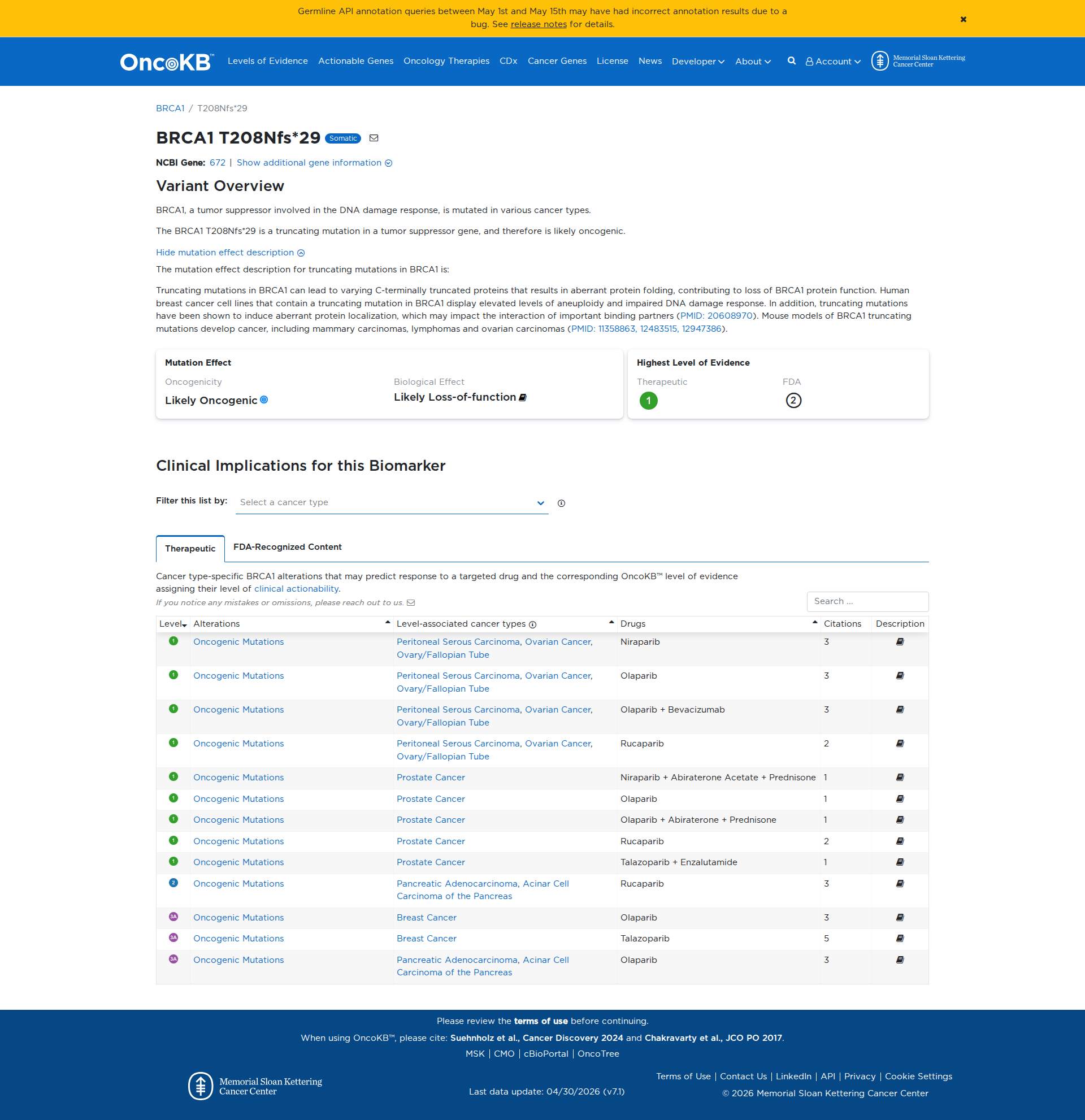
Error in OpenAI Consolidation. OncoKB: BRCA1T208Nfs*29BRCA1T208Nfs*29SomaticNCBI Gene:672|Show additional gene information Variant OverviewBRCA1, a tumor suppressor involved in the DNA damage response, is mutated in various cancer types.The BRCA1 T208Nfs*29 is a truncating mutation in a tumor suppressor gene, and therefore is likely oncogenic.Hide mutation effect description The mutation effect description for truncating mutations in BRCA1 is: Truncating mutations in BRCA1 can lead to varying C-terminally truncated proteins that results in aberrant protein folding, contributing to loss of BRCA1 protein function. Human breast cancer cell lines that contain a truncating mutation in BRCA1 display elevated levels of aneuploidy and impaired DNA damage response. In addition, truncating mutations have been shown to induce aberrant protein localization, which may impact the interaction of important binding partners (PMID: 20608970). Mouse models of BRCA1 truncating mutations develop cancer, including mammary carcinomas, lymphomas and ovarian carcinomas (PMID: 11358863, 12483515, 12947386). JAX-CKB: No results found
Click on previews to view full database entries. External databases may require institutional access.
Computational Analysis
Pathogenicity Predictions
SpliceAISpliceAI Scores
Window: ±500bp| Effect Type | Score | Position |
|---|---|---|
| Acceptor Loss (AL) | 0.0 | -47 bp |
| Donor Loss (DL) | 0.0 | -89 bp |
| Acceptor Gain (AG) | 0.02 | 29 bp |
| Donor Gain (DG) | 0.11 | -47 bp |
VCEP Guidelines
Applied ACMG/AMP Criteria (VCEP Specific)
PVS1 (Unknown (Pre-LLM))
From pre-LLM assessment (LLM Failed)
PS3 (Unknown (Pre-LLM))
From pre-LLM assessment (LLM Failed)
PM2 (Unknown (Pre-LLM))
From pre-LLM assessment (LLM Failed)