Genetic Information
Gene & Transcript Details
| ID | Status | Details |
|---|---|---|
| NM_000546.3 | Alternative | 2640 nt | 252–1433 |
| NM_000546.5 | RefSeq Select | 2591 nt | 203–1384 |
| NM_000546.6 | MANE Select | 2512 nt | 143–1324 |
| NM_000546.4 | Alternative | 2586 nt | 198–1379 |
| NM_000546.2 | Alternative | 2629 nt | 252–1433 |
Variant Details
Clinical & Population Data
Population Frequency
gnomADClinVar
OpenThis alteration is classified as likely benign based on a combination of the following: seen in unaffected individuals, population frequency, intact protein function, lack of segregation with disease, co-occurrence, RNA analysis, in silico models, amino acid conservation, lack of disease association in case-control studies, and/or the mechanism of disease or impacted region is inconsistent with a known cause of pathogenicity.
This missense variant replaces proline with serine at codon 309 of the TP53 protein. Computational prediction is inconclusive regarding the impact of this variant on protein structure and function. Functional studies have shown that this variant to be functional in yeast trancriptional activation assays and human cell growth suppression assays (PMID: 12826609, 30224644). This variant has been reported in individuals affected with chronic myeloid leukemia and B-cell acute lymphoblastic leukemia in the literature (PMID: 15784129, 29300620). This variant has not been identified in the general population by the Genome Aggregation Database (gnomAD). The available evidence is insufficient to determine the role of this variant in disease conclusively. Therefore, this variant is classified as a Variant of Uncertain Significance.
This sequence change replaces proline, which is neutral and non-polar, with serine, which is neutral and polar, at codon 309 of the TP53 protein (p.Pro309Ser). This variant is not present in population databases (gnomAD no frequency). This missense change has been observed in individual(s) with leukemias (PMID: 15784129, 29300620). ClinVar contains an entry for this variant (Variation ID: 458575). Invitae Evidence Modeling incorporating data from in vitro experimental studies (PMID: 12826609, 29979965, 30224644) indicates that this missense variant is not expected to disrupt TP53 function with a negative predictive value of 97.5%. Experimental studies have shown that this missense change does not substantially affect TP53 function (PMID: 12826609, 30224644). In summary, the available evidence is currently insufficient to determine the role of this variant in disease. Therefore, it has been classified as a Variant of Uncertain Significance.
This missense variant replaces proline with serine at codon 309 of the TP53 protein. Computational prediction is inconclusive regarding the impact of this variant on protein structure and function (internally defined REVEL score threshold 0.5 < inconclusive < 0.7, PMID: 27666373). Functional studies have shown that this variant to be functional in yeast trancriptional activation assays and human cell growth suppression assays (PMID: 12826609, 30224644). This variant has been reported in individuals affected with chronic myeloid leukemia and B-cell acute lymphoblastic leukemia in the literature (PMID: 15784129, 29300620). This variant has not been identified in the general population by the Genome Aggregation Database (gnomAD). The available evidence is insufficient to determine the role of this variant in disease conclusively. Therefore, this variant is classified as a Variant of Uncertain Significance.
Each variant was annotated with functional scores from MAVE data which was translated into functional evidence codes. All other evidence codes and combining criteria were adhered to as closely as possible based on the ClinGen VCEP (Variant Curation Expert Panel) gene-specific recommendations. See Supplemental Figure 34 of final paper (Supp Fig. 28 in preprint: doi:10.1101/2024.04.11.24305690) for a table to see which lines of evidence we did not have data for. The ClinGen VCEPs are highly regarded as the gold-standard for gene-specific variant curation and are developed after extensive evaluation of the evidence by clinical and scientific experts for the particular gene to classify genomic variants on a spectrum from pathogenic to benign using the 2015 ACMG/AMP Variant Interpretation Guidelines as a backbone (PMID: 25741868). Reclassification of these VUS variants from gnomAD or All of Us focused only on variants originally prescribed as VUS in ClinVar. To ensure reproducibility, transparency, and increased throughput, all the procedures for annotating variants and assigning evidence codes were codified using Python. All code has been made freely available and is linked in the Code Availability section and all reclassified variants with evidence codes used can be found in Tables S18-19 (preprint: doi:10.1101/2024.04.11.24305690). For the MAVE data, the clinical curation and clinical strength assignment as per the ClinGen recommendations in Brnich et al. (2020) (PMID: 31892348) for or against pathogenicity or benignity of each of these MAVE datasets utilized in this study were previously published in Fayer et al. (2021) (PMID: 34793697).For TP53, we used the output of the Naïve Bayes classifier that synthesized data from four different TP53 MAVEs in Fayer et al. (2021) (PMID: 34793697). If the classifier predicted a variant to be "Functionally abnormal," the variant was assigned PS3 evidence and no BS3 evidence. If a variant was predicted to be "Functionally normal," BS3_moderate evidence was used with no PS3 evidence. This variant GRCh38:17:7673603:G>A was assigned evidence codes ['BS3_Moderate', 'BP4'] and an overall classification of Likely benign
"This variant has been reported in ClinVar as Likely benign (1 clinical laboratories) and as Uncertain significance (4 clinical laboratories) and as Uncertain Significance (1 clinical laboratories)."
COSMIC Somatic Evidence
Open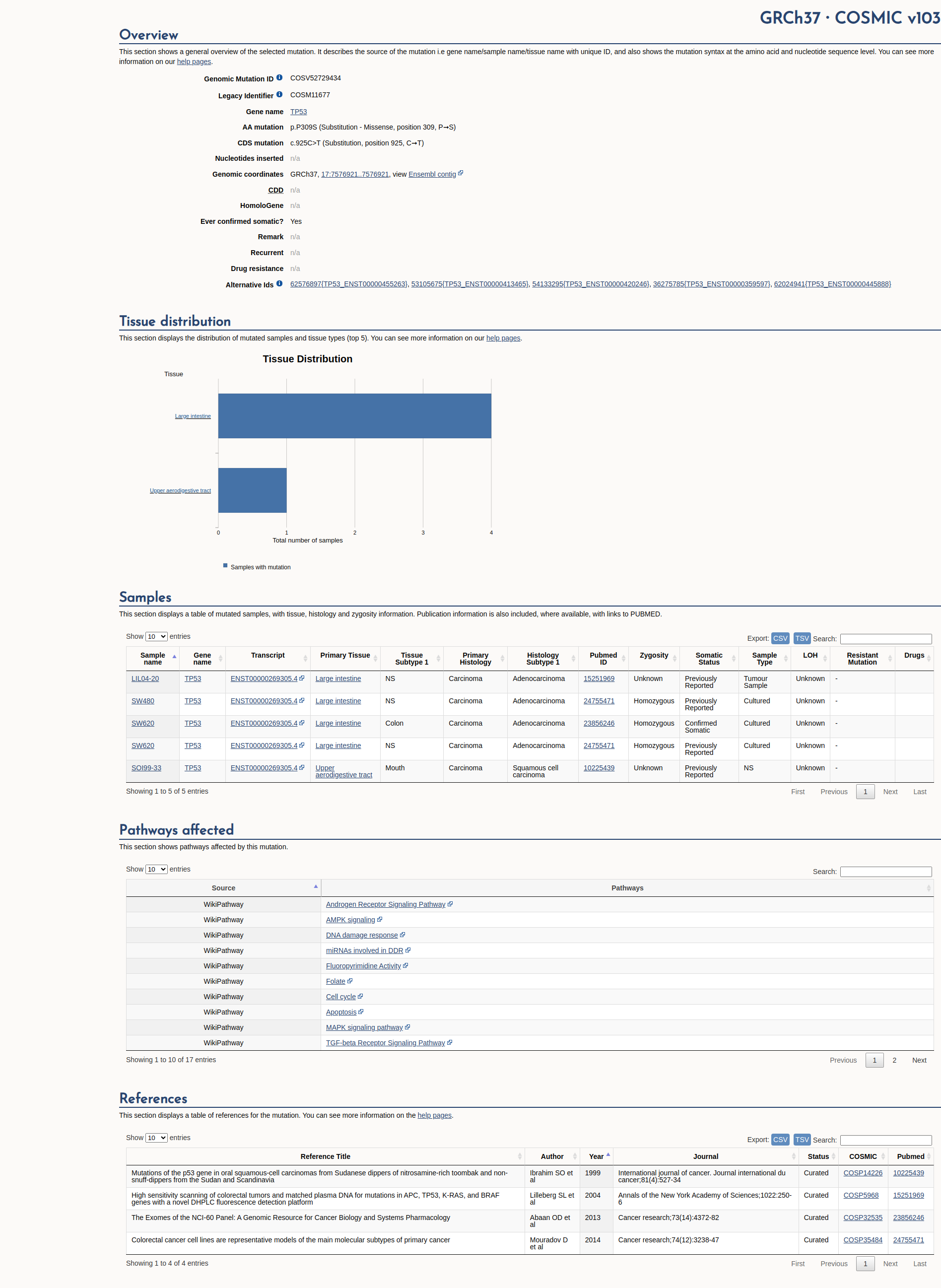
Functional Impact & Domains
Functional Domain
Error in OpenAI Consolidation. OncoKB: TP53P309STP53P309SSomaticNCBI Gene:7157|Show additional gene information Variant OverviewTP53, a tumor suppressor in the DNA damage pathway, is the most frequently mutated gene in cancer.The TP53 P309S mutation has not specifically been reviewed by the OncoKB team, and therefore its biological significance is unknown. JAX-CKB: TP53 P309S lies within the CCAR2, HIPK1, and CARM1-interacting regions and the bipartite nuclear localization signal region of the Tp53 protein (UniProt.org). P309S results in constitutive activation of p21 in conjunction with R273H (PMID: 16061257), but has not been individually characterized and therefore, its effect on Tp53 protein function is unknown.
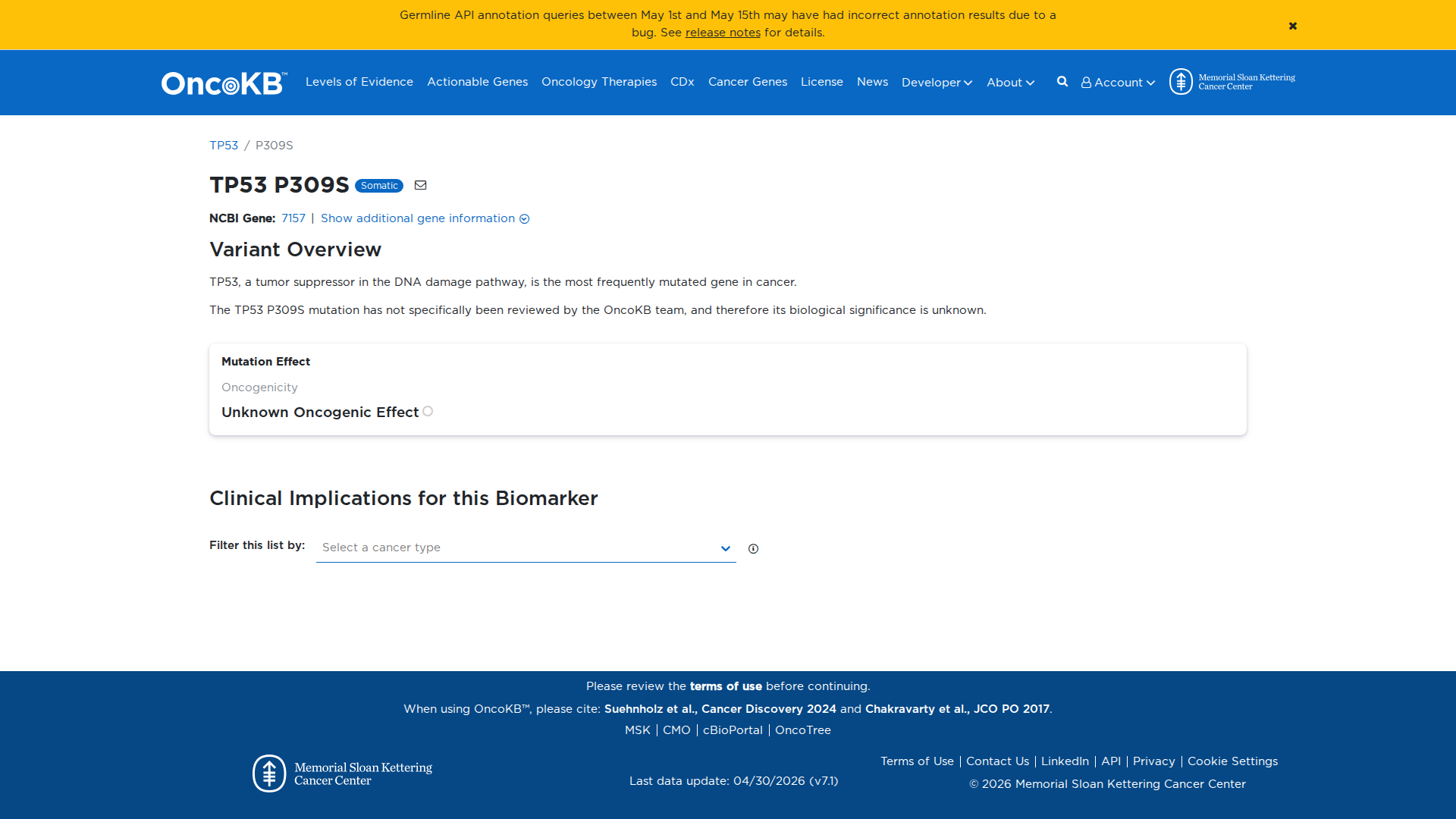
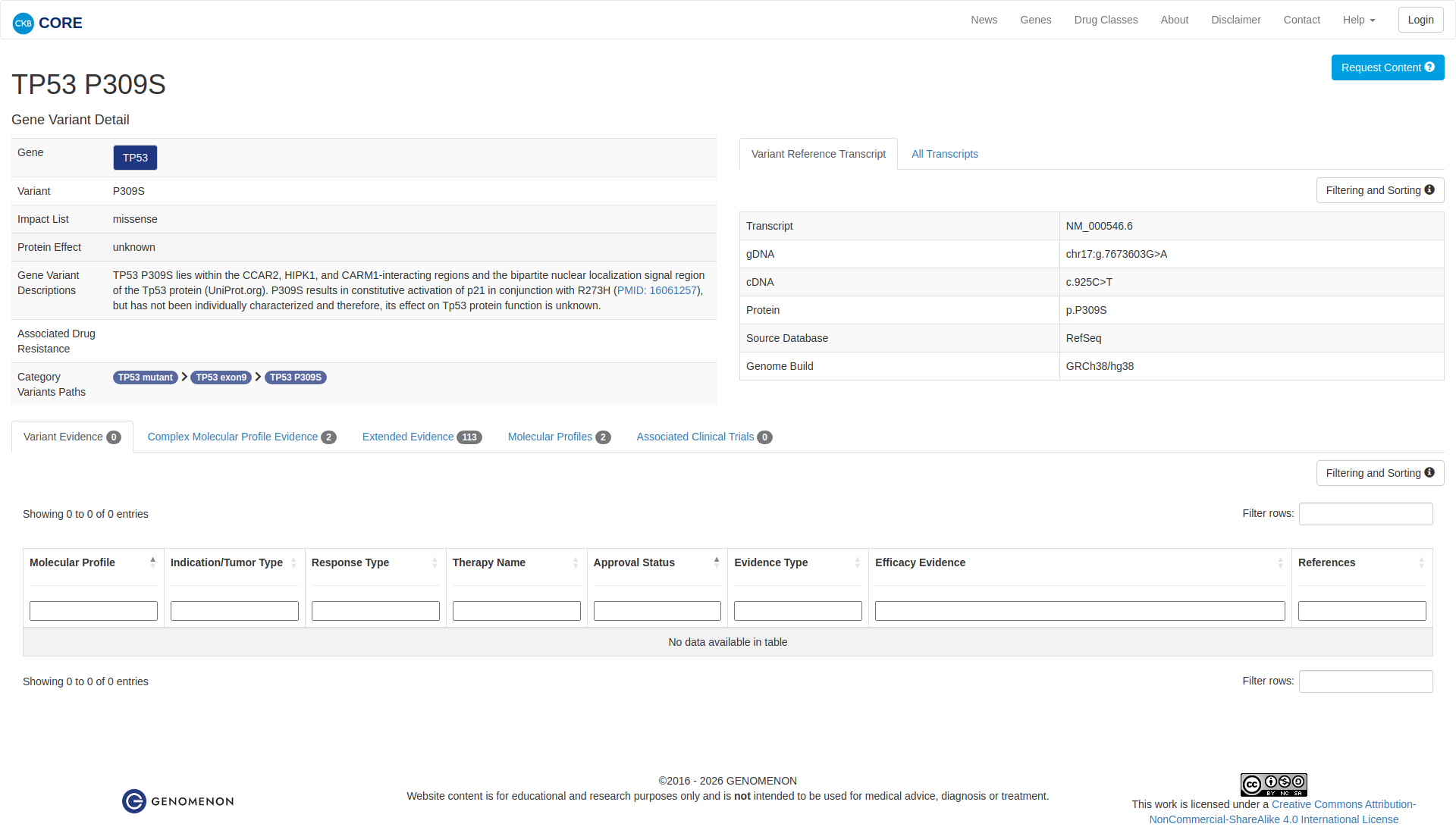
Click on previews to view full database entries. External databases may require institutional access.
Computational Analysis
Pathogenicity Predictions
SpliceAISpliceAI Scores
Window: ±500bp| Effect Type | Score | Position |
|---|---|---|
| Acceptor Loss (AL) | 0.0 | 41 bp |
| Donor Loss (DL) | 0.0 | 288 bp |
| Acceptor Gain (AG) | 0.0 | -27 bp |
| Donor Gain (DG) | 0.0 | -396 bp |
VCEP Guidelines
Applied ACMG/AMP Criteria (VCEP Specific)
PM2 (Unknown (Pre-LLM))
From pre-LLM assessment (LLM Failed)
BP4 (Unknown (Pre-LLM))
From pre-LLM assessment (LLM Failed)