Genetic Information
Gene & Transcript Details
| ID | Status | Details |
|---|---|---|
| NM_024675.4 | MANE Select | 4008 nt | 154–3714 |
| NM_024675.3 | RefSeq Select | 4069 nt | 201–3761 |
Variant Details
Clinical & Population Data
Population Frequency
gnomADClinVar
OpenThe p.T1030I variant (also known as c.3089C>T), located in coding exon 10 of the PALB2 gene, results from a C to T substitution at nucleotide position 3089. The threonine at codon 1030 is replaced by isoleucine, an amino acid with similar properties. This variant was identified in a series of >800 familial breast cancer cases in Germany (Hellebrand H et al, Hum. Mutat. 2011 Jun; 32(6):E2176-88). Functional analyses of the p.T1030I allele have shown reductions in protein stability and binding efficiency to RAD51C and RAD1, but intact BRCA2 interaction (Park JY et al, Oncogene 2014 Oct; 33(40):4803-12). This amino acid position is highly conserved in available vertebrate species. In addition, the in silico prediction for this alteration is inconclusive. Based on the available evidence, the clinical significance of this variant remains unclear.
This sequence change replaces threonine, which is neutral and polar, with isoleucine, which is neutral and non-polar, at codon 1030 of the PALB2 protein (p.Thr1030Ile). This variant is not present in population databases (gnomAD no frequency). This missense change has been observed in individual(s) with breast cancer (PMID: 21618343). ClinVar contains an entry for this variant (Variation ID: 232977). Invitae Evidence Modeling of protein sequence and biophysical properties (such as structural, functional, and spatial information, amino acid conservation, physicochemical variation, residue mobility, and thermodynamic stability) indicates that this missense variant is expected to disrupt PALB2 protein function with a positive predictive value of 80%. Experimental studies are conflicting or provide insufficient evidence to determine the effect of this variant on PALB2 function (PMID: 24141787, 31586400, 33964450). In summary, the available evidence is currently insufficient to determine the role of this variant in disease. Therefore, it has been classified as a Variant of Uncertain Significance.
"This variant has been reported in ClinVar as Uncertain significance (4 clinical laboratories) and as Uncertain Significance by ClinGen Hereditary Breast, Ovarian and Pancreatic Cancer Variant Curation Expert Panel, ClinGen expert panel."
COSMIC Somatic Evidence
Open
Functional Impact & Domains
Functional Domain
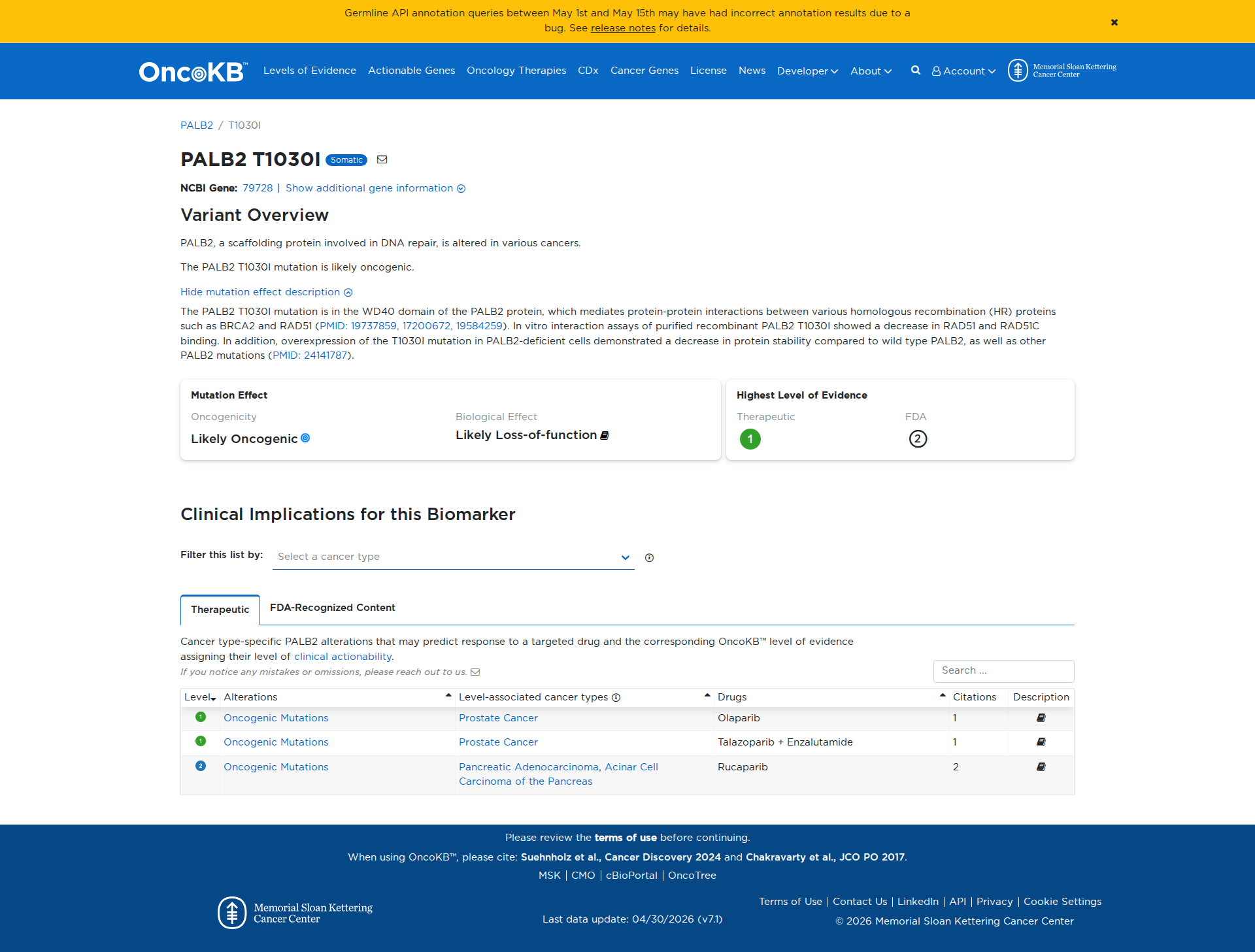
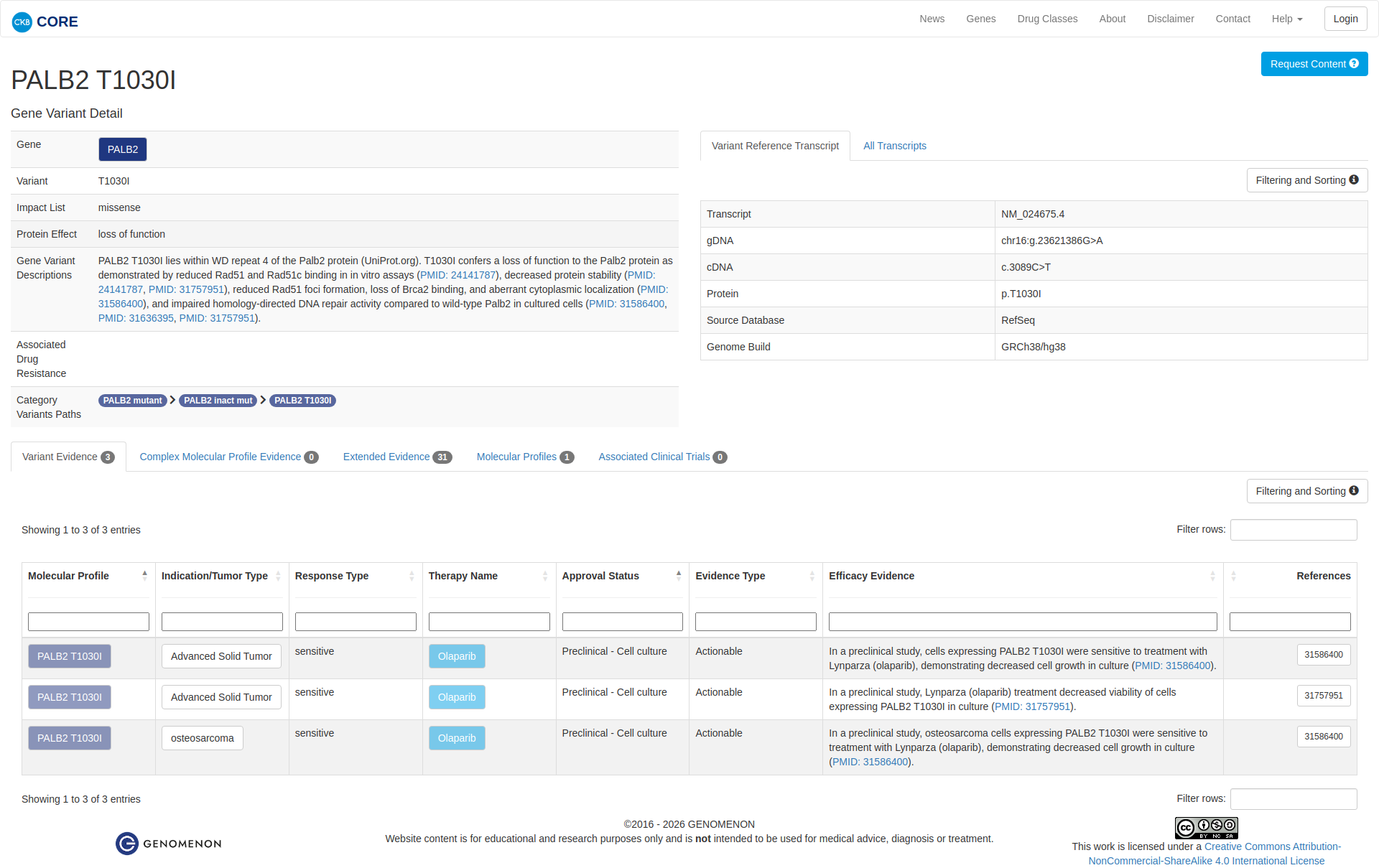
Error in OpenAI Consolidation. OncoKB: PALB2T1030IPALB2T1030ISomaticNCBI Gene:79728|Show additional gene information Variant OverviewPALB2, a scaffolding protein involved in DNA repair, is altered in various cancers.The PALB2 T1030I mutation is likely oncogenic.Hide mutation effect description The PALB2 T1030I mutation is in the WD40 domain of the PALB2 protein, which mediates protein-protein interactions between various homologous recombination (HR) proteins such as BRCA2 and RAD51 (PMID: 19737859, 17200672, 19584259). In vitro interaction assays of purified recombinant PALB2 T1030I showed a decrease in RAD51 and RAD51C binding. In addition, overexpression of the T1030I mutation in PALB2-deficient cells demonstrated a decrease in protein stability compared to wild type PALB2, as well as other PALB2 mutations (PMID: 24141787). JAX-CKB: PALB2 T1030I lies within WD repeat 4 of the Palb2 protein (UniProt.org). T1030I confers a loss of function to the Palb2 protein as demonstrated by reduced Rad51 and Rad51c binding in in vitro assays (PMID: 24141787), decreased protein stability (PMID: 24141787, PMID: 31757951), reduced Rad51 foci formation, loss of Brca2 binding, and aberrant cytoplasmic localization (PMID: 31586400), and impaired homology-directed DNA repair activity compared to wild-type Palb2 in cultured cells (PMID: 31586400, PMID: 31636395, PMID: 31757951).
Click on previews to view full database entries. External databases may require institutional access.
Computational Analysis
Pathogenicity Predictions
SpliceAISpliceAI Scores
Window: ±500bp| Effect Type | Score | Position |
|---|---|---|
| Acceptor Loss (AL) | 0.0 | 92 bp |
| Donor Loss (DL) | 0.0 | -24 bp |
| Acceptor Gain (AG) | 0.0 | 436 bp |
| Donor Gain (DG) | 0.01 | 7 bp |
VCEP Guidelines
Applied ACMG/AMP Criteria (VCEP Specific)
PS3 (Unknown (Pre-LLM))
From pre-LLM assessment (LLM Failed)
PM2 (Unknown (Pre-LLM))
From pre-LLM assessment (LLM Failed)
BP4 (Unknown (Pre-LLM))
From pre-LLM assessment (LLM Failed)