Genetic Information
Gene & Transcript Details
| ID | Status | Details |
|---|---|---|
| NM_000051.3 | RefSeq Select | 13147 nt | 386–9556 |
| NM_000051.4 | MANE Select | 12915 nt | 151–9321 |
Variant Details
Clinical & Population Data
Population Frequency
gnomADClinVar
OpenThe c.4158dupT pathogenic mutation, located in coding exon 27 of the ATM gene, results from a duplication of T at nucleotide position 4158, causing a translational frameshift with a predicted alternate stop codon (p.K1387*). This variant has been identified in the homozygous state in individuals with features consistent with Ataxia telangiectasia (Jackson TJ et al. Dev Med Child Neurol, 2016 Jul;58:690-7).This variant is considered to be rare based on population cohorts in the Genome Aggregation Database (gnomAD). This alteration is expected to result in loss of function by premature protein truncation or nonsense-mediated mRNA decay. As such, this alteration is interpreted as a disease-causing mutation.
This sequence change creates a premature translational stop signal (p.Lys1387*) in the ATM gene. It is expected to result in an absent or disrupted protein product. Loss-of-function variants in ATM are known to be pathogenic (PMID: 23807571, 25614872). This variant is not present in population databases (gnomAD no frequency). This premature translational stop signal has been observed in individual(s) with ataxia telangiectasia (PMID: 26896183). ClinVar contains an entry for this variant (Variation ID: 3148196). Algorithms developed to predict the effect of sequence changes on RNA splicing suggest that this variant may disrupt the consensus splice site. For these reasons, this variant has been classified as Pathogenic.
"This variant has been reported in ClinVar as Pathogenic (3 clinical laboratories) and as Pathogenic by ClinGen Hereditary Breast, Ovarian and Pancreatic Cancer Variant Curation Expert Panel, ClinGen expert panel."
COSMIC Somatic Evidence
Open
Functional Impact & Domains
Functional Domain
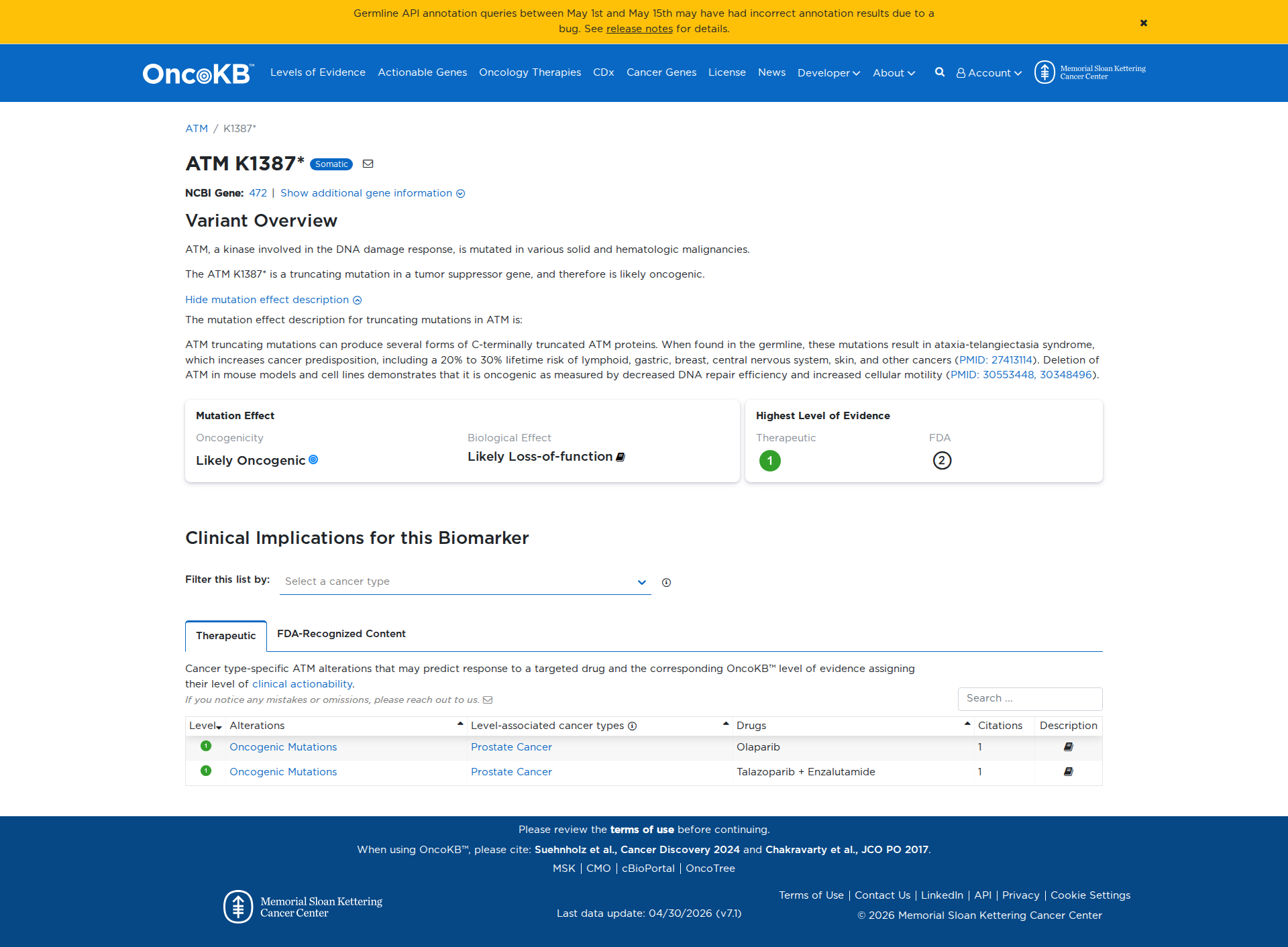
Error in OpenAI Consolidation. OncoKB: ATMK1387*ATMK1387*SomaticNCBI Gene:472|Show additional gene information Variant OverviewATM, a kinase involved in the DNA damage response, is mutated in various solid and hematologic malignancies.The ATM K1387* is a truncating mutation in a tumor suppressor gene, and therefore is likely oncogenic.Hide mutation effect description The mutation effect description for truncating mutations in ATM is: ATM truncating mutations can produce several forms of C-terminally truncated ATM proteins. When found in the germline, these mutations result in ataxia-telangiectasia syndrome, which increases cancer predisposition, including a 20% to 30% lifetime risk of lymphoid, gastric, breast, central nervous system, skin, and other cancers (PMID: 27413114). Deletion of ATM in mouse models and cell lines demonstrates that it is oncogenic as measured by decreased DNA repair efficiency and increased cellular motility (PMID: 30553448, 30348496). JAX-CKB: No results found
Click on previews to view full database entries. External databases may require institutional access.
Computational Analysis
Pathogenicity Predictions
SpliceAISpliceAI Scores
Window: ±500bp| Effect Type | Score | Position |
|---|---|---|
| Acceptor Loss (AL) | 0.02 | -46 bp |
| Donor Loss (DL) | 0.01 | 80 bp |
| Acceptor Gain (AG) | 0.0 | 129 bp |
| Donor Gain (DG) | 0.0 | 43 bp |
VCEP Guidelines
Applied ACMG/AMP Criteria (VCEP Specific)
PVS1 (Unknown (Pre-LLM))
From pre-LLM assessment (LLM Failed)
PS3 (Unknown (Pre-LLM))
From pre-LLM assessment (LLM Failed)
PM2 (Unknown (Pre-LLM))
From pre-LLM assessment (LLM Failed)
PP5 (Unknown (Pre-LLM))
From pre-LLM assessment (LLM Failed)