Genetic Information
Gene & Transcript Details
| ID | Status | Details |
|---|---|---|
| NM_000546.3 | Alternative | 2640 nt | 252–1433 |
| NM_000546.5 | RefSeq Select | 2591 nt | 203–1384 |
| NM_000546.6 | MANE Select | 2512 nt | 143–1324 |
| NM_000546.4 | Alternative | 2586 nt | 198–1379 |
| NM_000546.2 | Alternative | 2629 nt | 252–1433 |
Variant Details
Clinical & Population Data
Population Frequency
gnomADClinVar
OpenVariant summary: TP53 c.319T>C (p.Tyr107His) results in a conservative amino acid change located in the p53, DNA-binding domain of the encoded protein sequence. Three of five in-silico tools predict a benign effect of the variant on protein function. Functional studies based on the overall transcriptional activity in yeast assays classified this variant as partially functional (Kato_2003). The variant allele was found at a frequency of 0.00012 in 282734 control chromosomes, predominantly at a frequency of 0.0011 within the African or African-American subpopulation in the gnomAD database. The observed variant frequency within African or African-American control individuals in the gnomAD database is approximately 28 fold of the estimated maximal expected allele frequency for a pathogenic variant in TP53 causing Li-Fraumeni Syndrome phenotype (4e-05), strongly suggesting that the variant is a benign polymorphism found primarily in populations of African or African-American origin. In addition, this variant was observed in old females, older than age 70 years who have never had cancer (FLOSSIES database). This variant has been reported in cancer patients without strong evidence for causality. Eight ClinVar submitters, including one expert panel (ClinGen TP53 Variant Curation Expert Panel, benign), (evaluation after 2014) cite the variant as uncertain significance (1x), likely benign (6x) and benign (1x). Based on the evidence outlined above, the variant was classified as benign.
This submission and the accompanying classification are no longer maintained by the submitter. For more information on current observations and classification, please contact variantquestions@myriad.com.
BS1, BS3_supporting, BP4
"This variant has been reported in ClinVar as Benign (3 clinical laboratories) and as Likely benign (10 clinical laboratories) and as Uncertain significance (2 clinical laboratories) and as Benign by ClinGen TP53 Variant Curation Expert Panel, ClinGen expert panel."
COSMIC Somatic Evidence
Open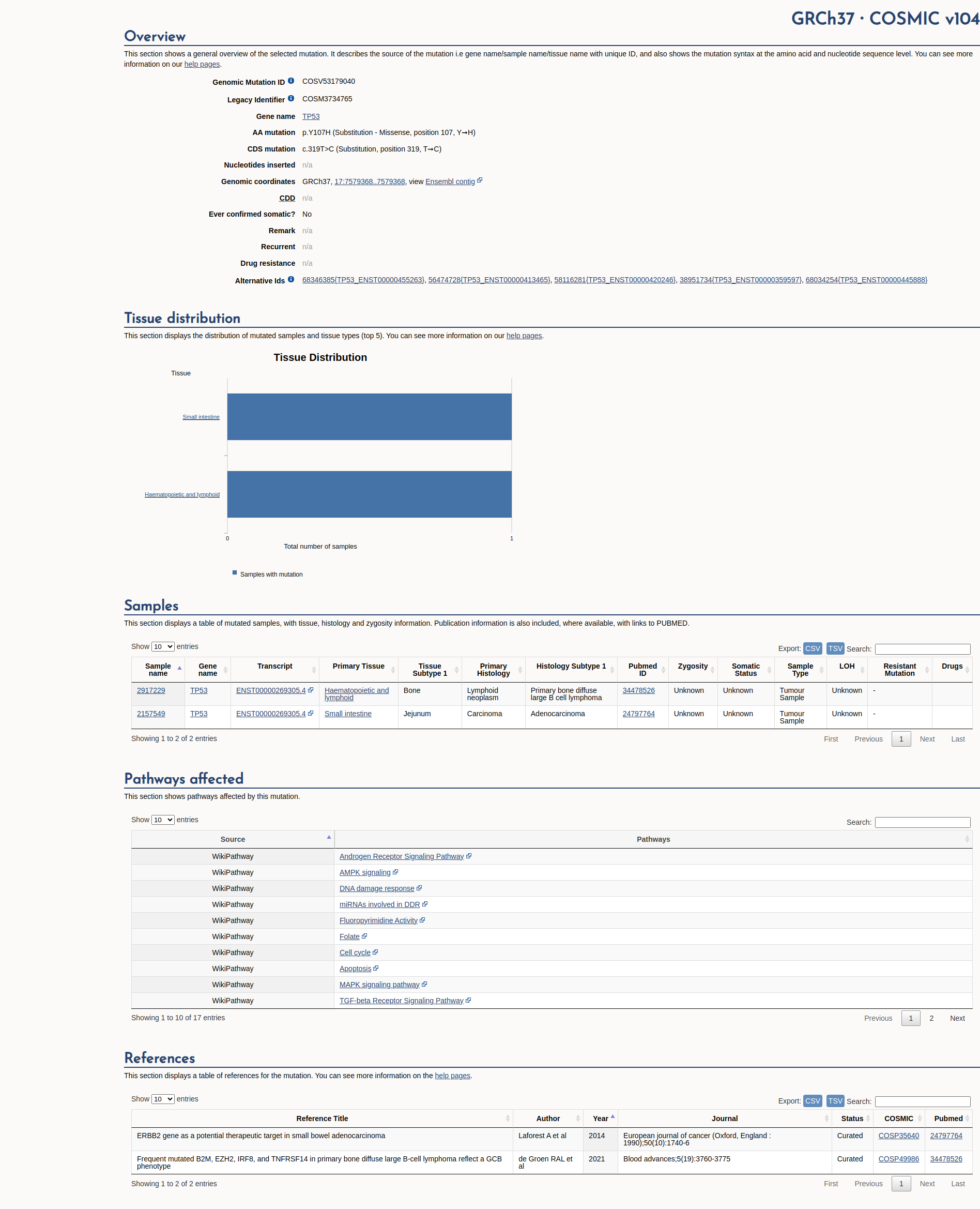
Functional Impact & Domains
Functional Domain
Error in OpenAI Consolidation. OncoKB: TP53Y107HTP53Y107HSomaticNCBI Gene:7157|Show additional gene information Variant OverviewTP53, a tumor suppressor in the DNA damage pathway, is the most frequently mutated gene in cancer.The TP53 Y107H mutation has been identified as a statistically significant hotspot and is likely to be oncogenic.Hide mutation effect description The TP53 Y107H mutation has not specifically been reviewed by the OncoKB team. However, the mutation effect description for TP53 Y107D, an alternate allele of TP53 Y107H, is: The TP53 Y107D mutation is located in the DNA-binding domain of the protein. This mutation has been identified in bladder cancer and is a statistically significant hotspot (PMID: 16061860). In vivo studies with yeast expressing TP53 Y107D demonstrated that the mutation is inactivating as measured by the loss of transactivational activity as compared to wildtype (PMID: 27328919, 12826609). In vitro studies with various human cancer cell lines expressing TP53 Y107D also demonstrated the mutation is inactivating as measured by reduced growth suppression activity as compared to wildtype (PMID: 29979965, 30224644). JAX-CKB: TP53 Y107H lies within the DNA-binding domain of the Tp53 protein (PMID: 22713868). Y107H results in colony growth and induction of apoptosis similar to wild-type Tp53 in culture (PMID: 33257846,) and transcriptional activity similar to wild-type Tp53 in reporter assays (PMID: 33257846, PMID: 39140857), however, results in decreased suppression of colony formation in TP53-null cells, increased sensitivity to DNA-damaging agents, altered transactivation of a subset of target genes, and impaired chromatin binding in culture and increased tumor formation in mouse models in another study (PMID: 37140445), and therefore, its effect on Tp53 protein function is unknown.
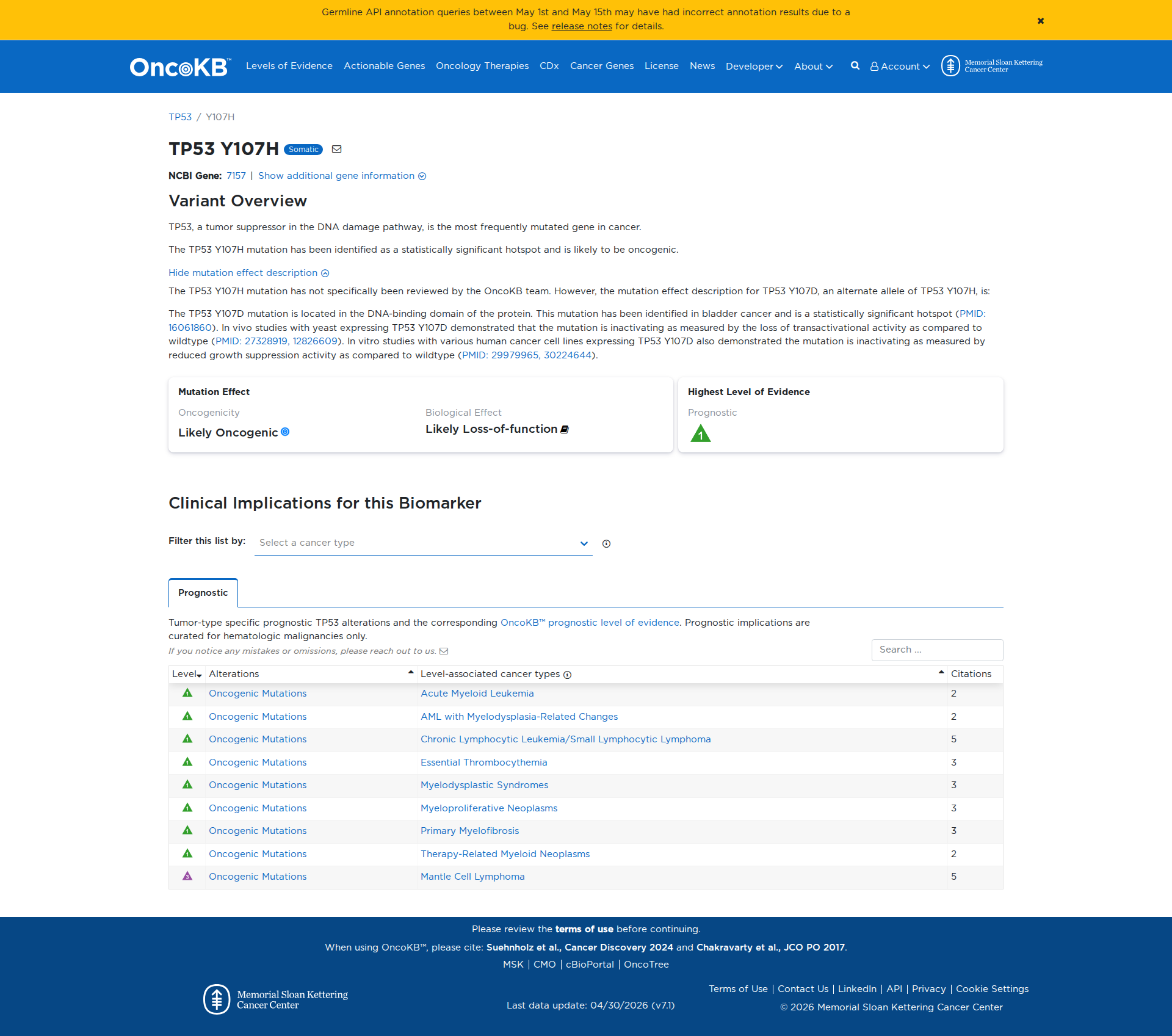
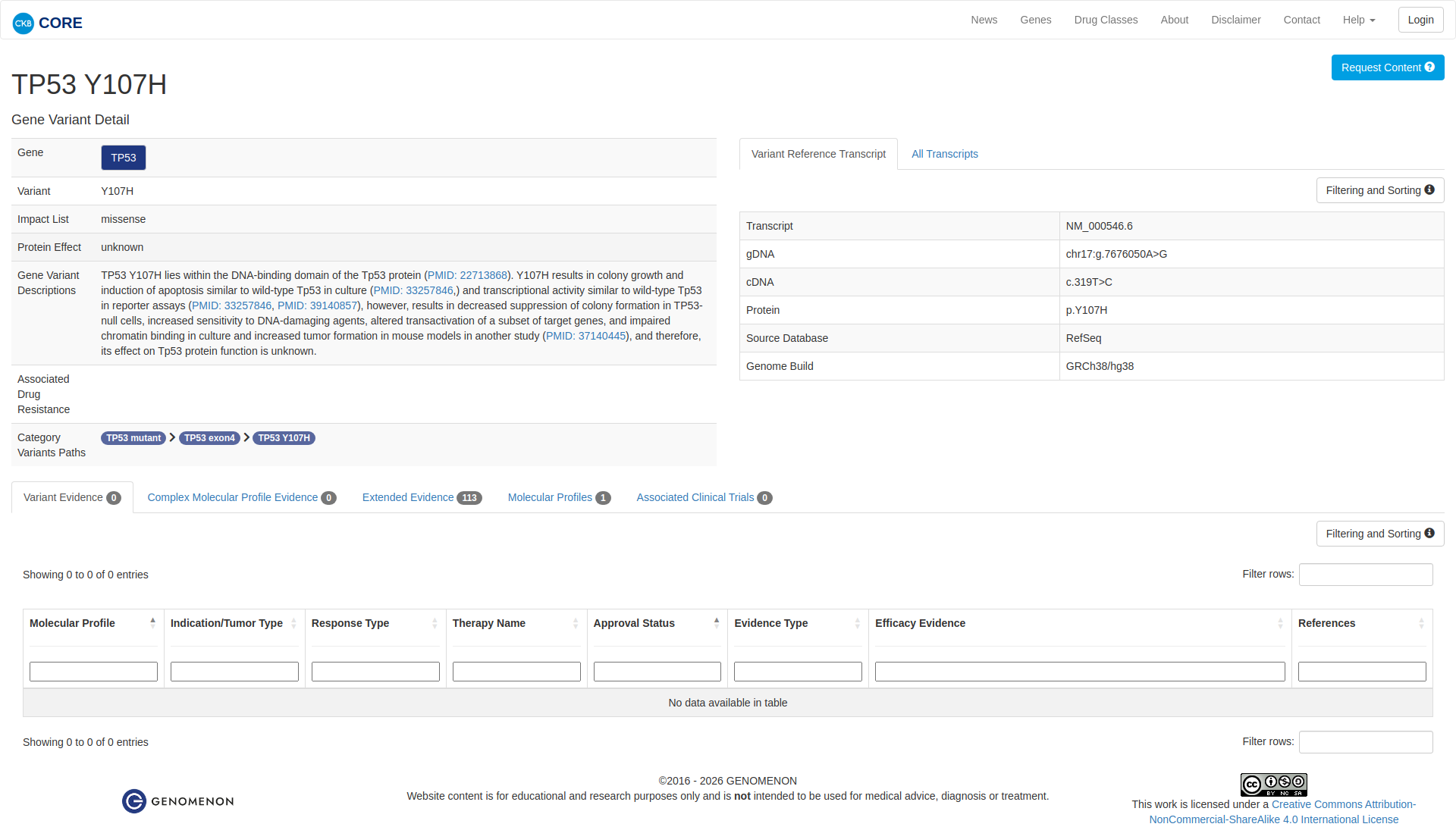
Click on previews to view full database entries. External databases may require institutional access.
Computational Analysis
Pathogenicity Predictions
SpliceAISpliceAI Scores
Window: ±500bp| Effect Type | Score | Position |
|---|---|---|
| Acceptor Loss (AL) | 0.02 | 18 bp |
| Donor Loss (DL) | 0.01 | -56 bp |
| Acceptor Gain (AG) | 0.0 | -348 bp |
| Donor Gain (DG) | 0.04 | 144 bp |
VCEP Guidelines
Applied ACMG/AMP Criteria (VCEP Specific)
PS3 (Unknown (Pre-LLM))
From pre-LLM assessment (LLM Failed)
PM2 (Unknown (Pre-LLM))
From pre-LLM assessment (LLM Failed)
BP4 (Unknown (Pre-LLM))
From pre-LLM assessment (LLM Failed)