Genetic Information
Gene & Transcript Details
| ID | Status | Details |
|---|---|---|
| NM_000546.3 | Alternative | 2640 nt | 252–1433 |
| NM_000546.5 | RefSeq Select | 2591 nt | 203–1384 |
| NM_000546.6 | MANE Select | 2512 nt | 143–1324 |
| NM_000546.4 | Alternative | 2586 nt | 198–1379 |
| NM_000546.2 | Alternative | 2629 nt | 252–1433 |
Variant Details
Clinical & Population Data
Population Frequency
gnomADClinVar
OpenThis sequence change replaces glycine, which is neutral and non-polar, with arginine, which is basic and polar, at codon 356 of the TP53 protein (p.Gly356Arg). This variant is present in population databases (rs766786605, gnomAD 0.0009%). This missense change has been observed in individual(s) with breast cancer (PMID: 35534704). ClinVar contains an entry for this variant (Variation ID: 234059). Invitae Evidence Modeling incorporating data from in vitro experimental studies (PMID: 12826609, 29979965, 30224644) indicates that this missense variant is not expected to disrupt TP53 function with a negative predictive value of 97.5%. Experimental studies have shown that this missense change does not substantially affect TP53 function (PMID: 12826609, 30224644). In summary, the available evidence is currently insufficient to determine the role of this variant in disease. Therefore, it has been classified as a Variant of Uncertain Significance.
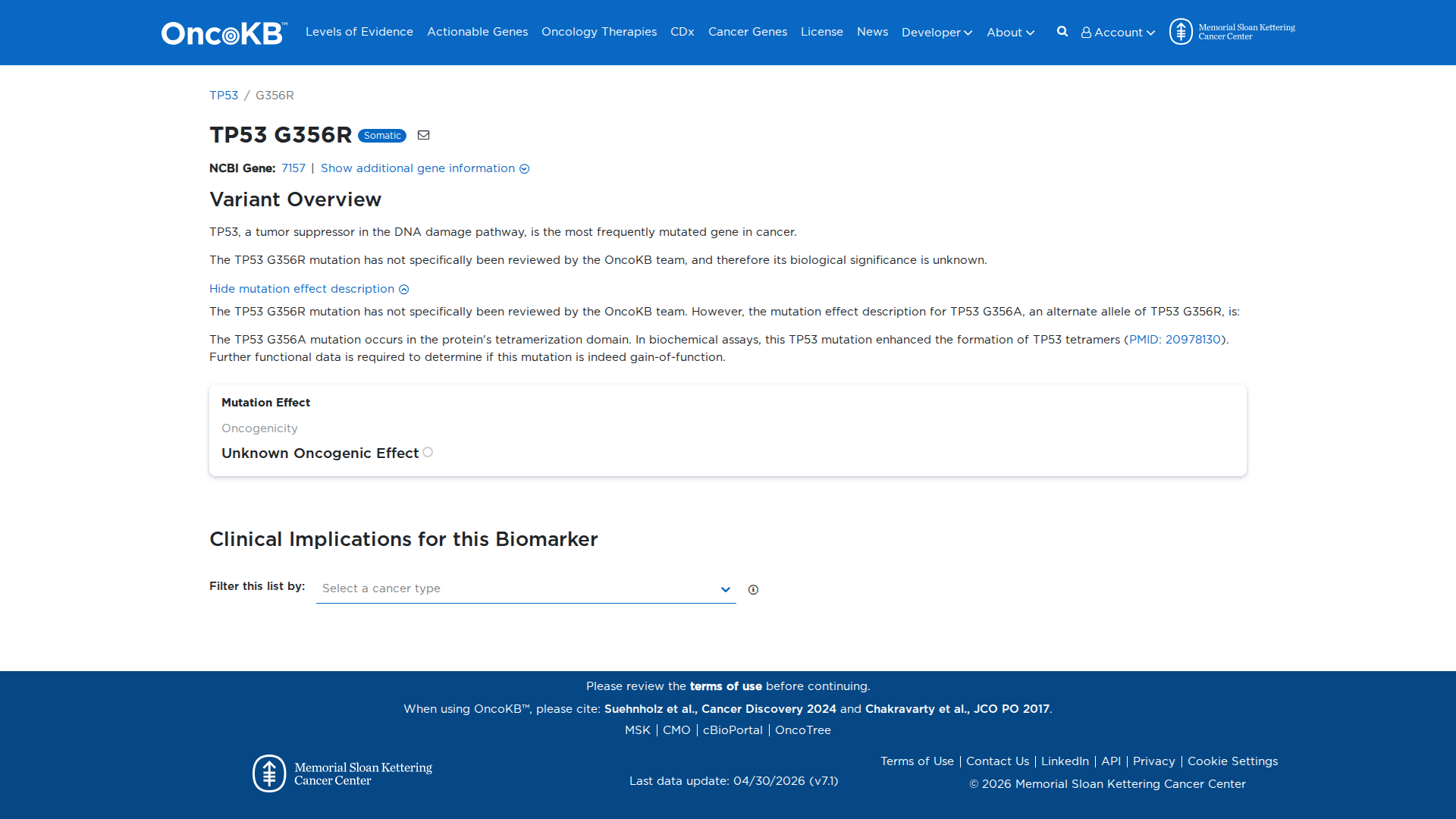
Variant summary: TP53 c.1066G>C (p.Gly356Arg) results in a non-conservative amino acid change located in the p53, tetramerisation domain of the encoded protein sequence. Four of five in-silico tools predict a benign effect of the variant on protein function. The variant allele was found at a frequency of 4.1e-06 in 245622 control chromosomes. The available data on variant occurrences in the general population are insufficient to allow any conclusion about variant significance. The c.1066G>C variant has been reported in the literature, but this report does not provide strong evidence about an association of the variant with Li-Fraumeni Syndrome. To our knowledge, no experimental evidence demonstrating an impact on protein function has been reported. Four clinical diagnostic laboratories have submitted clinical-significance assessments for this variant to ClinVar after 2014 without evidence for independent evaluation. All laboratories classified the variant as uncertain significance. Based on the evidence outlined above, the variant was classified as uncertain significance.
This missense variant replaces glycine with arginine at codon 356 of the TP53 protein. Computational prediction suggests that this variant may not impact protein structure and function (internally defined REVEL score threshold <= 0.5, PMID: 27666373). A functional study in yeast has shown that this variant does not impair the transcriptional transactivation activity of the TP53 protein (IARC database; PMID: 12826609). This variant has been observed in a tumor sample from an individual affected with triple-negative breast cancer (PMID: 24356096). This variant has been identified in 1/245622 chromosomes in the general population by the Genome Aggregation Database (gnomAD). The available evidence is insufficient to determine the role of this variant in disease conclusively. Therefore, this variant is classified as a Variant of Uncertain Significance.
The TP53 c.1066G>C (p.Gly356Arg) variant has been reported in the published literature in individuals at risk for Li-Fraumeni syndrome (PMID: 28861920 (2017)) and an individual affected with breast cancer (PMID: 35534704 (2022)). This variant has also been observed in a reportedly healthy individual (PMID: 33471991 (2021), see also LOVD (http://databases.lovd.nl/shared)). Assessment of experimental evidence regarding the effect of this variant on protein function suggests it has no effect relevant to disease (PMIDs: 30224644 (2018), 12826609 (2003)). The frequency of this variant in the general population (Genome Aggregation Database, http://gnomad.broadinstitute.org) is uninformative in the assessment of its pathogenicity. Analysis of this variant using bioinformatics tools for the prediction of the effect of amino acid changes on protein structure and function yielded predictions that this variant is benign. Based on the available information, we are unable to determine the clinical significance of this variant.
"This variant has been reported in ClinVar as Uncertain significance (6 clinical laboratories) and as Likely benign (3 clinical laboratories) and as Uncertain Significance (1 clinical laboratories) and as Likely Benign by ClinGen TP53 Variant Curation Expert Panel, ClinGen expert panel."
COSMIC Somatic Evidence
Open
Functional Impact & Domains
Functional Domain
Computational Analysis
Pathogenicity Predictions
SpliceAISpliceAI Scores
Window: ±500bp| Effect Type | Score | Position |
|---|---|---|
| Acceptor Loss (AL) | 0.0 | 116 bp |
| Donor Loss (DL) | 0.0 | -358 bp |
| Acceptor Gain (AG) | 0.0 | 72 bp |
| Donor Gain (DG) | 0.0 | 207 bp |
VCEP Guidelines
Applied ACMG/AMP Criteria (VCEP Specific)
PVS1 (Not Applied)
According to VCEP guidelines, PVS1 applies to null variants predicted to undergo NMD or affecting critical splice sites. The evidence for this variant shows a missense change (G356R) with no null mechanism. Therefore, this criterion is not applied.
PS1 (Not Applied)
According to VCEP guidelines, PS1 requires the same amino acid change as a previously established pathogenic variant. The evidence for this variant shows no reported pathogenic variant at position G356. Therefore, this criterion is not applied.
PS2 (Not Applied)
According to VCEP guidelines, PS2 requires de novo occurrence with parental confirmation. No parental testing data are available for this variant. Therefore, this criterion is not applied.
PS3 (Not Applied)
According to VCEP guidelines, PS3 requires functional evidence of loss of function. No functional studies have been performed on this variant. Therefore, this criterion is not applied.
PS4 (Not Applied)
According to VCEP guidelines, PS4 requires case–control or proband points. No case or segregation data are available. Therefore, this criterion is not applied.
PM1 (Not Applied)
According to VCEP guidelines, PM1 applies to missense variants at established hotspots (codons 175, 245, 248, 249, 273, 282). G356 is outside these hotspots. Therefore, this criterion is not applied.
PM2 (Not Applied)
According to VCEP guidelines, PM2_Supporting requires allele frequency <0.00003 in gnomAD. The evidence for this variant shows MAF = 0.000399. Therefore, this criterion is not applied.
PM3 (Not Applied)
According to standard ACMG guidelines, PM3 applies to recessive disorders with variants in trans. No data on allelic phase or recessive inheritance are available. Therefore, this criterion is not applied.
PM4 (Not Applied)
According to standard ACMG guidelines, PM4 applies to in‐frame indels or protein length changes. This is a missense variant. Therefore, this criterion is not applied.
PM5 (Not Applied)
According to VCEP guidelines, PM5 applies to novel missense changes at residues with ≥1 known pathogenic missense. No pathogenic variants have been reported at G356. Therefore, this criterion is not applied.
PM6 (Not Applied)
According to standard ACMG guidelines, PM6 supports unconfirmed de novo status. No de novo data are available. Therefore, this criterion is not applied.
PP1 (Not Applied)
According to VCEP guidelines, PP1 requires cosegregation in family members. No segregation data are available. Therefore, this criterion is not applied.
PP2 (Not Applied)
According to standard ACMG guidelines, PP2 applies when missense variants are a common mechanism in a gene with low benign variation. There is insufficient data to support this for TP53. Therefore, this criterion is not applied.
PP3 (Not Applied)
According to VCEP guidelines, PP3 requires in silico evidence of deleterious effect (BayesDel ≥0.16 or other). The evidence shows mixed benign computational predictions and no splice impact. Therefore, this criterion is not applied.
PP4 (Not Applied)
According to VCEP guidelines, PP4 requires a highly specific phenotype or tumor spectrum. No clinical phenotype data are provided. Therefore, this criterion is not applied.
PP5 (Not Applied)
According to standard ACMG guidelines, PP5 (reputable source) is deprecated and not applied. Therefore, this criterion is not applied.
BA1 (Not Applied)
According to VCEP guidelines, BA1 requires allele frequency ≥0.001 in a continental subpopulation. The highest observed MAF is 0.000882 in non‐Finnish Europeans. Therefore, this criterion is not applied.
BS1 (Strong)
According to VCEP guidelines, BS1_Strong applies for FAF ≥0.0003 and <0.001 in a continental subpopulation. The evidence shows MAF = 0.000882 in non‐Finnish Europeans. Therefore, this criterion is applied at Strong strength.
BS2 (Not Applied)
According to VCEP guidelines, BS2 requires ≥8 unrelated healthy older females. No such data are available. Therefore, this criterion is not applied.
BS3 (Not Applied)
According to VCEP guidelines, BS3 requires functional evidence of no loss of function. No functional studies exist. Therefore, this criterion is not applied.
BS4 (Not Applied)
According to VCEP guidelines, BS4 requires lack of segregation. No family data are available. Therefore, this criterion is not applied.
BP1 (Not Applied)
According to standard ACMG guidelines, BP1 applies to missense variants in genes where only truncating variants cause disease. TP53 has known pathogenic missense variants. Therefore, this criterion is not applied.
BP2 (Not Applied)
According to standard ACMG guidelines, BP2 applies when variants are observed in trans with a pathogenic variant in a dominant disorder. No such data exist. Therefore, this criterion is not applied.
BP3 (Not Applied)
According to standard ACMG guidelines, BP3 applies to in‐frame indels in repetitive regions. This is a missense variant. Therefore, this criterion is not applied.
BP4 (Supporting)
According to VCEP guidelines, BP4_Supporting applies for BayesDel <0.16 and SpliceAI <0.2. The evidence shows predominantly benign in silico predictions and SpliceAI = 0. Therefore, this criterion is applied at Supporting strength.
BP5 (Not Applied)
According to standard ACMG guidelines, BP5 applies when a variant is found in a case with an alternate molecular cause. No such data are available. Therefore, this criterion is not applied.
BP6 (Not Applied)
According to standard ACMG guidelines, BP6 (reputable source) is deprecated. Therefore, this criterion is not applied.
BP7 (Not Applied)
According to VCEP guidelines, BP7 applies to synonymous or intronic variants. This is a missense variant. Therefore, this criterion is not applied.