Analysis in progress
Initialising…
0%
complete
This report is still being assembled — sections appear as each stage finishes. It isn't final yet.
RECQL4
Final classification
Likely Pathogenic
RECQL4 c.2296del · p.Arg766GlyfsTer77
RECQL4

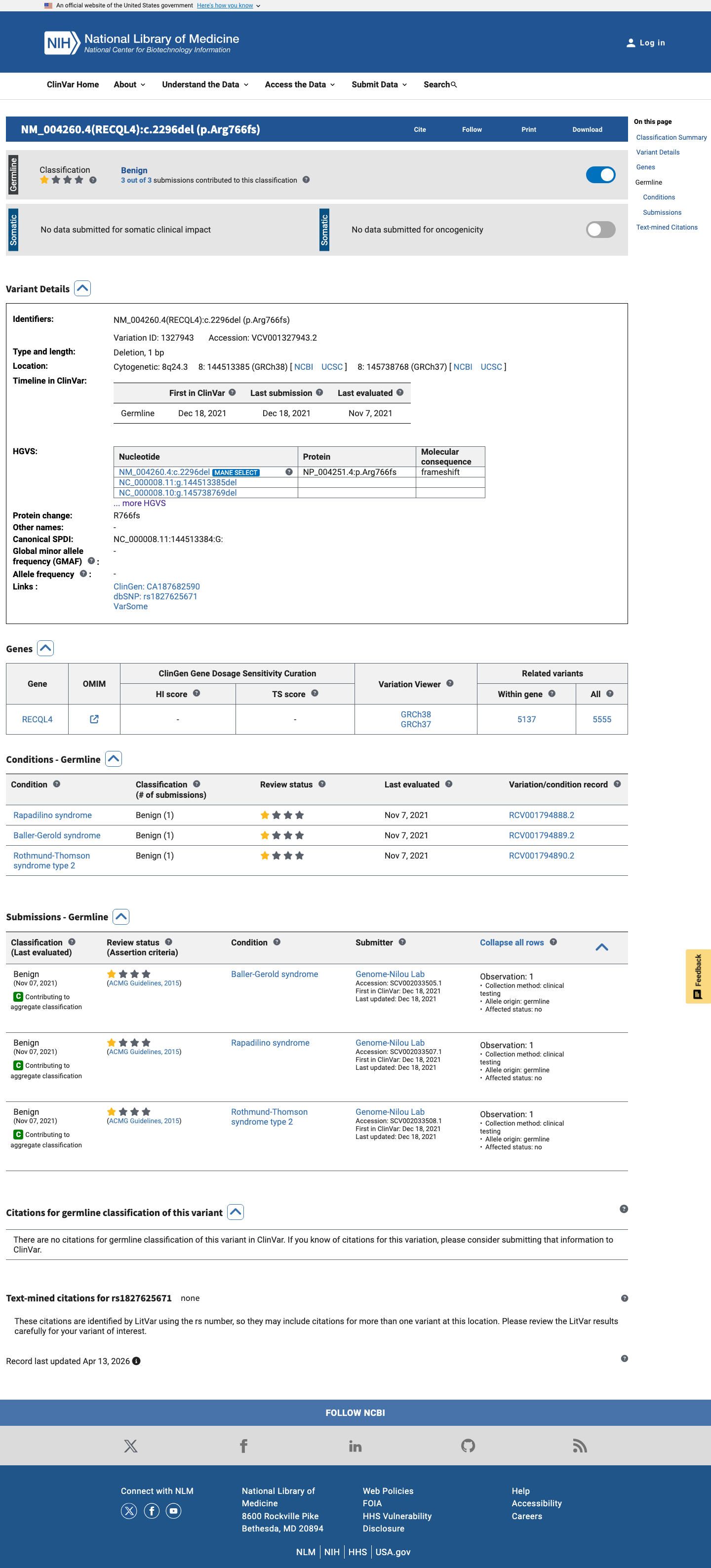
The RECQL4 c.2296del (p.Arg766GlyfsTer77) variant has not been observed in somatic cancers in COSMIC and has been reported in ClinVar as Benign by 3 single-submitter clinical laboratory submissions.

Gene
RECQL4
Transcript
NM_004260.4
HGVS · transcript:coding
NM_004260.4:c.2296del
Consequence
N/A
GRCh38
chr8:144513384 CG>C
GRCh37
chr8:145738767 CGG>C
Basis gene-specific framework lacked a usable explicit final combination framework, so generic ACMG/AMP 2015 final-combination rules were applied as fallback; applied criteria: PVS1 very strong, PM2 moderate; combination = 1 very strong + 1 moderate, which maps to Likely Pathogenic.
gene-specific framework lacked a usable explicit final combination framework, so generic ACMG/AMP 2015 final-combination rules were applied as fallback; applied criteria: PVS1 very strong, PM2 moderate; combination = 1 very strong + 1 moderate, which maps to Likely Pathogenic.
Classification rationale
PVS1PM2 Likely Pathogenic
RECQL4 c.2296del

The RECQL4 c.2296del (p.Arg766GlyfsTer77) variant has not been observed in somatic cancers in COSMIC and has been reported in ClinVar as Benign by 3 single-submitter clinical laboratory submissions.1 This variant is absent from gnomAD v2.1, gnomAD v4.1, and gnomAD-Canada, supporting rarity for a RECQL4 germline variant.2 This deletion causes a frameshift with premature termination, and the generic PVS1 framework supports loss-of-function interpretation because RECQL4 loss of function is an established germline disease mechanism.3 SpliceAI predicts no significant splice impact for this variant with a maximum delta score of 0.15, and missense-oriented predictors such as REVEL and BayesDel are not applicable to this deletion.4

PVS1 + PM2 Likely Pathogenic
Gene diagram · NM_004260.4 · variants mapped to exon structure
RECQL4 NM_004260.4
Fetching transcript structure from UCSC…
Applied criteria · 2 applied · 17 assessed
Applied · 2
Strength Supporting Moderate Strong Very strong
PVS1 very strong review Pathogenic
This variant is a frameshift deletion predicted to cause p.(Arg766GlyfsTer77). RECQL4 loss of function is supported as a germline disease mechanism, and the generic PVS1 framework is applicable. The predicted premature termination occurs well upstream of the last exon-exon junctions, which is consistent with a loss-of-function effect and supports PVS1 at very strong strength.
Frameshift consequence p.(Arg766GlyfsTer77)RECQL4 loss-of-function mechanism supportedPredicted truncation occurs before the terminal exons
PM2 moderate review Pathogenic
This variant is absent from gnomAD v2.1, gnomAD v4.1, and gnomAD-Canada. The observed population frequency is 0, which is below the 0.1% threshold used for rarity support in this non-VCEP review and supports PM2.
Absent from gnomAD v2.1Absent from gnomAD v4.1Absent from gnomAD-Canada
Assessed · not applied
Pathogenic
PS2 No confirmed de novo occurrence with maternity and paternity established was identified for this variant.
PS3 No well-established variant-specific functional study demonstrating a damaging effect for this exact deletion was identified from the available evidence.
PS4 Available evidence does not show enrichment of this variant in affected individuals over controls.
PM1 Available evidence does not support this variant lying in a mutational hotspot or a well-established critical functional domain without benign variation.
PM3 RECQL4-related disease is consistent with a recessive mechanism, but no observation of this variant in trans with a pathogenic RECQL4 variant was identified.
PM6 No presumed de novo report was identified for this variant.
PP1 No segregation data were identified for this variant.
PP4 No phenotype-specific clinical evidence was identified showing a presentation highly specific for a RECQL4-related disorder in an individual carrying this variant.
PP5 PP5 is not applied.
Benign
BA1 This variant is absent from available population datasets.
BS1 This variant is absent from available population datasets.
BS2 No evidence was identified showing this variant in healthy adult individuals at a frequency inconsistent with disease penetrance.
BS3 No well-established variant-specific functional study demonstrating a normal effect for this exact deletion was identified.
BS4 No non-segregation data were identified for this variant.
BP2 No phase-resolved observation was identified showing this variant in cis with another pathogenic variant or in trans with a pathogenic variant for a fully penetrant dominant condition.
BP5 No alternate molecular explanation was identified that would make this variant an incidental finding for the observed phenotype.
BP6 BP6 is not applied.
N/A · 9 PS1 · PM4 · PM5 · PP2 · PP3 · BP1 · BP3 · BP4 · BP7
Research & evidence
Population frequency · supports pathogenic
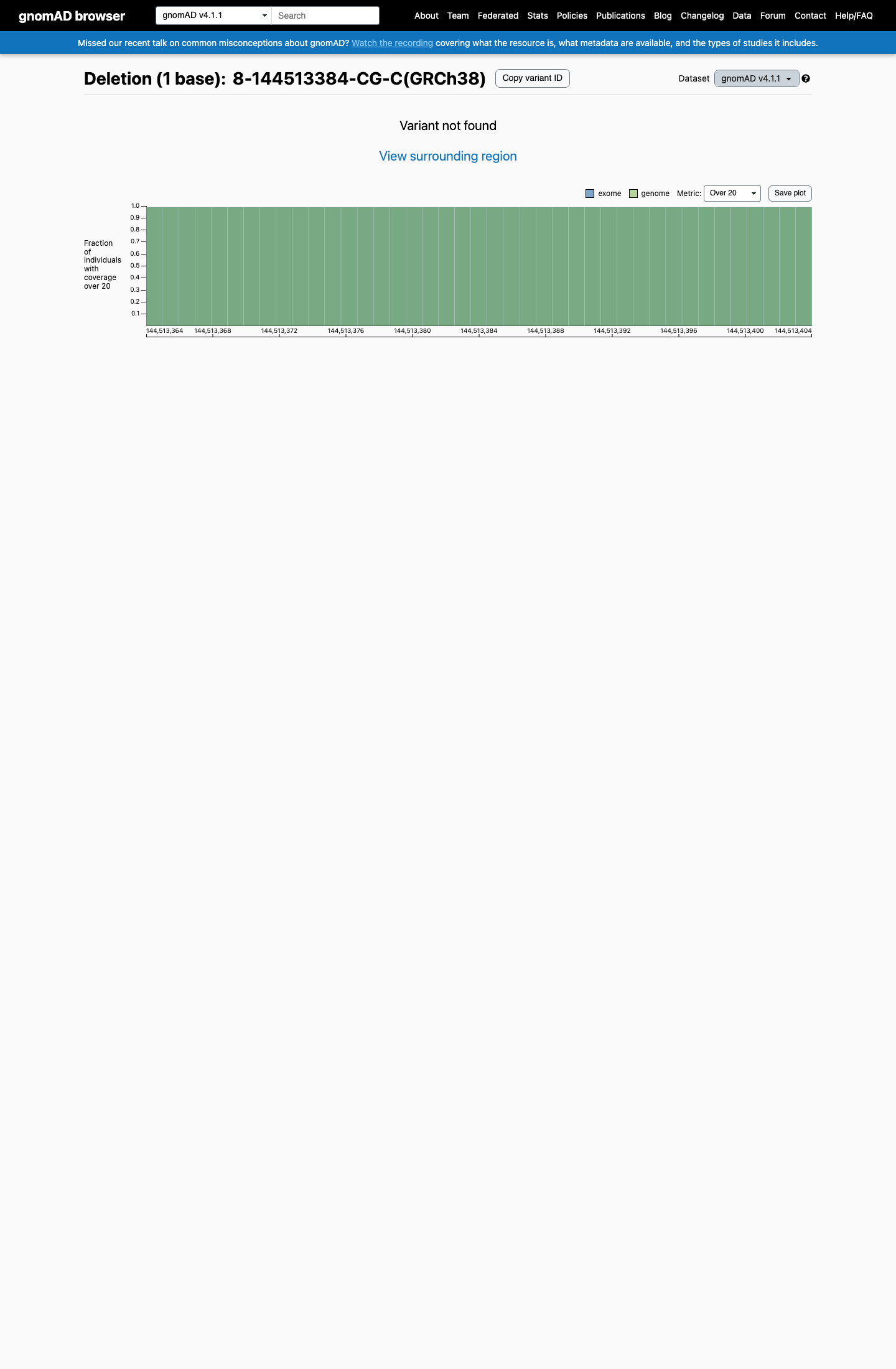
gnomAD v4.1 screenshot
gnomAD v4.1
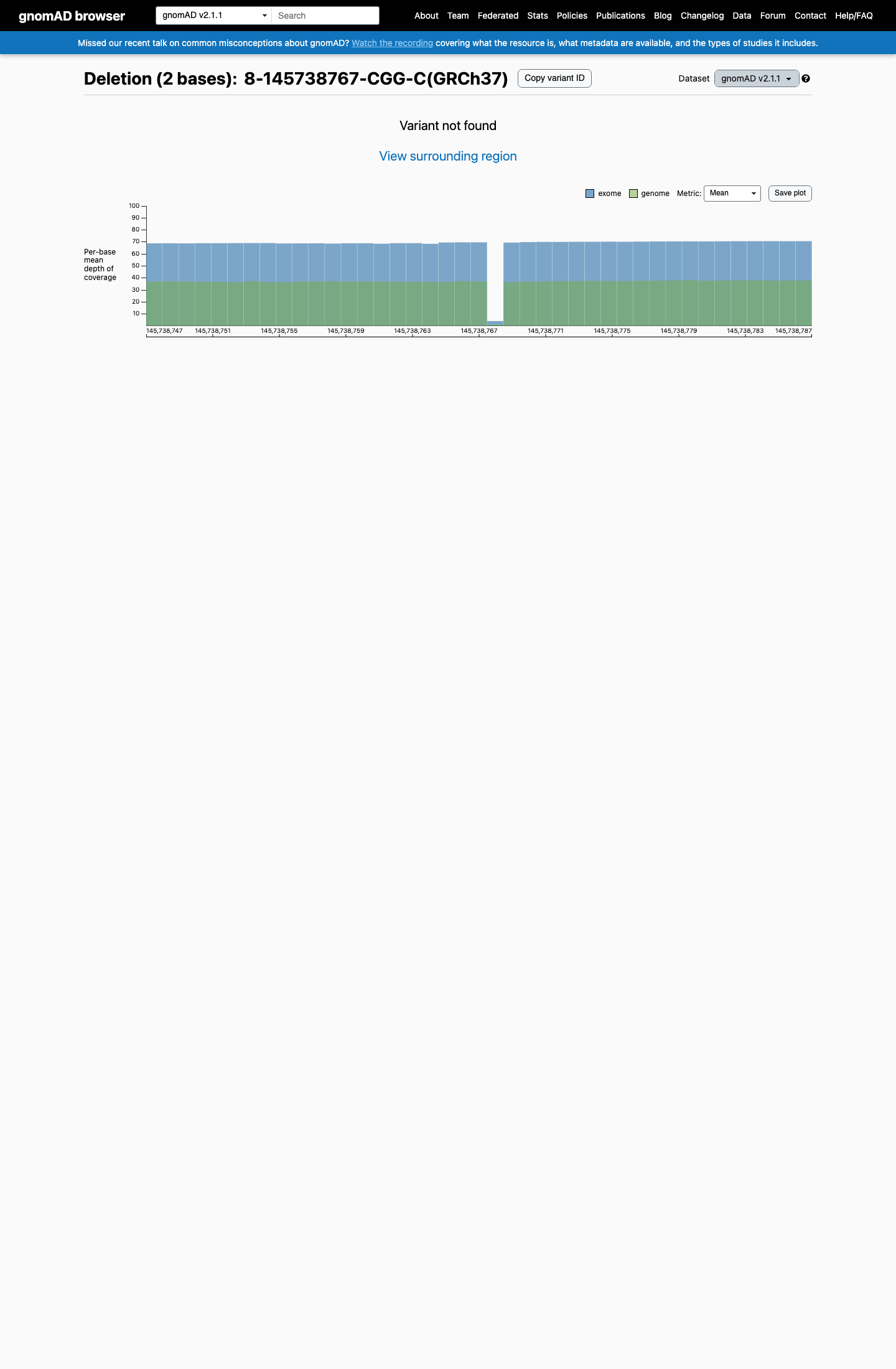
gnomAD v2.1 screenshot
gnomAD v2.1
v4.1
Absent from gnomAD v4.1.
v2.1
Absent from gnomAD v2.1.
🇨🇦 CA
Absent from gnomAD-Canada v1.0.
Allele frequency by ancestry
three datasets · side by side
gnomAD v4.1
Absent · 0 / ?
0 hom
Not observed in any ancestry group.
gnomAD v2.1
Absent · 0 / ?
0 hom
Not observed in any ancestry group.
gnomAD Canada 🇨🇦
Absent · 0 / ?
0 hom
Not observed in any ancestry group.
ClinVar screenshot
ClinVar
This variant has been reported in ClinVar as Benign (3 clinical laboratories). (ClinVarID = 1327943)
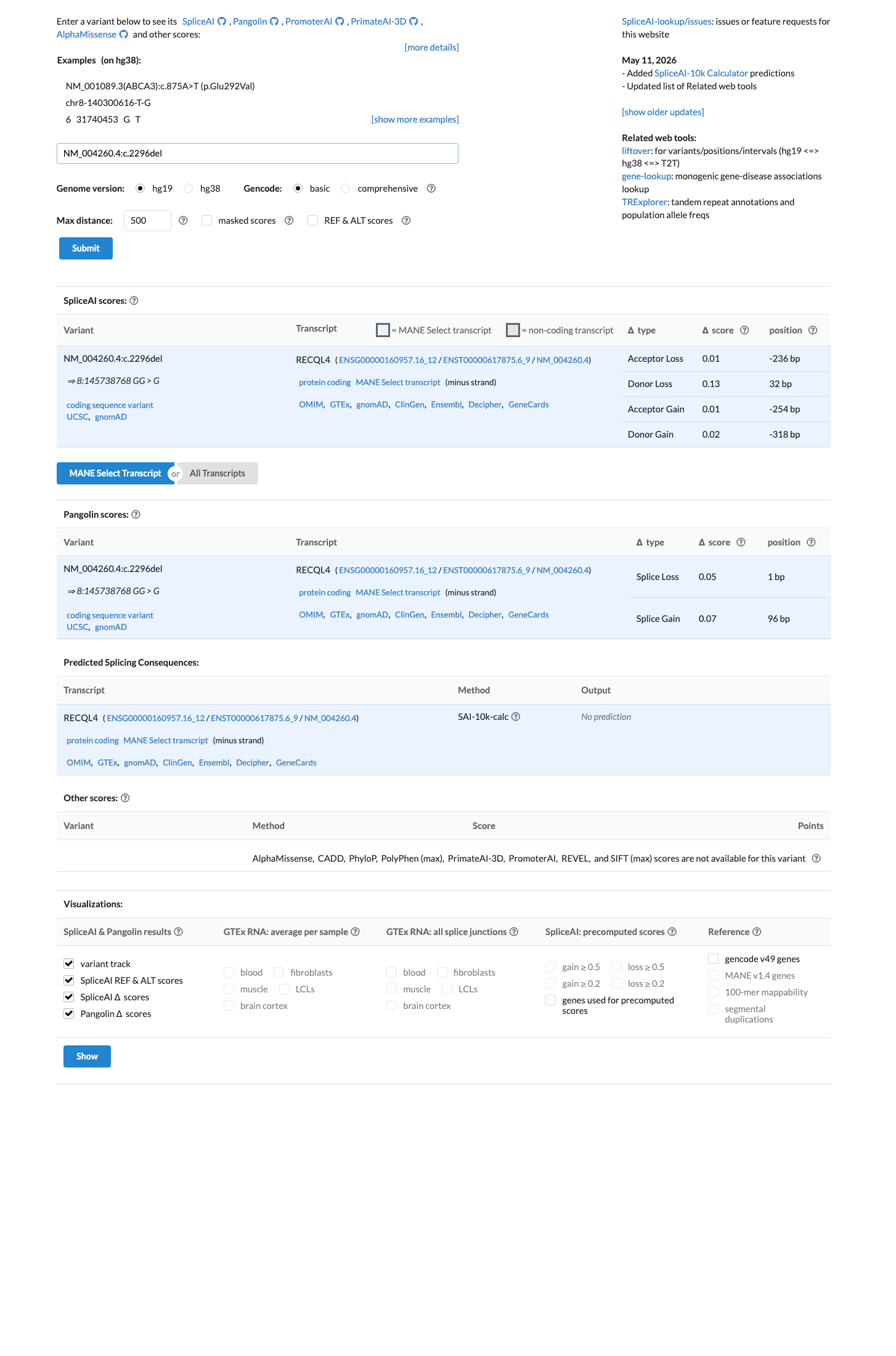
SpliceAI screenshot
In silico
SpliceAI predicts no significant splice impact for this variant (max delta score = 0.15).
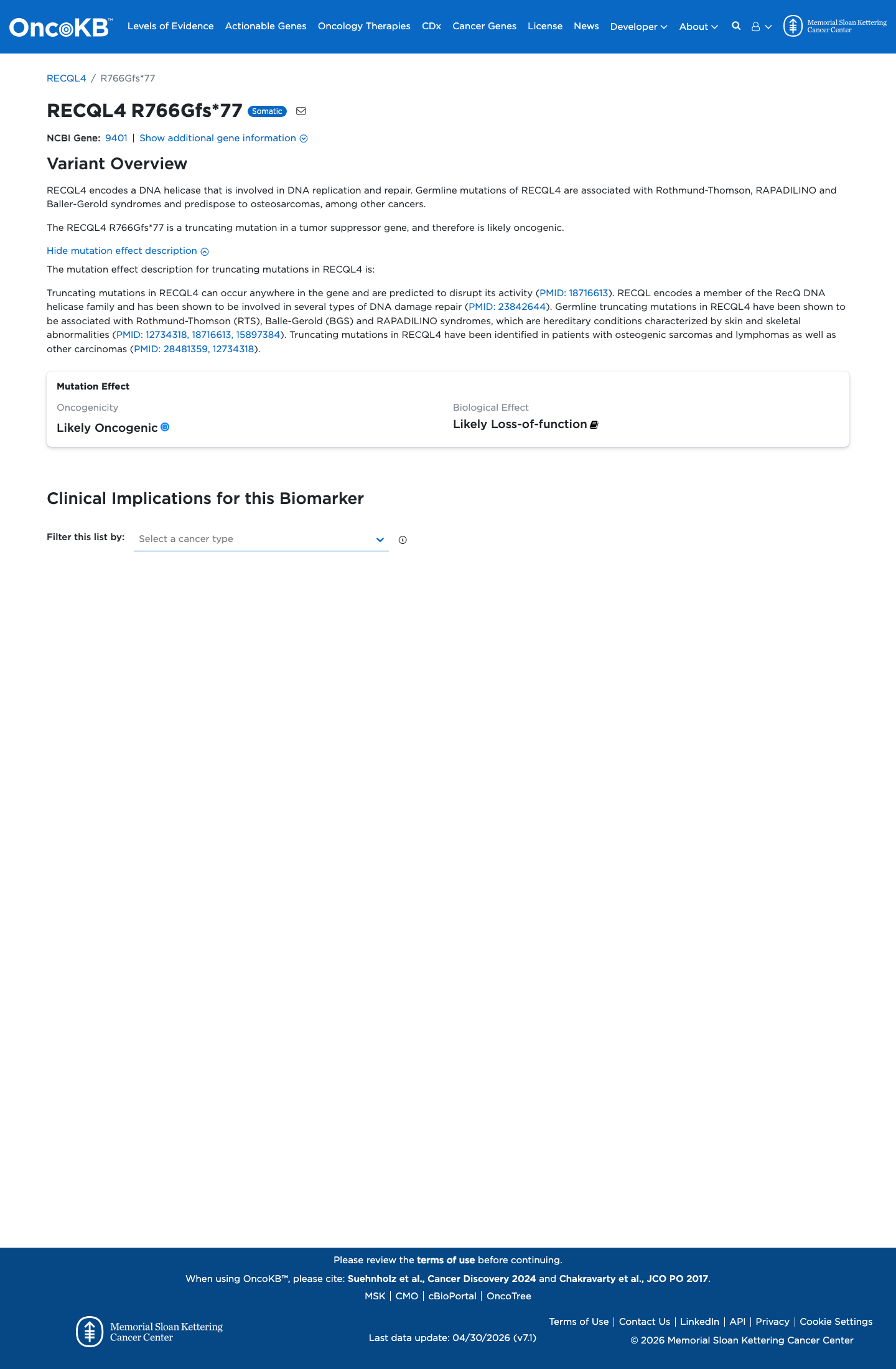
Functional / OncoKB screenshot
Functional Likely Oncogenic
OncoKB identified variant-specific curated literature and context relevant to functional review; biological-effect context: Likely Loss-of-function; curated oncogenicity label: Likely Oncogenic.
OncoKB ↗
COSMIC screenshot
COSMIC
Cancer hotspots screenshot
Cancer hotspots
Somatic evidence Not in COSMIC / hotspots
COSMIC
This variant does not lie in a statistically significant hotspot. This variant has not previously been reported in somatic cancers (COSMIC).
Hotspots
This variant does not lie in a statistically significant hotspot.
Sources & reference links
8Sources
ClinVar
gnomAD v2.1
gnomAD v4.1
gnomAD-Canada
SpliceAI
OncoKB
COSMIC
Cancer hotspots
Triaged references · 8 PMIDs not cited in assessment
12734318 ↗ Association between osteosarcoma and deleterious mutations in the RECQL4 gene in Rothmund-Thomson syndrome. ONCOKB
15897384 ↗ A patient with Rothmund-Thomson syndrome and all features of RAPADILINO. ONCOKB
18716613 ↗ The mutation spectrum in RECQL4 diseases. ONCOKB
23842644 ↗ DNA helicases involved in DNA repair and their roles in cancer. ONCOKB
28481359 ↗ Mutational landscape of metastatic cancer revealed from prospective clinical sequencing of 10,000 patients. ONCOKB
25741868 ↗ Standards and guidelines for the interpretation of sequence variants: a joint consensus recommendation of the American College of Medical Genetics and Genomics and the Association for Molecular Pathology. CLINVAR
20301383 ↗ Baller-Gerold Syndrome. CLINVAR
20301415 ↗ Rothmund-Thomson Syndrome. CLINVAR