The CTNNB1 c.1149G>T (p.Trp383Cys) variant has been observed in somatic cancers 12 times in COSMIC and has also been reported in ClinVar, although ClinVar submission-level classification details were not available from the retrieved record.1 This variant is absent from gnomAD v2.1, gnomAD v4.1, and gnomAD-Canada, placing its observed population frequency at 0, below the 0.1% rarity threshold used for PM2.2 In a published functional study of CTNNB1 armadillo repeat 5 and 6 substitutions, residue W383 was identified as recurrently mutated in cancer, and substitutions in this region were associated with reduced APC binding and increased downstream beta-catenin signaling, but direct functional testing of p.Trp383Cys was not established from the retrieved evidence.3 Computational findings are concerning for a missense effect, with REVEL 0.642 and BayesDel 0.287483, while SpliceAI predicts no meaningful splice effect with a maximum delta score of 0.02.4
Final classification
VUS
PM2
CTNNB1
c.1149G>T
p.Trp383Cys
This variant
The CTNNB1 c.1149G>T (p.Trp383Cys) variant has been observed in somatic cancers 12 times in COSMIC and has also been reported in ClinVar, although ClinVar submission-level classification details were not available from the retrieved record.
gene-specific framework lacked a usable explicit final combination framework, so generic ACMG/AMP 2015 final-combination rules were applied as fallback; applied criteria: PM2 supporting; combination = 1 supporting, which maps to VUS.
Classification rationale
PM2
VUS
CTNNB1 c.1149G>T
PM2
→
VUS
LYFE Sciences is an AI system, and it can make mistakes. Criteria
may be applied incorrectly, sources may be misread, and a confident-looking
classification can still be wrong. Double-check every criterion and
its underlying evidence before relying on any call.
Gene diagram
· NM_001904.4 · variants mapped to exon structure
CTNNB1
NM_001904.4
Fetching transcript structure from UCSC…
Applied criteria · 1 applied · 19 assessed
MetEvidence satisfies this criterion.
Not metEvaluated against available evidence; threshold not reached.
Not assessedApplies in principle, but no evidence was found to evaluate it.
N/ADoesn't apply to this variant type.
Applied · 1
Strength
Supporting
Moderate
Strong
Very strong
PM2
supporting
Pathogenic
This variant is absent from gnomAD v2.1, gnomAD v4.1, and gnomAD-Canada, so the observed population frequency is 0 and is below the 0.1% PM2 threshold.
Absent from gnomAD v2.1Absent from gnomAD v4.1Absent from gnomAD-Canada v1.0
Assessed · not applied
· 5 not met · 14 not assessed
Pathogenic
PS1
No evidence was identified showing that this nucleotide change creates the same amino acid change as a previously established pathogenic variant.
PS2
No confirmed de novo occurrence data were identified for this variant.
PS3
A published study showed that CTNNB1 substitutions in armadillo repeats 5 and 6 can reduce APC binding and increase downstream signaling, but direct well-established functional testing of p.Trp383Cys was not established from the retrieved evidence.
PS4
This variant has been observed in somatic cancers and has a ClinVar record, but no germline case-control enrichment or statistically increased prevalence in affected individuals was identified.
PM1
Residue W383 lies in a recurrently mutated CTNNB1 cancer region, but the available evidence does not establish a germline disease-specific mutational hotspot or critical benign-variation-depleted region suitable for applying PM1 with confidence.
PM6
No assumed de novo occurrence data were identified for this variant.
PP1
No segregation data were identified for this variant.
PP2
No gene-specific evidence framework was available to support applying PP2 for this CTNNB1 missense variant.
PP3
Computational results are concerning for a missense effect, with REVEL 0.642 and BayesDel 0.287483, while SpliceAI predicts no significant splice impact with a max delta score of 0.02; however, without a gene-specific computational rule or clearly prespecified threshold for this case, these data were not used alone to apply PP3.
PP4
No phenotype data were provided to assess whether the clinical presentation is highly specific for a CTNNB1-related disorder.
Benign
BA1
This variant is absent from gnomAD v2.1, gnomAD v4.1, and gnomAD-Canada, so the observed population frequency is 0 and is far below the 1% BA1 threshold.
BS1
This variant is absent from gnomAD v2.1, gnomAD v4.1, and gnomAD-Canada, so the observed population frequency is 0 and does not exceed the 0.3% BS1 threshold.
BS2
No evidence was identified showing this variant in healthy adult individuals in a context sufficient to apply BS2.
BS3
Available functional literature does not show a normal or benign effect for this variant.
BS4
No data were identified showing lack of segregation with disease.
BP1
BP1 was not applied because no gene-specific framework was available to determine whether this CTNNB1 missense change should be treated as a low-prior-probability missense mechanism.
BP2
No phase data with another variant were identified.
BP4
Benign computational evidence was not identified.
BP5
No alternative molecular explanation was identified to support BP5.
N/A · 8
PVS1 · PM3 · PM4 · PM5 · PP5 · BP3 · BP6 · BP7
Research & evidence
Population frequency
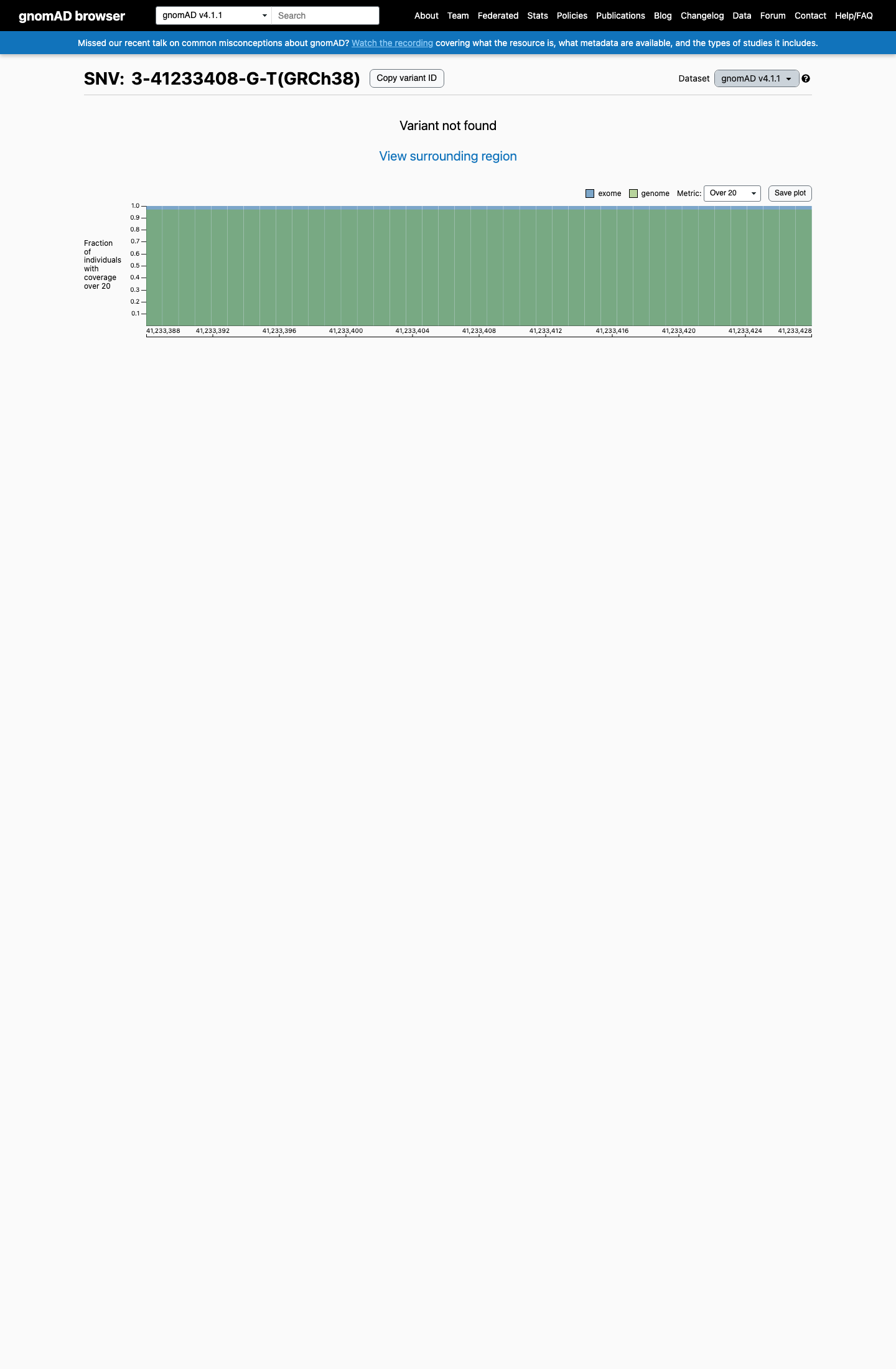
gnomAD v4.1
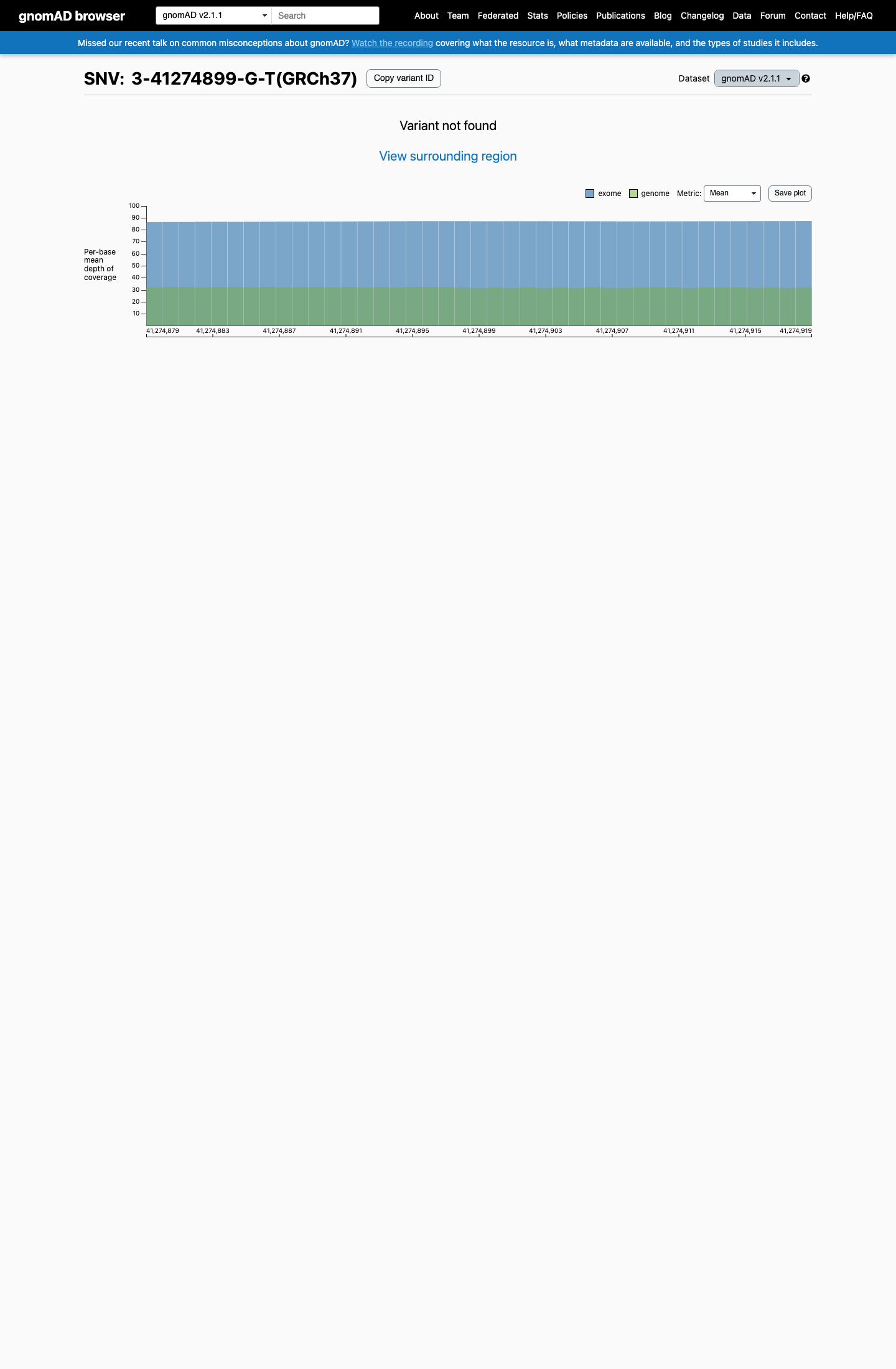
gnomAD v2.1
v4.1
Absent from gnomAD v4.1.
v2.1
Absent from gnomAD v2.1.
🇨🇦 CA
Absent from gnomAD-Canada v1.0.
Allele frequency by ancestry
three datasets · side by side
gnomAD v4.1
Absent
· 0 / ?
0 hom
0 hom
Not observed in any ancestry group.
gnomAD v2.1
Absent
· 0 / ?
0 hom
0 hom
Not observed in any ancestry group.
gnomAD Canada 🇨🇦
Absent
· 0 / ?
0 hom
0 hom
Not observed in any ancestry group.
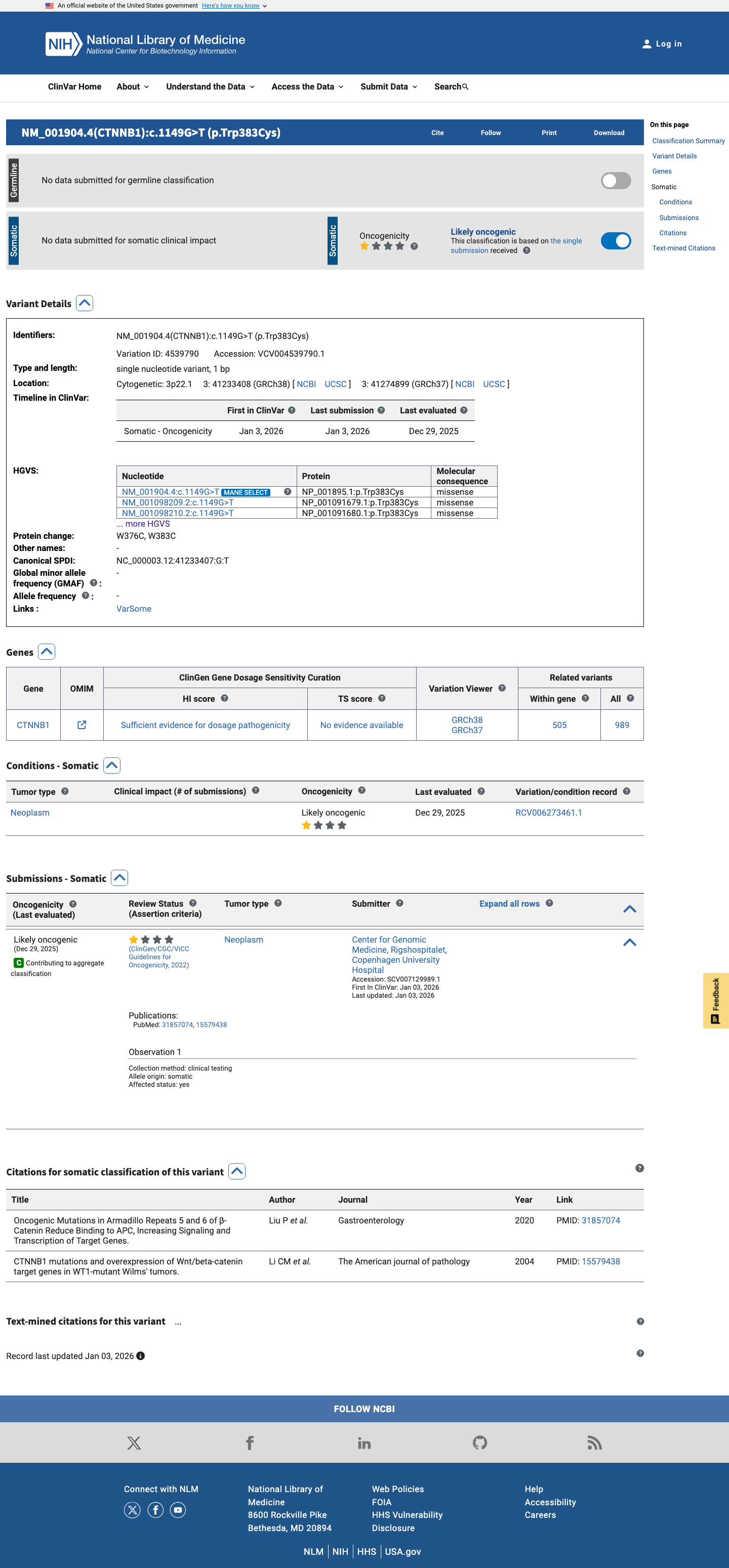
ClinVar
This variant has been reported in ClinVar but submission details could not be extracted. (ClinVarID = 4539790)
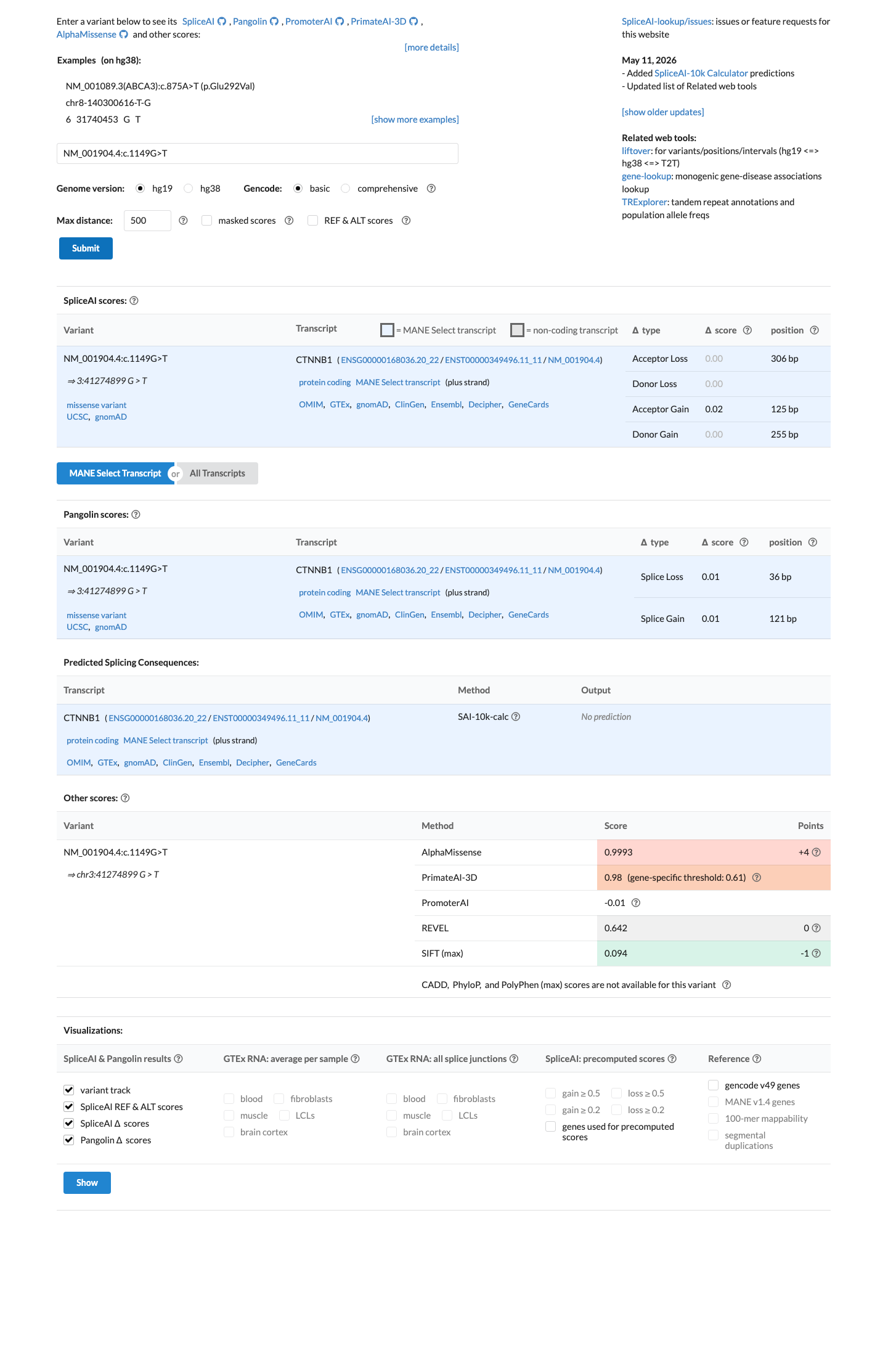
In silico
SpliceAI predicts no significant splice impact for this variant (max delta score = 0.02). REVEL score = 0.642. BayesDel score = 0.287483.
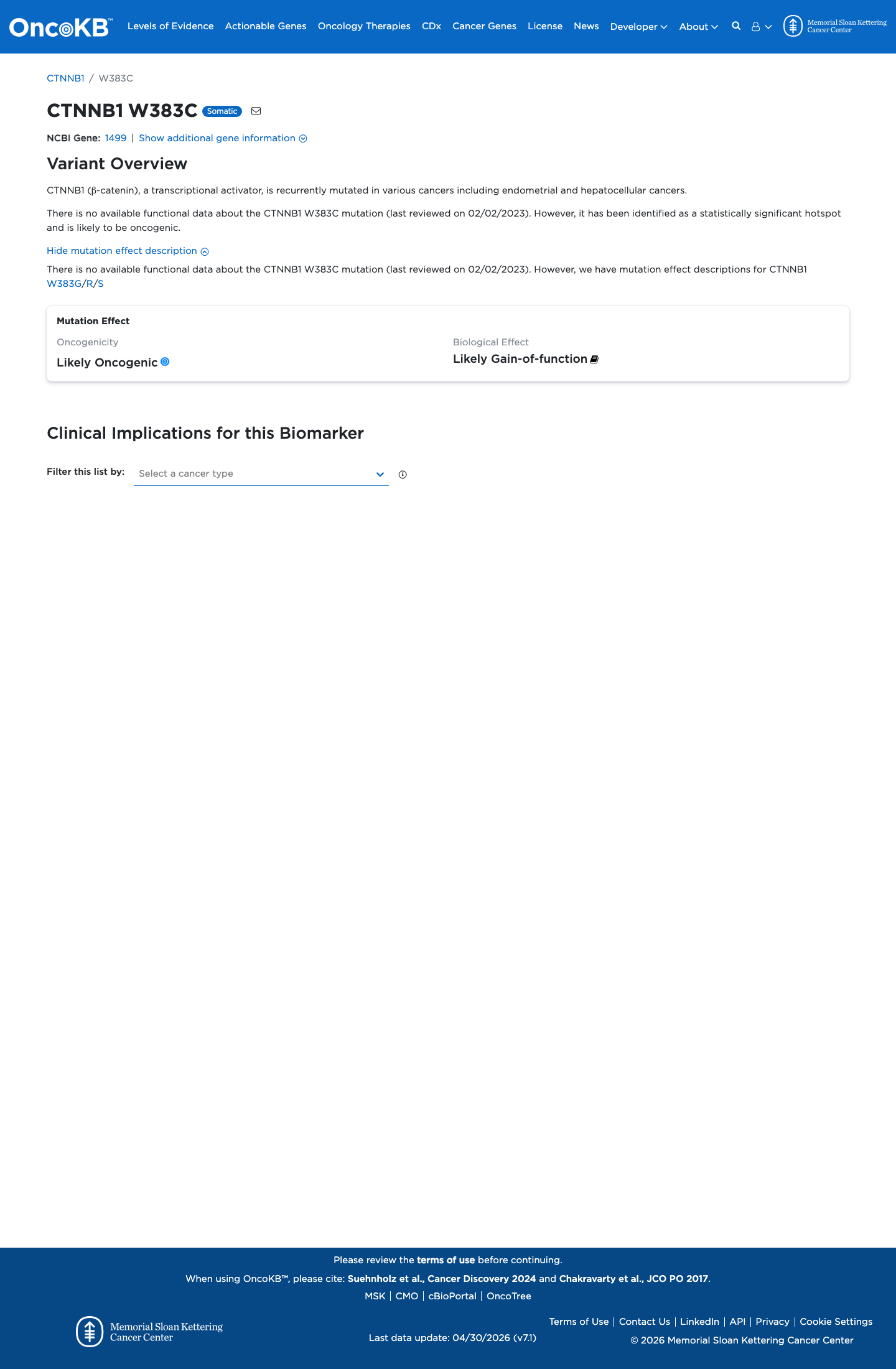
Functional
Likely Oncogenic
OncoKB identified variant-specific curated literature and context relevant to functional review; biological-effect context: Likely Gain-of-function; curated oncogenicity label: Likely Oncogenic.
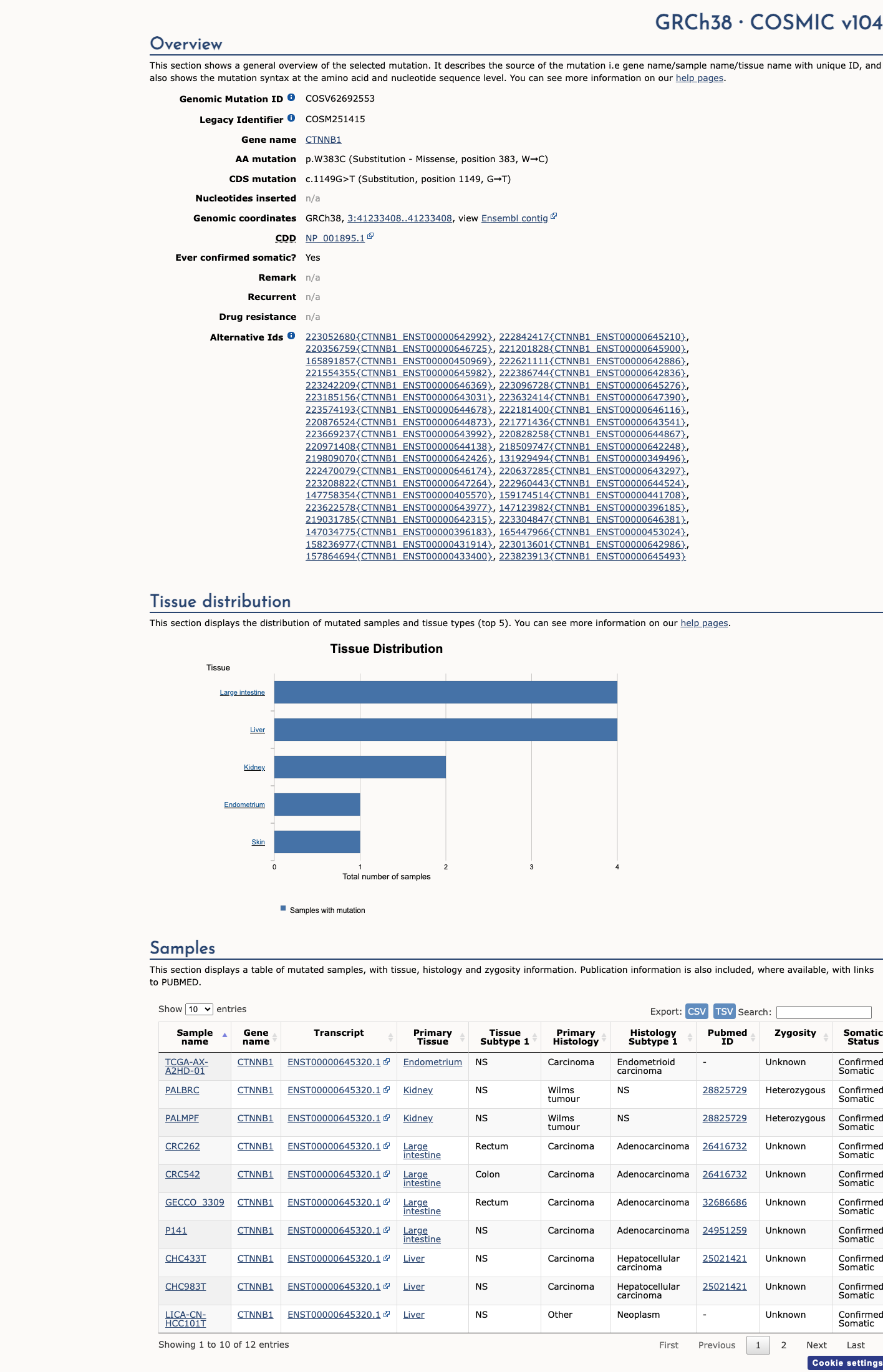
COSMIC

Cancer hotspots
Somatic evidence
Not in COSMIC / hotspots
COSMIC
This variant lies in a statistically significant hotspot. This variant has previously been reported in somatic cancers (COSMIC; COSV62692553, n = 12 times).
Hotspots
This variant lies in a statistically significant hotspot.
Sources & reference links
Triaged references · 6 PMIDs not cited in assessment
15579438 ↗
CTNNB1 mutations and overexpression of Wnt/beta-catenin target genes in WT1-mutant Wilms' tumors.
CLINVAR
31857074 ↗
Oncogenic Mutations in Armadillo Repeats 5 and 6 of β-Catenin Reduce Binding to APC, Increasing Signaling and Transcription of Target Genes.
CLINVAR
35101336 ↗
Standards for the classification of pathogenicity of somatic variants in cancer (oncogenicity): Joint recommendations of Clinical Genome Resource (ClinGen), Cancer Genomics Consortium (CGC), and Variant Interpretation for Cancer Consortium (VICC).
CLINVAR
22918138 ↗
Opportunities and challenges associated with clinical diagnostic genome sequencing: a report of the Association for Molecular Pathology.
CLINVAR
34131312 ↗
Chromosomal microarray analysis, including constitutional and neoplastic disease applications, 2021 revision: a technical standard of the American College of Medical Genetics and Genomics (ACMG).
CLINVAR
23619274 ↗
American College of Medical Genetics and Genomics technical standards and guidelines: microarray analysis for chromosome abnormalities in neoplastic disorders.
CLINVAR