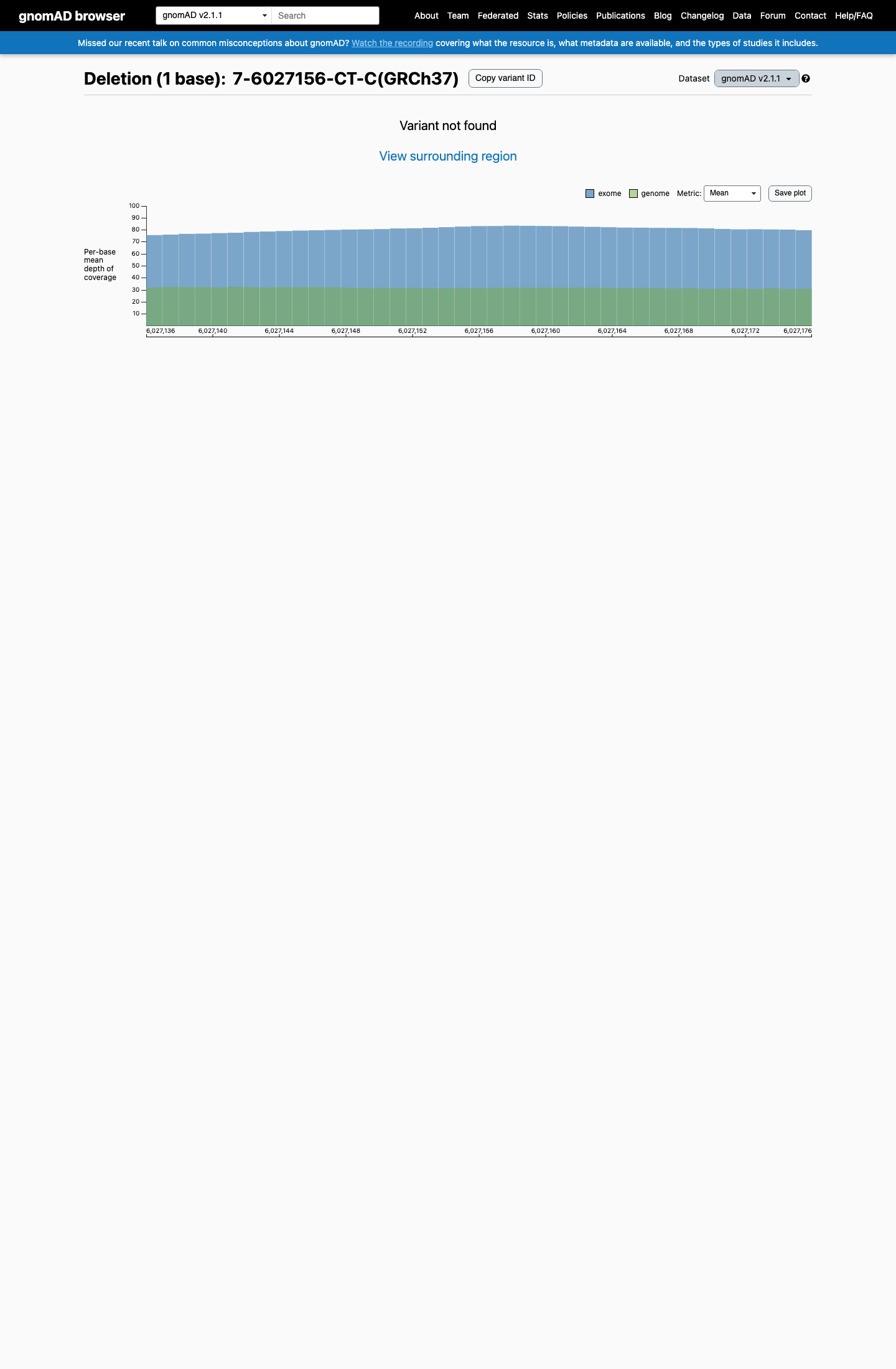
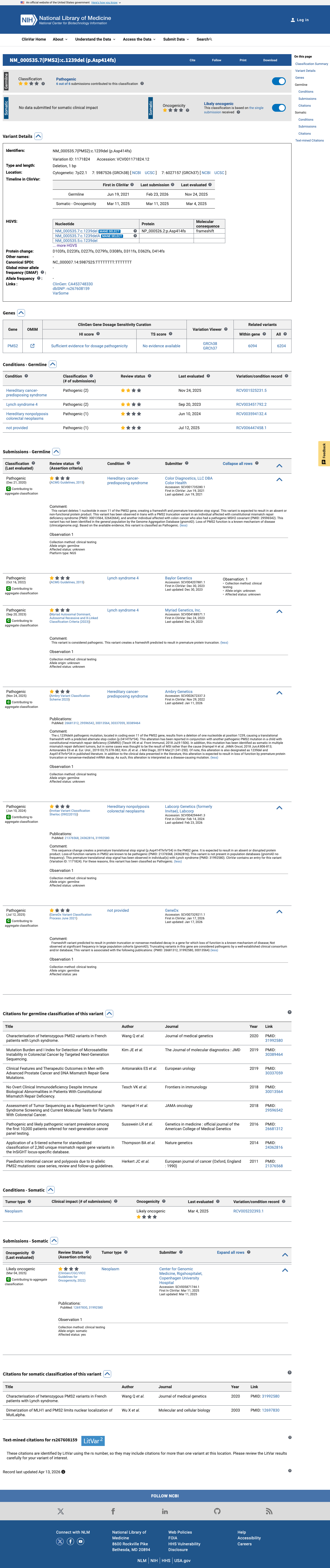
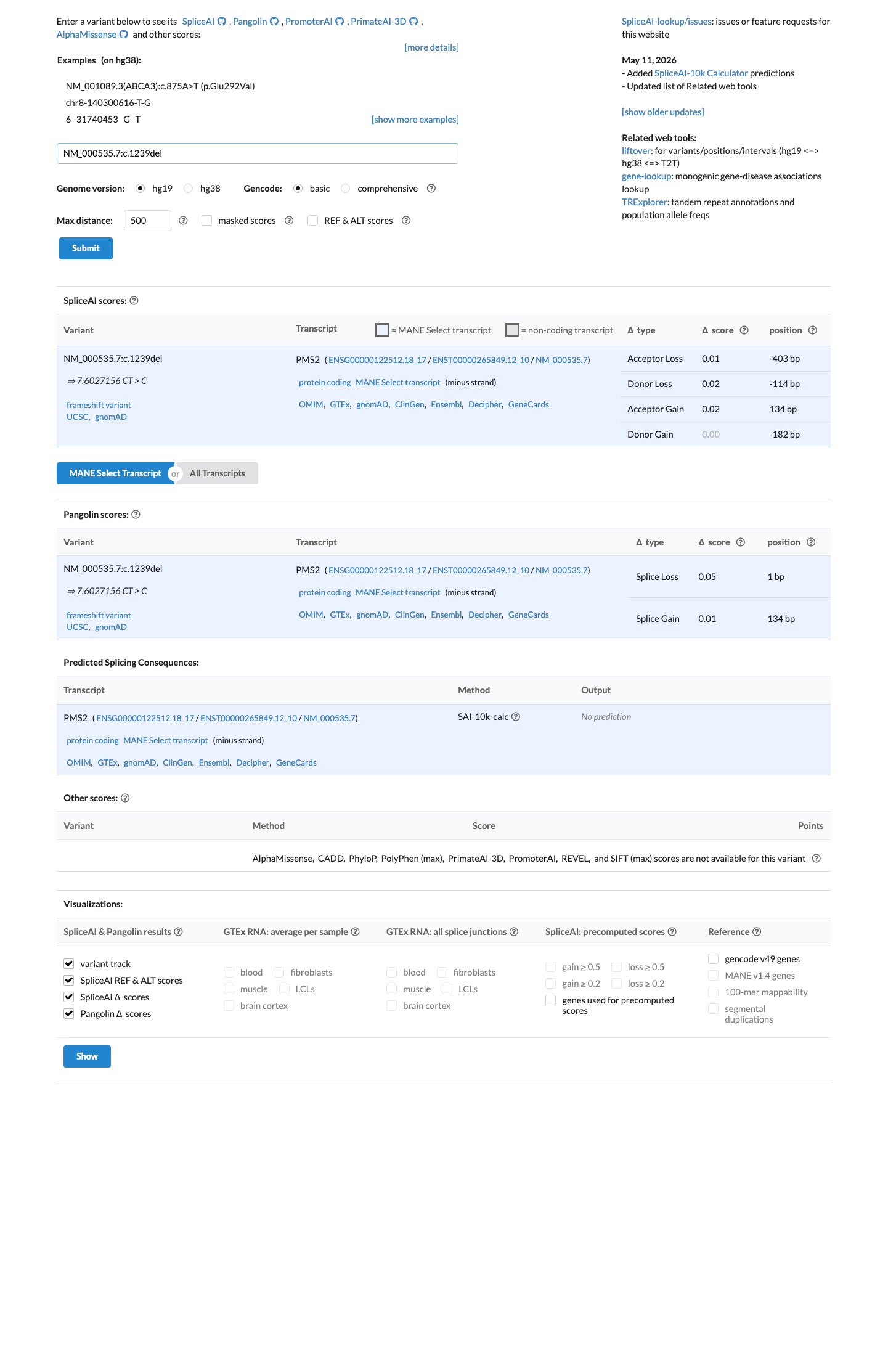
The PMS2 NM_000535.7:c.1239del (p.(Asp414ThrfsTer34), p.(D414Tfs*34)) variant has been reported in ClinVar as Pathogenic by 6 clinical laboratories.1 This variant is absent from gnomAD v2.1 and gnomAD-Canada v1.0 and is present only once in gnomAD v4.1 (AF 6.19581e-07; 1/1613994 alleles), which is below the PMS2 PM2_Supporting threshold of 0.00002.2 This frameshift is predicted to introduce a premature termination codon after 34 altered amino acids, and the PMS2 VCEP specification applies PVS1 at very strong strength to frameshift variants with a premature stop at or before codon 798.3 SpliceAI predicts no significant splice impact for this variant (maximum delta score 0.02); however, the primary predicted effect remains a truncating frameshift rather than an isolated splice or missense change.4
Final classification
VUS
PVS1PM2
PMS2
c.1239del
p.Asp414ThrfsTer34
This variant
The PMS2 NM_000535.7:c.1239del (p.(Asp414ThrfsTer34), p.(D414Tfs*34)) variant has been reported in ClinVar as Pathogenic by 6 clinical laboratories.
ClinGen InSiGHT Hereditary Colorectal Cancer/Polyposis Expert Panel Specifications to the ACMG/AMP Variant Interpretation Guidelines for PMS2 Version 2.0.0 v2.0.0 criteria-combination framework was evaluated deterministically with applied criteria: PVS1 very strong, PM2 supporting; no rule matched the adjudicated criteria.
Classification rationale
PVS1PM2
VUS
PMS2 c.1239del
PVS1 + PM2
→
VUS
3
cspec ↗pvs1_gene_contextpvs1_variant_assessment
LYFE Sciences is an AI system, and it can make mistakes. Criteria
may be applied incorrectly, sources may be misread, and a confident-looking
classification can still be wrong. Double-check every criterion and
its underlying evidence before relying on any call.
Gene diagram
· NM_000535.7 · variants mapped to exon structure
PMS2
NM_000535.7
Fetching transcript structure from UCSC…
Applied criteria · 2 applied · 11 assessed
MetEvidence satisfies this criterion.
Not metEvaluated against available evidence; threshold not reached.
Not assessedApplies in principle, but no evidence was found to evaluate it.
N/ADoesn't apply to this variant type.
Applied · 2
Strength
Supporting
Moderate
Strong
Very strong
PVS1
very strong
Pathogenic
This frameshift variant is predicted to cause p.(Asp414ThrfsTer34) and introduce a premature termination codon well before codon 798 in PMS2. Under the PMS2 VCEP specification, nonsense or frameshift variants introducing a premature stop at or before codon 798 meet PVS1 at very strong strength.
Predicted frameshift consequence p.(Asp414ThrfsTer34)/p.(D414Tfs*34)PMS2 VCEP PVS1 rule for frameshift variants with premature stop codon at or before codon 798
PM2
supporting
Pathogenic
This variant is absent from gnomAD v2.1 and gnomAD-Canada v1.0 and is present only once in gnomAD v4.1 (1/1613994 alleles; AF 6.19581e-07, 0.00006%), which is below the PMS2 VCEP PM2_Supporting threshold of 0.00002.
gnomAD v2.1 absentgnomAD v4.1 AF 6.19581e-07gnomAD-Canada absent
Assessed · not applied
· 2 not met · 9 not assessed
Pathogenic
PS2
No confirmed de novo occurrence data were identified for this variant, so PS2 cannot be applied.
PS3
Available evidence supports a truncating loss-of-function interpretation, but no variant-specific calibrated functional assay result or qualifying RNA study was identified to support PS3 under the PMS2 VCEP rules.
PM3
No confirmed in trans observation with another pathogenic or likely pathogenic PMS2 variant was identified for this variant, so PM3 cannot be applied.
PP1
No segregation data were identified for this variant, so PP1 cannot be applied.
PP4
No qualifying tumor MSI or mismatch repair immunohistochemistry data linked to this variant were identified, so PP4 cannot be applied.
Benign
BA1
Population frequency does not meet BA1.
BS1
Population frequency does not meet BS1.
BS2
No evidence was identified showing this variant in trans with a known pathogenic PMS2 variant in an older individual without features of constitutional mismatch repair deficiency, so BS2 cannot be applied.
BS3
No variant-specific functional evidence demonstrating retained PMS2 function or normal RNA behavior was identified, so BS3 cannot be applied.
BS4
No lack-of-segregation data were identified for this variant, so BS4 cannot be applied.
BP5
No qualifying tumor findings inconsistent with PMS2-related disease were identified, so BP5 cannot be applied.
N/A · 15
PS1 · PS4 · PM1 · PM4 · PM5 · PM6 · PP2 · PP3 · PP5 · BP1 · BP2 · BP3 · BP4 · BP6 · BP7
Research & evidence
Population frequency

gnomAD v4.1
gnomAD v2.1
v4.1
This variant is present in gnomAD v4.1 (AF= 6.19581e-07; MAF= 0.00006%, 1/1613994 alleles, homozygotes = 0) and has highest observed frequency in the European (non-Finnish) population (AF= 8.47482e-07; MAF= 0.00008%, 1/1179966 alleles, homozygotes = 0).
v2.1
Absent from gnomAD v2.1.
🇨🇦 CA
Absent from gnomAD-Canada v1.0.
Allele frequency by ancestry
three datasets · side by side
gnomAD v4.1
6.2e-05%
· 1 / 1,613,994
0 hom
0 hom
European (non-Finnish) 1 / 1,179,966 |
8.5e-05% |
+ 9 not observed (Remaining individuals, Admixed American, European (Finnish), Amish, East Asian, Middle Eastern, South Asian, Ashkenazi Jewish, African/African American)
gnomAD v2.1
Absent
· 0 / ?
0 hom
0 hom
Not observed in any ancestry group.
gnomAD Canada 🇨🇦
Absent
· 0 / ?
0 hom
0 hom
Not observed in any ancestry group.
ClinVar
This variant has been reported in ClinVar as Pathogenic (6 clinical laboratories). (ClinVarID = 1171824)
In silico
SpliceAI predicts no significant splice impact for this variant (max delta score = 0.02).
Functional
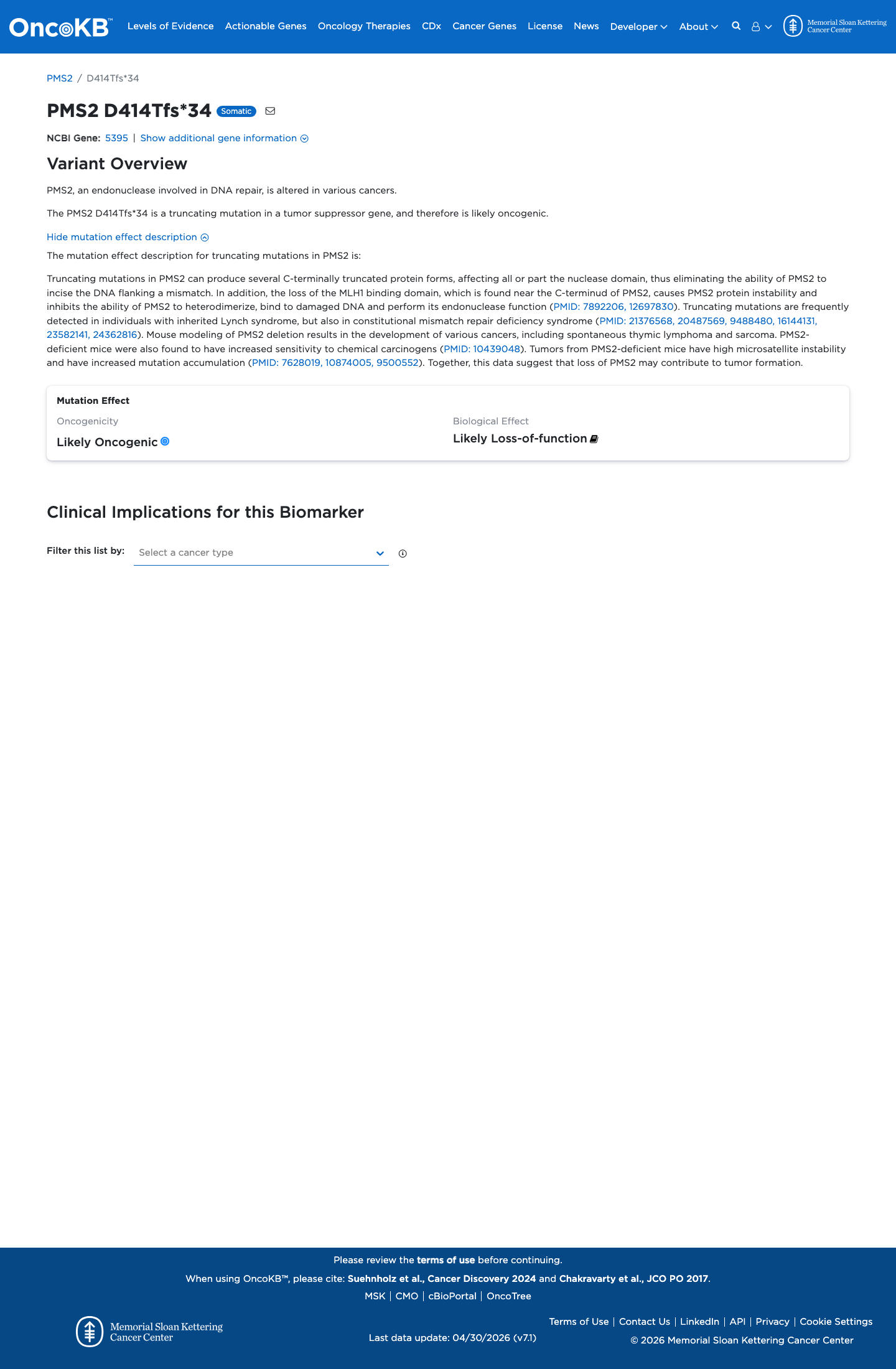
Likely Oncogenic
OncoKB identified variant-specific curated literature and context relevant to functional review; biological-effect context: Likely Loss-of-function; curated oncogenicity label: Likely Oncogenic.
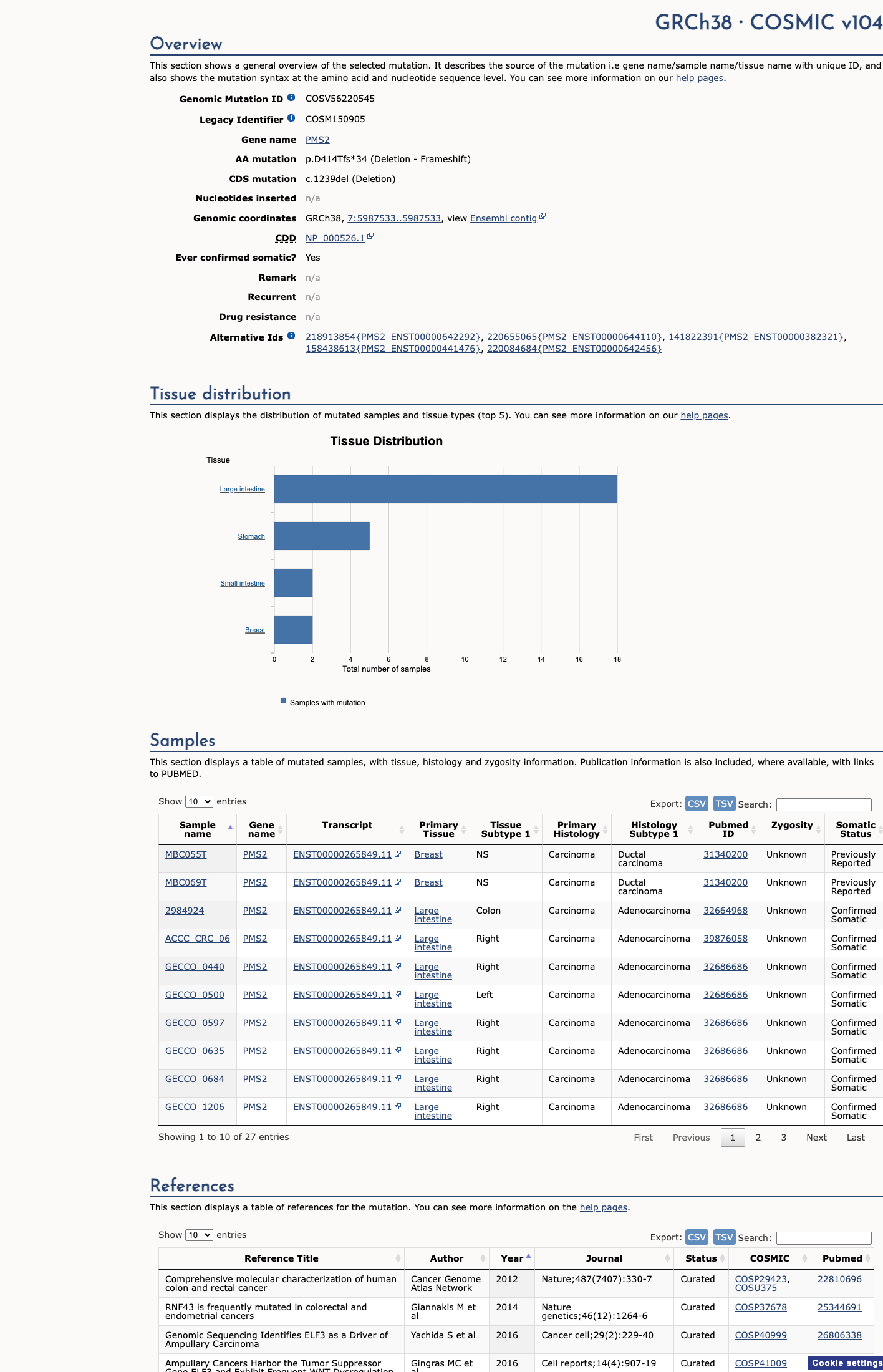
COSMIC

Cancer hotspots
Somatic evidence
Not in COSMIC / hotspots
COSMIC
This variant does not lie in a statistically significant hotspot. This variant has previously been reported in somatic cancers (COSMIC; COSV56220545, n = 27 times).
Hotspots
This variant does not lie in a statistically significant hotspot.
Sources & reference links
9Sources
Triaged references · 9 PMIDs not cited in assessment
21376568 ↗
Paediatric intestinal cancer and polyposis due to bi-allelic PMS2 mutations: case series, review and follow-up guidelines.
ONCOKB
24362816 ↗
Application of a 5-tiered scheme for standardized classification of 2,360 unique mismatch repair gene variants in the InSiGHT locus-specific database.
ONCOKB
10439048 ↗
Mice defective in the DNA mismatch gene PMS2 are hypersensitive to MNU induced thymic lymphoma and are partially protected by transgenic expression of human MGMT.
ONCOKB
10874005 ↗
Mutagenesis in PMS2- and MSH2-deficient mice indicates differential protection from transversions and frameshifts.
ONCOKB
20487569 ↗
MSH6 and PMS2 mutation positive Australian Lynch syndrome families: novel mutations, cancer risk and age of diagnosis of colorectal cancer.
ONCOKB
23619274 ↗
American College of Medical Genetics and Genomics technical standards and guidelines: microarray analysis for chromosome abnormalities in neoplastic disorders.
CLINVAR
28492532 ↗
Sherloc: a comprehensive refinement of the ACMG-AMP variant classification criteria.
CLINVAR