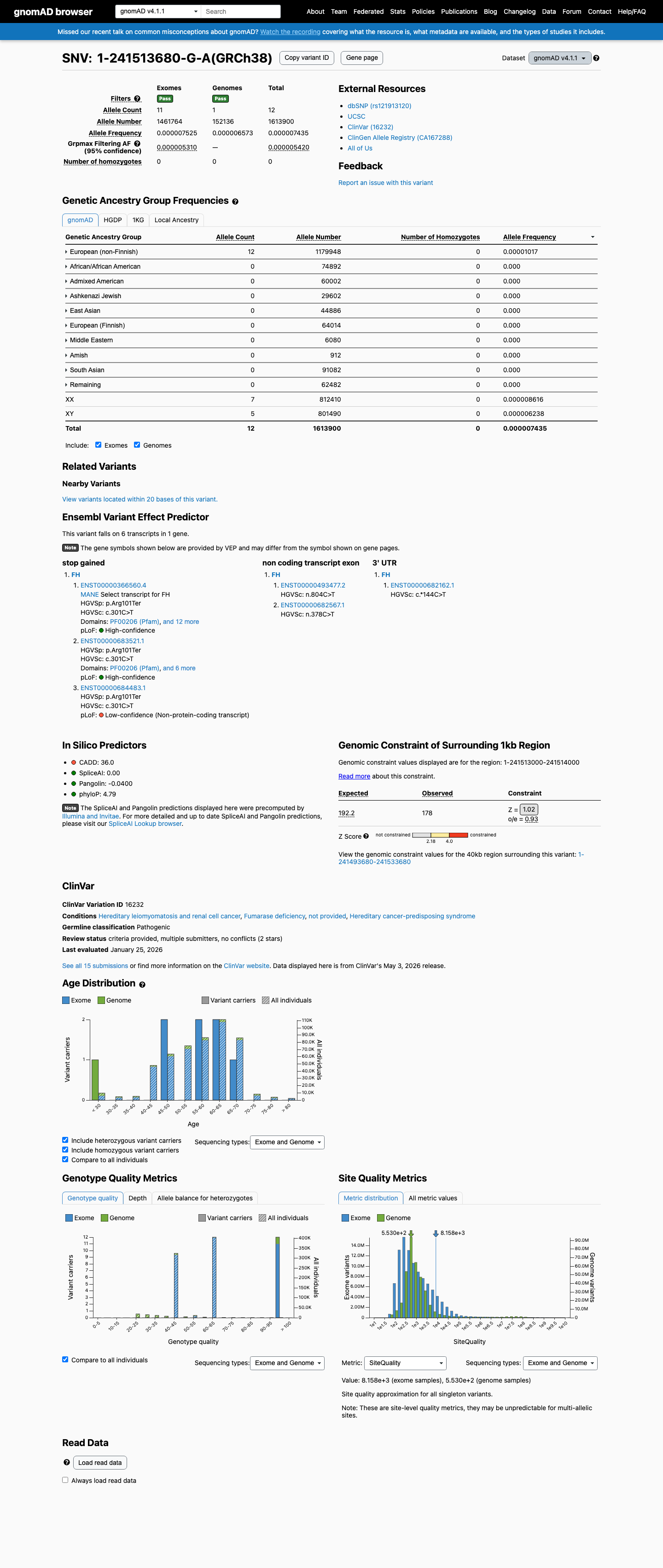
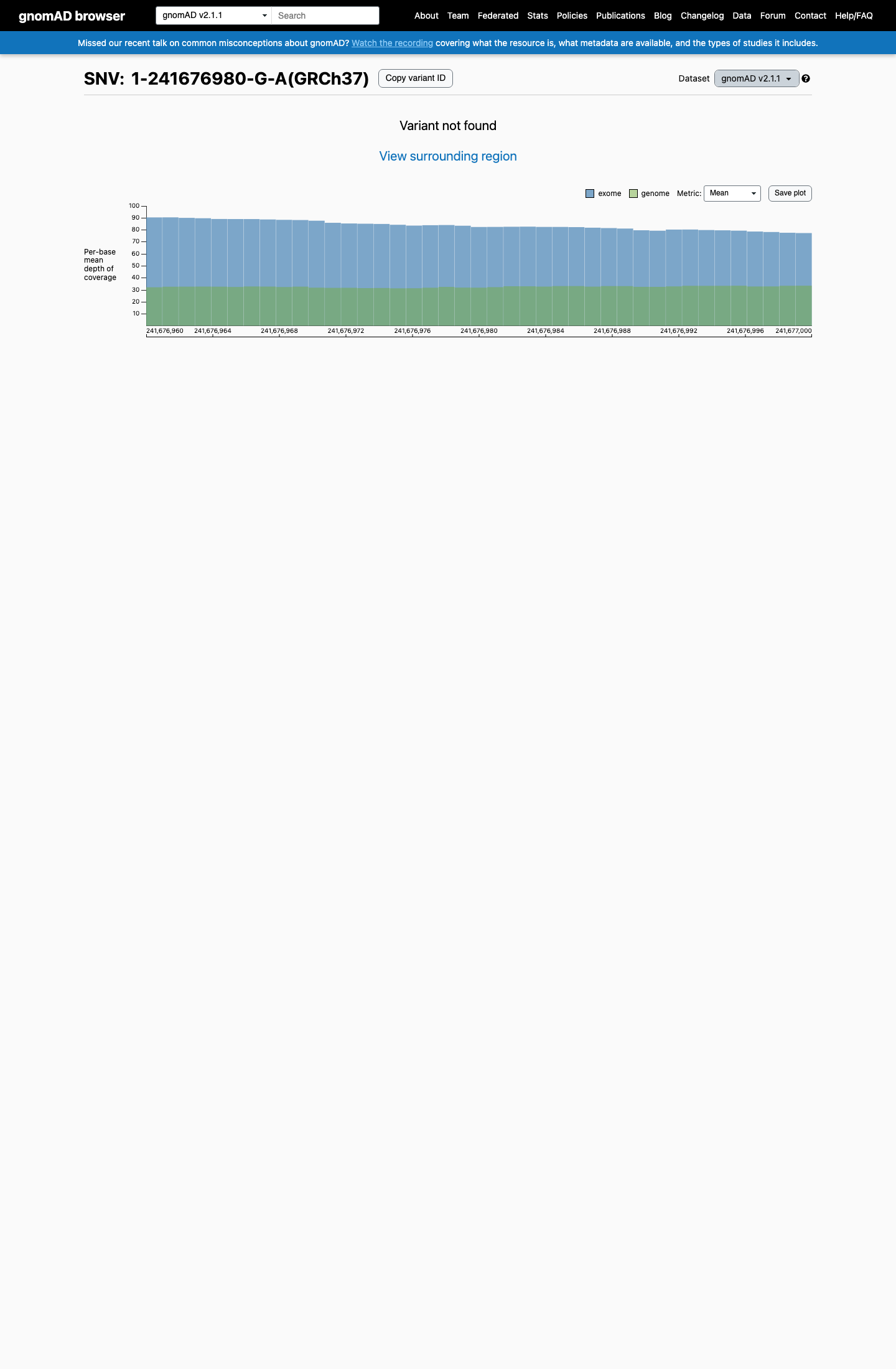
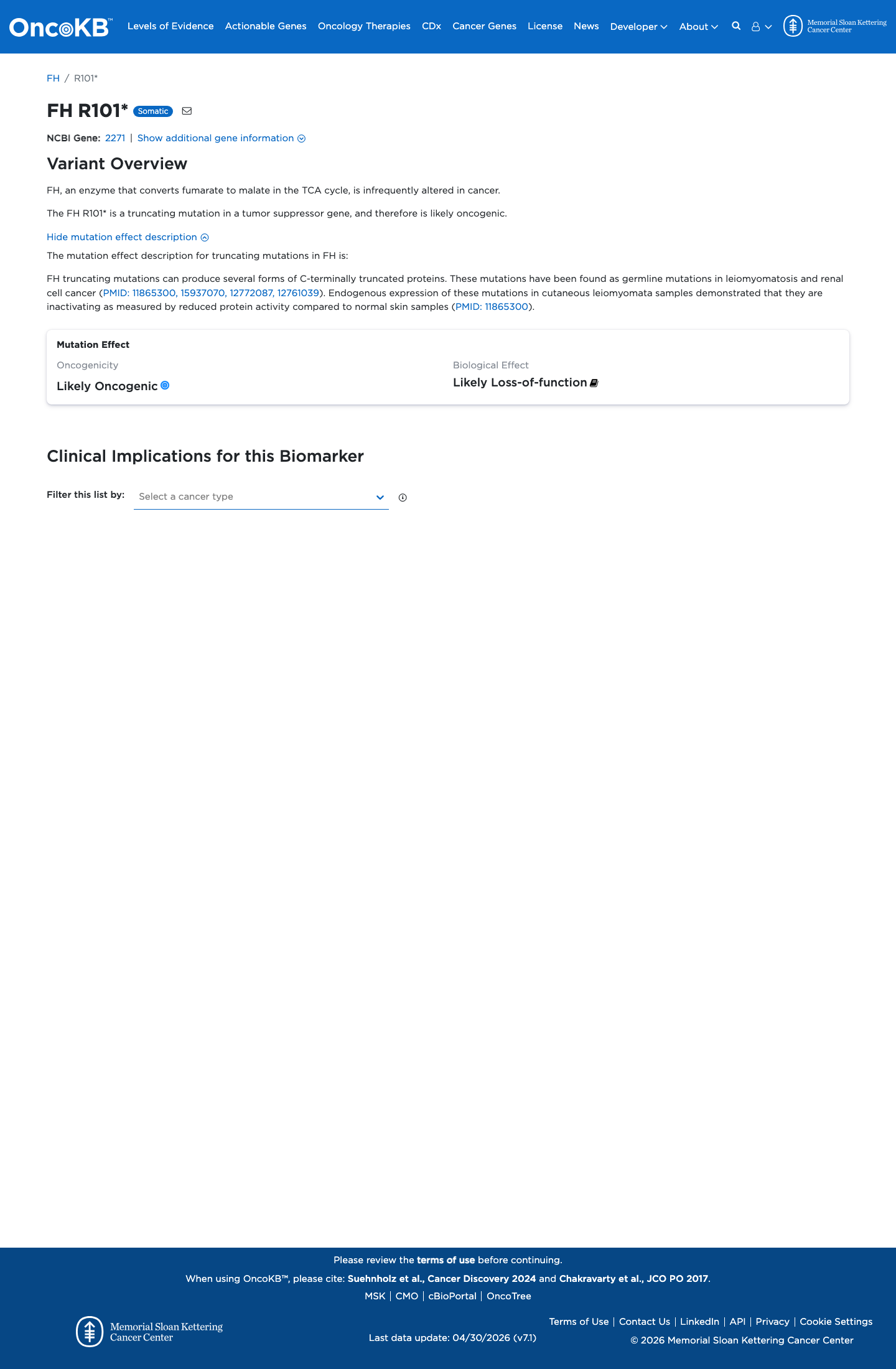
NM_000143.4:c.301C>T (p.Arg101Ter) is a nonsense variant in exon 3 of 10 in the FH gene, which encodes fumarate hydratase. Loss-of-function variants in FH are an established cause of autosomal dominant hereditary leiomyomatosis and renal cell cancer (HLRCC).1 This variant introduces a premature termination codon at position 101 of 511 amino acids, predicted to trigger nonsense-mediated decay and result in complete loss of protein function. Under ClinGen SVI PVS1 guidelines, this meets criteria for PVS1 at very strong strength.2 The variant is absent from gnomAD v2.1 and gnomAD-Canada, and is present at extremely low frequency in gnomAD v4.1 (12/1,613,900 alleles, AF = 0.00074%, no homozygotes), meeting PM2 at moderate strength.3 Protein-truncating FH mutations have been demonstrated to be functionally null alleles in published studies, and OncoKB annotates R101* as Likely Loss-of-function, supporting a damaging functional effect at PS3 supporting strength.4 This variant has been classified as Pathogenic by 14 clinical laboratories in ClinVar (Variation ID 16232) and is annotated as Likely Oncogenic by OncoKB, meeting PP5 at supporting strength.5 No benign criteria are met. The variant is absent or at extremely low frequency in population databases (BA1/BS1 not met), functional evidence supports a damaging effect (BS3 not met), and no reputable source reports this variant as benign (BP6 not met).6 Applying the ACMG/AMP 2015 combination rules: 1 Very Strong (PVS1) + 1 Moderate (PM2) + 2 Supporting (PS3, PP5) satisfies the threshold for Pathogenic classification.7
Final classification
Pathogenic
PVS1PS3PM2PP5
FH
c.301C>T
p.Arg101Ter
This variant
NM_000143.4:c.301C>T (p.Arg101Ter) is a nonsense variant in exon 3 of 10 in the FH gene, which encodes fumarate hydratase. Loss-of-function variants in FH are an established cause of autosomal dominant hereditary leiomyomatosis and renal cell cancer (HLRCC).
gene-specific framework lacked a usable explicit final combination framework, so generic ACMG/AMP 2015 final-combination rules were applied as fallback; applied criteria: PVS1 very strong, PS3 supporting, PM2 moderate, PP5 supporting; combination = 1 very strong + 1 moderate + 2 supporting, which maps to Pathogenic.
Classification rationale
PVS1PS3PM2PP5
Pathogenic
FH c.301C>T
PVS1 + PS3 + PM2 + PP5
→
Pathogenic
1
pvs1_gene_context
2
pvs1_generic_framework ↗pvs1_variant_assessment
7
generic_acmg_combination_rules
LYFE Sciences is an AI system, and it can make mistakes. Criteria
may be applied incorrectly, sources may be misread, and a confident-looking
classification can still be wrong. Double-check every criterion and
its underlying evidence before relying on any call.
Gene diagram
· NM_000143.4 · variants mapped to exon structure
FH
NM_000143.4
Fetching transcript structure from UCSC…
Applied criteria · 4 applied · 16 assessed
MetEvidence satisfies this criterion.
Not metEvaluated against available evidence; threshold not reached.
Not assessedApplies in principle, but no evidence was found to evaluate it.
N/ADoesn't apply to this variant type.
Applied · 4
Strength
Supporting
Moderate
Strong
Very strong
PVS1
very strong
Pathogenic
Null variant (nonsense) in gene FH where loss of function is a known mechanism of disease for hereditary leiomyomatosis and renal cell cancer (HLRCC). The variant introduces a premature termination codon at position 101 of 511 amino acids in exon 3 of 10, predicted to trigger nonsense-mediated decay. FH is an established tumor suppressor with autosomal dominant HLRCC predisposition; truncating germline FH variants are a well-characterized cause of this syndrome. Per ClinGen SVI PVS1 recommendations (PMC6185798), a nonsense variant in a gene with established LoF disease mechanism is assigned PVS1 at full strength.
Nonsense mutation c.301C>T creates premature stop codon p.Arg101Ter (R101*) in exon 3/10FH loss-of-function is an established disease mechanism for HLRCC (autosomal dominant)Germline pathogenic FH variants identified in 35.7% of FH-deficient uterine leiomyomas
PS3
supporting
Pathogenic
Protein-truncating FH mutations have been demonstrated to be functionally null alleles. PMID:12761039 states that 'Protein-truncating FH mutations are functionally null alleles,' and multiple studies (PMID:16597677, PMID:21398687) have demonstrated significantly reduced FH enzymatic activity in cells from HLRCC patients harboring various FH mutations. OncoKB annotates this variant as 'Likely Loss-of-function.' While no full-text publication specifically assaying the R101* variant was identified, the functional null effect of nonsense variants in FH is well-established across the literature. The strength is downgraded to supporting because the evidence is derived from class-level functional characterization rather than a variant-specific assay.
PMID:12761039 abstract: 'Protein-truncating FH mutations are functionally null alleles'PMID:16597677: FH enzyme activity significantly reduced in HLRCC lymphoblastoid and fibroblast cell linesPMID:21398687: 32 FH mutations demonstrated as deleterious by FH enzymatic activity reduction
PM2
moderate
Pathogenic
The variant is absent from gnomAD v2.1 and gnomAD-Canada v1.0, and is present at extremely low frequency in gnomAD v4.1 (12/1,613,900 alleles, global AF = 0.00074%), all observed in the European (non-Finnish) population (12/1,179,948, subpopulation AF = 0.00102%). This frequency is well below the 0.1% threshold for PM2 in non-VCEP assessment. No homozygotes are observed.
gnomAD v2.1: absent (0 alleles)gnomAD v4.1: 12/1613
PP5
supporting
Pathogenic
Multiple reputable clinical laboratories and curated databases report NM_000143.4:c.301C>T as pathogenic. ClinVar records 14 clinical laboratories classifying this variant as Pathogenic (Variation ID 16232, review status: criteria provided, single submitter). Three major clinical testing laboratories (Ambry Genetics, Invitae/Labcorp, Fulgent Genetics) and OMIM have submitted Pathogenic classifications. OncoKB annotates this variant as Likely Oncogenic with a Likely Loss-of-function biological effect. While the evidence underlying these classifications could not be independently verified, the consensus from multiple reputable sources supports application of PP5.
ClinVar Variation ID 16232: Pathogenic14 clinical laboratoriescriteria provided (single submitter)
Assessed · not applied
· 8 not met · 8 not assessed
Pathogenic
PS2
No de novo observation with confirmed paternity and maternity was identified in the available evidence.
PS4
No formal case-control study or statistically significant enrichment data specific to NM_000143.4:c.301C>T was identified in the available evidence.
PM1
The variant is not located in a recognized mutational hotspot for FH.
PM6
No de novo observation (without confirmed paternity and maternity) was identified for this variant in the available evidence.
PP1
No co-segregation data for NM_000143.4:c.301C>T with disease in multiple affected family members was identified in the available evidence.
PP3
Insufficient computational evidence to support a deleterious effect.
PP4
No patient-specific phenotype or family history data were available for review.
Benign
BA1
The variant is absent from gnomAD v2.1 and present at extremely low frequency in gnomAD v4.1 (AF = 0.00074%).
BS1
The variant is present in gnomAD v4.1 at a global AF of 0.00074% (grpmax FAF = 5.42e-06).
BS2
The variant is observed in gnomAD v4.1 at very low frequency (12/1,613,900 alleles, all in the NFE population, 0 homozygotes).
BS3
BS3 requires well-established functional studies showing no damaging effect on protein function or splicing.
BS4
No segregation data were available to assess lack of co-segregation with disease in affected family members.
BP2
No data were available regarding observation of this variant in trans with a known pathogenic FH variant.
BP4
BP4 requires multiple lines of computational evidence suggesting no impact on gene or gene product.
BP5
No data were available regarding observation of this variant in a case with an alternate molecular basis for disease.
BP6
BP6 requires a reputable source to report the variant as benign.
N/A · 8
PS1 · PM3 · PM4 · PM5 · PP2 · BP1 · BP3 · BP7
Research & evidence
Population frequency · supports pathogenic
gnomAD v4.1
gnomAD v2.1
v4.1
This variant is present in gnomAD v4.1 (AF= 7.4354e-06; MAF= 0.00074%, 12/1613900 alleles, homozygotes = 0) and has highest observed frequency in the European (non-Finnish) population (AF= 1.01699e-05; MAF= 0.00102%, 12/1179948 alleles, homozygotes = 0); grpmax FAF= 5.42e-06.
v2.1
Absent from gnomAD v2.1.
🇨🇦 CA
Absent from gnomAD-Canada v1.0.
Allele frequency by ancestry
three datasets · side by side
gnomAD v4.1
0.00074%
· 12 / 1,613,900
0 hom · FAF 0.00054%
0 hom · FAF 0.00054%
European (non-Finnish) 12 / 1,179,948 |
0.001% |
+ 9 not observed (Remaining individuals, Admixed American, European (Finnish), Amish, East Asian, Middle Eastern, South Asian, Ashkenazi Jewish, African/African American)
gnomAD v2.1
Absent
· 0 / ?
0 hom
0 hom
Not observed in any ancestry group.
gnomAD Canada 🇨🇦
Absent
· 0 / ?
0 hom
0 hom
Not observed in any ancestry group.

ClinVar
This variant has been reported in ClinVar as Pathogenic (14 clinical laboratories). (ClinVarID = 16232)
In silico
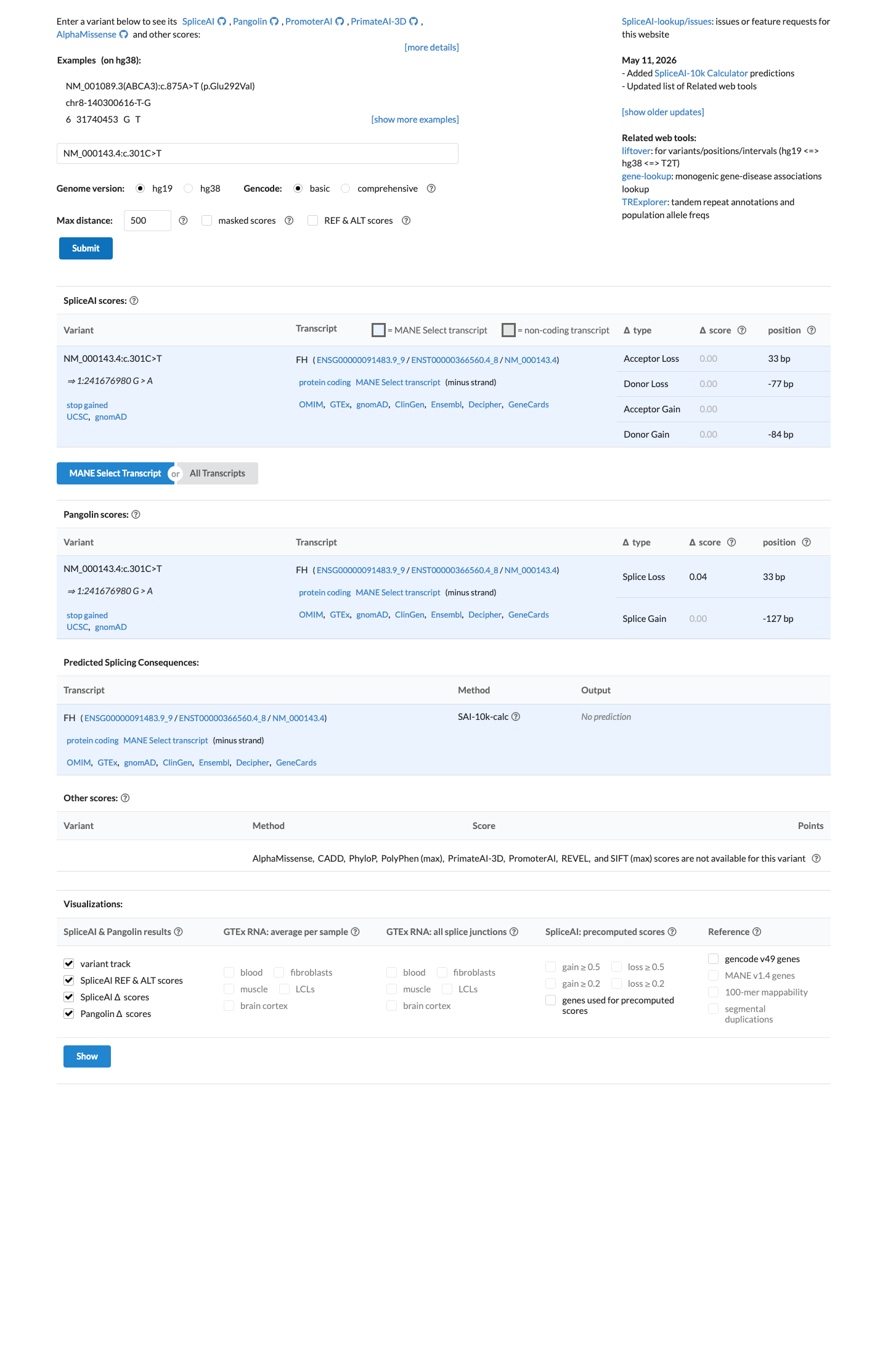
SpliceAI predicts no significant splice impact for this variant (max delta score = 0.00). BayesDel score = 0.486496.
Functional
Likely Oncogenic
OncoKB identified variant-specific curated literature and context relevant to functional review; biological-effect context: Likely Loss-of-function; curated oncogenicity label: Likely Oncogenic.

COSMIC

Cancer hotspots
Somatic evidence
Not in COSMIC / hotspots
COSMIC
This variant does not lie in a statistically significant hotspot. This variant has not previously been reported in somatic cancers (COSMIC).
Hotspots
This variant does not lie in a statistically significant hotspot.
Literature · how each cited paper was used
4papers cited
Each card is an audit: what was searched, what was found, whether it names the variant, which criteria it fed, and why. 4 further PMIDs triaged but not cited — see Sources & references.
Genetic and functional analyses of FH mutations in multiple cutaneous and uterine leiomyomatosis, hereditary leiomyomatosis and renal cancer, and fumarate hydratase deficiency.
Found
abstract: 'Protein-truncating FH mutations are functionally null alleles' PMID:16597677: FH enzyme activity significantly reduced in HLRCC lymphoblastoid and fibroblast cell lines PMID:21398687: 32 FH mutations demonstrated as deleterious by FH enzymatic activity reduction OncoKB: Likely Loss-of-function Likely Oncogenic for R101*
Applied to
→PS3
supporting
Fumarate hydratase enzyme activity in lymphoblastoid cells and fibroblasts of individuals in families with hereditary leiomyomatosis and renal cell cancer.
Found
abstract: 'Protein-truncating FH mutations are functionally null alleles' PMID:16597677: FH enzyme activity significantly reduced in HLRCC lymphoblastoid and fibroblast cell lines PMID:21398687: 32 FH mutations demonstrated as deleterious by FH enzymatic activity reduction OncoKB: Likely Loss-of-function Likely Oncogenic for R101*
Applied to
→PS3
supporting
Novel FH mutations in families with hereditary leiomyomatosis and renal cell cancer (HLRCC) and patients with isolated type 2 papillary renal cell carcinoma.
Found
abstract: 'Protein-truncating FH mutations are functionally null alleles' PMID:16597677: FH enzyme activity significantly reduced in HLRCC lymphoblastoid and fibroblast cell lines PMID:21398687: 32 FH mutations demonstrated as deleterious by FH enzymatic activity reduction OncoKB: Likely Loss-of-function Likely Oncogenic for R101*
Applied to
→PS3
supporting
PMID 41496563
Found
Nonsense mutation c.301C>T creates premature stop codon p.Arg101Ter (R101*) in exon 3/10 FH loss-of-function is an established disease mechanism for HLRCC (autosomal dominant) Germline pathogenic FH variants identified in 35.7% of FH-deficient uterine leiomyomas truncating mutations significantly more prevalent in hereditary cases (PMID:41496563) NM_000143.4 is the MANE Select transcript NMD is predicted (PTC at codon 101 well upstream of the last exon-exon junction)
Applied to
→PVS1
very strong
Sources & reference links
Triaged references · 4 PMIDs not cited in assessment
11865300 ↗
Germline mutations in FH predispose to dominantly inherited uterine fibroids, skin leiomyomata and papillary renal cell cancer.
ONCOKB
15937070 ↗
Novel mutations in FH and expansion of the spectrum of phenotypes expressed in families with hereditary leiomyomatosis and renal cell cancer.
ONCOKB
12772087 ↗
Mutations in the fumarate hydratase gene cause hereditary leiomyomatosis and renal cell cancer in families in North America.
ONCOKB
28492532 ↗
Sherloc: a comprehensive refinement of the ACMG-AMP variant classification criteria.
CLINVAR