NM_000546.5:c.509C>T (p.Thr170Met) is a missense variant in exon 5 of TP53. This variant is present at very low frequency in gnomAD v4.1 (AF=1.55e-05, 25/1,614,086 alleles, 0 homozygotes), meeting PM2_Supporting per the TP53 VCEP specifications (total AF < 0.003%; no non-founder subpopulation with multiple alleles exceeds 0.004%).1 Functional assay data from the TP53 VCEP Functional-worksheet.xlsx (Supplementary Table S3) demonstrates that p.Thr170Met is partially functional in the Kato et al. yeast transactivation assay and shows no loss of function across all available eligible assays (Funk, Giacomelli, Kotler), meeting BS3_Supporting per the VCEP functional rules.2 In silico predictions were evaluated per the TP53 VCEP PP3-BP4-codes.xlsx (Supplementary Table S2), which assigns 'No evidence' for c.509C>T — neither PP3 nor BP4 is met. The variant has aGVGD Class C15 and BayesDel score 0.321305.3 The variant has been reported in ClinVar with an expert panel classification of Likely Benign by the ClinGen TP53 Variant Curation Expert Panel (ClinVar ID: 184014). It has been observed in COSMIC as a somatic variant (n=14) but does not lie in a statistically significant cancer hotspot.4 PVS1, PS1, PS2, PS4, PS5, PM1, PM5, PM6, PP1, PP2, PP4, PP5, BA1, BS1, BS2, BS4, BP1, BP2, BP4, BP5, BP6, and BP7 are either not met, not assessed due to lack of evidence, or not applicable per the TP53 VCEP specifications.5 Tavtigian point total: PM2_Supporting (+1) + BS3_Supporting (−1) = 0 points, corresponding to a final classification of Uncertain Significance (VUS) per the TP53 VCEP v2.4.0 point-based system (VUS range: −1 to 5).6
Final classification
VUS
PM2BS3BP6
TP53
c.509C>T
p.Thr170Met
This variant
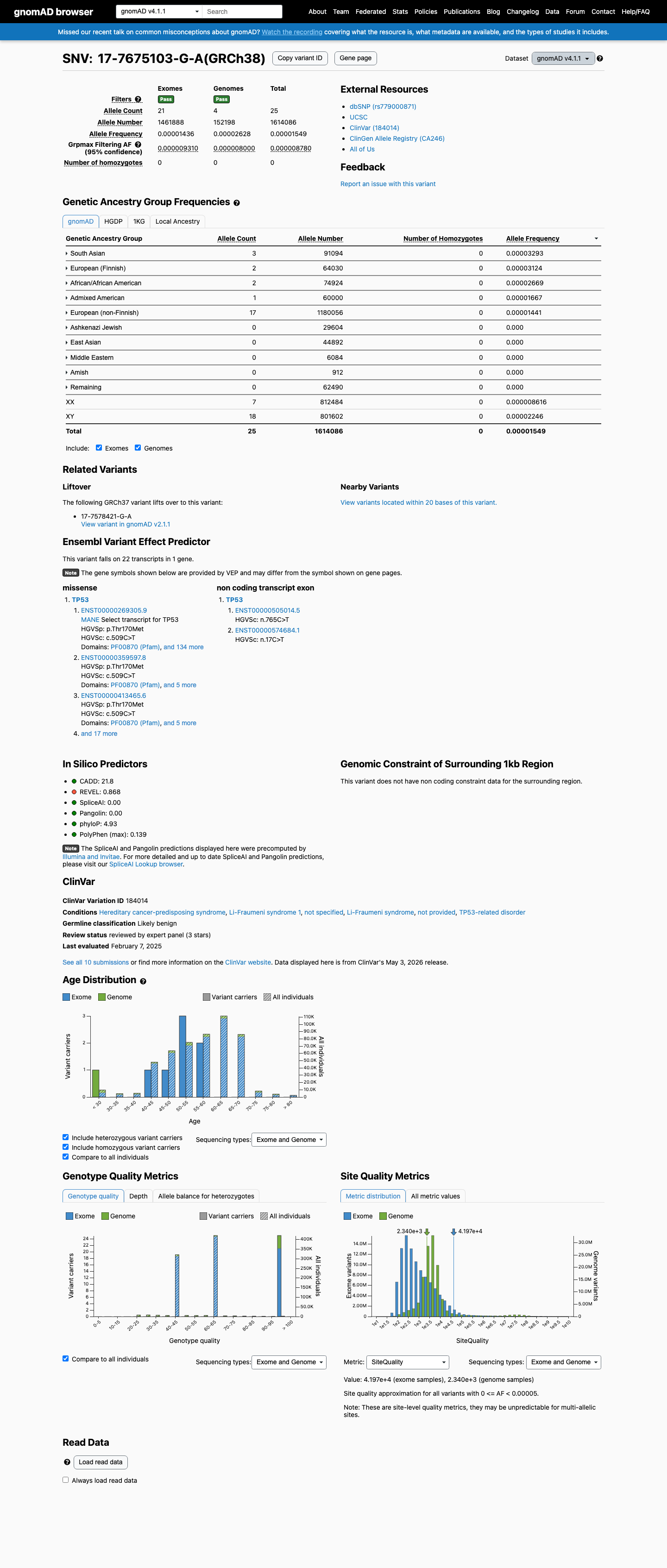
NM_000546.5:c.509C>T (p.Thr170Met) is a missense variant in exon 5 of TP53. This variant is present at very low frequency in gnomAD v4.1 (AF=1.55e-05, 25/1,614,086 alleles, 0 homozygotes), meeting PM2_Supporting per the TP53 VCEP specifications (total AF < 0.003%; no non-founder subpopulation with multiple alleles exceeds 0.004%).
Tavtigian et.al., 2020 - Bayesian adaptation of Richards et.al., 2015 v2.4.0 point-based framework: PM2 supporting (+1) + BS3 supporting (-1) = 0 points, which maps to VUS.
Classification rationale
PM2
BS3BP6
VUS
TP53 c.509C>T
PM2 + BS3 + BP6
→
VUS
LYFE Sciences is an AI system, and it can make mistakes. Criteria
may be applied incorrectly, sources may be misread, and a confident-looking
classification can still be wrong. Double-check every criterion and
its underlying evidence before relying on any call.
Gene diagram
· NM_000546.5 · variants mapped to exon structure
TP53
NM_000546.5
Fetching transcript structure from UCSC…
Applied criteria · 3 applied · 14 assessed
MetEvidence satisfies this criterion.
Not metEvaluated against available evidence; threshold not reached.
Not assessedApplies in principle, but no evidence was found to evaluate it.
N/ADoesn't apply to this variant type.
Applied · 3
Strength
Supporting
Moderate
Strong
Very strong
PM2
supporting
Pathogenic
This variant is present at very low frequency in gnomAD v4.1 (total AF = 1.55e-05, 25/1,614,086 alleles, 0 homozygotes). The highest non-founder subpopulation frequency is South Asian at 3.29e-05 (3 alleles). All non-excluded genetic ancestry groups with multiple alleles have AF < 0.00004, and total AF < 0.00003, meeting the TP53 VCEP PM2_Supporting threshold.
gnomAD v4.1: total AF=1.55e-05 (25/1614086)
BS3
supporting
Benign
The TP53 VCEP Functional-worksheet.xlsx (Supplementary Table S3) assigns BS3_Supporting to p.Thr170Met. The variant is Partially functional in the Kato et al. (PMID:12826609) assay and demonstrates no loss of function (noLOF) across all available eligible assays (Funk, Giacomelli, Kotler). This satisfies the VCEP BS3_Supporting rule: Partially functional on Kato data AND no evidence of LOF by all available assays.
VCEP Functional-worksheet.xlsx: T170M = BS3_SupportingKato: Partially functionalFunk: noLOF
Assessed · not applied
· 8 not met · 6 not assessed
Pathogenic
PS1
PS1 requires the same amino acid change (p.Thr170Met) to be previously established as Pathogenic or Likely Pathogenic per the TP53 VCEP specifications.
PS2
No de novo occurrence data for NM_000546.5:c.509C>T was identified in the available evidence sources.
PS3
The TP53 VCEP Functional-worksheet.xlsx assigns BS3_Supporting (not PS3) to p.Thr170Met.
PS4
No case-control enrichment data or proband counts meeting the TP53 VCEP PS4 point-based thresholds (LFS-associated cancer scores) were available for this variant.
PM1
Thr170 is not among the VCEP-specified PM1 hot-spot codons (175, 245, 248, 249, 273, 282).
PM5
PM5 requires a different missense variant at the same amino acid residue (Thr170) previously classified as Pathogenic or Likely Pathogenic per the TP53 VCEP specifications.
PP1
No co-segregation data (variant tracking through affected family members across meioses) was identified for NM_000546.5:c.509C>T in any available source.
PP3
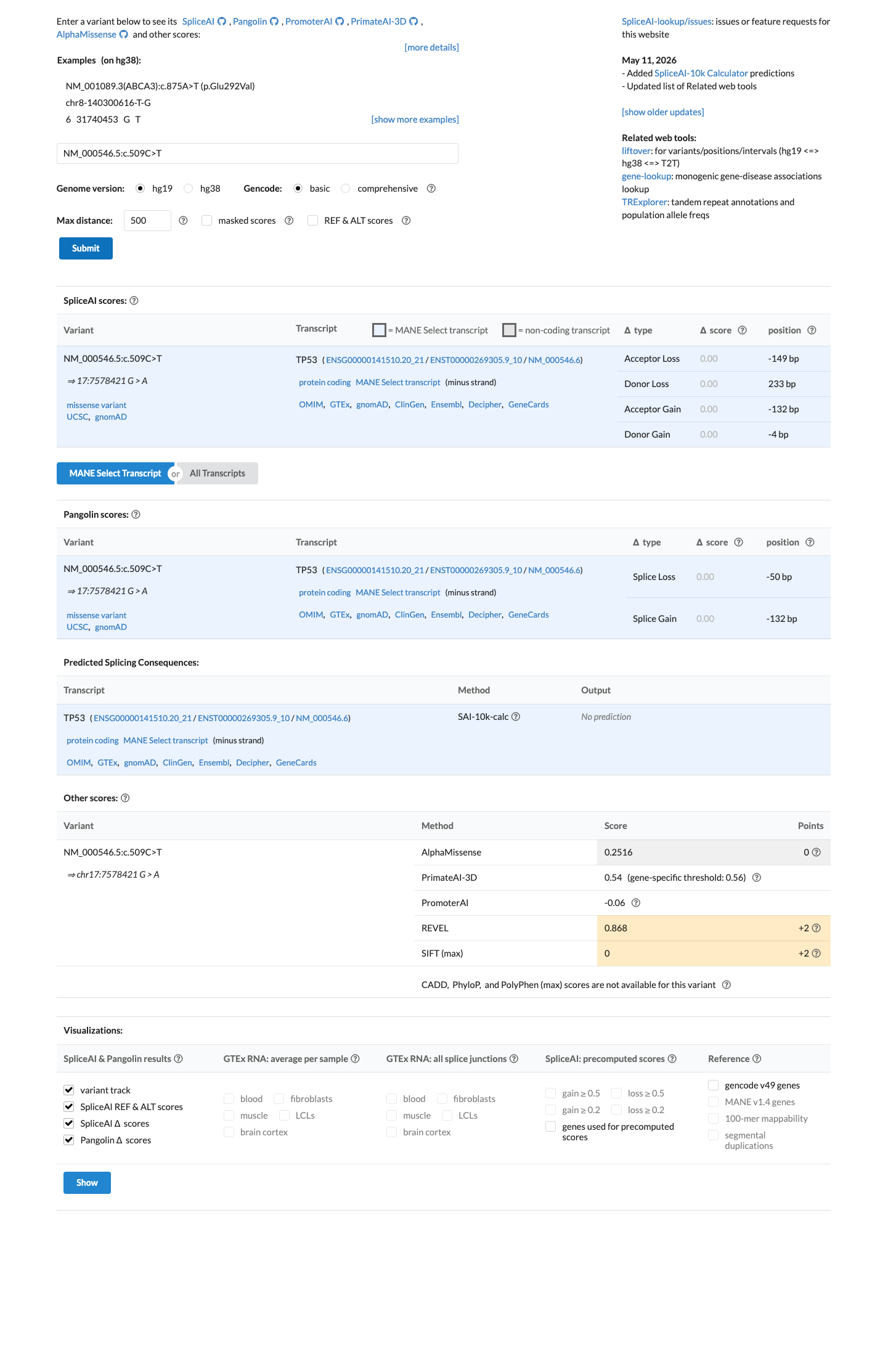
The TP53 VCEP PP3-BP4-codes.xlsx (Supplementary Table S2) assigns 'No evidence' to c.509C>T (p.Thr170Met).
PP4
PP4 per the TP53 VCEP requires observations of the variant with variant allele fraction (VAF) 5-35% in blood.
Benign
BA1
The TP53 VCEP BA1 threshold requires a filtering allele frequency (FAF) ≥0.001 (0.1%) in a continental subpopulation.
BS1
The TP53 VCEP BS1 threshold requires a filtering allele frequency (FAF) ≥0.0003 (0.03%) but <0.001 in a continental subpopulation.
BS2
BS2 requires observation of the variant in unrelated females who have reached at least 60 years of age without cancer.
BS4
BS4 requires observation of lack of segregation in affected family members (family members with LFS-associated cancers lacking the variant).
BP4
The TP53 VCEP PP3-BP4-codes.xlsx (Supplementary Table S2) assigns 'No evidence' to c.509C>T (p.Thr170Met).
N/A · 8
PVS1 · PM6 · PP2 · PP5 · BP1 · BP2 · BP5 · BP7
Research & evidence
Population frequency
gnomAD v4.1
gnomAD v2.1
v4.1
This variant is present in gnomAD v4.1 (AF= 1.54886e-05; MAF= 0.00155%, 25/1614086 alleles, homozygotes = 0) and has highest observed frequency in the South Asian population (AF= 3.2933e-05; MAF= 0.00329%, 3/91094 alleles, homozygotes = 0); grpmax FAF= 8.78e-06.
v2.1
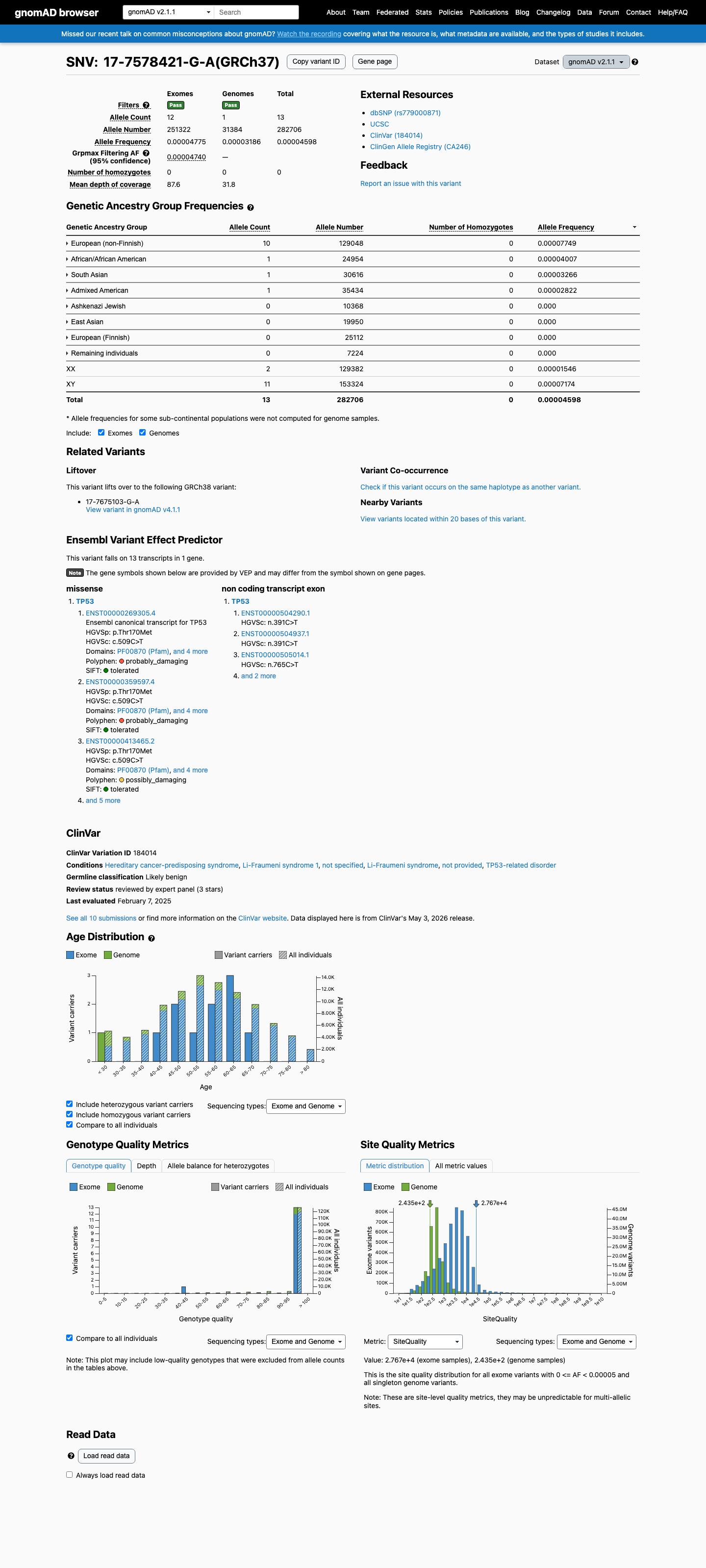
This variant is present in gnomAD v2.1 (AF= 4.59842e-05; MAF= 0.00460%, 13/282706 alleles, homozygotes = 0) and has highest observed frequency in the European (non-Finnish) population (AF= 7.74905e-05; MAF= 0.00775%, 10/129048 alleles, homozygotes = 0); grpmax FAF= 4.74e-05.
🇨🇦 CA
This variant is absent from gnomAD-Canada.
Allele frequency by ancestry
three datasets · side by side
gnomAD v4.1
0.0015%
· 25 / 1,614,086
0 hom · FAF 0.00088%
0 hom · FAF 0.00088%
South Asian 3 / 91,094 |
0.0033% |
European (Finnish) 2 / 64,030 |
0.0031% |
African/African American 2 / 74,924 |
0.0027% |
Admixed American 1 / 60,000 |
0.0017% |
European (non-Finnish) 17 / 1,180,056 |
0.0014% |
+ 5 not observed (Remaining individuals, Amish, East Asian, Middle Eastern, Ashkenazi Jewish)
gnomAD v2.1
0.0046%
· 13 / 282,706
0 hom · FAF 0.0047%
0 hom · FAF 0.0047%
European (non-Finnish) 10 / 129,048 |
0.0077% |
African/African American 1 / 24,954 |
0.004% |
South Asian 1 / 30,616 |
0.0033% |
Admixed American 1 / 35,434 |
0.0028% |
+ 4 not observed (Ashkenazi Jewish, East Asian, European (Finnish), Remaining individuals)
gnomAD Canada 🇨🇦
Absent
· 0 / ?
0 hom
0 hom
Not observed in any ancestry group.

ClinVar
This variant has been reported in ClinVar as Likely benign (5 clinical laboratories) and as Uncertain significance (3 clinical laboratories) and as Uncertain Significance (1 clinical laboratory) and as Likely Benign by ClinGen TP53 Variant Curation Expert Panel, ClinGen (expert panel). (ClinVarID = 184014)
Functional
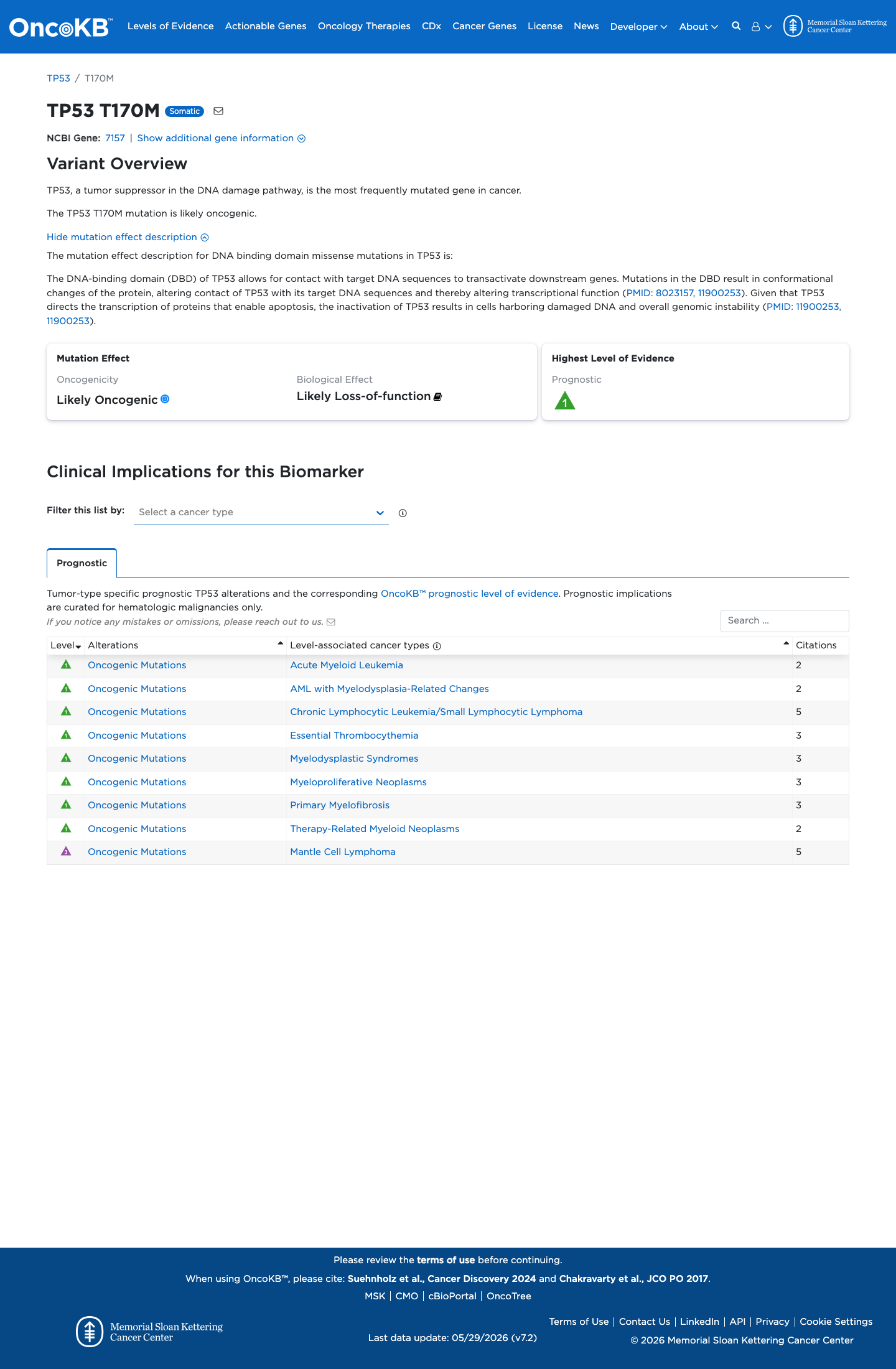
Likely Oncogenic
OncoKB identified variant-specific curated literature and context relevant to functional review; biological-effect context: Likely Loss-of-function; curated oncogenicity label: Likely Oncogenic.
COSMIC

Cancer hotspots
Somatic evidence
Not in COSMIC / hotspots
COSMIC
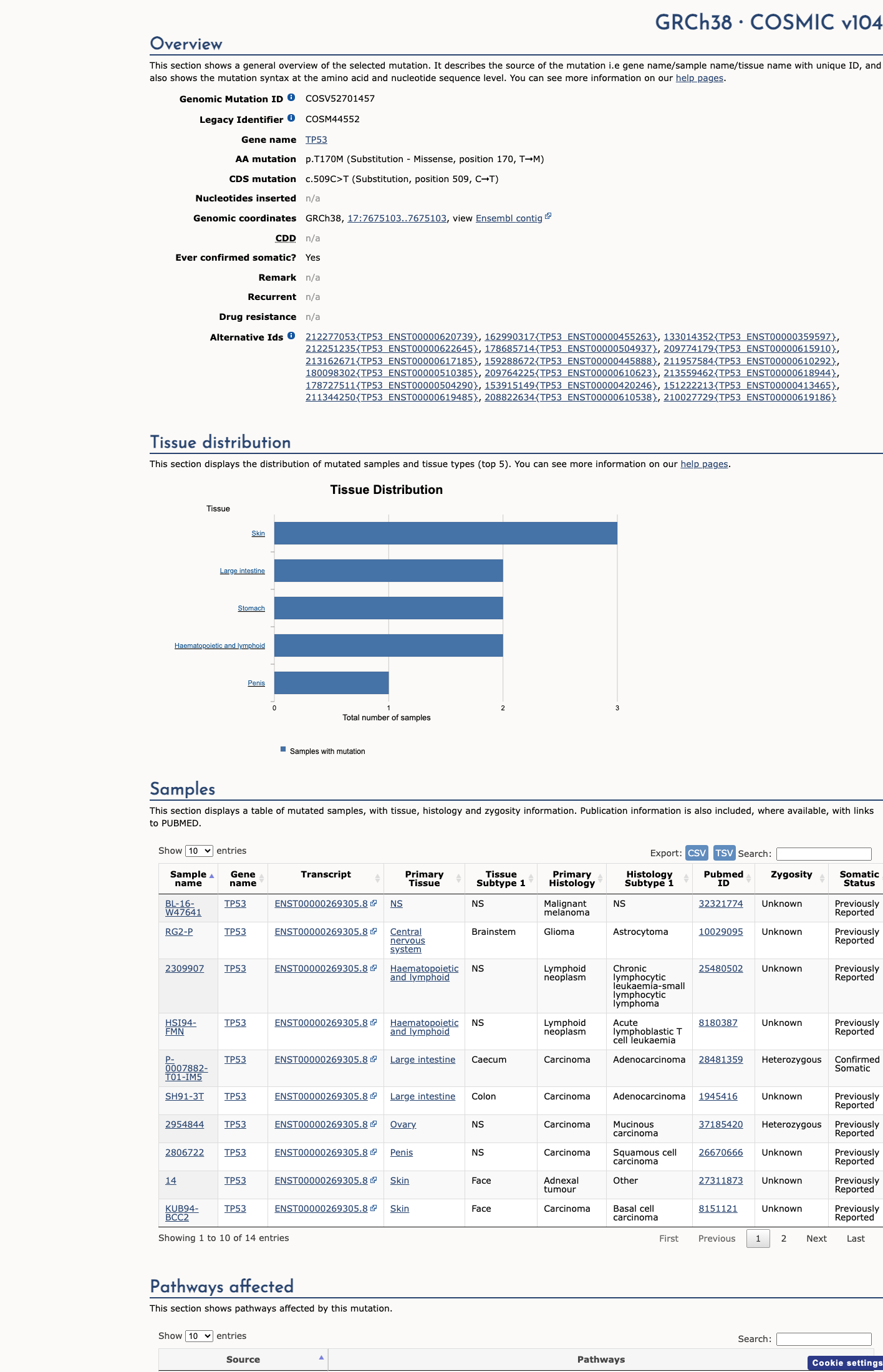
This variant does not lie in a statistically significant hotspot. This variant has previously been reported in somatic cancers (COSMIC; COSV52701457, n = 14 times).
Hotspots
This variant does not lie in a statistically significant hotspot.
Sources & reference links
Triaged references · 9 PMIDs not cited in assessment
8023157 ↗
Crystal structure of a p53 tumor suppressor-DNA complex: understanding tumorigenic mutations.
ONCOKB
12826609 ↗
Understanding the function-structure and function-mutation relationships of p53 tumor suppressor protein by high-resolution missense mutation analysis.
CLINVAR
17311302 ↗
Impact of mutant p53 functional properties on TP53 mutation patterns and tumor phenotype: lessons from recent developments in the IARC TP53 database.
CLINVAR
22653678 ↗
Prevalence of germline TP53 mutations and history of Li-Fraumeni syndrome in families with childhood adrenocortical tumors, choroid plexus tumors, and rhabdomyosarcoma: a population-based survey.
CLINVAR
23200980 ↗
Mutant TP53 in duodenal samples of pancreatic juice from patients with pancreatic cancer or high-grade dysplasia.
CLINVAR
25741868 ↗
Standards and guidelines for the interpretation of sequence variants: a joint consensus recommendation of the American College of Medical Genetics and Genomics and the Association for Molecular Pathology.
CLINVAR
28861920 ↗
Higher-than-expected population prevalence of potentially pathogenic germline TP53 variants in individuals unselected for cancer history.
CLINVAR
28492532 ↗
Sherloc: a comprehensive refinement of the ACMG-AMP variant classification criteria.
CLINVAR