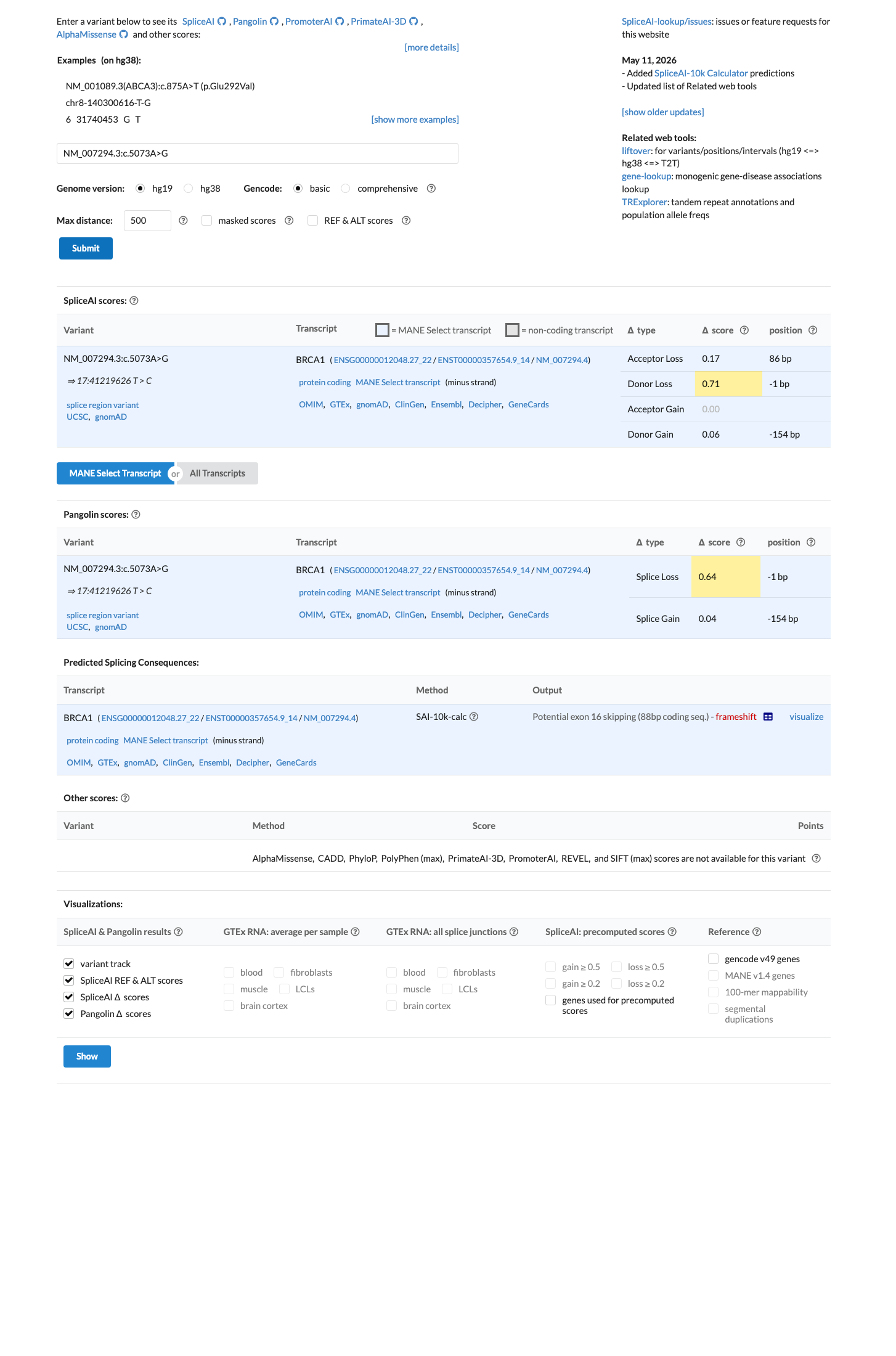
NM_007294.3:c.5073A>G (p.Thr1691=) is a synonymous variant in exon 16 of BRCA1, located within the BRCT domain (aa 1650-1857), a clinically important functional domain.1 The variant is absent from gnomAD v2.1 and is present at extremely low frequency in gnomAD v4.1 (1/1,607,416 alleles; AF=6.22e-7), meeting PM2_Supporting under ENIGMA population frequency criteria.2 SpliceAI predicts a donor loss effect with a max delta score of 0.71 (DS_DL=0.71), exceeding the ENIGMA PP3 threshold of 0.2 for predicted splicing impact in silent variants, meeting PP3 at Supporting strength.3 No case-control data (PS4), cosegregation evidence (PP1), or non-segregation evidence (BS4) were identified for this variant.4 BP4 is not met because SpliceAI predicts splicing impact (0.71 > 0.1 threshold). BP1 is not applicable because the variant lies within the BRCT clinically important functional domain and has predicted splicing impact. BP7_Supporting is not met because BP4 is a prerequisite.5 No functional assay data from calibrated studies were identified in ENIGMA Table 9 or ST4. The Findlay et al. 2018 (PMID:30209399) saturation genome editing study covers this region, but the variant-specific functional score could not be retrieved from the inaccessible full-text supplementary data, leaving PS3 and BS3 unassessed.6 No clinical-history likelihood ratio data were available for this variant in the Li et al. 2020 (PMID:31853058) BRCA1 table, leaving PP4 and BP5 unassessed.7 Applying the ENIGMA point-based classification system: PM2_Supporting (+1, pathogenic) + PP3_Supporting (+1, pathogenic) = +2 total. With no benign criteria met and only two pathogenic Supporting criteria, the total points (+2) fall within the VUS range (-1 to +5).8 However, the SpliceAI prediction of donor loss (delta 0.71) suggests this synonymous variant may alter splicing, and definitive classification requires functional characterization via mRNA transcript analysis and/or retrieval of the Findlay et al. 2018 saturation genome editing functional score to resolve PS3/BS3.9
Final classification
VUS
PM2PP3
BRCA1
c.5073A>G
p.Thr1691=
This variant
NM_007294.3:c.5073A>G (p.Thr1691=) is a synonymous variant in exon 16 of BRCA1, located within the BRCT domain (aa 1650-1857), a clinically important functional domain.
ENIGMA BRCA1/2 v1.2 point-based classification: PM2_Supporting (+1) + PP3_Supporting (+1) = +2 total pathogenic points. No benign criteria are met. The total of +2 falls within the ENIGMA VUS range (-1 to +5). No explicit ENIGMA Table 3 combination rule matches '2 Supporting only', and the generic ACMG/AMP 2015 rules also yield VUS (no PVS1, PS, or PM criteria are met to trigger a Pathogenic or Likely Pathogenic combination).
Classification rationale
PM2PP3
VUS
BRCA1 c.5073A>G
PM2 + PP3
→
VUS
LYFE Sciences is an AI system, and it can make mistakes. Criteria
may be applied incorrectly, sources may be misread, and a confident-looking
classification can still be wrong. Double-check every criterion and
its underlying evidence before relying on any call.
Gene diagram
· NM_007294.3 · variants mapped to exon structure
BRCA1
NM_007294.3
Fetching transcript structure from UCSC…
Applied criteria · 2 applied · 13 assessed
MetEvidence satisfies this criterion.
Not metEvaluated against available evidence; threshold not reached.
Not assessedApplies in principle, but no evidence was found to evaluate it.
N/ADoesn't apply to this variant type.
Applied · 2
Strength
Supporting
Moderate
Strong
Very strong
PM2
supporting
Pathogenic
The variant is absent from gnomAD v2.1 (non-cancer, exome subset) and is present at extremely low frequency in gnomAD v4.1 (1/1,607,416 alleles; AF=6.22e-7; no homozygotes). Under ENIGMA rules, PM2_Supporting applies when a variant is absent from gnomAD v2.1 and v3.1 non-cancer populations.
Absent from gnomAD v2.1 (exome)gnomAD v4.1: 1/1607
PP3
supporting
Pathogenic
SpliceAI predicts a splicing impact for this silent variant with a max delta score of 0.71 (donor loss: DS_DL=0.71, DP_DL=-1), exceeding the ENIGMA PP3 threshold of ≥0.2 for predicted splicing alterations. Under ENIGMA rules, PP3 at Supporting strength applies to silent variants with SpliceAI ≥0.2 irrespective of location within clinically important functional domains.
SpliceAI max delta score = 0.71 (donor loss prediction at -1 position)SpliceAI DS_DL=0.71DS_AL=0.17
Assessed · not applied
· 7 not met · 6 not assessed
Pathogenic
PS1
No previously classified pathogenic or likely pathogenic comparator variant with the same predicted amino acid change or splicing impact at this residue was identified in available evidence sources.
PS3
The variant c.5073A>G is not listed in ENIGMA Table 9 (curated functional assay results) or Supplementary Table 4 (full functional assay dataset).
PS4
No case-control study demonstrating significantly increased prevalence of c.5073A>G in affected individuals versus controls (p≤0.05 and OR≥4) was identified.
PP1
No cosegregation data were identified for c.5073A>G in any published study or database.
PP4
The variant c.5073A>G was not found in the Li et al.
Benign
BA1
ENIGMA BA1 requires a filter allele frequency (FAF) above 0.1% (FAF > 0.001) in gnomAD v2.1 or v3.1 non-cancer populations.
BS1
ENIGMA BS1_Strong requires FAF > 0.01% and BS1_Supporting requires FAF > 0.002% and ≤ 0.01%.
BS2
No data were identified regarding observation of this variant in homozygous or compound heterozygous state in individuals without Fanconi anemia phenotype.
BS3
The variant c.5073A>G is not listed in ENIGMA Table 9 (curated functional assay results assigning BS3 codes) or Supplementary Table 4 (full functional assay dataset).
BS4
No data demonstrating lack of segregation of c.5073A>G in affected family members were identified.
BP4
ENIGMA BP4_Supporting for a silent variant inside a clinically important functional domain requires no predicted splicing impact (SpliceAI ≤0.1).
BP5
The variant c.5073A>G was not found in the Li et al.
BP7
ENIGMA BP7_Strong (RNA) requires a well-established mRNA assay showing no splicing aberration, which is not available for this variant.
N/A · 10
PVS1 · PS2 · PM1 · PM5 · PM6 · PP2 · PP5 · BP1 · BP2 · BP6
Research & evidence
Population frequency
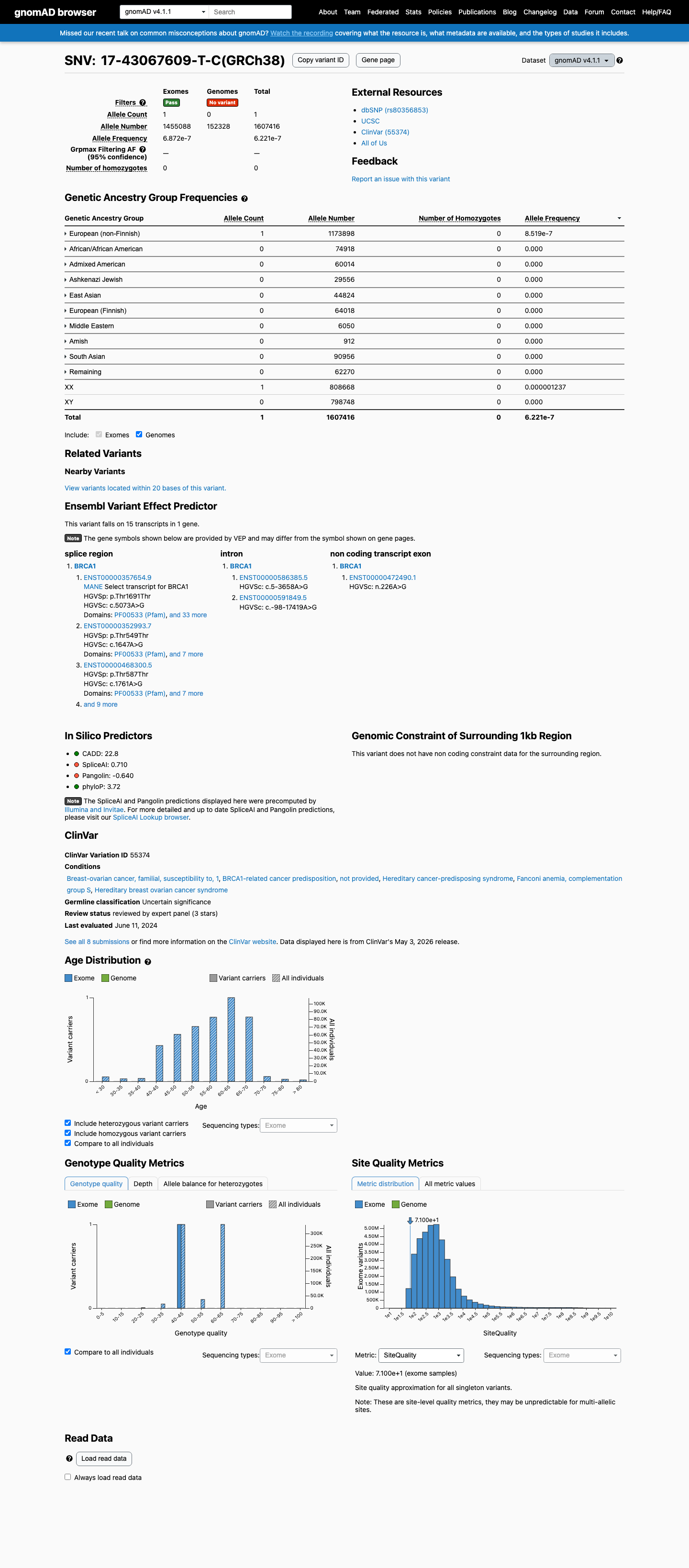
gnomAD v4.1
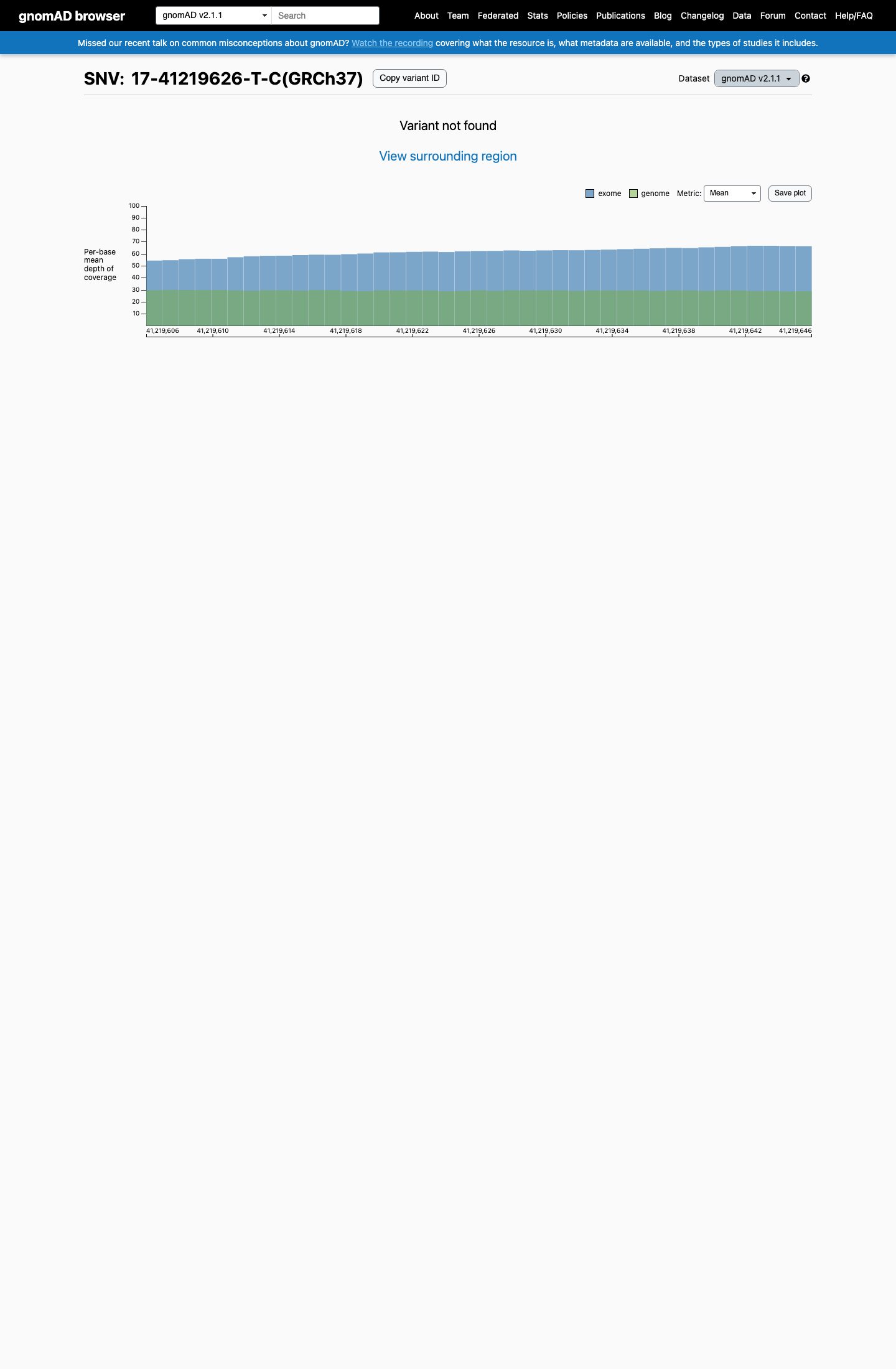
gnomAD v2.1
v4.1
This variant is present in gnomAD v4.1 (AF= 6.22116e-07; MAF= 0.00006%, 1/1607416 alleles, homozygotes = 0) and has highest observed frequency in the European (non-Finnish) population (AF= 8.51863e-07; MAF= 0.00009%, 1/1173898 alleles, homozygotes = 0).
v2.1
Absent from gnomAD v2.1.
🇨🇦 CA
This variant is absent from gnomAD-Canada.
Allele frequency by ancestry
three datasets · side by side
gnomAD v4.1
6.2e-05%
· 1 / 1,607,416
0 hom
0 hom
European (non-Finnish) 1 / 1,173,898 |
8.5e-05% |
+ 9 not observed (Remaining individuals, Admixed American, European (Finnish), Amish, East Asian, Middle Eastern, South Asian, Ashkenazi Jewish, African/African American)
gnomAD v2.1
Absent
· 0 / ?
0 hom
0 hom
Not observed in any ancestry group.
gnomAD Canada 🇨🇦
Absent
· 0 / ?
0 hom
0 hom
Not observed in any ancestry group.
In silico
SpliceAI predicts possible splice impact for this variant (max delta score = 0.71).

Functional
Unknown Oncogenic Effect
OncoKB identified curated literature and non-variant-specific oncogenicity context for review; listed oncogenicity label: Unknown Oncogenic Effect.

COSMIC

Cancer hotspots
Somatic evidence
Not in COSMIC / hotspots
COSMIC
This variant does not lie in a statistically significant hotspot. This variant has not previously been reported in somatic cancers (COSMIC).
Hotspots
This variant does not lie in a statistically significant hotspot.
Sources & reference links
Triaged references · 2 PMIDs not cited in assessment
25394175 ↗
A practice guideline from the American College of Medical Genetics and Genomics and the National Society of Genetic Counselors: referral indications for cancer predisposition assessment.
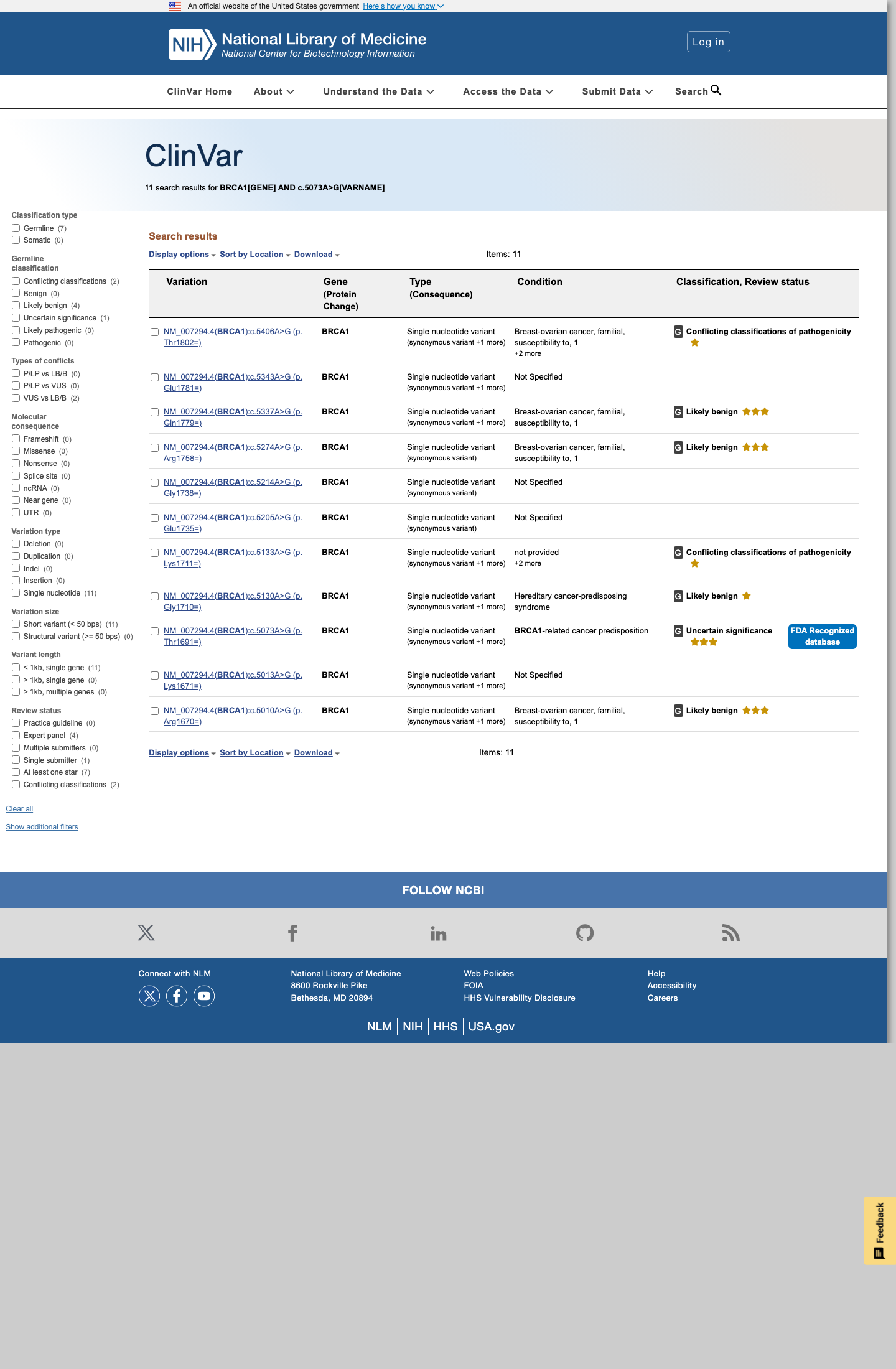
CLINVAR