NM_000546.5:c.370T>G (p.Cys124Gly) is a missense variant in TP53 exon 4, absent from gnomAD v2.1 and v4.1 (PM2_Supporting met; 1 point).1 In silico analysis per TP53 VCEP assigns PP3_Moderate: aGVGD Class C65 and BayesDel 0.217 (≥0.16), with no predicted splicing effect (SpliceAI max delta 0.04) (2 points).2 No functional evidence is applicable per the TP53 VCEP Functional-worksheet, which assigns C124G a code of 'No evidence' due to mixed assay results: Kato partially functional, Giacomelli LOF, Kotler noLOF.3 The variant has been observed 6 times in somatic cancers (COSMIC COSV52680549) but is not listed in cancerhotspots.org as a statistically significant hotspot, and codon 124 is not among the VCEP-defined PM1 hotspot codons.4 No proband-level phenotype, cosegregation, de novo, or case-control data are available for this variant. ClinVar reports a single submitter classification of Uncertain significance.5 Total Tavtigian points: PM2_Supporting (1) + PP3_Moderate (2) = 3 points, falling within the TP53 VCEP VUS range (-1 to 5 points). The variant is classified as Uncertain Significance.6
Final classification
VUS
PM2PP3
TP53
c.370T>G
p.Cys124Gly
This variant
NM_000546.5:c.370T>G (p.Cys124Gly) is a missense variant in TP53 exon 4, absent from gnomAD v2.1 and v4.1 (PM2_Supporting met; 1 point).
Tavtigian et.al., 2020 - Bayesian adaptation of Richards et.al., 2015 v2.4.0 point-based framework: PM2 supporting (+1) + PP3 moderate (+2) = 3 points, which maps to VUS.
Classification rationale
PM2PP3
VUS
TP53 c.370T>G
PM2 + PP3
→
VUS
LYFE Sciences is an AI system, and it can make mistakes. Criteria
may be applied incorrectly, sources may be misread, and a confident-looking
classification can still be wrong. Double-check every criterion and
its underlying evidence before relying on any call.
Gene diagram
· NM_000546.5 · variants mapped to exon structure
TP53
NM_000546.5
Fetching transcript structure from UCSC…
Applied criteria · 2 applied · 13 assessed
MetEvidence satisfies this criterion.
Not metEvaluated against available evidence; threshold not reached.
Not assessedApplies in principle, but no evidence was found to evaluate it.
N/ADoesn't apply to this variant type.
Applied · 2
Strength
Supporting
Moderate
Strong
Very strong
PM2
supporting
Pathogenic
The variant is absent from gnomAD v2.1 and v4.1, meeting the TP53 VCEP PM2_Supporting threshold (allele frequency < 0.003% / 0.00003 in large population databases).
Absent from gnomAD v2.1 (0 alleles).Absent from gnomAD v4.1 (0 alleles).
PP3
moderate
Pathogenic
The TP53 VCEP PP3-BP4-codes spreadsheet (Supplementary Table S2) assigns c.370T>G a pre-computed code of PP3_moderate based on aGVGD Class C65 and BayesDel score 0.216879 (≥0.16). SpliceAI max delta score is 0.04, indicating no predicted splicing effect, so in silico evidence is not confounded by splicing.
VCEP PP3-BP4-codes: c.370T>G → PP3_moderateaGVGD: Class C65BayesDel: 0.216879 (≥0.16 meets PP3 threshold)
Assessed · not applied
· 12 not met · 1 not assessed
Pathogenic
PS2
No confirmed de novo occurrence of NM_000546.5:c.370T>G with confirmed paternity/maternity has been identified in published literature or databases.
PS3
The TP53 VCEP Functional-worksheet (Supplementary Table S3) assigns C124G a code of 'No evidence.' The Kato assay showed partially functional activity; Giacomelli showed LOF but Kotler showed noLOF.
PS4
No proband data meeting the TP53 VCEP PS4 point system (LFS-associated cancers per proband) is available for this variant.
PM1
Codon 124 is not among the TP53 VCEP-defined mutational hotspot codons (175, 245, 248, 249, 273, 282) for PM1_Moderate.
PM5
Other missense variants exist at codon 124 (e.g., C124R, C124S) but none have been definitively classified as Pathogenic or Likely Pathogenic following TP53 VCEP specifications.
PP1
No published cosegregation data for NM_000546.5:c.370T>G in affected family members has been identified.
PP4
No proband-specific phenotype data or variant allele fraction (VAF) observations meeting the TP53 VCEP PP4 thresholds are available.
Benign
BA1
The variant is absent from gnomAD v2.1 and v4.1, so the TP53 VCEP BA1 threshold (filtering allele frequency ≥0.001 / 0.1% in a single continental genetic ancestry group) is not met.
BS1
The variant is absent from gnomAD v2.1 and v4.1, so the TP53 VCEP BS1 threshold (filtering allele frequency ≥0.0003 but <0.001 in a single continental genetic ancestry group) is not met.
BS2
No data are available regarding unrelated females ≥60 years of age without cancer carrying this variant.
BS3
The TP53 VCEP Functional-worksheet assigns C124G a code of 'No evidence.' The Kato assay showed partially functional (not 'Functional') activity, so neither BS3_Strong (requires Functional on Kato + no LOF by majority) nor BS3_Supporting (requires Partially functional on Kato + no LOF by all assays; Giacomelli shows LOF) is met.
BS4
No reports of non-segregation (apparently healthy individuals carrying the variant in affected families) for c.370T>G have been identified.
BP4
The TP53 VCEP PP3-BP4-codes spreadsheet assigns c.370T>G a code of PP3_moderate, not BP4.
N/A · 13
PVS1 · PS1 · PM3 · PM4 · PM6 · PP2 · PP5 · BP1 · BP2 · BP3 · BP5 · BP6 · BP7
Research & evidence
Population frequency
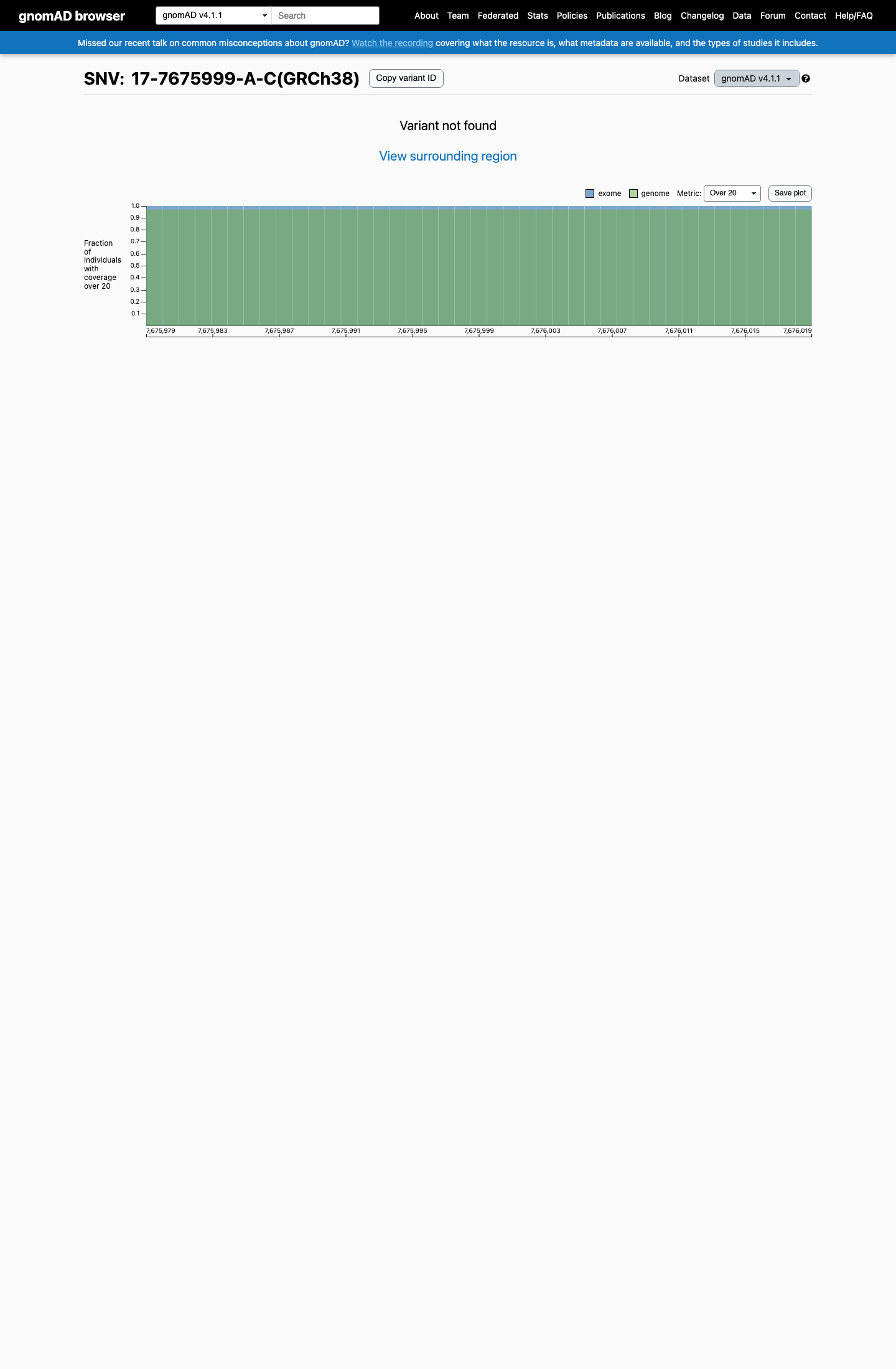
gnomAD v4.1
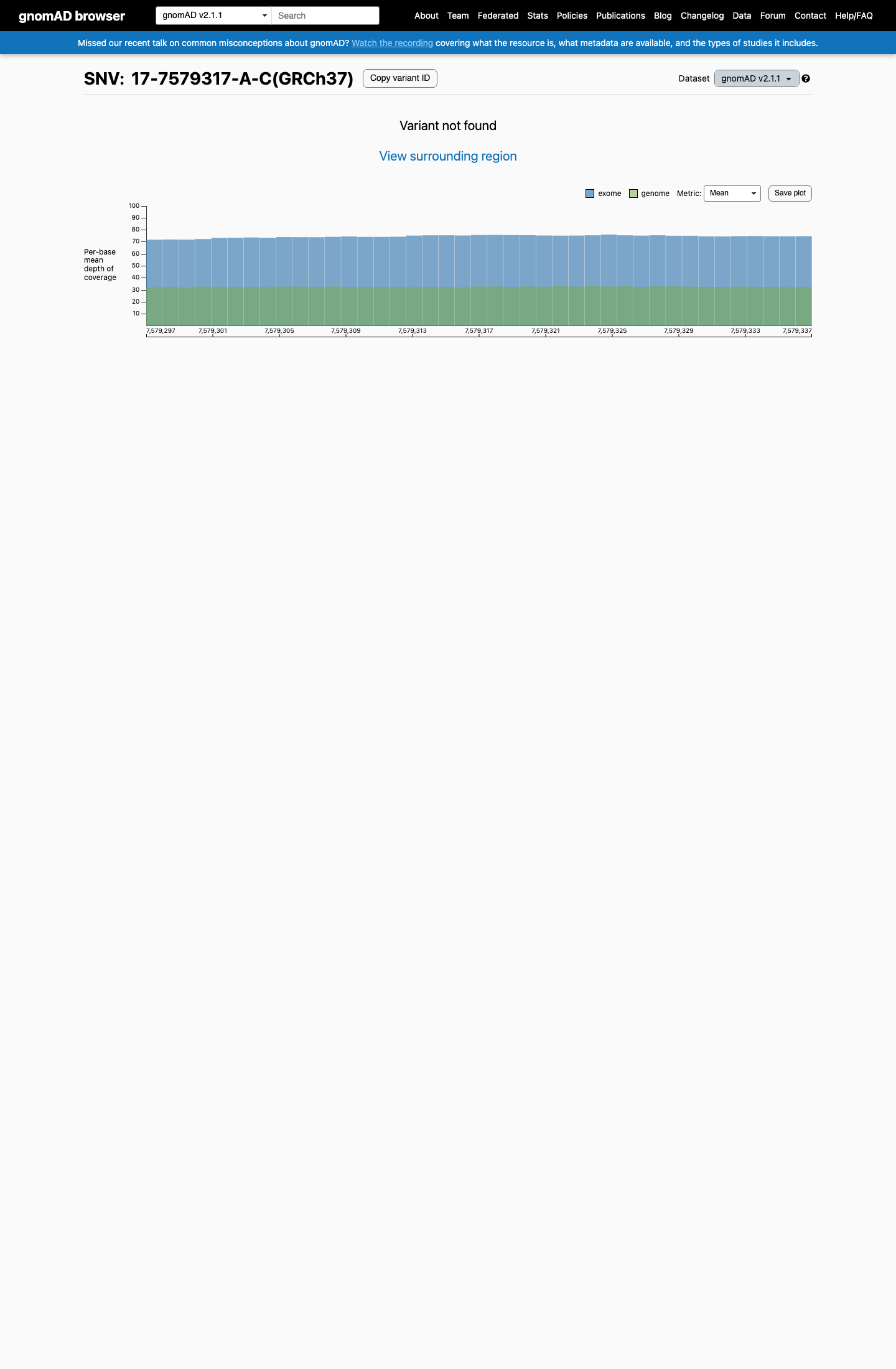
gnomAD v2.1
v4.1
Absent from gnomAD v4.1.
v2.1
Absent from gnomAD v2.1.
🇨🇦 CA
This variant is absent from gnomAD-Canada.
Allele frequency by ancestry
three datasets · side by side
gnomAD v4.1
Absent
· 0 / ?
0 hom
0 hom
Not observed in any ancestry group.
gnomAD v2.1
Absent
· 0 / ?
0 hom
0 hom
Not observed in any ancestry group.
gnomAD Canada 🇨🇦
Absent
· 0 / ?
0 hom
0 hom
Not observed in any ancestry group.
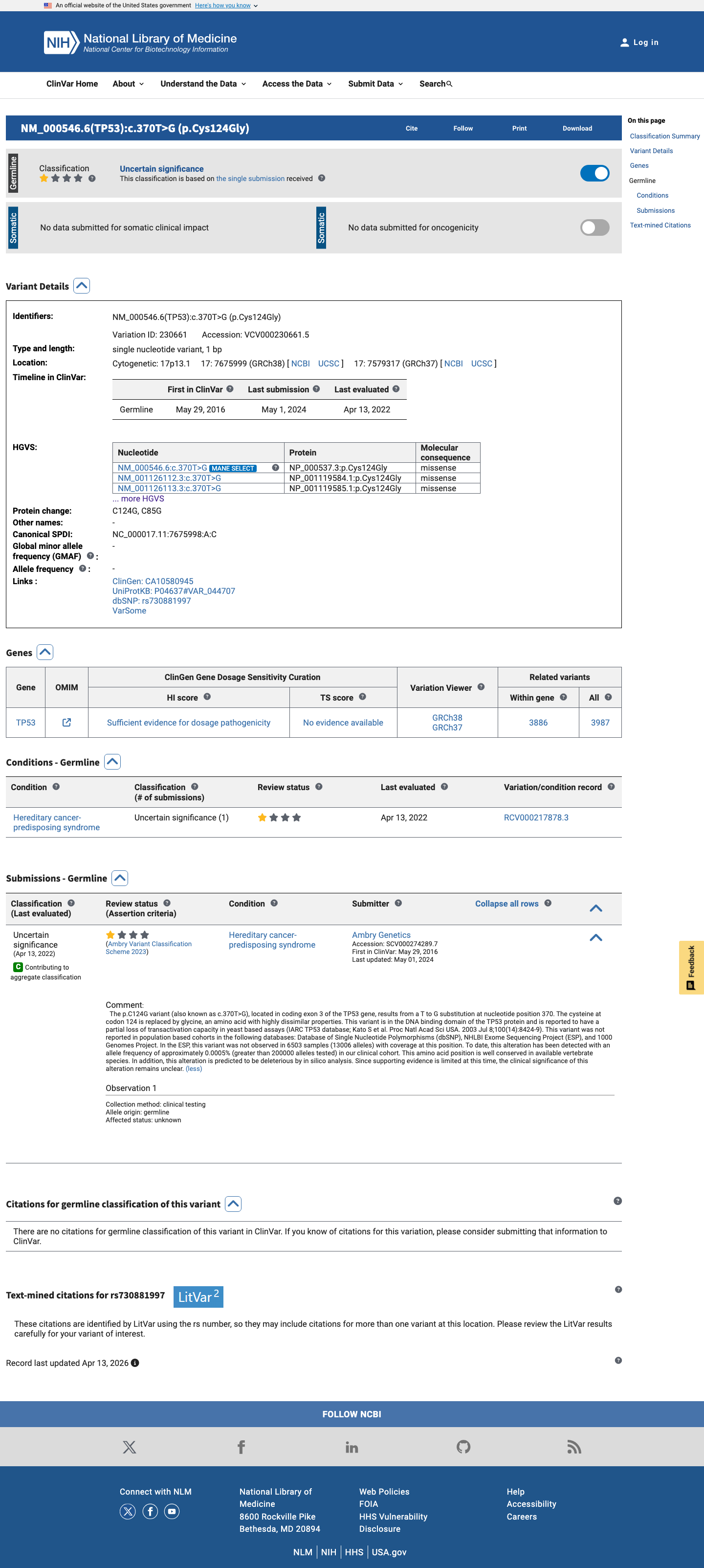
ClinVar
This variant has been reported in ClinVar as Uncertain significance (1 clinical laboratory). (ClinVarID = 230661)
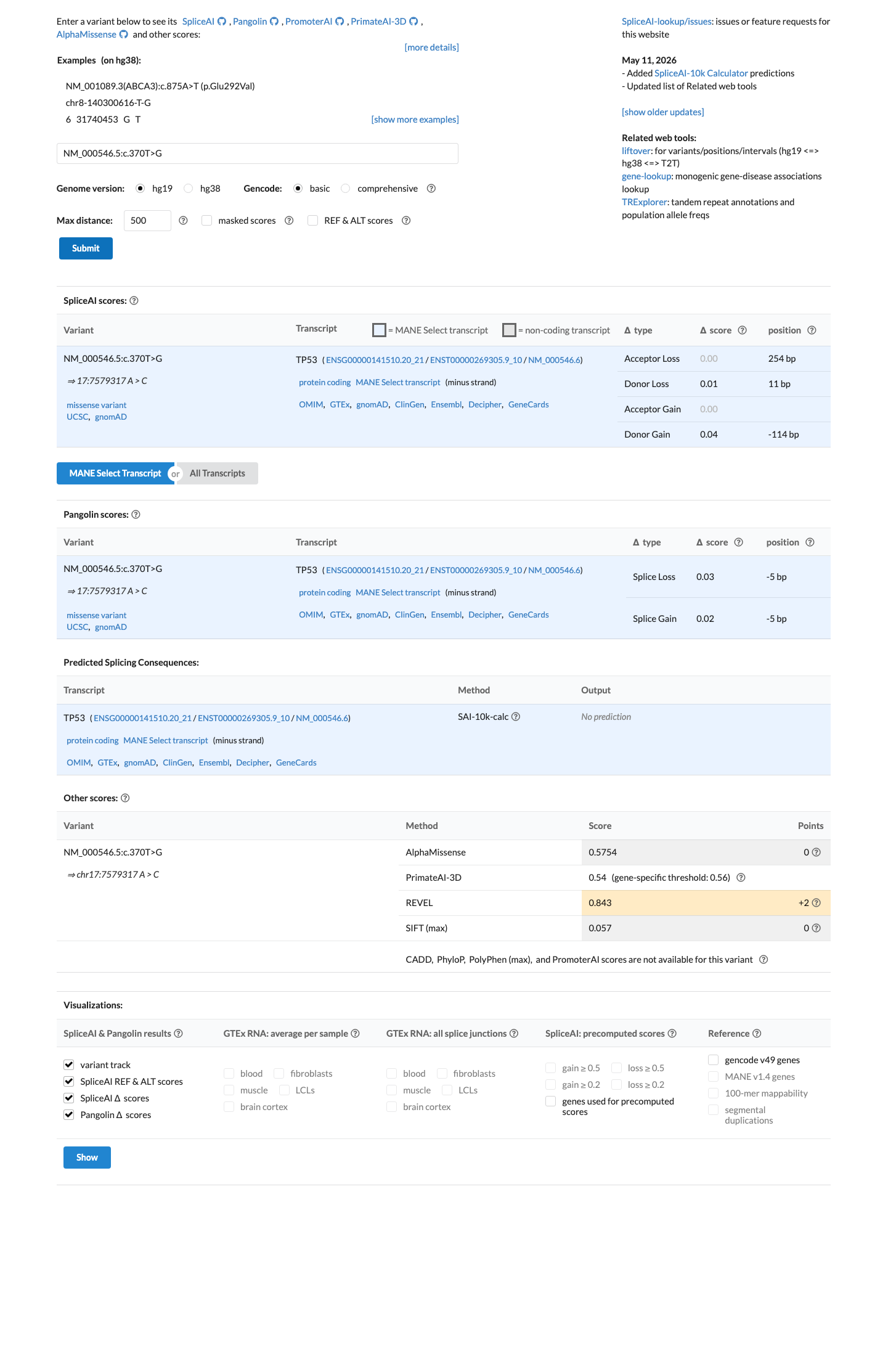
In silico
SpliceAI predicts no significant splice impact for this variant (max delta score = 0.04). REVEL score = 0.843. BayesDel score = 0.216879.
Functional
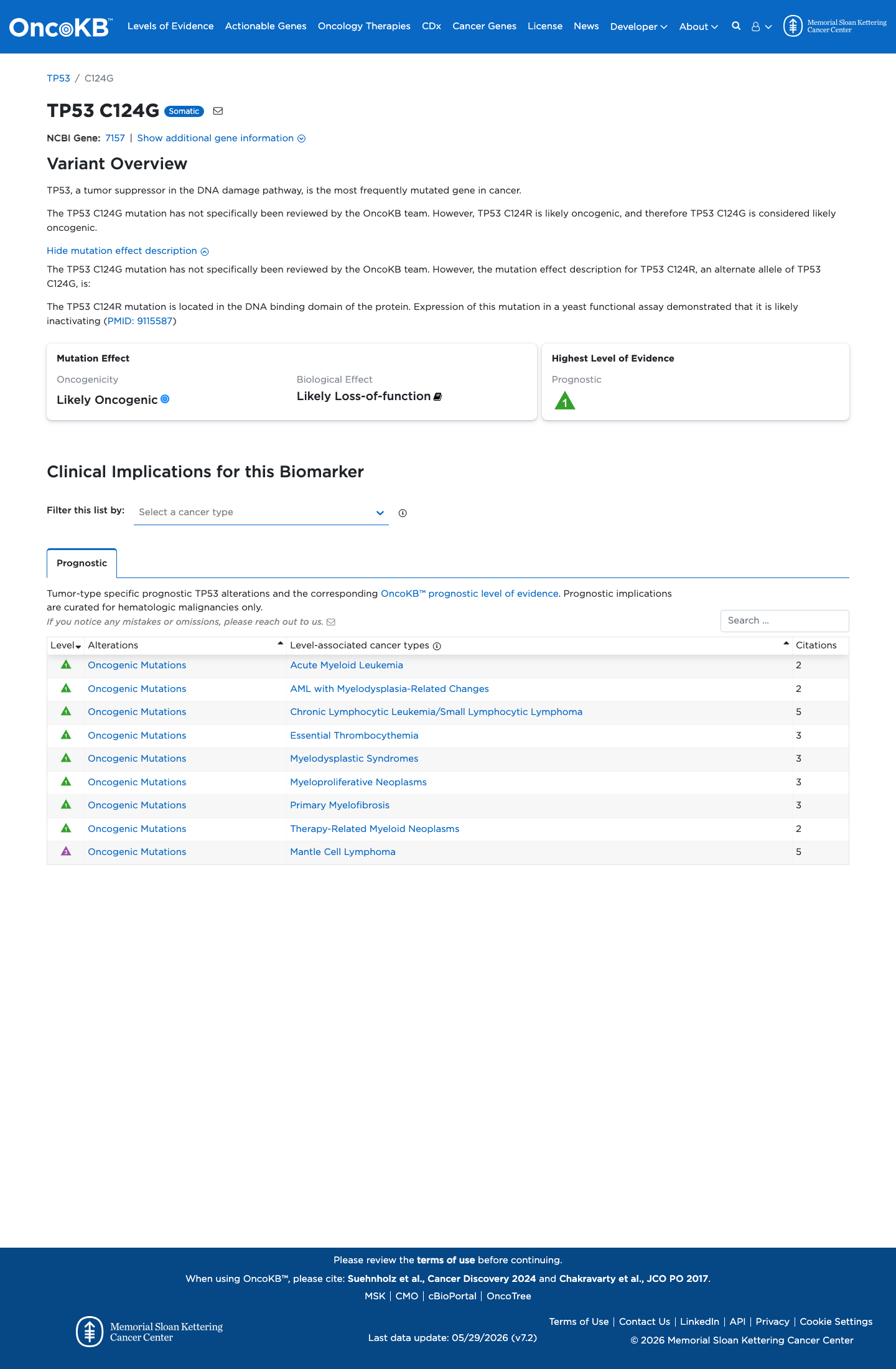
Likely Oncogenic
OncoKB did not identify variant-specific reviewed functional evidence for this variant; gene-level curated context is available for reviewer follow-up. TP53, a tumor suppressor in the DNA damage pathway, is the most frequently mutated gene in cancer.
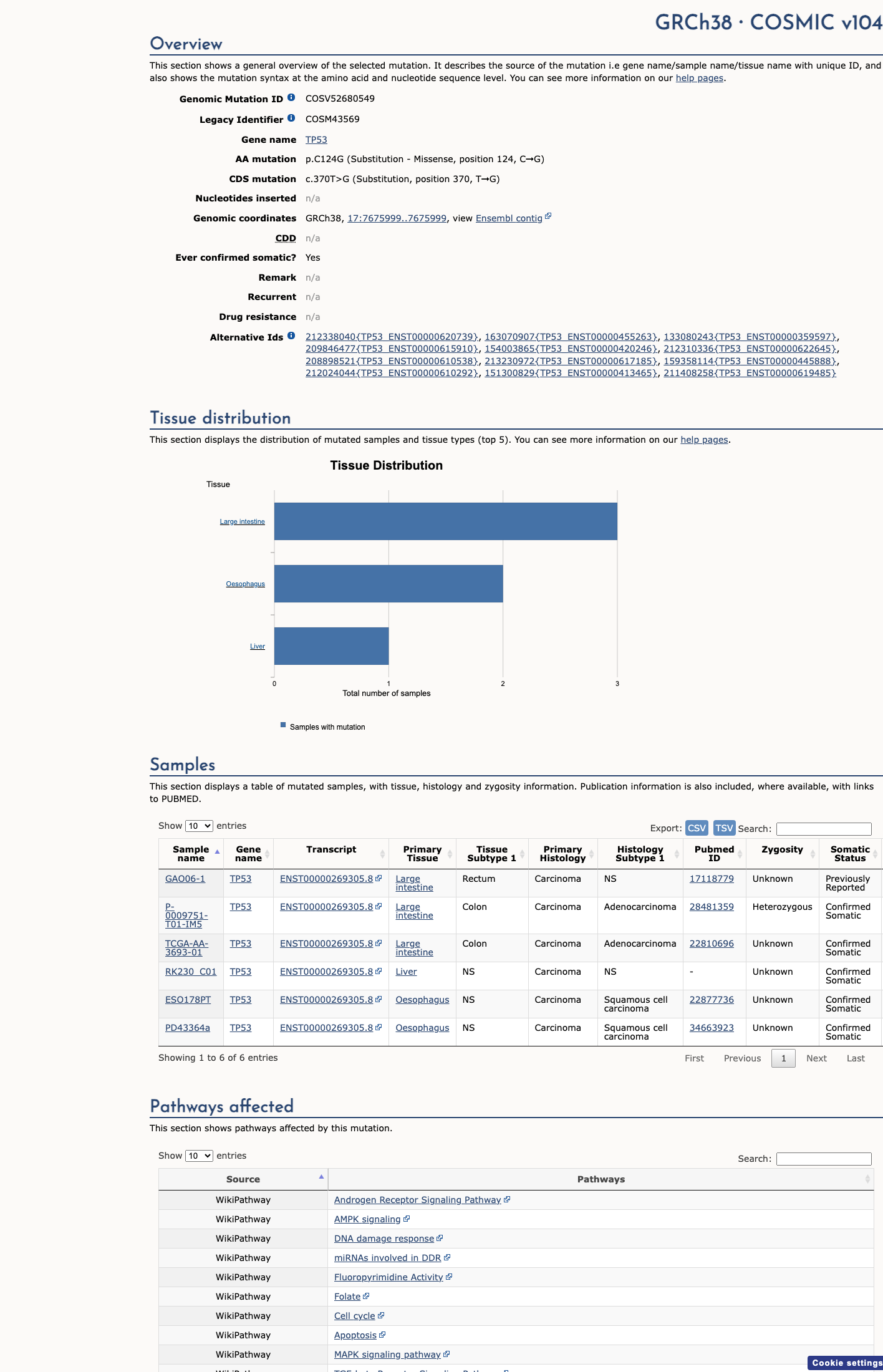
COSMIC

Cancer hotspots
Somatic evidence
Not in COSMIC / hotspots
COSMIC
This variant does not lie in a statistically significant hotspot. This variant has previously been reported in somatic cancers (COSMIC; COSV52680549, n = 6 times).
Hotspots
This variant does not lie in a statistically significant hotspot.
Sources & reference links
Triaged references · 2 PMIDs not cited in assessment
9115587 ↗
Reappraisal of p53 mutations in human malignant astrocytic neoplasms by p53 functional assay: comparison with conventional structural analyses.
ONCOKB
25394175 ↗
A practice guideline from the American College of Medical Genetics and Genomics and the National Society of Genetic Counselors: referral indications for cancer predisposition assessment.
CLINVAR