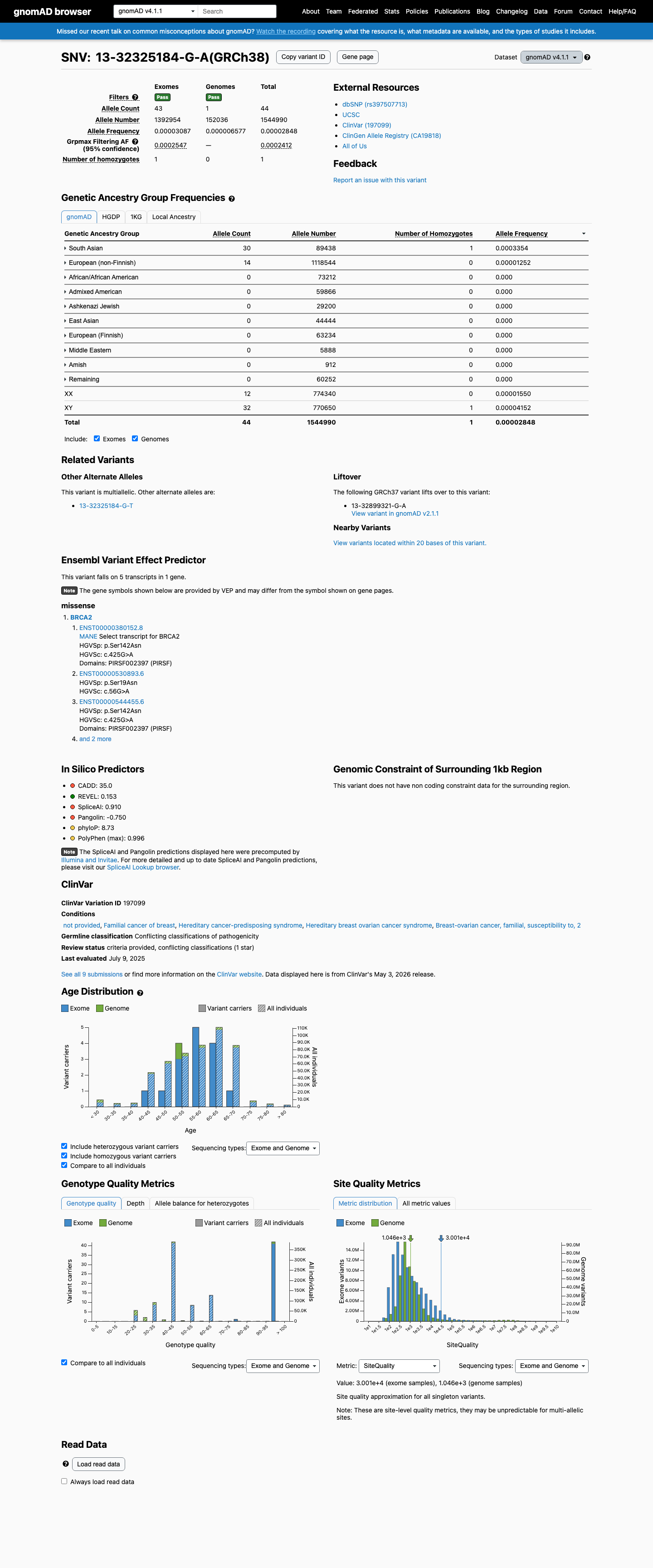
NM_000059.4:c.425G>A (p.Ser142Asn) is a missense variant in BRCA2 exon 4, located outside the established clinically important functional domains (PALB2-binding domain aa 10-40; DNA-binding domain aa 2481-3186).1 This variant is absent from gnomAD v2.1 but present in gnomAD v4.1 in 44 of 1,544,990 alleles (AF=0.00285%), including 1 homozygote, with a grpmax filter allele frequency of 0.024% (0.00024125). The highest subpopulation frequency is in the South Asian population (30/89,438 alleles, AF=0.034%).2 SpliceAI predicts a splicing alteration with a maximum delta score of 0.91, exceeding the ENIGMA PP3 threshold of ≥0.2 for missense variants, supporting a potential splice effect (PP3_Supporting). However, the specific SpliceAI sub-scores (donor gain/loss, acceptor gain/loss) are not available, and no RNA splicing assay has been performed to confirm this prediction.3 The population frequency evidence meets ENIGMA BS1 at Supporting strength: the grpmax FAF of 0.00024125 exceeds the 0.01% threshold, and the observation of a homozygous individual in gnomAD v4.1 argues against high-penetrance pathogenicity. The variant is absent from gnomAD v2.1 per the ENIGMA-specified dataset, but the larger v4.1 release confirms population presence.4 Multifactorial likelihood analysis from Parsons et al. 2019 (PMID:31131967) yields a combined LR of 1.383 (neutral), with segregation LR=1.554 and pathology LR=0.89. Neither PP1 (co-segregation) nor BS4 (lack of segregation) thresholds are met. The clinical-history LR from Li et al. 2020 (PMID:31853058) is 1.027 (1 proband, neutral zone); PP4 and BP5 are not met.5 The variant is not listed in ENIGMA Table 9 for calibrated functional assay results (PS3/BS3 not assessed). No variant-specific functional evidence was identified in the literature or in OncoKB.6 In ClinVar, this variant is classified as Uncertain Significance by 4 clinical laboratories, as Likely Pathogenic by 3, and as Pathogenic by 2 (ClinVar Variation ID: 197099), with review status of criteria provided, single submitter and no expert panel classification.7 Under the ENIGMA BRCA1/2 v1.2.0 combining rules (Table 3): PP3_Supporting (1 pathogenic supporting) and BS1_Supporting (1 benign supporting) are the only met criteria. Neither Likely Pathogenic nor Likely Benign thresholds are reached. The variant is classified as a Variant of Uncertain Significance (VUS).8
Final classification
VUS
PP3BS1
BRCA2
c.425G>A
p.Ser142Asn
This variant
NM_000059.4:c.425G>A (p.Ser142Asn) is a missense variant in BRCA2 exon 4, located outside the established clinically important functional domains (PALB2-binding domain aa 10-40; DNA-binding domain aa 2481-3186).
ENIGMA BRCA1/BRCA2 v1.2.0 Table 3 conflicting-evidence point system: PP3_Supporting (+1 pathogenic point) + BS1_Supporting (-1 benign point) = 0 total points, which falls in the VUS range (-1 to 5). No other criteria are met. The single pathogenic supporting criterion and single benign supporting criterion are insufficient to reach Likely Pathogenic or Likely Benign thresholds under the ENIGMA all_of combination rules, and the point system resolves the conflict to VUS.
Classification rationale
PP3
BS1
VUS
BRCA2 c.425G>A
PP3 + BS1
→
VUS
1
cspec ↗
5
vcep_humu_40_1557_s001vcep_pmid_31853058_brca2_clinical_history_lrPMID:31131967 ↗PMID:31853058 ↗
6
vcep_specifications_table9_v1_2_2024_11_18oncokb ↗
8
cspec ↗
LYFE Sciences is an AI system, and it can make mistakes. Criteria
may be applied incorrectly, sources may be misread, and a confident-looking
classification can still be wrong. Double-check every criterion and
its underlying evidence before relying on any call.
Gene diagram
· NM_000059.4 · variants mapped to exon structure
BRCA2
NM_000059.4
Fetching transcript structure from UCSC…
Applied criteria · 2 applied · 13 assessed
MetEvidence satisfies this criterion.
Not metEvaluated against available evidence; threshold not reached.
Not assessedApplies in principle, but no evidence was found to evaluate it.
N/ADoesn't apply to this variant type.
Applied · 2
Strength
Supporting
Moderate
Strong
Very strong
PP3
supporting
review
Pathogenic
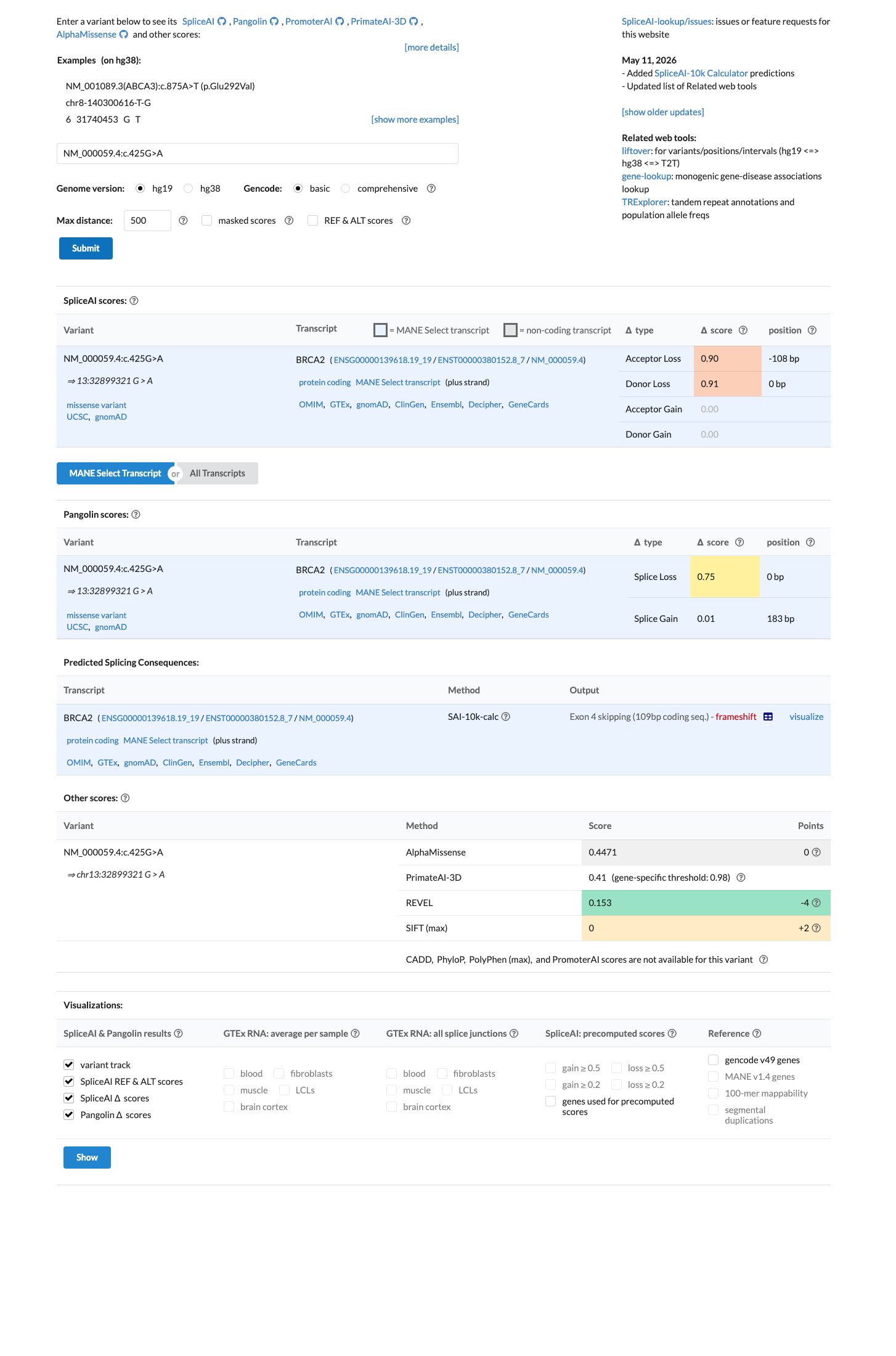
SpliceAI predicts a splicing impact with a maximum delta score of 0.91, which exceeds the ENIGMA PP3 threshold of ≥0.2 for missense variants irrespective of location in clinically important functional domains. Per ENIGMA Figure 1A, PP3 Supporting is applied for missense variants with predicted splicing alteration (SpliceAI ≥0.2). The variant is annotated as missense_variant/splice_region_variant. The amino acid substitution (p.Ser142Asn) is located outside the BRCA2 clinically important functional domains (PALB2-binding aa 10-40; DNA-binding aa 2481-3186), so protein-level prediction (BayesDel no-AF = -0.314, REVEL = 0.153) is not used for PP3; the splicing prediction alone supports PP3.
SpliceAI max delta=0.91 (≥0.2 threshold)variant in splice region
BS1
supporting
review
Benign
The gnomAD v4.1 grpmax filter allele frequency (FAF) is 0.00024125 (0.024%), which exceeds the ENIGMA BS1 Strong threshold of FAF >0.01% (FAF >0.0001). However, the ENIGMA v1.2 rule specifies gnomAD v2.1 and v3.1; the variant is absent from gnomAD v2.1 and confirmed present only in the newer v4.1 release. Given this version discrepancy, BS1 is applied at Supporting strength rather than Strong. The variant is observed in 44 of 1,544,990 alleles (AF=0.00285%), including 1 homozygote, with highest frequency in the South Asian population (30/89,438 alleles, AF=0.034%). These observations support that the variant is unlikely to be a highly penetrant pathogenic allele.
gnomAD v4.1: 44 alleles1 homozygotegrpmax FAF=0.00024125 (>0.0001 ENIGMA threshold)
Assessed · not applied
· 8 not met · 5 not assessed
Pathogenic
PS1
No previously classified pathogenic variant with the same amino acid change (Ser142Asn) was identified.
PS3
The variant is not listed in ENIGMA Specifications Table 9 (curated functional assay results).
PS4
No case-control study with an odds ratio meeting ENIGMA criteria (OR ≥4, lower CI excluding 2.0, p ≤0.05) was identified for this variant.
PM2
The variant is absent from gnomAD v2.1 (exome), but is present in gnomAD v4.1 with 44 alleles (AF=2.85e-05), including 1 homozygote, and a grpmax FAF of 0.00024125.
PP1
The co-segregation likelihood ratio from the Parsons et al.
PP4
The clinical-history likelihood ratio from Li et al.
Benign
BA1
The gnomAD v4.1 grpmax filter allele frequency (FAF) is 0.00024125 (0.024%), which is below the ENIGMA BA1 threshold of >0.1% (FAF >0.001).
BS2
BS2 requires proband-level assessment of Fanconi Anemia (FA) phenotype absence with a point-based system per ENIGMA Specifications Table 8.
BS3
The variant is not listed in ENIGMA Specifications Table 9 (curated functional assay results for PS3/BS3).
BS4
The segregation likelihood ratio from Parsons et al.
BP1
BP1_Strong requires a missense variant outside clinically important functional domains AND no splicing predicted (SpliceAI ≤0.1).
BP4
ENIGMA BP4 for missense variants applies only when inside a clinically important functional domain with no predicted impact via protein change (BayesDel no-AF ≤0.18) AND no predicted splicing (SpliceAI ≤0.1).
BP5
The clinical-history likelihood ratio from Li et al.
N/A · 10
PVS1 · PS2 · PM1 · PM5 · PM6 · PP2 · PP5 · BP2 · BP6 · BP7
Research & evidence
Population frequency
gnomAD v4.1
gnomAD v2.1
v4.1
This variant is present in gnomAD v4.1 (AF= 2.84791e-05; MAF= 0.00285%, 44/1544990 alleles, homozygotes = 1) and has highest observed frequency in the South Asian population (AF= 0.000335428; MAF= 0.03354%, 30/89438 alleles, homozygotes = 1); grpmax FAF= 0.00024125.
v2.1
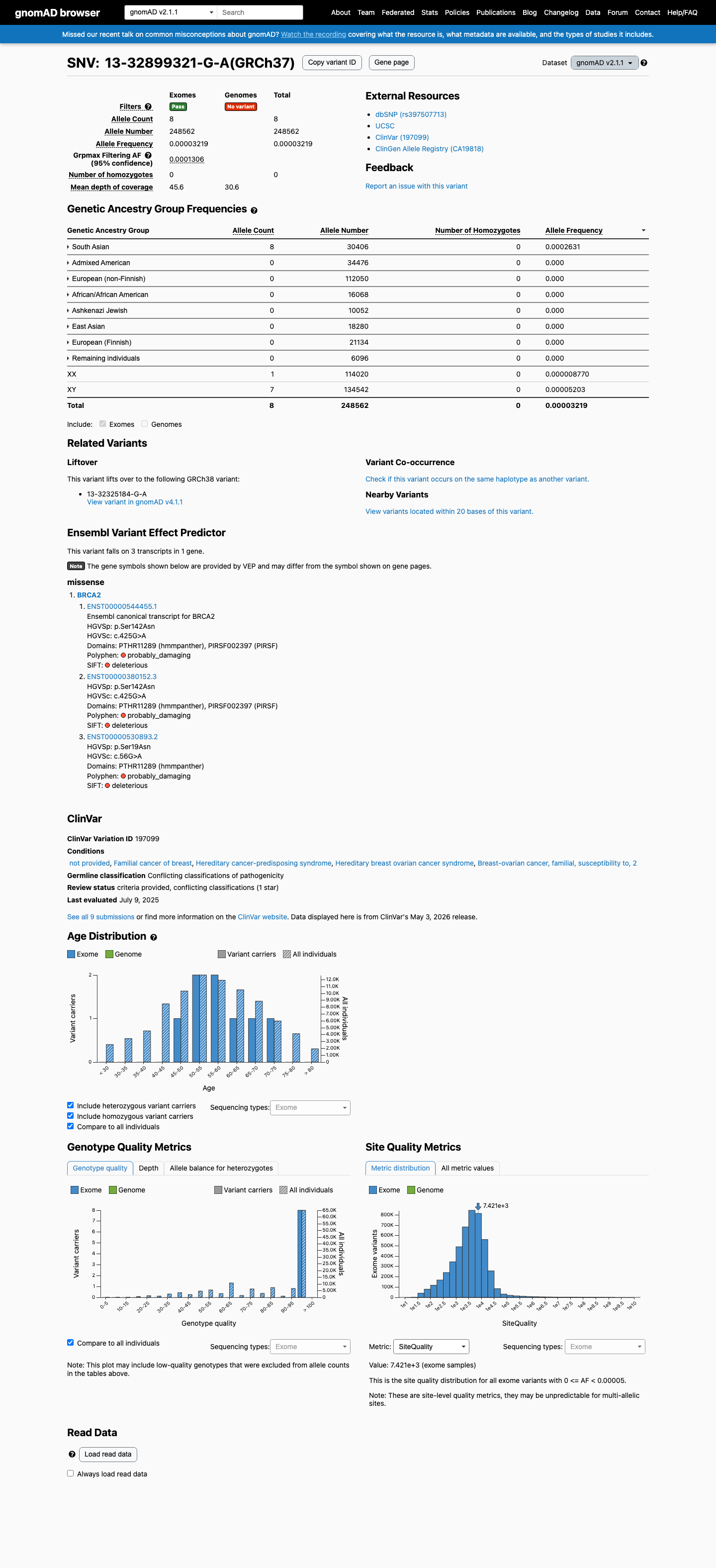
Absent from gnomAD v2.1.
🇨🇦 CA
This variant is absent from gnomAD-Canada.
Allele frequency by ancestry
three datasets · side by side
gnomAD v4.1
0.0028%
· 44 / 1,544,990
1 hom · FAF 0.024%
1 hom · FAF 0.024%
South Asian 30 / 89,438 |
0.034% 1 hom |
European (non-Finnish) 14 / 1,118,544 |
0.0013% |
+ 8 not observed (Remaining individuals, Admixed American, European (Finnish), Amish, East Asian, Middle Eastern, Ashkenazi Jewish, African/African American)
gnomAD v2.1
Absent
· 0 / ?
0 hom
0 hom
Not observed in any ancestry group.
gnomAD Canada 🇨🇦
Absent
· 0 / ?
0 hom
0 hom
Not observed in any ancestry group.

ClinVar
This variant has been reported in ClinVar as Uncertain significance (4 clinical laboratories) and as Likely pathogenic (3 clinical laboratories) and as Pathogenic (2 clinical laboratories). (ClinVarID = 197099)
In silico
SpliceAI predicts possible splice impact for this variant (max delta score = 0.91). REVEL score = 0.153. BayesDel score = -0.314007.
Functional
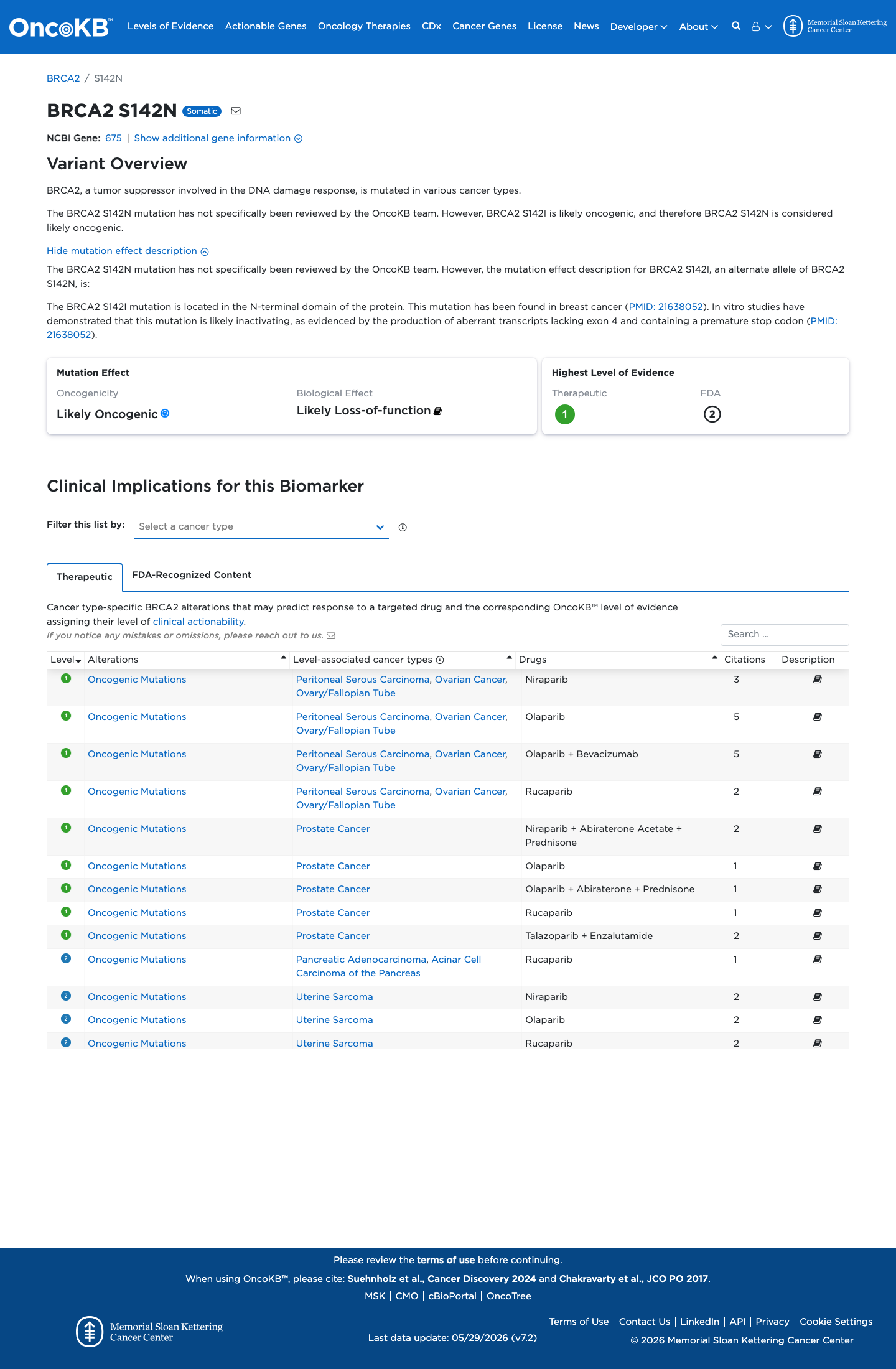
Likely Oncogenic
OncoKB did not identify variant-specific reviewed functional evidence for this variant; gene-level curated context is available for reviewer follow-up. BRCA2, a tumor suppressor involved in the DNA damage response, is mutated in various cancer types.

COSMIC

Cancer hotspots
Somatic evidence
Not in COSMIC / hotspots
COSMIC
This variant does not lie in a statistically significant hotspot. This variant has not previously been reported in somatic cancers (COSMIC).
Hotspots
This variant does not lie in a statistically significant hotspot.
Sources & reference links
Triaged references · 8 PMIDs not cited in assessment
21638052 ↗
Characterisation of unclassified variants in the BRCA1/2 genes with a putative effect on splicing.
ONCOKB
17576681 ↗
Aberrant 5' splice sites in human disease genes: mutation pattern, nucleotide structure and comparison of computational tools that predict their utilization.
CLINVAR
25741868 ↗
Standards and guidelines for the interpretation of sequence variants: a joint consensus recommendation of the American College of Medical Genetics and Genomics and the Association for Molecular Pathology.
CLINVAR
26467025 ↗
A Standardized DNA Variant Scoring System for Pathogenicity Assessments in Mendelian Disorders.
CLINVAR
31131967 ↗
Large scale multifactorial likelihood quantitative analysis of BRCA1 and BRCA2 variants: An ENIGMA resource to support clinical variant classification.
CLINVAR
32398771 ↗
Alternative mRNA splicing can attenuate the pathogenicity of presumed loss-of-function variants in BRCA2.
CLINVAR
32853339 ↗
Germline Sequencing DNA Repair Genes in 5545 Men With Aggressive and Nonaggressive Prostate Cancer.
CLINVAR
28492532 ↗
Sherloc: a comprehensive refinement of the ACMG-AMP variant classification criteria.
CLINVAR