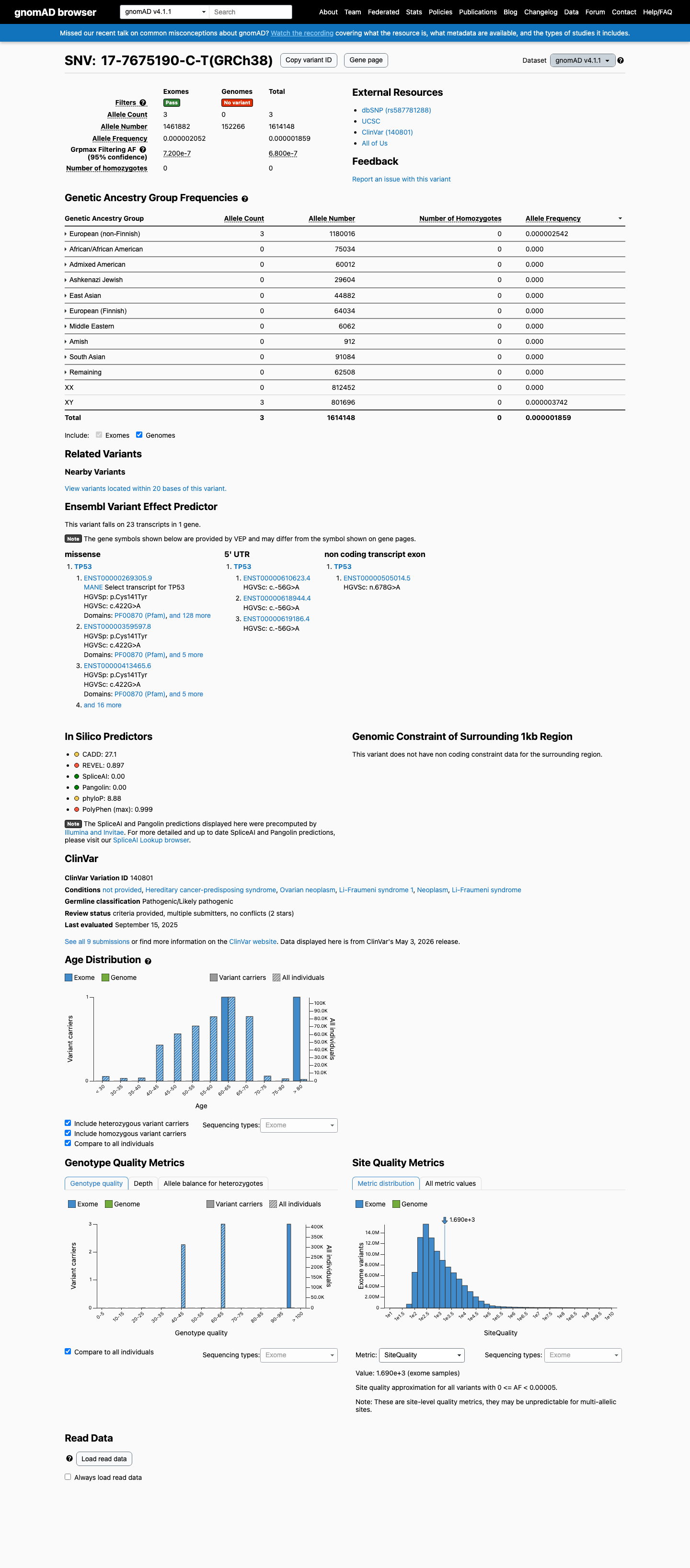
NM_000546.5:c.422G>A (p.Cys141Tyr) is a missense variant in exon 5 of TP53. This variant is extremely rare in population databases: gnomAD v4.1 total allele frequency = 1.86e-6 (3/1,614,148 alleles), meeting PM2_Supporting (VCEP threshold <0.00003). It is absent from gnomAD v2.1 and gnomAD-Canada.1 Functional studies demonstrate complete loss of function. The variant is non-functional in the Kato transactivation assay, and all additional eligible assays (Funk, Giacomelli, Kotler) show LOF, satisfying PS3 (strong) per TP53 VCEP specifications.2 In silico predictions strongly support a deleterious effect: BayesDel score = 0.568676, aGVGD Class C65, REVEL = 0.897. The VCEP PP3-BP4-codes.xlsx assigns PP3_moderate for c.422G>A.3 SpliceAI predicts no splicing impact (max delta = 0.00), confirming this variant is assessed as a missense change without splicing aberration.4 The variant has been reported in ClinVar as Pathogenic by 5 clinical laboratories and Likely Pathogenic by 2, and has been observed 182 times in COSMIC somatic cancer database.5 Combined Tavtigian point score (TP53 VCEP v2.4.0): PS3 (strong) = +4, PP3_moderate = +2, PM2_Supporting = +1. Total = +7 points, which falls in the Likely Pathogenic range (6-9 points).6 Additional criteria (PS4, PS2, PP1) could not be assessed due to lack of proband-level cancer phenotype data, de novo observations, and cosegregation data in the available evidence. If PS4 evidence becomes available with ≥4 points (≥1 proband with strongly associated LFS cancer), the total would reach ≥10 points, reclassifying the variant as Pathogenic.
Final classification
Likely Pathogenic
PS3PM2PP3
TP53
c.422G>A
p.Cys141Tyr
This variant
NM_000546.5:c.422G>A (p.Cys141Tyr) is a missense variant in exon 5 of TP53.
Tavtigian et.al., 2020 - Bayesian adaptation of Richards et.al., 2015 v2.4.0 point-based framework: PS3 strong (+4) + PM2 supporting (+1) + PP3 moderate (+2) = 7 points, which maps to Likely Pathogenic.
Classification rationale
PS3PM2PP3
Likely Pathogenic
TP53 c.422G>A
PS3 + PM2 + PP3
→
Likely Pathogenic
LYFE Sciences is an AI system, and it can make mistakes. Criteria
may be applied incorrectly, sources may be misread, and a confident-looking
classification can still be wrong. Double-check every criterion and
its underlying evidence before relying on any call.
Gene diagram
· NM_000546.5 · variants mapped to exon structure
TP53
NM_000546.5
Fetching transcript structure from UCSC…
Applied criteria · 3 applied · 13 assessed
MetEvidence satisfies this criterion.
Not metEvaluated against available evidence; threshold not reached.
Not assessedApplies in principle, but no evidence was found to evaluate it.
N/ADoesn't apply to this variant type.
Applied · 3
Strength
Supporting
Moderate
Strong
Very strong
PS3
strong
Pathogenic
The TP53 VCEP Functional-worksheet.xlsx (Supplementary Table S3) assigns PS3 to C141Y. Kato assay: Non-functional. Additional eligible assays: Funk — LOF, Giacomelli — LOF, Kotler — LOF. This satisfies the VCEP PS3 rule: 'Non-functional on Kato et al. data AND loss of function (LOF) by the majority of other eligible assays' (3 of 3 non-Kato assays show LOF), conferring PS3 (strong). The variant is non-functional across all tested platforms.
VCEP Functional-worksheet.xlsx assigns PS3 for C141YKato assay (PMID:12826609): Non-functionalFunk assay: LOF
PM2
supporting
Pathogenic
PM2_Supporting is met per VCEP specifications. gnomAD v4.1 total allele frequency = 1.86e-6 (0.000186%), which is well below the VCEP cutoff of <0.00003 (0.003%). In the highest subpopulation (European non-Finnish), AF = 2.54e-6 with 3 alleles across 1,180,016 alleles (<0.00004). The variant is absent from gnomAD v2.1 and gnomAD-Canada. The VCEP requires PM2 to be applied at supporting level for TP53.
gnomAD v4.1: AF = 1.86e-6 (3/1614148 alleles
PP3
moderate
Pathogenic
The TP53 VCEP PP3-BP4-codes.xlsx (Supplementary Table S2) assigns PP3_moderate to c.422G>A (p.Cys141Tyr). BayesDel score = 0.568676 (≥0.16), aGVGD Class C65, and SpliceAI max delta = 0.00 (no predicted splicing effect, so the missense in silico rules apply directly). This satisfies the VCEP PP3_moderate rule: aGVGD Class C65 and BayesDel score ≥0.16. REVEL score = 0.897, consistent with a damaging prediction.
VCEP PP3-BP4-codes.xlsx assigns PP3_moderate for c.422G>ABayesDel score = 0.568676 (≥0.16)aGVGD Class C65 (most pathogenic class)
Assessed · not applied
· 6 not met · 7 not assessed
Pathogenic
PS1
PS1 requires a different nucleotide change at the same codon that produces the identical amino acid change (e.g., c.421T>A also yields p.Cys141Tyr) and has been previously classified as Pathogenic or Likely Pathogenic per TP53 VCEP specifications.
PS2
No de novo evidence was identified for this variant.
PS4
PS4 requires proband counts with LFS-associated cancer phenotypes to calculate points per the VCEP PS4-Points-Table (strongly associated cancers = 4 pts, moderately associated = 2 pts per proband).
PM1
PM1 is not met.
PM5
PM5 is not met.
PP1
No cosegregation data is available for this variant.
PP4
No variant allele fraction (VAF) data is available to assess PP4.
Benign
BA1
BA1 is not met.
BS1
BS1 is not met.
BS2
No data are available on healthy females ≥60 years of age without cancer who carry this variant.
BS3
BS3 is not met.
BS4
No segregation data demonstrating lack of segregation in affected family members is available.
BP4
BP4 is not met.
N/A · 12
PVS1 · PM3 · PM4 · PM6 · PP2 · PP5 · BP1 · BP2 · BP3 · BP5 · BP6 · BP7
Research & evidence
Population frequency · supports pathogenic
gnomAD v4.1
gnomAD v2.1
v4.1
This variant is present in gnomAD v4.1 (AF= 1.85857e-06; MAF= 0.00019%, 3/1614148 alleles, homozygotes = 0) and has highest observed frequency in the European (non-Finnish) population (AF= 2.54234e-06; MAF= 0.00025%, 3/1180016 alleles, homozygotes = 0); grpmax FAF= 6.8e-07.
v2.1
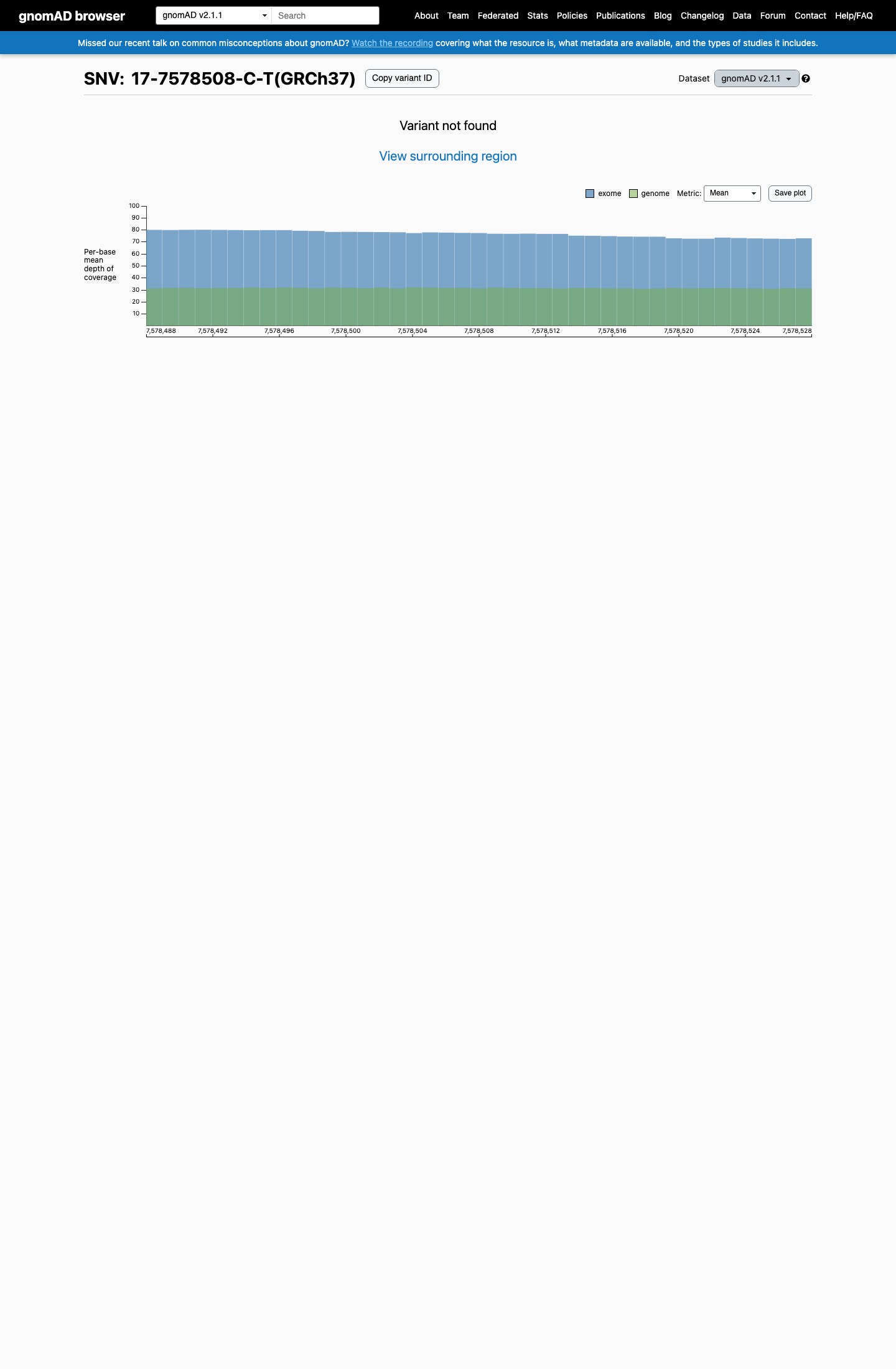
Absent from gnomAD v2.1.
🇨🇦 CA
This variant is absent from gnomAD-Canada.
Allele frequency by ancestry
three datasets · side by side
gnomAD v4.1
0.00019%
· 3 / 1,614,148
0 hom · FAF 6.8e-05%
0 hom · FAF 6.8e-05%
European (non-Finnish) 3 / 1,180,016 |
0.00025% |
+ 9 not observed (Remaining individuals, Admixed American, European (Finnish), Amish, East Asian, Middle Eastern, South Asian, Ashkenazi Jewish, African/African American)
gnomAD v2.1
Absent
· 0 / ?
0 hom
0 hom
Not observed in any ancestry group.
gnomAD Canada 🇨🇦
Absent
· 0 / ?
0 hom
0 hom
Not observed in any ancestry group.

ClinVar
This variant has been reported in ClinVar as Pathogenic (5 clinical laboratories) and as Likely pathogenic (2 clinical laboratories). (ClinVarID = 140801)

In silico
SpliceAI predicts no significant splice impact for this variant (max delta score = 0.00). REVEL score = 0.897. BayesDel score = 0.568676.
Functional
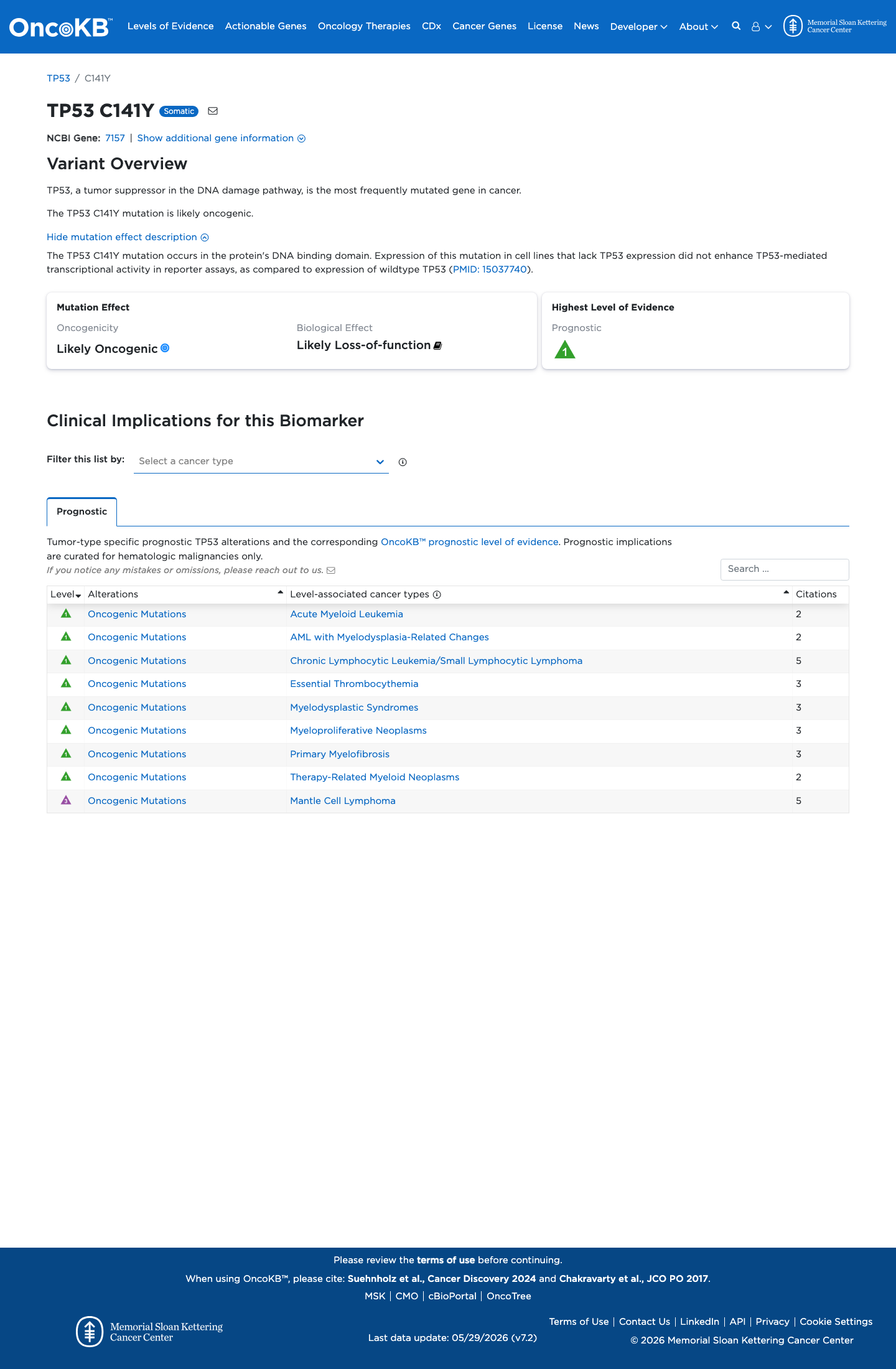
Likely Oncogenic
OncoKB identified variant-specific curated literature and context relevant to functional review; biological-effect context: Likely Loss-of-function; curated oncogenicity label: Likely Oncogenic.
COSMIC

Cancer hotspots
Somatic evidence
Hotspot
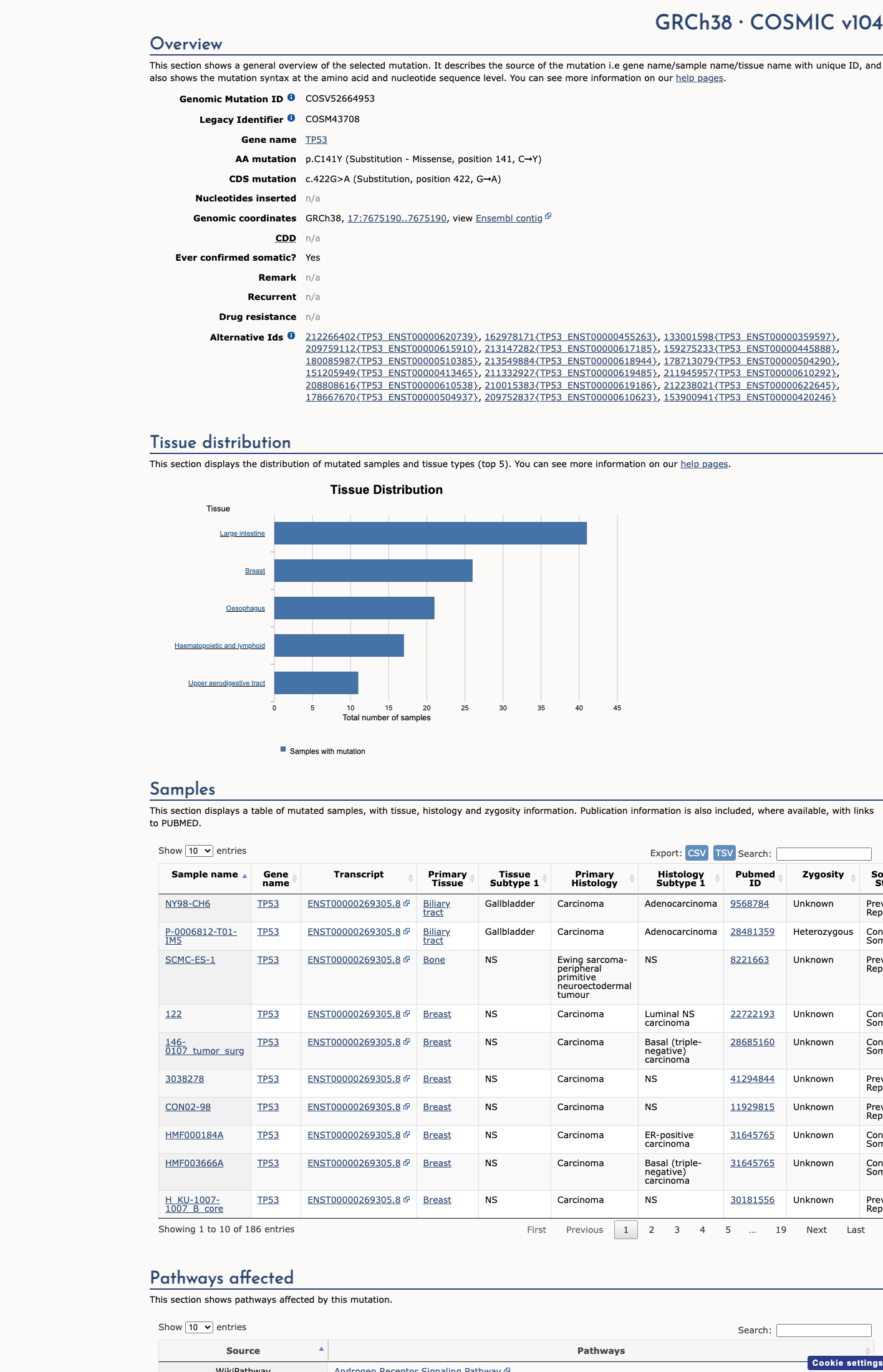
COSMIC
This variant lies in a statistically significant hotspot. This variant has previously been reported in somatic cancers (COSMIC; COSV52664953, n = 182 times).
Hotspots
This variant lies in a statistically significant hotspot.
Literature · how each cited paper was used
3papers cited
Each card is an audit: what was searched, what was found, whether it names the variant, which criteria it fed, and why. 10 further PMIDs triaged but not cited — see Sources & references.
Understanding the function-structure and function-mutation relationships of p53 tumor suppressor protein by high-resolution missense mutation analysis.
Found
VCEP Functional-worksheet.xlsx assigns PS3 for C141Y Kato assay (PMID:12826609): Non-functional Funk assay: LOF Giacomelli assay (PMID:30224644): LOF Kotler assay (PMID:29979965): LOF Majority of eligible assays (3/3 non-Kato) show LOF
Applied to
→PS3
strong
PMID 29979965
Found
VCEP Functional-worksheet.xlsx assigns PS3 for C141Y Kato assay (PMID:12826609): Non-functional Funk assay: LOF Giacomelli assay (PMID:30224644): LOF Kotler assay (PMID:29979965): LOF Majority of eligible assays (3/3 non-Kato) show LOF
Applied to
→PS3
strong
PMID 30224644
Found
VCEP Functional-worksheet.xlsx assigns PS3 for C141Y Kato assay (PMID:12826609): Non-functional Funk assay: LOF Giacomelli assay (PMID:30224644): LOF Kotler assay (PMID:29979965): LOF Majority of eligible assays (3/3 non-Kato) show LOF
Applied to
→PS3
strong
Sources & reference links
Triaged references · 10 PMIDs not cited in assessment
16861262 ↗
Inactive full-length p53 mutants lacking dominant wild-type p53 inhibition highlight loss of heterozygosity as an important aspect of p53 status in human cancers.
CLINVAR
20128691 ↗
Analysis of the DNA-binding activity of p53 mutants using functional protein microarrays and its relationship to transcriptional activation.
CLINVAR
21232794 ↗
A comprehensive study of TP53 mutations in chronic lymphocytic leukemia: Analysis of 1287 diagnostic and 1148 follow-up CLL samples.
CLINVAR
21343334 ↗
Dominant-negative features of mutant TP53 in germline carriers have limited impact on cancer outcomes.
CLINVAR
24256616 ↗
Identification of new p53 target microRNAs by bioinformatics and functional analysis.
CLINVAR
25741868 ↗
Standards and guidelines for the interpretation of sequence variants: a joint consensus recommendation of the American College of Medical Genetics and Genomics and the Association for Molecular Pathology.
CLINVAR
19042984 ↗
National Academy of Clinical Biochemistry laboratory medicine practice guidelines for use of tumor markers in testicular, prostate, colorectal, breast, and ovarian cancers.
CLINVAR
22964825 ↗
Screening for ovarian cancer: U.S. Preventive Services Task Force reaffirmation recommendation statement.
CLINVAR
28492532 ↗
Sherloc: a comprehensive refinement of the ACMG-AMP variant classification criteria.
CLINVAR