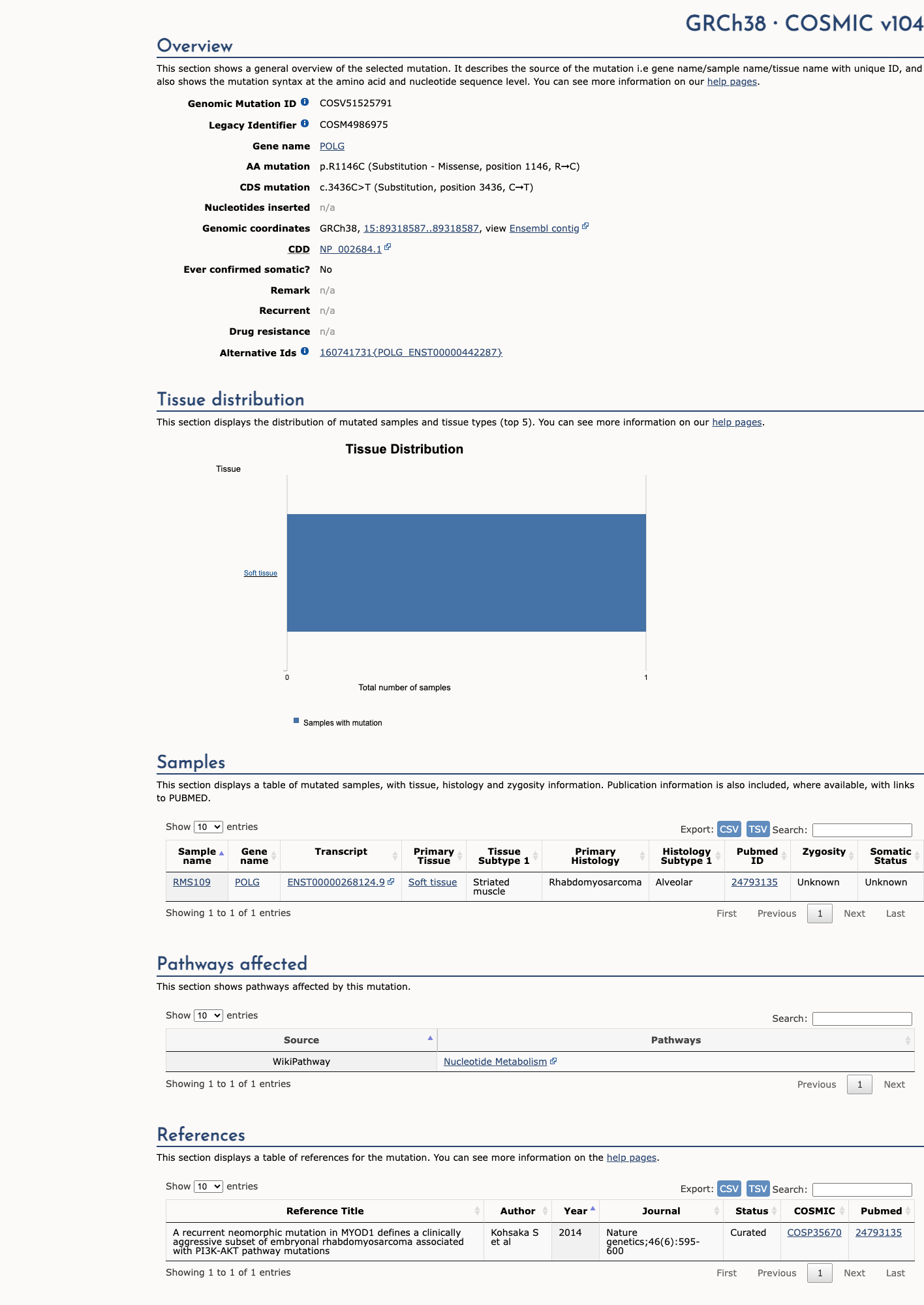
NM_001126131.1:c.3436C>T (p.Arg1146Cys) is a missense variant in exon 21 of POLG, encoding the catalytic subunit of mitochondrial DNA polymerase gamma. This variant is present in gnomAD v2.1 at an overall allele frequency of 0.01874% (53/282,776 alleles, 0 homozygotes), with the highest subpopulation frequency of 0.03508% in the East Asian population, exceeding the VCEP BS1 threshold of >0.0092%.1 The variant is absent from gnomAD v4.1 and gnomAD-Canada.2 The REVEL in silico prediction score of 0.915 exceeds the VCEP threshold of >0.75 for PP3 at Supporting strength, indicating computational evidence of a deleterious effect.3 SpliceAI predicts no splicing impact (max delta score = 0.00).4 This variant has been reported in ClinVar (VariationID: 21313) as a Variant of Uncertain Significance by 8 clinical laboratories and as Benign by 1 clinical laboratory (review status: criteria provided, single submitter).5 The variant has been observed once in the COSMIC somatic cancer database (COSV51525791). Amino acid position 1146 is not located within any of the POLG functional domains specified by the VCEP (TPP binding site, heterodimer interface, heterotetramer interface, or phosphorylation loop).6 No de novo observations, segregation data, same-residue pathogenic comparators, or functional studies were identified for this specific variant in the available evidence. Applying the VCEP framework: BS1 (Strong benign) is met based on population frequency exceeding the gene-specific threshold; PP3 (Supporting pathogenic) is met based on REVEL score >0.75. No other criteria are met. The strong benign criterion outweighs the single supporting pathogenic criterion.7
Final classification
VUS
PP3BS1
POLG
c.3436C>T
p.Arg1146Cys
This variant
NM_001126131.1:c.3436C>T (p.Arg1146Cys) is a missense variant in exon 21 of POLG, encoding the catalytic subunit of mitochondrial DNA polymerase gamma.
ClinGen Mitochondrial Disease Nuclear and Mitochondrial Expert Panel Specifications to the ACMG/AMP Variant Interpretation Guidelines Version 1_ntDNA v1.0.0 lacked a usable explicit final combination framework, so generic ACMG/AMP 2015 final-combination rules were applied as fallback; applied criteria: PP3 supporting, BS1 strong; combination = 1 supporting + 1 strong benign, which maps to VUS.
Classification rationale
PP3
BS1
VUS
POLG c.3436C>T
PP3 + BS1
→
VUS
LYFE Sciences is an AI system, and it can make mistakes. Criteria
may be applied incorrectly, sources may be misread, and a confident-looking
classification can still be wrong. Double-check every criterion and
its underlying evidence before relying on any call.
Gene diagram
· NM_001126131.1 · variants mapped to exon structure
POLG
NM_001126131.1
Fetching transcript structure from UCSC…
Applied criteria · 2 applied · 14 assessed
MetEvidence satisfies this criterion.
Not metEvaluated against available evidence; threshold not reached.
Not assessedApplies in principle, but no evidence was found to evaluate it.
N/ADoesn't apply to this variant type.
Applied · 2
Strength
Supporting
Moderate
Strong
Very strong
PP3
supporting
Pathogenic
The REVEL in silico predictor score of 0.915 exceeds the VCEP-specified threshold of >0.75 for PP3 at Supporting strength, indicating multiple lines of computational evidence support a deleterious effect.
REVEL score = 0.915. VCEP PP3 threshold: REVEL >0.75 (Supporting). BayesDel score = 0.513 (supportive but not independently applied per VCEP). SpliceAI max delta = 0.00 (no splicing impact).
BS1
strong
Benign
The variant is present in gnomAD v2.1 at an overall allele frequency of 0.01874% (53/282,776 alleles) with a maximum subpopulation frequency of 0.03508% in East Asians, which exceeds the POLG VCEP BS1 threshold of >0.0092%.
gnomAD v2.1: overall AF=0.01874% (53/282776 alleles0 homozygotes)
Assessed · not applied
· 14 not met · 0 not assessed
Pathogenic
PS1
No evidence of a different nucleotide change at codon 1146 resulting in the same amino acid change (p.Arg1146Cys) that has been established as pathogenic.
PS2
No de novo observation for this variant has been reported in any of the available evidence sources or publications.
PM1
Amino acid position 1146 (Arg1146) is not located within any of the POLG functional domains specified by the VCEP: TPP binding site, alpha-beta heterodimer interface, alpha2-beta2 heterotetramer interface, or phosphorylation loop region.
PM2
The variant is present in gnomAD v2.1 at an allele frequency of 0.01874% (53/282,776 alleles), which exceeds the POLG VCEP PM2 threshold of <0.00092%.
PM5
No pathogenic missense variants at amino acid position 1146 other than p.Arg1146Cys were identified in ClinVar or the literature.
PM6
No de novo observation (confirmed or assumed) for this variant has been reported in any available evidence source or publication.
PP1
No co-segregation data is available for this variant.
PP4
No patient phenotype data is available for this adjudication.
Benign
BA1
The maximum population allele frequency of 0.03508% (gnomAD v2.1 East Asian) is below the POLG VCEP BA1 threshold of >0.092%.
BS2
No homozygous individuals are observed in gnomAD (0 homozygotes across 282,776 alleles in v2.1; absent in v4.1).
BS4
No segregation data is available for this variant.
BP2
No evidence of the variant being observed in trans with a pathogenic variant or in cis with a pathogenic variant has been reported.
BP4
The REVEL score of 0.915 far exceeds the VCEP BP4 threshold of <0.15.
BP5
No evidence has been identified of this variant being found in a case with an alternate molecular basis for disease.
N/A · 10
PVS1 · PS3 · PS4 · PP2 · PP5 · BS3 · BP1 · BP3 · BP6 · BP7
Research & evidence
Population frequency
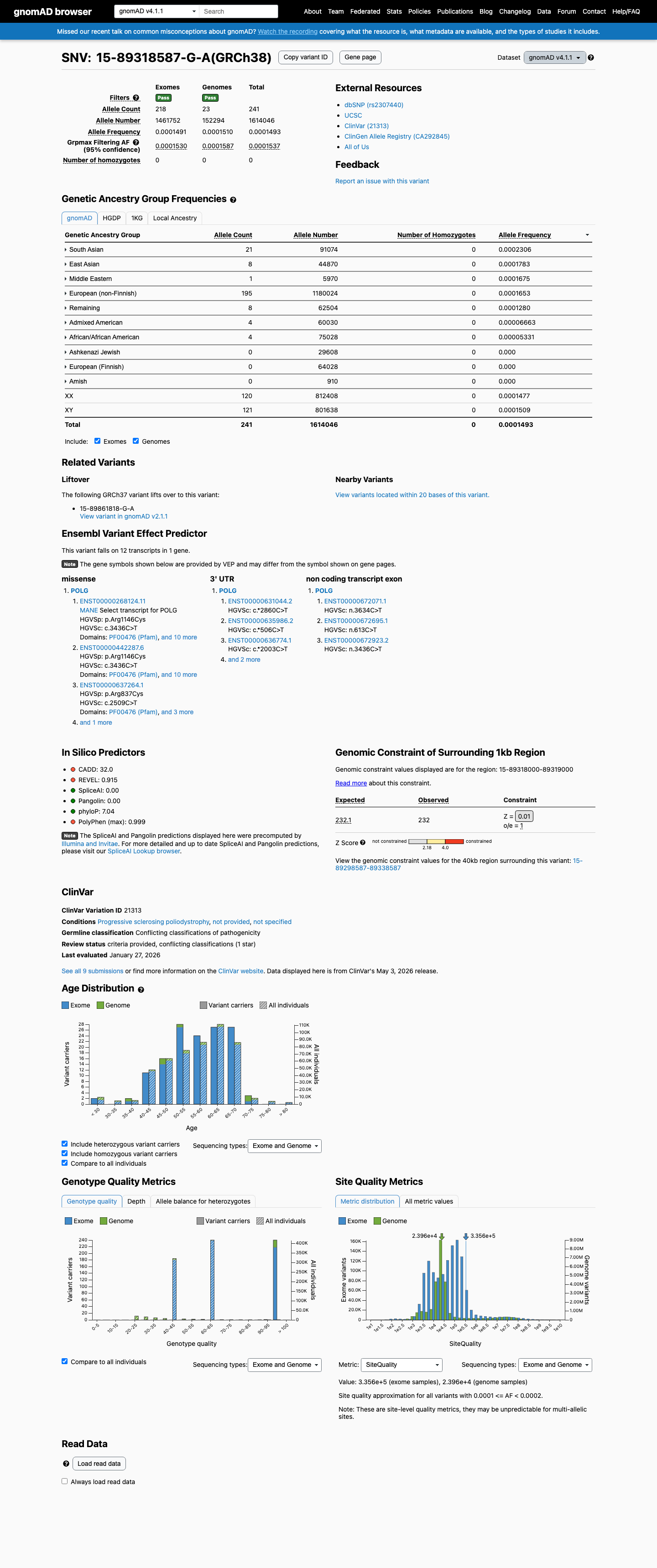
gnomAD v4.1
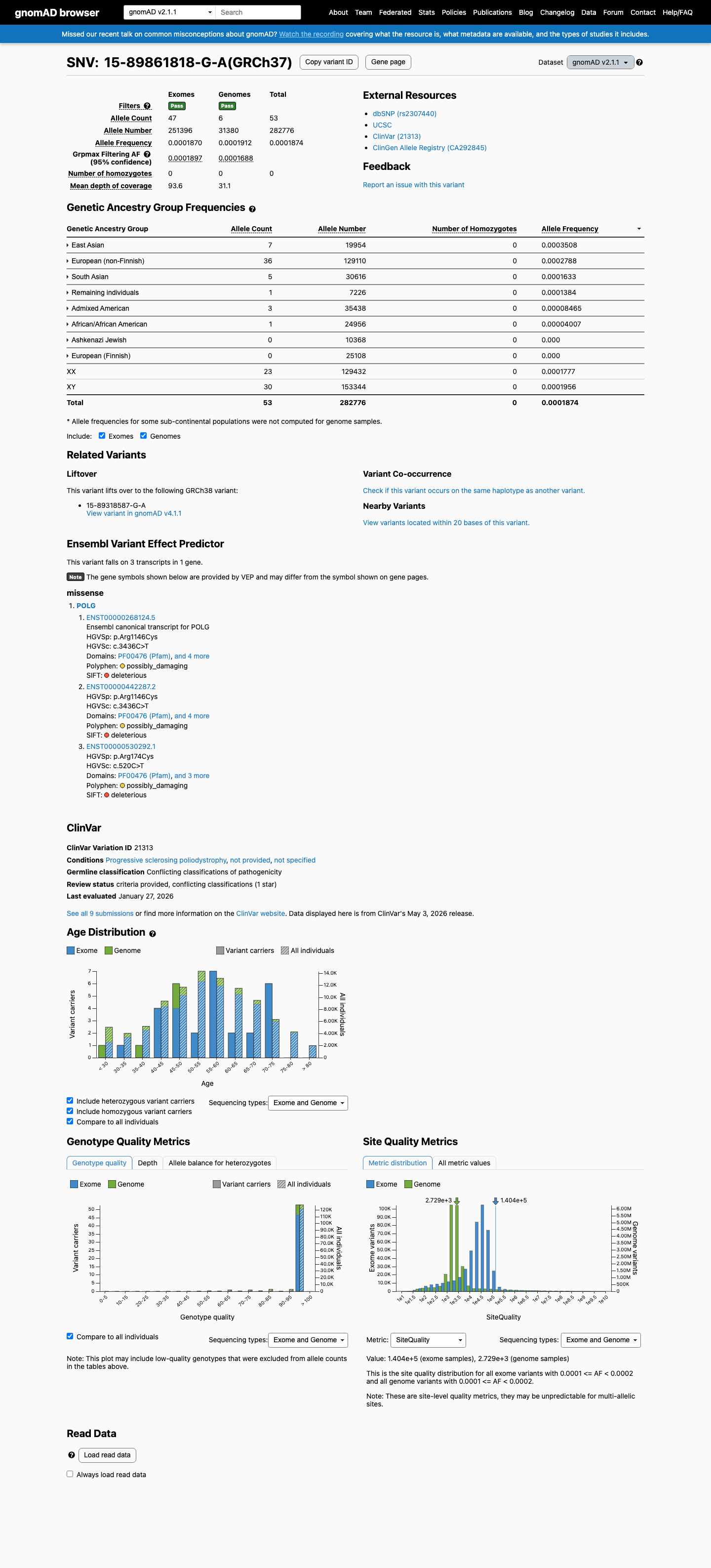
gnomAD v2.1
v4.1
Absent from gnomAD v4.1.
v2.1
This variant is present in gnomAD v2.1 (AF= 0.000187428; MAF= 0.01874%, 53/282776 alleles, homozygotes = 0) and has highest observed frequency in the East Asian population (AF= 0.000350807; MAF= 0.03508%, 7/19954 alleles, homozygotes = 0); grpmax FAF= 0.00018972.
🇨🇦 CA
This variant is absent from gnomAD-Canada.
Allele frequency by ancestry
three datasets · side by side
gnomAD v4.1
Absent
· 0 / ?
0 hom
0 hom
Not observed in any ancestry group.
gnomAD v2.1
0.019%
· 53 / 282,776
0 hom · FAF 0.019%
0 hom · FAF 0.019%
East Asian 7 / 19,954 |
0.035% |
European (non-Finnish) 36 / 129,110 |
0.028% |
South Asian 5 / 30,616 |
0.016% |
Remaining individuals 1 / 7,226 |
0.014% |
Admixed American 3 / 35,438 |
0.0085% |
African/African American 1 / 24,956 |
0.004% |
+ 2 not observed (Ashkenazi Jewish, European (Finnish))
gnomAD Canada 🇨🇦
Absent
· 0 / ?
0 hom
0 hom
Not observed in any ancestry group.

ClinVar
This variant has been reported in ClinVar as Uncertain significance (8 clinical laboratories) and as Benign (1 clinical laboratory). (ClinVarID = 21313)
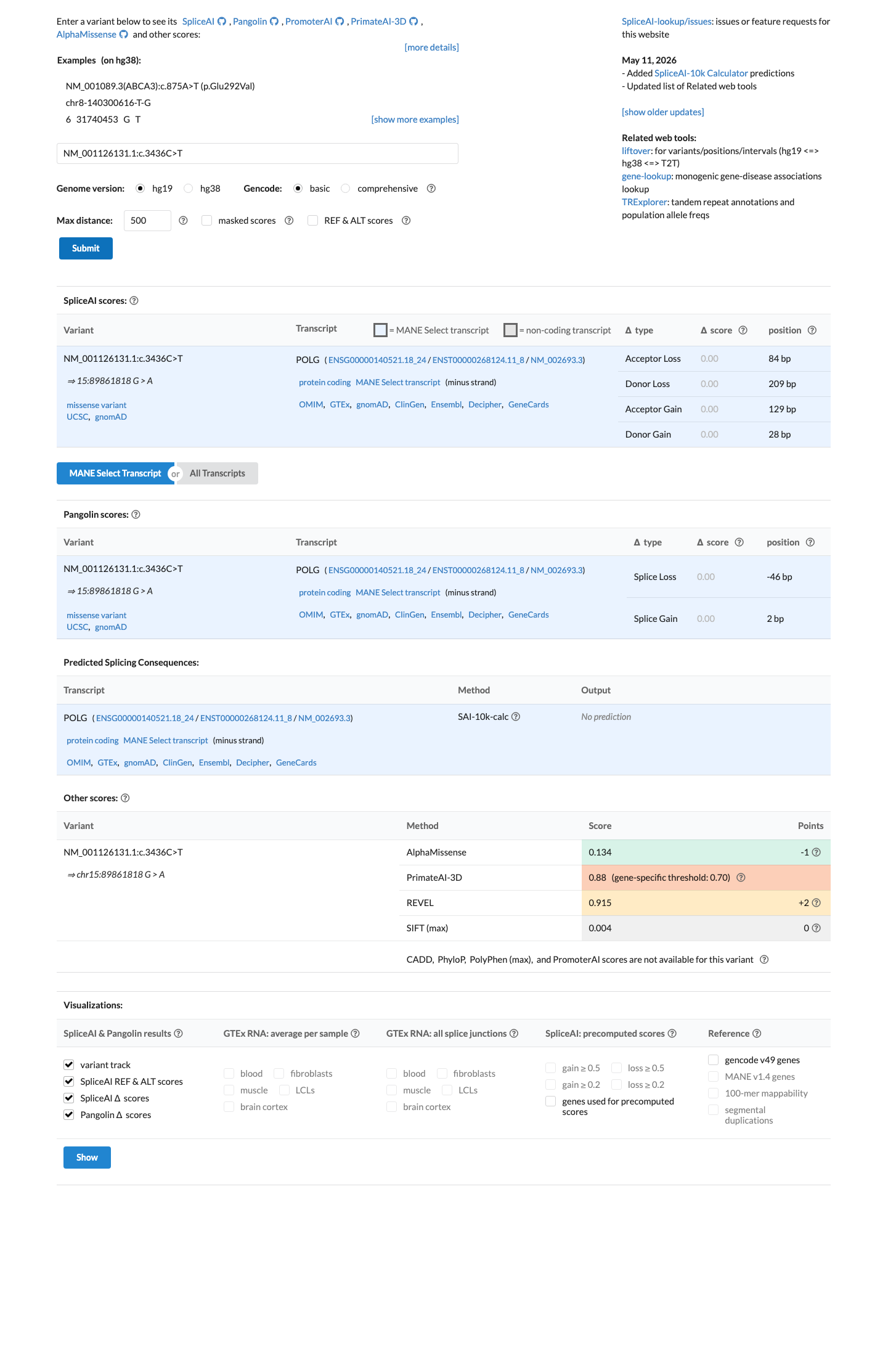
In silico
SpliceAI predicts no significant splice impact for this variant (max delta score = 0.00). REVEL score = 0.915. BayesDel score = 0.512792.
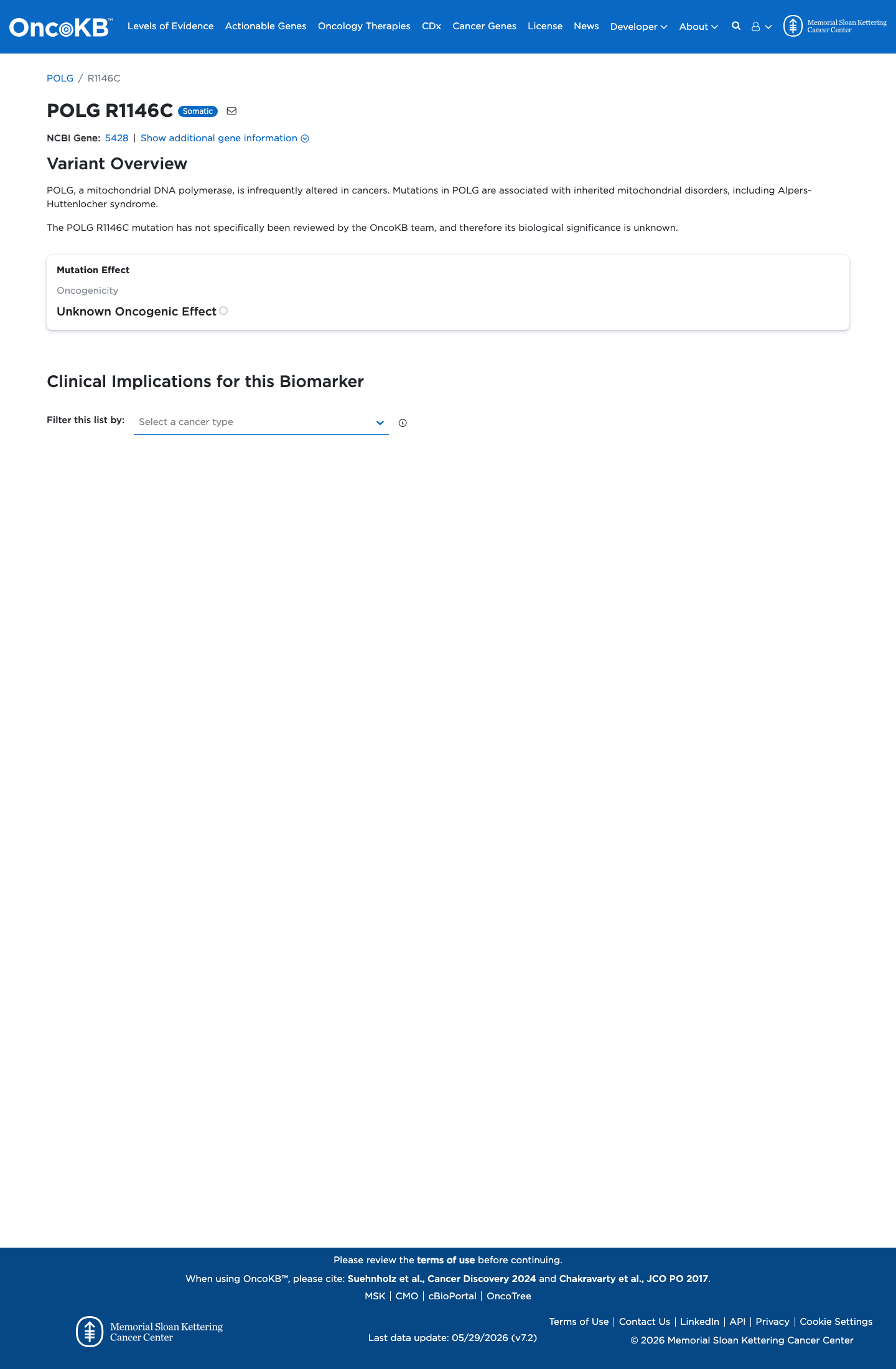
Functional
Unknown Oncogenic Effect
OncoKB did not identify variant-specific reviewed functional evidence for this variant; gene-level curated context is available for reviewer follow-up. POLG, a mitochondrial DNA polymerase, is infrequently altered in cancers. Mutations in POLG are associated with inherited mitochondrial disorders, inc
COSMIC

Cancer hotspots
Somatic evidence
Not in COSMIC / hotspots
COSMIC
This variant does not lie in a statistically significant hotspot. This variant has previously been reported in somatic cancers (COSMIC; COSV51525791, n = 1 times).
Hotspots
This variant does not lie in a statistically significant hotspot.
Sources & reference links
Triaged references · 9 PMIDs not cited in assessment
16401742 ↗
Association of novel POLG mutations and multiple mitochondrial DNA deletions with variable clinical phenotypes in a Spanish population.
CLINVAR
20843780 ↗
Identification of rare DNA variants in mitochondrial disorders with improved array-based sequencing.
CLINVAR
21880868 ↗
Mitochondrial DNA polymerase gamma mutations: an ever expanding molecular and clinical spectrum.
CLINVAR
25462018 ↗
Polymorphisms in DNA polymerase γ affect the mtDNA stability and the NRTI-induced mitochondrial toxicity in Saccharomyces cerevisiae.
CLINVAR
25741868 ↗
Standards and guidelines for the interpretation of sequence variants: a joint consensus recommendation of the American College of Medical Genetics and Genomics and the Association for Molecular Pathology.
CLINVAR
26467025 ↗
A Standardized DNA Variant Scoring System for Pathogenicity Assessments in Mendelian Disorders.
CLINVAR
30838265 ↗
Dystonia in a Patient with Autosomal-Dominant Progressive External Ophthalmoplegia Type 1 Caused by Mutation in the POLG Gene.
CLINVAR
32613234 ↗
The role of genetics in Parkinson's disease: a large cohort study in Chinese mainland population.
CLINVAR
28492532 ↗
Sherloc: a comprehensive refinement of the ACMG-AMP variant classification criteria.
CLINVAR