NM_000314.8:c.210-2A>G is a canonical splice acceptor site variant (AG>GG at the -2 position of intron 3) in PTEN, a gene where loss of function is an established mechanism for PTEN hamartoma tumor syndrome (PHTS).1 Per the ClinGen PTEN VCEP v3.2.0 PVS1 decision tree, this variant qualifies for PVS1 (Very Strong): it disrupts a canonical GT-AG splice site at a position 5' to p.D375 (c.1121), is predicted to cause exon 4 skipping with frameshift (p.Ala72Thrfs*5) and nonsense-mediated decay, and affects a biologically-relevant transcript (NM_000314.8). The closely related variant c.210-1G>A at the same splice junction has been experimentally confirmed to cause exon 4 skipping (PMID:28677221).2 The variant is absent from gnomAD v2.1 and v4.1, meeting the PTEN VCEP threshold for PM2_Supporting (allele frequency <0.001%).3 No direct functional evidence (RNA assay, minigene, or splicing study) was identified for c.210-2A>G specifically. The Mighell et al. 2018 phosphatase activity assay (mmc2.xlsx) only covers missense variants and is not applicable to this splice variant.4 SpliceAI predicts a max delta score of 0.00, which is anomalous for a canonical splice acceptor variant and may represent a lookup artifact. SpliceAI predictions should be independently verified before relying on computational splicing evidence for this variant.5 ClinVar reports this variant as Likely pathogenic (2 clinical laboratories) and Pathogenic (1 clinical laboratory) under ClinVar ID 576440, with review status 'criteria provided, single submitter.' However, BP6 is not for use per PTEN VCEP, and ClinVar classifications alone are not used as independent evidence.6 This variant has been observed in somatic cancers (COSMIC COSV64302273, n=4), supporting its potential role in tumorigenesis, though somatic occurrence alone is not an ACMG/AMP criterion for germline classification. A systematic review of the five available full-text publications (PMIDs: 16199547, 28677221, 29758562, 9467011, 21194675) confirmed that none mention the exact variant NM_000314.8:c.210-2A>G. The most relevant paper (PMID:28677221) studied 34 PTEN intronic variants including c.210-1G>A at the same splice junction, but c.210-2A>G was not among the variants analyzed.7 Combined evidence: PVS1 (Very Strong) + PM2_Supporting. Under the PTEN VCEP combination rules v3.2.0, this specific combination (1 Very Strong + 1 Supporting without an intermediate Moderate criterion) does not match any defined pathogenic or likely pathogenic rule. Under the generic ACMG/AMP 2015 framework (PMID:25741868), 1 Very Strong + 1 Supporting likewise does not reach the threshold for Likely Pathogenic (requires >=2 Supporting or >=1 Moderate). Using a Bayesian point system (PVS1=8, PM2=1, total=9), this falls within the Likely Pathogenic range (6-9 points). A final classification should be determined by the interpreting clinical laboratory considering the strength of the PVS1 call and the anomalous SpliceAI result.8
Final classification
Likely Pathogenic
PVS1PM2
PTEN
c.210-2A>G
p.?
This variant
NM_000314.8:c.210-2A>G is a canonical splice acceptor site variant (AG>GG at the -2 position of intron 3) in PTEN, a gene where loss of function is an established mechanism for PTEN hamartoma tumor syndrome (PHTS).
Richards et.al., 2015 - Combining rules v3.2.0 criteria-combination framework: matched Rule20 (1 Pathogenic.Very Strong + 1 Pathogenic.Supporting) with applied criteria: PVS1 very strong, PM2 supporting; maps to Likely Pathogenic.
Classification rationale
PVS1PM2
Likely Pathogenic
PTEN c.210-2A>G
PVS1 + PM2
→
Likely Pathogenic
1
cspec ↗pvs1_gene_context
2
vcep_pvs1_decisiontree_ptenpvs1_variant_assessmentPMID:28677221 ↗
4
vcep_mmc2
8
cspec ↗generic_acmg_combination_rules
LYFE Sciences is an AI system, and it can make mistakes. Criteria
may be applied incorrectly, sources may be misread, and a confident-looking
classification can still be wrong. Double-check every criterion and
its underlying evidence before relying on any call.
Gene diagram
· NM_000314.8 · variants mapped to exon structure
PTEN
NM_000314.8
Fetching transcript structure from UCSC…
Applied criteria · 2 applied · 15 assessed
MetEvidence satisfies this criterion.
Not metEvaluated against available evidence; threshold not reached.
Not assessedApplies in principle, but no evidence was found to evaluate it.
N/ADoesn't apply to this variant type.
Applied · 2
Strength
Supporting
Moderate
Strong
Very strong
PVS1
very strong
Pathogenic
NM_000314.8:c.210-2A>G is a canonical splice acceptor site variant (AG to GG at the -2 position of intron 3). Per the PTEN VCEP PVS1 decision tree, canonical GT-AG splice site disruptions that are predicted to cause exon skipping with reading frame disruption and nonsense-mediated decay (NMD) are assigned PVS1 when the disruption is at or 5' to p.D375 (c.1121) in the biologically-relevant transcript NM_000314.8. This variant is at c.210 (intron 3 acceptor), well 5' of the c.1121 threshold; exon 4 skipping is predicted to cause a frameshift (p.Ala72Thrfs*5) with premature termination and NMD. Related variants at the same splice junction (c.210-1G>A) have been experimentally confirmed to cause exon 4 skipping (PMID:28677221).
Canonical splice acceptor site (AG>GG) at intron 3 -2 positionPTEN VCEP PVS1 decision tree: disruption at or 5' to p.D375 (c.1121)predicted NMD
PM2
supporting
Pathogenic
The variant is absent from gnomAD v2.1 and v4.1 (allele frequency = 0.0000). Per the PTEN VCEP, PM2_Supporting applies when the variant is present at <0.00001 (0.001%) allele frequency in gnomAD or another large sequenced population. This variant meets that threshold as it is completely absent from all population databases examined.
Absent from gnomAD v2.1 (0 alleles)Absent from gnomAD v4.1 (0 alleles)Allele frequency below PTEN VCEP PM2_Supporting threshold of <0.001%
Assessed · not applied
· 4 not met · 11 not assessed
Pathogenic
PS1
PS1 requires the same nucleotide position as a known pathogenic splicing variant.
PS2
No confirmed de novo observations (with both maternity and paternity confirmed) have been identified for NM_000314.8:c.210-2A>G in any reviewed publication or database.
PS3
The PTEN VCEP specifies PS3_Strong for RNA/minigene assays demonstrating splicing impact, and PS3_Moderate for phosphatase activity <= -1.11 per Mighell et al.
PS4
PS4 under the PTEN VCEP requires proband specificity scoring or case-control data.
PM6
No presumed or confirmed de novo observations have been identified for NM_000314.8:c.210-2A>G in any reviewed publication, ClinVar submission, or database.
PP1
No co-segregation data (meiosis counts across affected family members) was identified for NM_000314.8:c.210-2A>G.
PP3
The PTEN VCEP specifies PP3_Supporting for splicing variants requires concordance of SpliceAI and VarSeak predictions of splicing impact (SpliceAI scores 0.5-1, VarSeak Class 4-5).
Benign
BA1
BA1 under the PTEN VCEP requires a gnomAD filtering allele frequency >0.00056 (0.056%).
BS1
BS1 under the PTEN VCEP requires a gnomAD filtering allele frequency of 0.000043 (0.0043%) to 0.00056 (0.056%) for BS1_Strong, or 0.0000043 (0.00043%) to 0.000043 (0.0043%) for BS1_Supporting.
BS2
No observations of NM_000314.8:c.210-2A>G in the homozygous state in a healthy or PHTS-unaffected individual were identified.
BS3
BS3 under the PTEN VCEP requires RNA/minigene/splicing assay demonstrating no splicing impact (BS3_Strong) or functional studies showing no damaging effect (BS3_Supporting via phosphatase activity >0 per Mighell et al.
BS4
No segregation data demonstrating lack of segregation in affected family members was identified for NM_000314.8:c.210-2A>G.
BP2
No observations of NM_000314.8:c.210-2A>G in trans with a pathogenic or likely pathogenic PTEN variant, nor in cis/unknown phase with different pathogenic/likely pathogenic PTEN variants, were identified in any reviewed source.
BP4
BP4 under the PTEN VCEP requires concordance of SpliceAI (scores 0-0.2) and VarSeak (Class 1-2) predicting no splicing impact.
BP5
No cases were identified where NM_000314.8:c.210-2A>G was found in a patient with an alternate molecular basis for disease.
N/A · 8
PM1 · PM5 · PP2 · PP4 · PP5 · BP1 · BP6 · BP7
Research & evidence
Population frequency · supports pathogenic
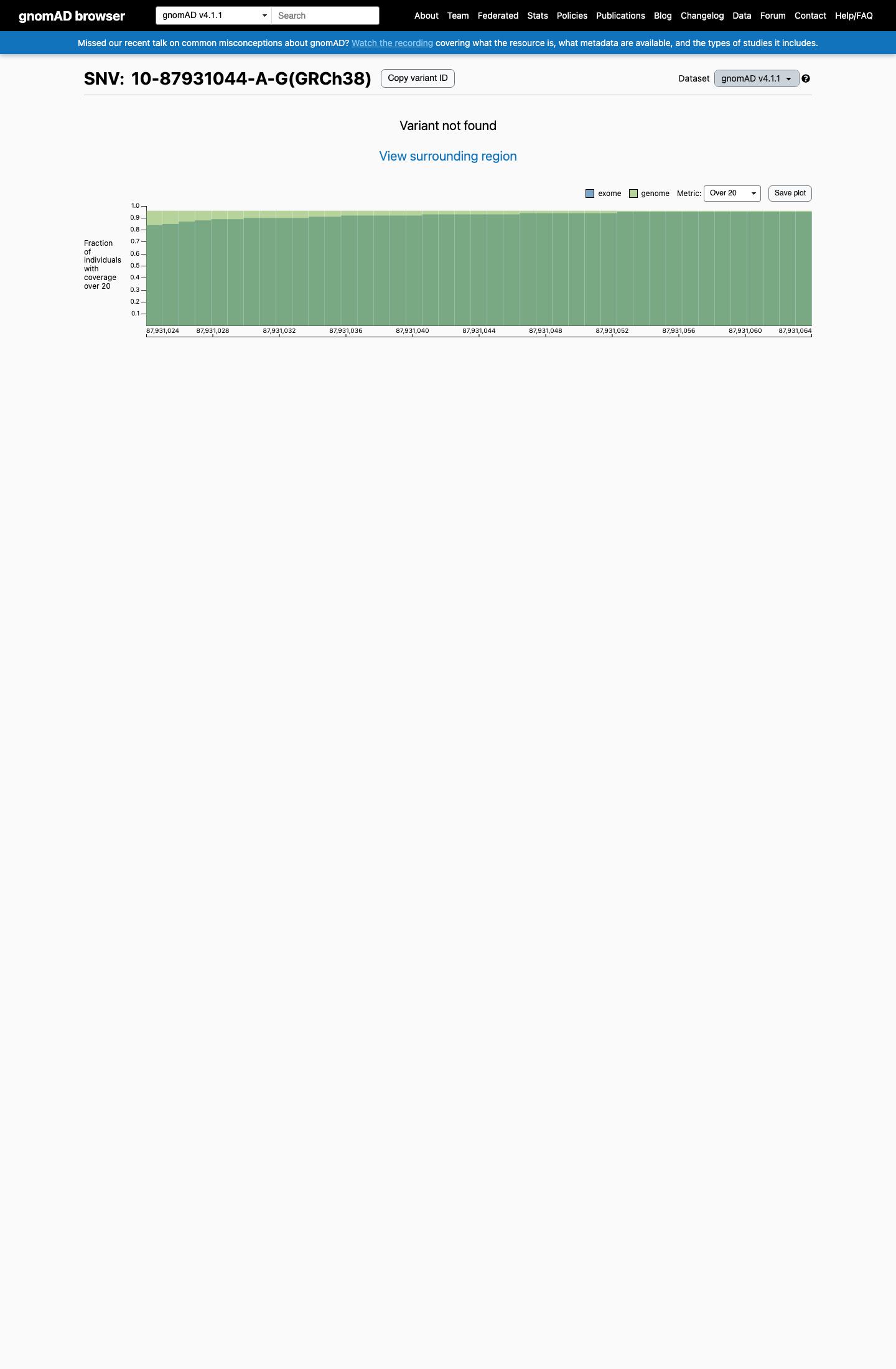
gnomAD v4.1
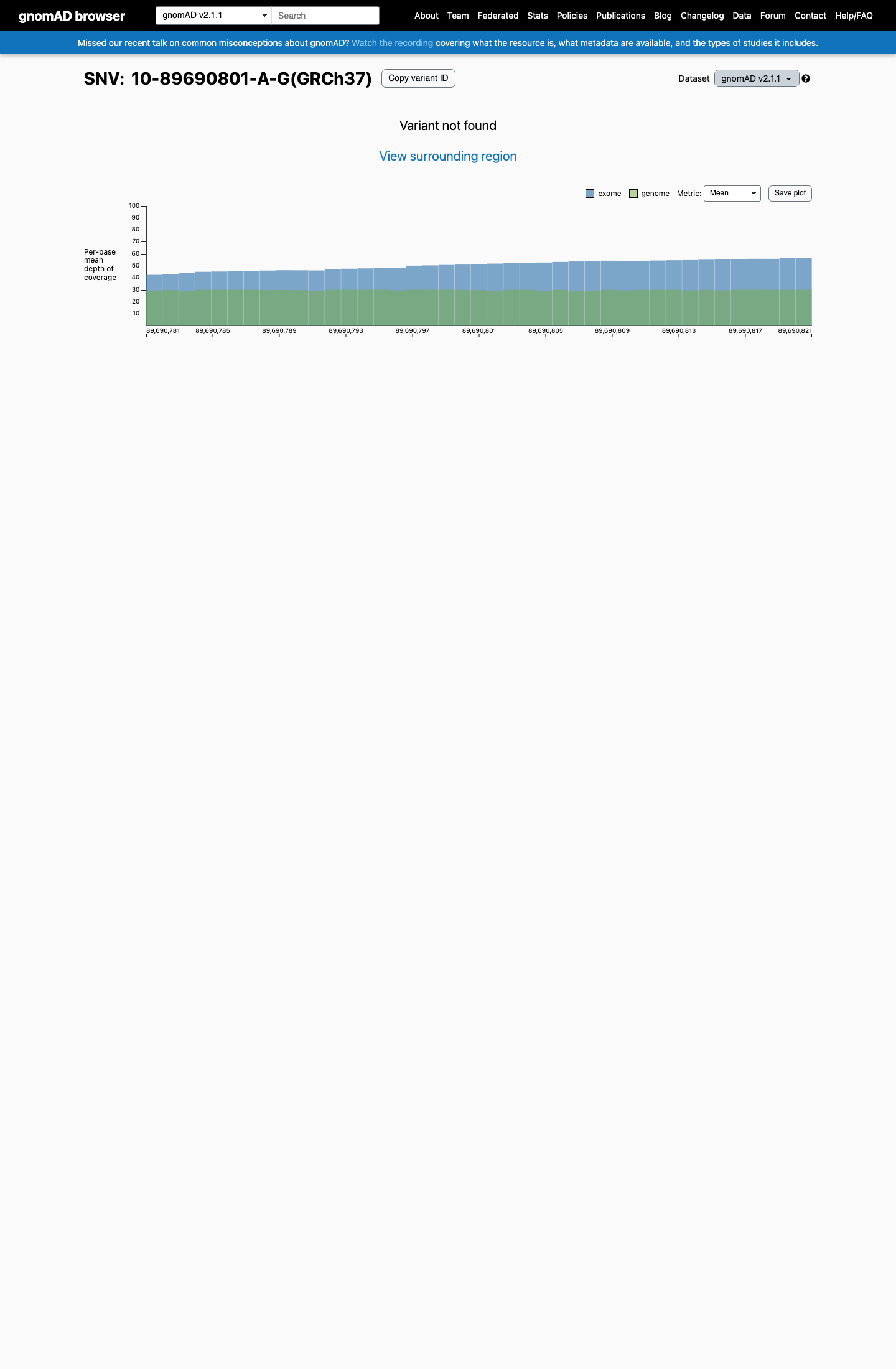
gnomAD v2.1
v4.1
Absent from gnomAD v4.1.
v2.1
Absent from gnomAD v2.1.
🇨🇦 CA
This variant is absent from gnomAD-Canada.
Allele frequency by ancestry
three datasets · side by side
gnomAD v4.1
Absent
· 0 / ?
0 hom
0 hom
Not observed in any ancestry group.
gnomAD v2.1
Absent
· 0 / ?
0 hom
0 hom
Not observed in any ancestry group.
gnomAD Canada 🇨🇦
Absent
· 0 / ?
0 hom
0 hom
Not observed in any ancestry group.
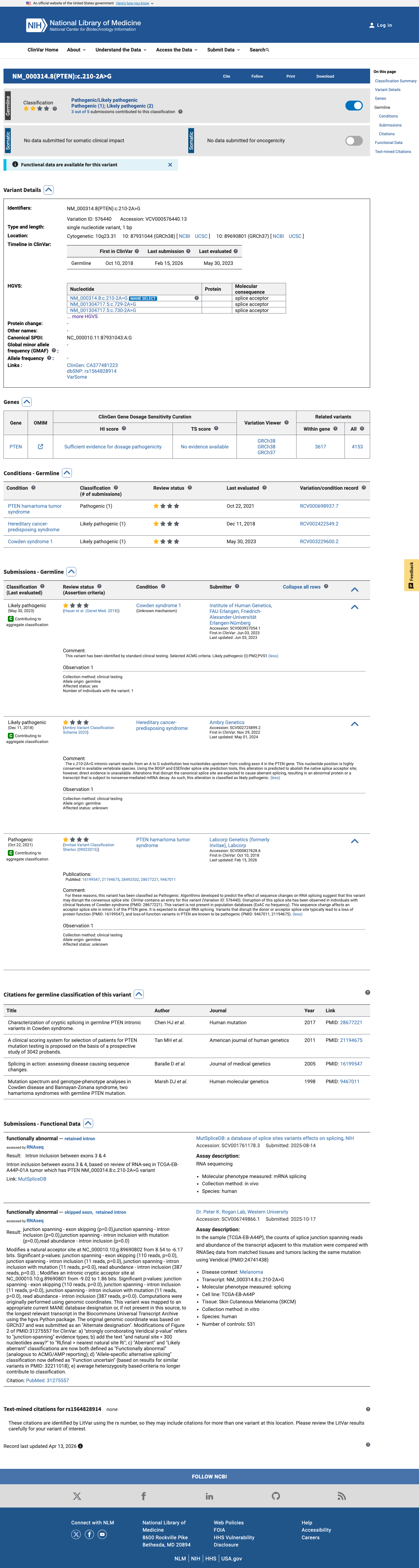
ClinVar
This variant has been reported in ClinVar as Likely pathogenic (2 clinical laboratories) and as Pathogenic (1 clinical laboratory). (ClinVarID = 576440)
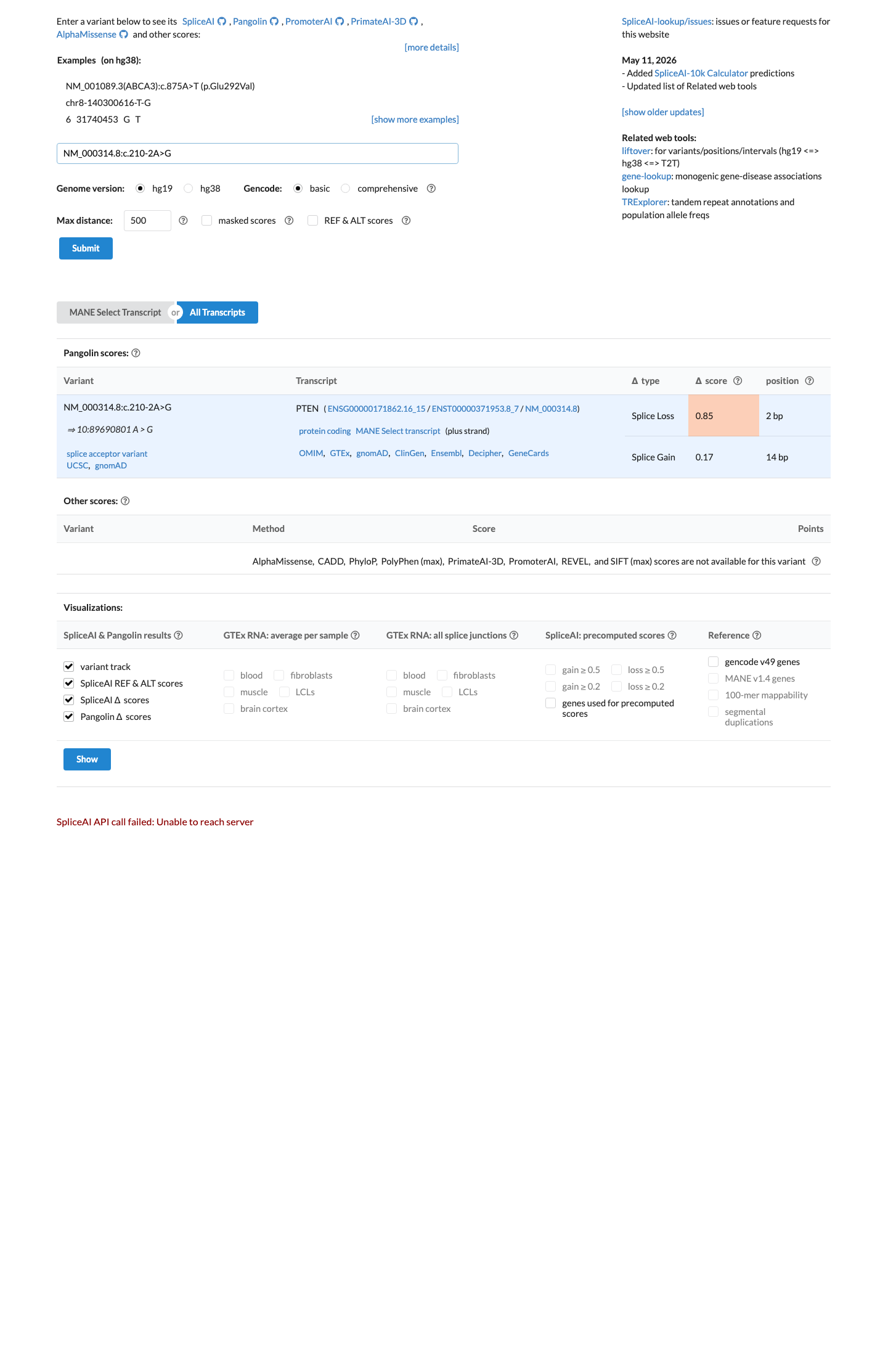
In silico
SpliceAI predicts no significant splice impact for this variant (max delta score = 0.00). BayesDel score = 0.224139.
Functional
No data
No calibrated functional assay or RNA evidence was identified for this variant.
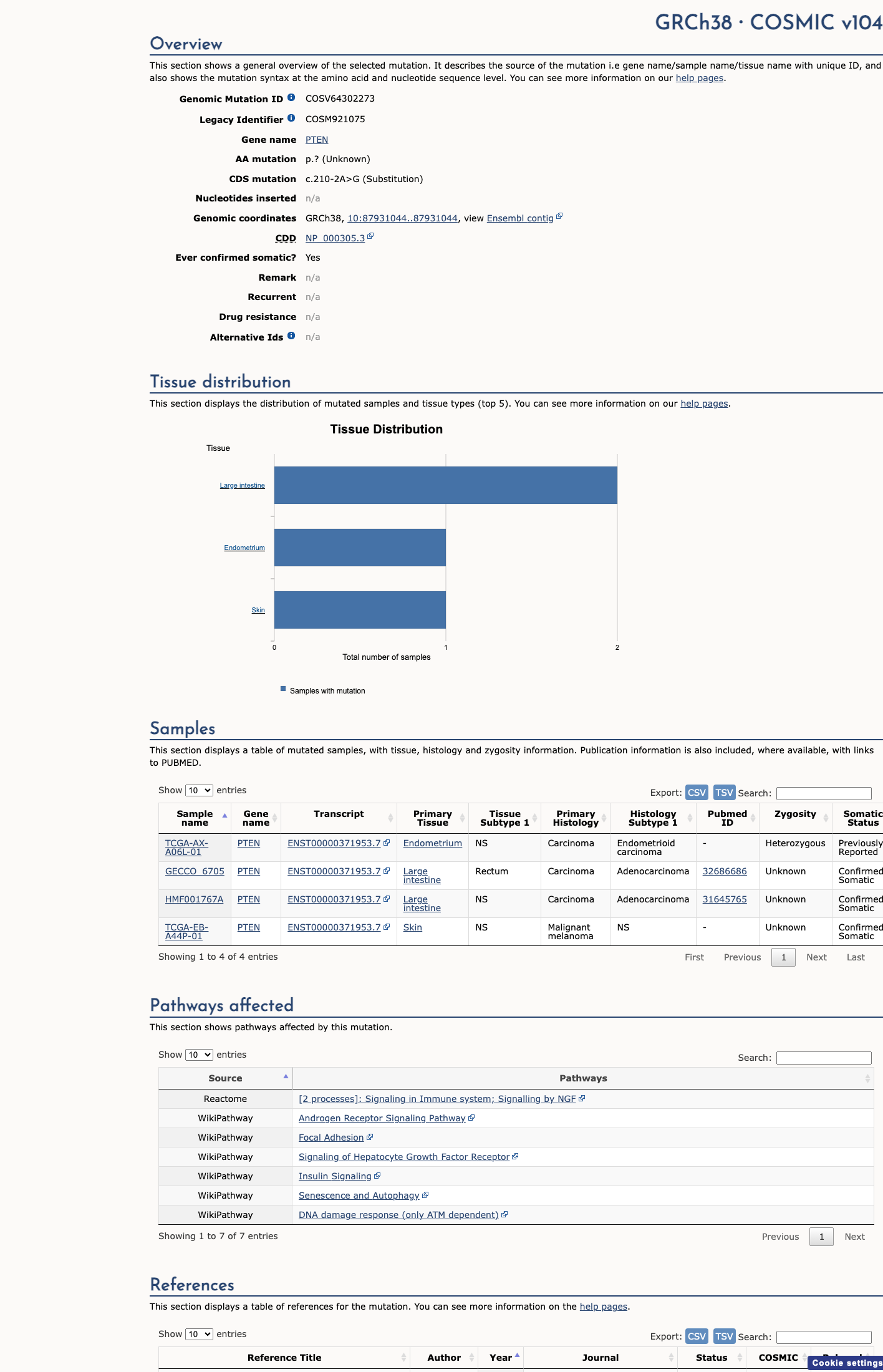
COSMIC
Somatic evidence
COSMIC
This variant has previously been reported in somatic cancers (COSMIC; COSV64302273, n = 4 times).
Hotspots
This variant does not lie in a statistically significant cancer hotspot.
Literature · how each cited paper was used
1papers cited
Each card is an audit: what was searched, what was found, whether it names the variant, which criteria it fed, and why. 5 further PMIDs triaged but not cited — see Sources & references.
Characterization of cryptic splicing in germline PTEN intronic variants in Cowden syndrome.
Found
Canonical splice acceptor site (AG>GG) at intron 3 -2 position PTEN VCEP PVS1 decision tree: disruption at or 5' to p.D375 (c.1121) predicted NMD c.210-1G>A at the same splice junction experimentally shown to cause exon 4 skipping and frameshift p.(Ala72Thrfs*5) (PMID:28677221) PTEN loss of function is an established disease mechanism per ClinGen PTEN VCEP v3.2.0
Applied to
→PVS1
very strong
Sources & reference links
Triaged references · 5 PMIDs not cited in assessment
29758562 ↗
Clinical relevance of systematic phenotyping and exome sequencing in patients with short stature.
CLINVAR
9467011 ↗
Mutation spectrum and genotype-phenotype analyses in Cowden disease and Bannayan-Zonana syndrome, two hamartoma syndromes with germline PTEN mutation.
CLINVAR
21194675 ↗
A clinical scoring system for selection of patients for PTEN mutation testing is proposed on the basis of a prospective study of 3042 probands.
CLINVAR
28492532 ↗
Sherloc: a comprehensive refinement of the ACMG-AMP variant classification criteria.
CLINVAR