NM_007194.4:c.542G>A (p.Arg181His) in CHEK2 is present in gnomAD at low frequency (v2.1 AF=0.0127%, v4.1 AF=0.0053%) with one homozygote observed in the East Asian population.1 In a well-established cell-based functional assay (KAP1 phosphorylation in RPE1-CHEK2-KO cells), p.Arg181His was classified as NEUTRAL, retaining >50% of wild-type CHK2 kinase activity (Kleiblova et al. 2019).2 Multiple lines of in silico evidence suggest no damaging impact: SpliceAI predicts no splicing alteration (max delta=0.00), BayesDel score is in the benign range (-0.032), and REVEL is borderline (0.46).3 ClinVar aggregate classification is Likely benign from 10 clinical diagnostic laboratories, with an additional 8 labs reporting Uncertain significance (Variation ID 5598).4 The variant has been reported in 1/400 sporadic prostate cancer cases (Dong et al. 2003), 1/516 familial breast cancer patients (Dufault et al. 2004), and 2/1928 breast/ovarian cancer patients (Kleiblova et al. 2019) without statistically significant enrichment versus controls.5 No de novo observations, co-segregation data, or statistically significant case-control enrichment have been reported for this variant.
Final classification
Likely Benign
BS3BP4BP6
CHEK2
c.542G>A
p.Arg181His
This variant
NM_007194.4:c.542G>A (p.Arg181His) in CHEK2 is present in gnomAD at low frequency (v2.1 AF=0.0127%, v4.1 AF=0.0053%) with one homozygote observed in the East Asian population.
Hereditary Breast, Ovarian and Pancreatic Cancer Specification v1.0.0 lacked a usable explicit final combination framework, so generic ACMG/AMP 2015 final-combination rules were applied as fallback; applied criteria: BS3 supporting, BP4 supporting, BP6 supporting; combination = 3 supporting benign, which maps to Likely Benign.
Classification rationale
BS3BP4BP6
Likely Benign
CHEK2 c.542G>A
BS3 + BP4 + BP6
→
Likely Benign
3
spliceai ↗bayesdelrevel
LYFE Sciences is an AI system, and it can make mistakes. Criteria
may be applied incorrectly, sources may be misread, and a confident-looking
classification can still be wrong. Double-check every criterion and
its underlying evidence before relying on any call.
Gene diagram
· NM_007194.4 · variants mapped to exon structure
CHEK2
NM_007194.4
Fetching transcript structure from UCSC…
Applied criteria · 3 applied · 17 assessed
MetEvidence satisfies this criterion.
Not metEvaluated against available evidence; threshold not reached.
Not assessedApplies in principle, but no evidence was found to evaluate it.
N/ADoesn't apply to this variant type.
Applied · 3
Strength
Supporting
Moderate
Strong
Very strong
BS3
supporting
Benign
BS3 is met at supporting level. Kleiblova et al. (PMID:31050813) performed a well-established cell-based functional assay quantifying CHK2-specific phosphorylation of endogenous KAP1 in human non-transformed RPE1-CHEK2-knock-out cells. The c.542G>A (p.Arg181His) variant was classified as NEUTRAL, retaining >50% of wild-type CHK2 kinase activity. This assay is considered well-validated — it reflects in vivo CHK2 behavior more accurately than in vitro kinase assays, resolves discrepancies seen in prior yeast-based and overexpression systems, and correctly stratified known pathogenic and benign controls. The neutral functional classification provides supporting evidence for a benign effect.
Kleiblova et al. (2019) KAP1 phosphorylation assay in RPE1-CHEK2-KO cells: p.Arg181His classified as NEUTRAL (>50% WT activity).
BP4
supporting
Benign
BP4 is met at supporting level. Multiple lines of in silico evidence suggest no impact on gene product: SpliceAI predicts no splicing alteration (max delta = 0.00); BayesDel score is -0.032 (benign range, below zero); REVEL score is 0.46, which is borderline and does not reach the typical pathogenic threshold (~0.7). The convergence of SpliceAI and BayesDel on a benign prediction, with REVEL being non-contributory, satisfies BP4 at the supporting level.
SpliceAI max delta 0.00 (no splicing impact)BayesDel -0.032 (benign)REVEL 0.46 (borderline/non-contributory).
BP6
supporting
Benign
BP6 is met at supporting level. The ClinVar aggregate classification for Variation ID 5598 is Likely benign, reported by 10 clinical diagnostic laboratories (9 as Likely benign, 1 as Benign). An additional 8 submissions classify it as Uncertain significance and 1 as likely benign. The plurality of clinical laboratories with assertion criteria favor a benign interpretation. No expert panel review has been performed.
ClinVar aggregate: 10 of 19 clinical labs with criteria classify as Likely benign/Benign (Variation ID 5598).
Assessed · not applied
· 17 not met · 0 not assessed
Pathogenic
PS1
No different nucleotide change at codon 181 producing the same missense change (p.Arg181His) has been established as pathogenic.
PS2
No de novo observations have been reported for this variant in public databases or the literature.
PS3
PS3 requires well-established functional studies showing a damaging effect.
PS4
PS4 requires statistically significant enrichment of the variant in affected individuals versus controls.
PM1
PM1 requires location in a mutational hot spot or critical functional domain with absent or very low benign variation.
PM2
PM2 applies when a variant is absent from population databases.
PM6
PM6 requires a de novo observation with maternity and paternity confirmed.
PP1
PP1 requires co-segregation of the variant with disease in multiple affected family members.
PP2
PP2 requires a missense variant in a gene with a low rate of benign missense variation and where missense variants are a common mechanism of disease.
PP3
PP3 requires multiple lines of in silico evidence supporting a deleterious effect.
PP4
PP4 requires the patient's phenotype or family history to be highly specific for the gene.
PP5
PP5 requires a reputable source to have classified the variant as pathogenic.
Benign
BA1
BA1 requires allele frequency >1% in a population database.
BS1
BS1 requires allele frequency >0.3% in a population database.
BS2
BS2 requires observation in a healthy adult individual for a disorder with full penetrance expected at an early age.
BS4
BS4 requires lack of segregation of the variant with disease in affected family members.
BP5
BP5 requires the variant to be found in a case with an alternate molecular basis for disease.
N/A · 5
PVS1 · PM5 · BP1 · BP2 · BP7
Research & evidence
Population frequency · supports benign
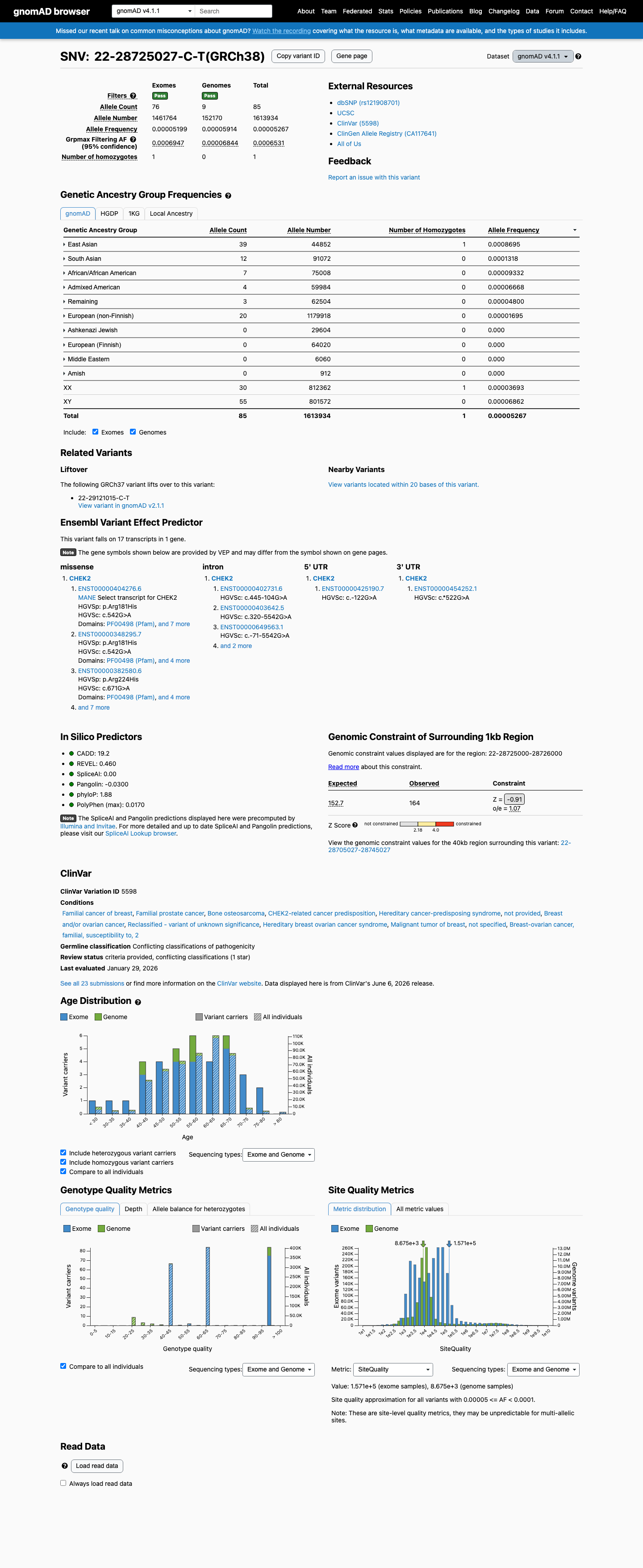
gnomAD v4.1
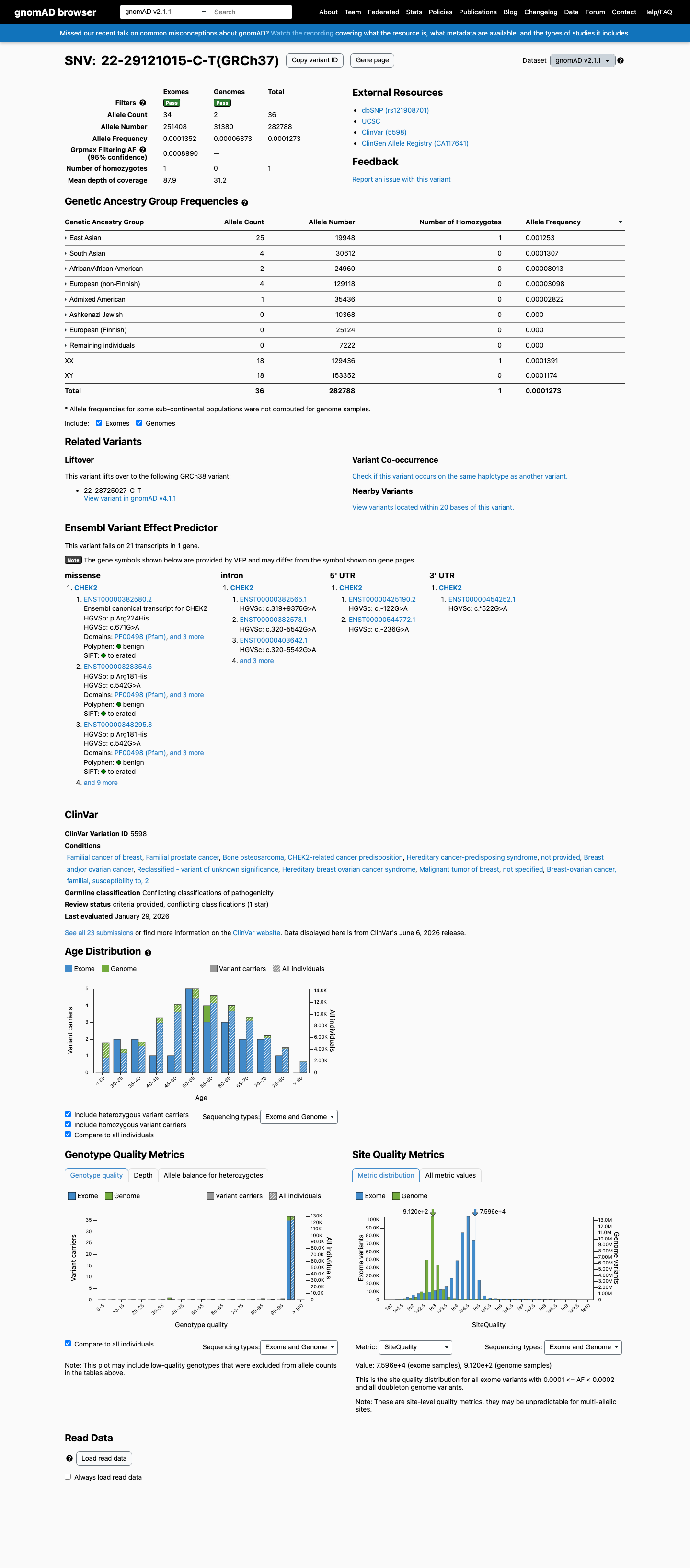
gnomAD v2.1
v4.1
This variant is present in gnomAD v4.1 (AF= 5.26663e-05; MAF= 0.00527%, 85/1613934 alleles, homozygotes = 1) and has highest observed frequency in the East Asian population (AF= 0.000869526; MAF= 0.08695%, 39/44852 alleles, homozygotes = 1); grpmax FAF= 0.00065305.
v2.1
This variant is present in gnomAD v2.1 (AF= 0.000127304; MAF= 0.01273%, 36/282788 alleles, homozygotes = 1) and has highest observed frequency in the East Asian population (AF= 0.00125326; MAF= 0.12533%, 25/19948 alleles, homozygotes = 1); grpmax FAF= 0.00089902.
🇨🇦 CA
This variant is absent from gnomAD-Canada.
Allele frequency by ancestry
three datasets · side by side
gnomAD v4.1
0.0053%
· 85 / 1,613,934
1 hom · FAF 0.065%
1 hom · FAF 0.065%
East Asian 39 / 44,852 |
0.087% 1 hom |
South Asian 12 / 91,072 |
0.013% |
African/African American 7 / 75,008 |
0.0093% |
Admixed American 4 / 59,984 |
0.0067% |
Remaining individuals 3 / 62,504 |
0.0048% |
European (non-Finnish) 20 / 1,179,918 |
0.0017% |
+ 4 not observed (European (Finnish), Amish, Middle Eastern, Ashkenazi Jewish)
gnomAD v2.1
0.013%
· 36 / 282,788
1 hom · FAF 0.09%
1 hom · FAF 0.09%
East Asian 25 / 19,948 |
0.13% 1 hom |
South Asian 4 / 30,612 |
0.013% |
African/African American 2 / 24,960 |
0.008% |
European (non-Finnish) 4 / 129,118 |
0.0031% |
Admixed American 1 / 35,436 |
0.0028% |
+ 3 not observed (Ashkenazi Jewish, European (Finnish), Remaining individuals)
gnomAD Canada 🇨🇦
Absent
· 0 / ?
0 hom
0 hom
Not observed in any ancestry group.

ClinVar
This variant has been reported in ClinVar as Likely benign (9 clinical laboratories) and as Uncertain significance (8 clinical laboratories) and as likely benign (1 clinical laboratory) and as Benign (1 clinical laboratory). (ClinVarID = 5598)

In silico
SpliceAI predicts no significant splice impact for this variant (max delta score = 0.00). REVEL score = 0.46. BayesDel score = -0.0318827.
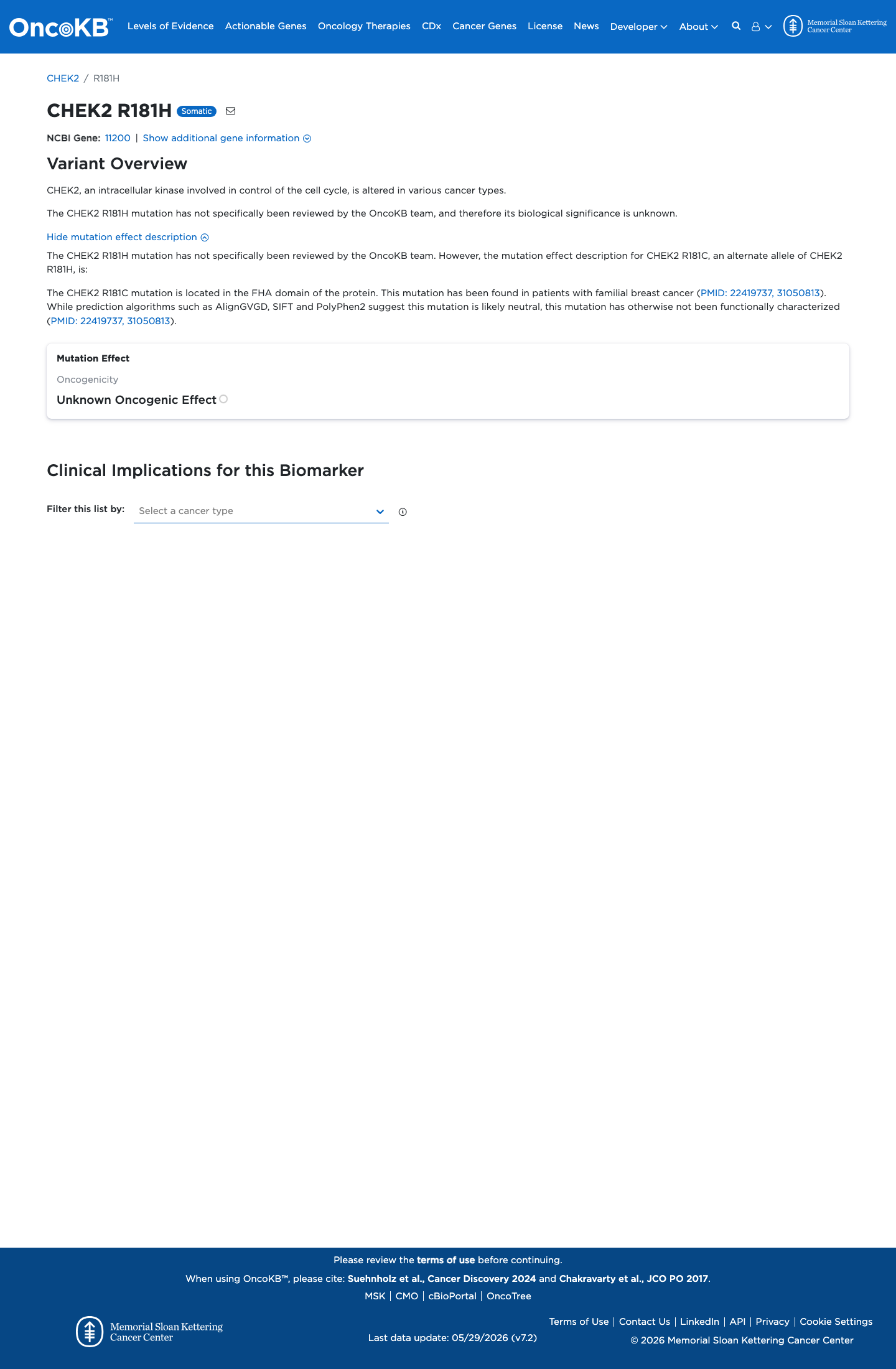
Functional
Unknown Oncogenic Effect
OncoKB did not identify variant-specific reviewed functional evidence for this variant; gene-level curated context is available for reviewer follow-up. CHEK2, an intracellular kinase involved in control of the cell cycle, is altered in various cancer types.

COSMIC

Cancer hotspots
Somatic evidence
Not in COSMIC / hotspots
COSMIC
This variant does not lie in a statistically significant hotspot. This variant has not previously been reported in somatic cancers (COSMIC).
Hotspots
This variant does not lie in a statistically significant hotspot.
Literature · how each cited paper was used
1papers cited
Each card is an audit: what was searched, what was found, whether it names the variant, which criteria it fed, and why. 6 further PMIDs triaged but not cited — see Sources & references.
Identification of deleterious germline CHEK2 mutations and their association with breast and ovarian cancer.
Found
Structured finding pending for this record — see source link.
Applied to
→BS3
supporting
Sources & reference links
Triaged references · 6 PMIDs not cited in assessment
16982735 ↗
Rare germ line CHEK2 variants identified in breast cancer families encode proteins that show impaired activation.
CLINVAR
28492532 ↗
Sherloc: a comprehensive refinement of the ACMG-AMP variant classification criteria.
CLINVAR