NM_000500.9:c.1493G>T is a synonymous substitution in the 3' untranslated region of CYP21A2 (c.*5G>T), with no predicted amino acid change (p.(=)). CYP21A2 encodes 21-hydroxylase; loss-of-function variants cause autosomal recessive congenital adrenal hyperplasia (21-hydroxylase deficiency). This variant is absent from ClinVar; no clinical classification has been asserted by any submitter or expert panel. Population frequency data is unavailable for this 3' UTR position: gnomAD v2.1 and v4.1 returned no data, and gnomAD-Canada shows zero coverage, precluding PM2/BA1/BS1 assessment. No functional studies, case-control data, de novo reports, segregation analyses, or in silico predictions specific to this 3' UTR variant have been identified in the literature or public databases. PVS1 is not applicable as this is not a null variant (nonsense, frameshift, or canonical splice site change). PS1, PS5, PM5, PP2, BP1, and BP7 are not applicable as this variant is not a missense or coding-synonymous change.1 The variant cannot be classified at this time due to insufficient evidence across all applicable ACMG/AMP criteria. It remains a variant of uncertain significance (VUS) by default under generic ACMG/AMP 2015 rules, given the absence of both pathogenic and benign evidence.2
Final classification
VUS
CYP21A2
c.1493G>T
This variant
NM_000500.9:c.1493G>T is a synonymous substitution in the 3' untranslated region of CYP21A2 (c.*5G>T), with no predicted amino acid change (p.(=)).
gene-specific framework lacked a usable explicit final combination framework, so generic ACMG/AMP 2015 final-combination rules were applied as fallback; applied criteria: none; combination = no applied criteria, which maps to VUS.
Classification rationale
VUS
CYP21A2 c.1493G>T
2
generic_acmg_combination_rules
LYFE Sciences is an AI system, and it can make mistakes. Criteria
may be applied incorrectly, sources may be misread, and a confident-looking
classification can still be wrong. Double-check every criterion and
its underlying evidence before relying on any call.
Applied criteria · 0 applied · 19 assessed
MetEvidence satisfies this criterion.
Not metEvaluated against available evidence; threshold not reached.
Not assessedApplies in principle, but no evidence was found to evaluate it.
N/ADoesn't apply to this variant type.
Applied · 0
No criteria were applied for this variant.
Assessed · not applied
· 6 not met · 13 not assessed
Pathogenic
PS2
No de novo occurrence (with both maternity and paternity confirmed) has been reported for this variant in the literature or databases.
PS3
No functional studies evaluating the impact of this 3' UTR variant on mRNA stability, miRNA binding, splicing, or protein expression have been identified in the literature or in curated functional databases.
PS4
No case-control studies or statistically significant enrichment of this variant in affected individuals compared to population controls has been demonstrated.
PM1
This variant is located at c.*5 in the 3' UTR, not within a known functional domain, critical residue, or established mutational hotspot in the CYP21A2 gene.
PM2
Population frequency data is unavailable for this 3' UTR position.
PM6
No de novo observation (without confirmation of both maternity and paternity) has been reported for this variant in the literature or databases.
PP1
No family cosegregation data is available for this variant.
PP3
Standard in silico prediction tools (REVEL, BayesDel, SpliceAI, HCI prior) do not apply to this 3' UTR variant and returned no scores.
PP4
No patient phenotype or family history data specific to this variant has been reported in the literature or clinical databases.
PP5
No reputable source (e.g., ClinGen-recognized expert panel, clinical diagnostic laboratory) has classified this variant as pathogenic.
Benign
BA1
No population allele frequency data is available to evaluate whether this variant exceeds the BA1 threshold (>1% per generic ACMG cutoff).
BS1
No population allele frequency data is available to evaluate whether this variant exceeds the BS1 threshold (>0.3% per generic ACMG cutoff).
BS2
No data regarding observation of this variant in healthy adult individuals is available.
BS3
No functional studies demonstrating a neutral (non-damaging) effect of this 3' UTR variant on gene expression, mRNA stability, or protein function have been identified.
BS4
No family segregation data demonstrating lack of cosegregation with congenital adrenal hyperplasia or other CYP21A2-related phenotypes is available.
BP2
No data on observation of this variant in trans with a known pathogenic CYP21A2 variant in an unaffected individual is available.
BP4
Standard computational prediction tools (REVEL, BayesDel, SpliceAI) do not apply to this 3' UTR variant and returned no scores.
BP5
No observation of this variant in a case with an alternative molecular cause for the phenotype (e.g., a different confirmed pathogenic variant in CYP21A2 or another gene) has been reported.
BP6
No reputable source (e.g., ClinGen-recognized expert panel, clinical diagnostic laboratory) has classified this variant as benign without accessible evidence.
N/A · 9
PVS1 · PS1 · PM3 · PM4 · PM5 · PP2 · BP1 · BP3 · BP7
Research & evidence
Population frequency
v4.1
This variant is absent from gnomAD v4.1.
v2.1
This variant is absent from gnomAD v2.1.
🇨🇦 CA
This variant is absent from gnomAD-Canada.
Allele frequency by ancestry
three datasets · side by side
gnomAD Canada 🇨🇦
Absent
· 0 / ?
0 hom
0 hom
Not observed in any ancestry group.
In silico
No data
No in-silico prediction was recorded for this variant.
Functional
No data
No calibrated functional assay or RNA evidence was identified for this variant.
COSMIC
Somatic evidence
COSMIC
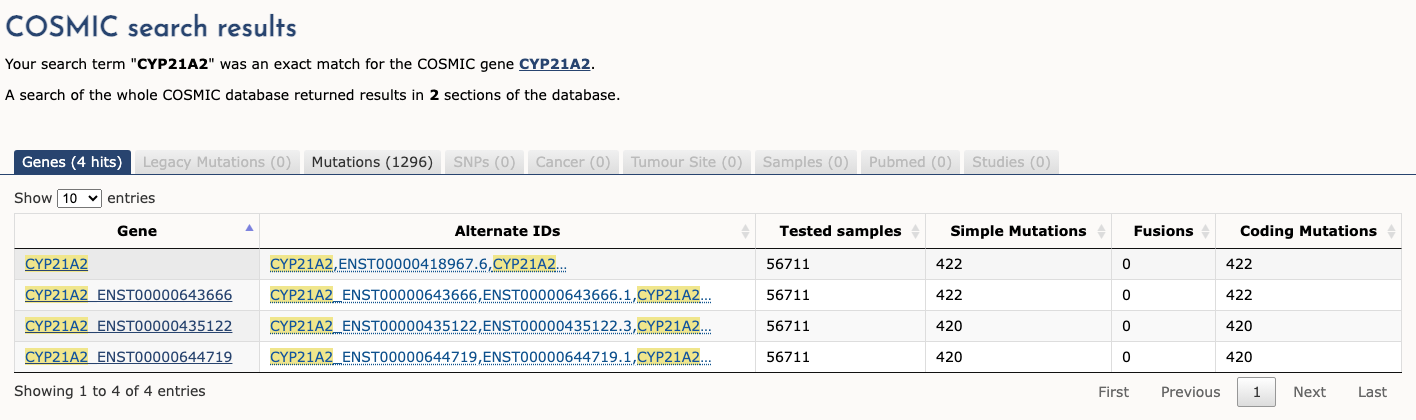
This variant has not previously been reported in somatic cancers (COSMIC).
Hotspots
This variant does not lie in a statistically significant cancer hotspot.
Sources & reference links