PTEN c.238A>G (p.Lys80Glu) is a missense variant in exon 4 of the phosphatase domain. The variant is absent from population databases (gnomAD v2.1 and v4.1), meeting PM2_Supporting per PTEN VCEP.1 Functional data from Mighell et al. 2018 (PMID: 29706350) saturation mutagenesis assay demonstrates a cumulative fitness score of -1.60681967, below the -1.11 threshold for PS3_Moderate, indicating significantly reduced phosphatase activity with high confidence.2 Computational evidence supports pathogenicity: REVEL score 0.775 (>0.7 threshold for PP3) per PTEN VCEP specification.3 PP2 is applied as PTEN has a low rate of benign missense variation and missense variants are a common disease mechanism.4 No benign criteria are met: variant is absent from population databases (BA1/BS1 not met), no homozygous observations (BS2 not met), functional data shows damaging effect (BS3 not met), REVEL exceeds benign threshold (BP4 not met).5 Under the PTEN VCEP v3.2.0 combination rules, this evidence set (PS3_Moderate + PM2_Supporting + PP2 + PP3 = 1 moderate + 3 supporting) does not trigger any Pathogenic or Likely Pathogenic classification rule. The variant is classified as Variant of Uncertain Significance (VUS).6
Final classification
VUS
PS3PM2PP2PP3
PTEN
c.238A>G
p.Lys80Glu
This variant
PTEN c.238A>G (p.Lys80Glu) is a missense variant in exon 4 of the phosphatase domain.
Richards et.al., 2015 - Combining rules v3.2.0 criteria-combination framework was evaluated deterministically with applied criteria: PS3 moderate, PM2 supporting, PP2 supporting, PP3 supporting; no rule matched the adjudicated criteria.
Classification rationale
PS3PM2PP2PP3
VUS
PTEN c.238A>G
PS3 + PM2 + PP2 + PP3
→
VUS
LYFE Sciences is an AI system, and it can make mistakes. Criteria
may be applied incorrectly, sources may be misread, and a confident-looking
classification can still be wrong. Double-check every criterion and
its underlying evidence before relying on any call.
Gene diagram
· NM_000314.8 · variants mapped to exon structure
PTEN
NM_000314.8
Fetching transcript structure from UCSC…
Applied criteria · 4 applied · 15 assessed
MetEvidence satisfies this criterion.
Not metEvaluated against available evidence; threshold not reached.
Not assessedApplies in principle, but no evidence was found to evaluate it.
N/ADoesn't apply to this variant type.
Applied · 4
Strength
Supporting
Moderate
Strong
Very strong
PS3
moderate
Pathogenic
PS3_Moderate is met per PTEN VCEP specification. The variant p.Lys80Glu (K80E) was directly assayed in the Mighell et al. 2018 (PMID: 29706350) saturation mutagenesis functional study of PTEN phosphatase activity. The cumulative fitness score (Cum_score) from Table S2 of the study is -1.60681967, which is ≤ -1.11, meeting the VCEP threshold for PS3_Moderate. The measurement is flagged as high confidence (High_conf=True).
Mighell et al. 2018 Table S2: K80E Cum_score = -1.60681967 (≤ -1.11 threshold)High_conf=True
PM2
supporting
Pathogenic
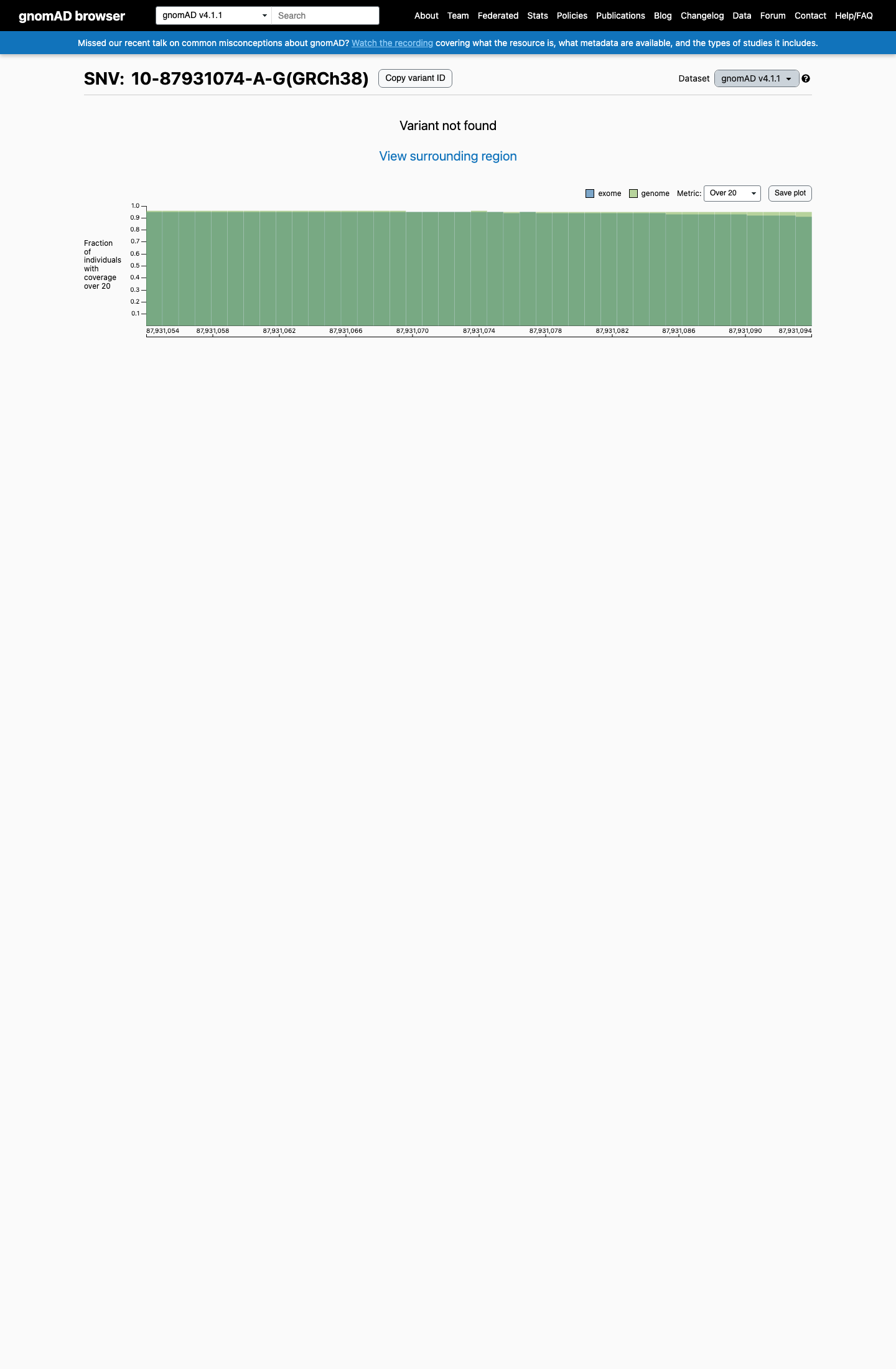
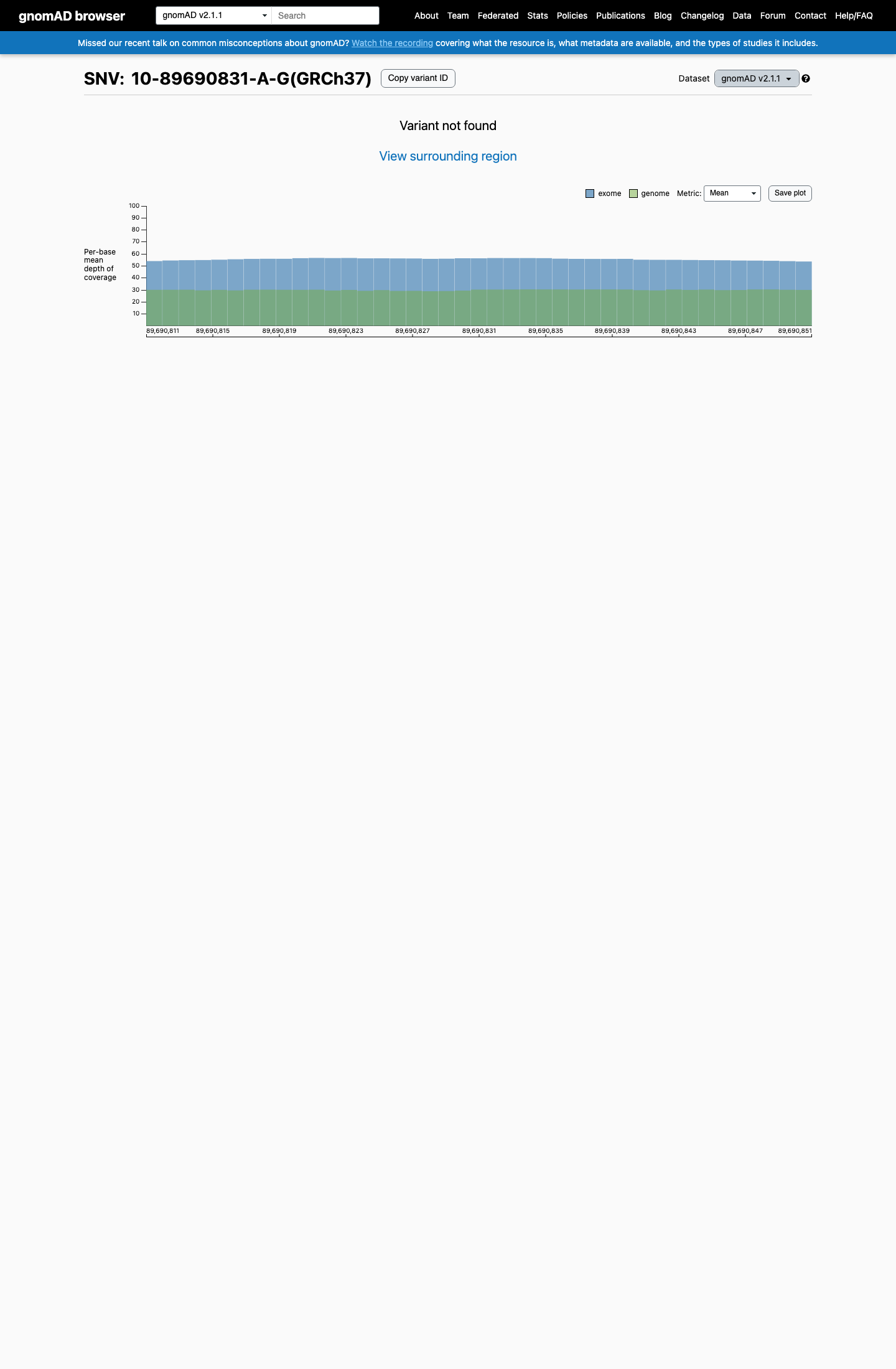
PM2_Supporting is met per PTEN VCEP specification. The variant is absent from gnomAD v2.1 and v4.1 (allele frequency < 0.00001 / 0.001%), meeting the VCEP threshold for population absence. Absent also in gnomAD-Canada v1.0.
Absent from gnomAD v2.1 (AF < 0.001%)Absent from gnomAD v4.1 (AF < 0.001%)
PP2
supporting
Pathogenic
PP2 is met per PTEN VCEP specification. PTEN has a low rate of benign missense variation and missense variants are a common mechanism of disease in PTEN. The variant p.Lys80Glu is a missense substitution.
PTEN has low rate of benign missense variationmissense is a common disease mechanism
PP3
supporting
Pathogenic
PP3 is met per PTEN VCEP specification for missense variants. The REVEL score for this variant is 0.775, which exceeds the VCEP threshold of >0.7 for multiple lines of computational evidence supporting a deleterious effect. SpliceAI predicts no significant splice impact (max delta = 0.01), which is expected for this missense variant and does not contradict the REVEL-based PP3 call.
REVEL score = 0.775 (>0.7 threshold)BayesDel score = 0.174SpliceAI max delta = 0.01 (no splice impact)
Assessed · not applied
· 14 not met · 1 not assessed
Pathogenic
PS1
PS1 requires the same amino acid change as a previously established pathogenic variant regardless of nucleotide change, or a different variant at the same nucleotide position as a known pathogenic splicing variant.
PS2
PS2 requires a de novo observation with both maternity and paternity confirmed in a patient with the disease and no family history.
PS4
PS4 requires proband counts with specificity scores per PTEN VCEP thresholds.
PM1
The PTEN VCEP defines PM1 as located in a mutational hot spot and/or critical functional domain, specifically residues in catalytic motifs: 90-94, 123-130, and 166-168 (NP_000305.3).
PM5
PM5 requires a missense change at an amino acid residue where a different missense change has been determined to be pathogenic or likely pathogenic, with the interrogated variant having a BLOSUM62 score equal to or less than the known variant.
PM6
PM6 requires an assumed de novo occurrence (without confirmation of paternity and maternity) in a proband with the disease and no family history.
PP1
PP1 requires co-segregation with disease in multiple affected family members with ≥3 meioses (PTEN VCEP: 3-4 meioses = Supporting, 5-6 = Moderate, ≥7 across ≥2 families = Strong).
Benign
BA1
BA1 requires a gnomAD filtering allele frequency >0.00056 (0.056%) per PTEN VCEP.
BS1
BS1 requires a gnomAD filtering allele frequency of ≥0.0000043 (0.00043%) for Supporting or ≥0.000043 (0.0043%) for Strong per PTEN VCEP.
BS2
BS2 requires observation in the homozygous state in a healthy or PHTS-unaffected individual (Strong for one confirmed homozygous, Supporting for two unconfirmed or if BS1 also applied).
BS3
BS3_Supporting per PTEN VCEP requires phosphatase activity >0 in the Mighell et al.
BS4
BS4 requires lack of segregation in affected members of one family (Supporting) or two or more families (Strong) per PTEN VCEP.
BP2
BP2 requires observation in trans with a pathogenic or likely pathogenic PTEN variant or at least three observations in cis/phase unknown with different P/LP PTEN variants per the VCEP specification.
BP4
BP4 for missense variants per PTEN VCEP requires REVEL score <0.5.
BP5
BP5 requires the variant to be found in a case with an alternate molecular basis for disease, where the other gene/disorder is highly penetrant and the patient's personal/family history shows no overlap with PTEN.
N/A · 6
PVS1 · PP4 · PP5 · BP1 · BP6 · BP7
Research & evidence
Population frequency
gnomAD v4.1
gnomAD v2.1
v4.1
Absent from gnomAD v4.1.
v2.1
Absent from gnomAD v2.1.
🇨🇦 CA
This variant is absent from gnomAD-Canada.
Allele frequency by ancestry
three datasets · side by side
gnomAD v4.1
Absent
· 0 / ?
0 hom
0 hom
Not observed in any ancestry group.
gnomAD v2.1
Absent
· 0 / ?
0 hom
0 hom
Not observed in any ancestry group.
gnomAD Canada 🇨🇦
Absent
· 0 / ?
0 hom
0 hom
Not observed in any ancestry group.

In silico
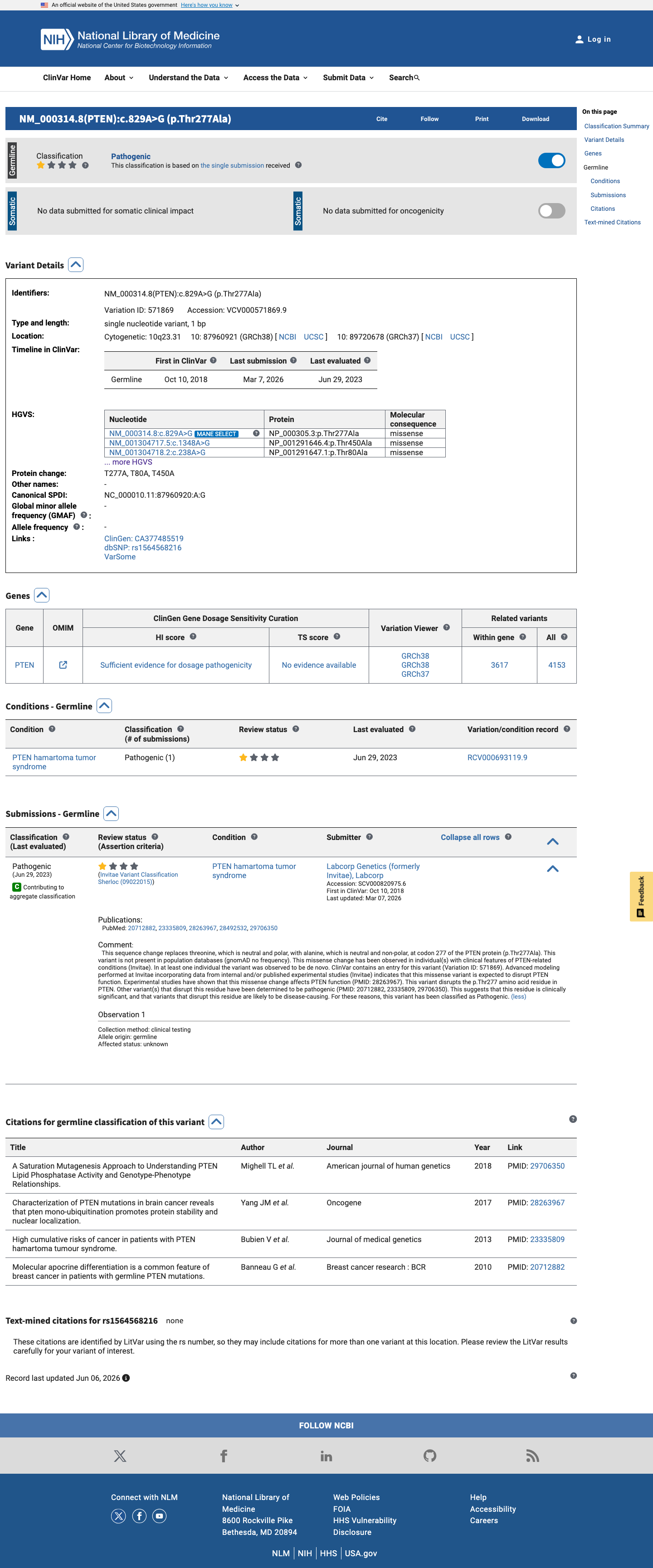
SpliceAI predicts no significant splice impact for this variant (max delta score = 0.01). REVEL score = 0.775. BayesDel score = 0.173785.
Functional
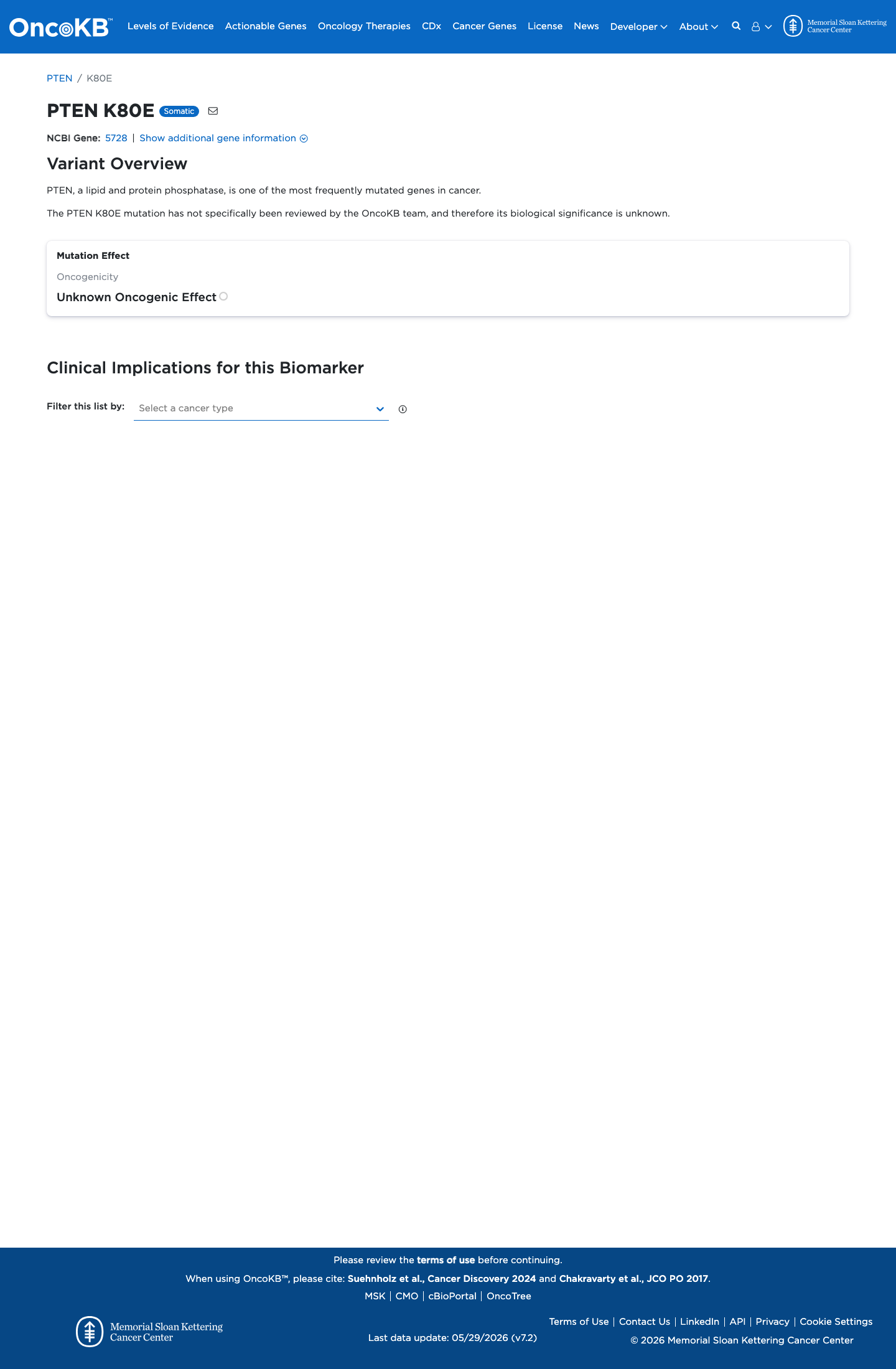
Unknown Oncogenic Effect
OncoKB did not identify variant-specific reviewed functional evidence for this variant; gene-level curated context is available for reviewer follow-up. PTEN, a lipid and protein phosphatase, is one of the most frequently mutated genes in cancer.
COSMIC

Cancer hotspots
Somatic evidence
Not in COSMIC / hotspots
COSMIC
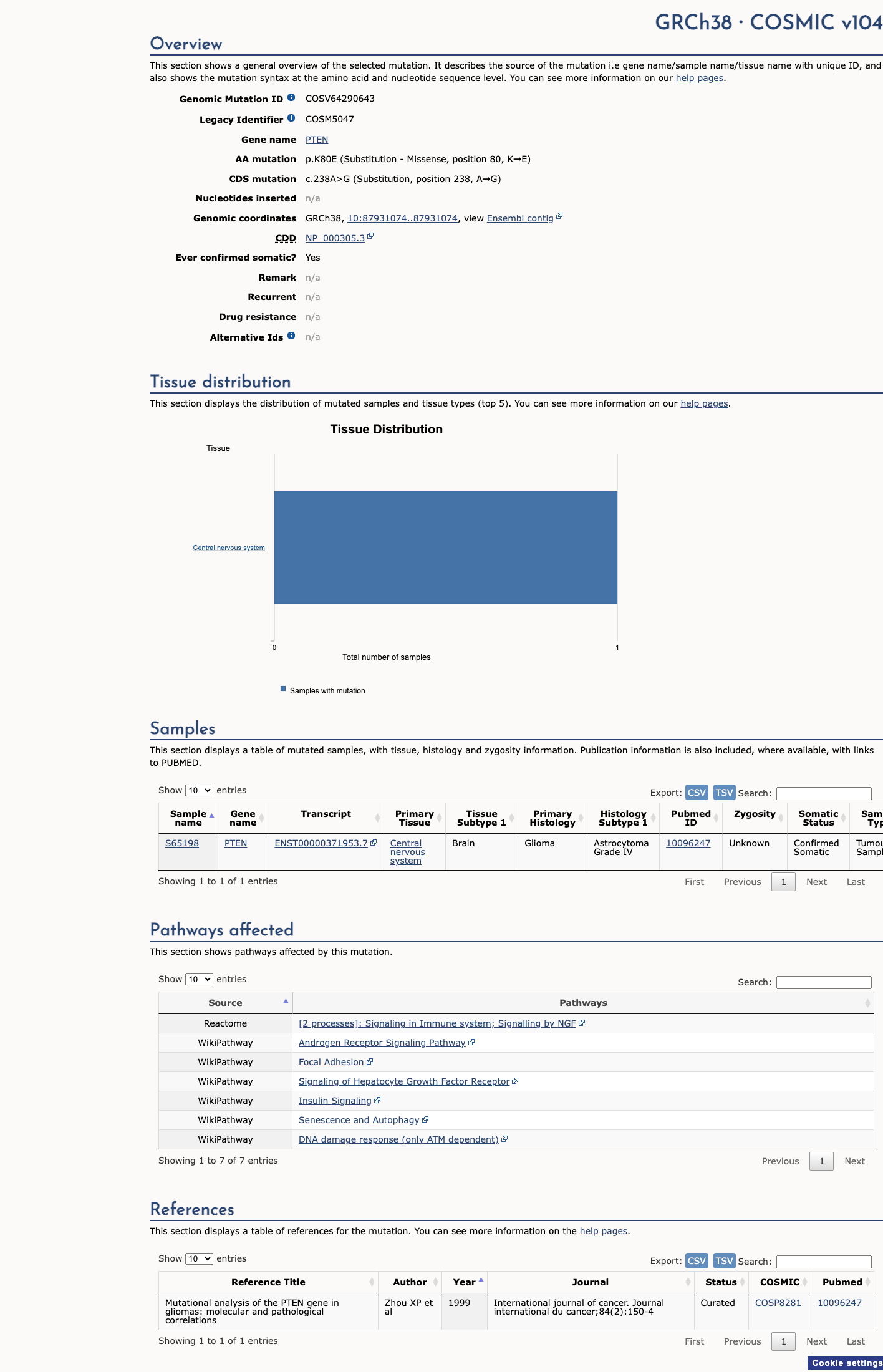
This variant does not lie in a statistically significant hotspot. This variant has previously been reported in somatic cancers (COSMIC; COSV64290643, n = 1 times).
Hotspots
This variant does not lie in a statistically significant hotspot.
Literature · how each cited paper was used
1papers cited
Each card is an audit: what was searched, what was found, whether it names the variant, which criteria it fed, and why. 8 further PMIDs triaged but not cited — see Sources & references.
A Saturation Mutagenesis Approach to Understanding PTEN Lipid Phosphatase Activity and Genotype-Phenotype Relationships.
Found
Structured finding pending for this record — see source link.
Applied to
→PS3
moderate
Sources & reference links
Triaged references · 8 PMIDs not cited in assessment
20712882 ↗
Molecular apocrine differentiation is a common feature of breast cancer in patients with germline PTEN mutations.
CLINVAR
25645574 ↗
ACG clinical guideline: Genetic testing and management of hereditary gastrointestinal cancer syndromes.
CLINVAR
28263967 ↗
Characterization of PTEN mutations in brain cancer reveals that pten mono-ubiquitination promotes protein stability and nuclear localization.
CLINVAR
17392385 ↗
American Cancer Society guidelines for breast screening with MRI as an adjunct to mammography.
CLINVAR
23519317 ↗
Clinical genetics evaluation in identifying the etiology of autism spectrum disorders: 2013 guideline revisions.
CLINVAR
28492532 ↗
Sherloc: a comprehensive refinement of the ACMG-AMP variant classification criteria.
CLINVAR