NM_000507.4:c.960delinsGG (p.Ser321ValfsTer13) is a frameshift variant in exon 7 (last exon) of FBP1, where loss of function is an established mechanism for fructose-1,6-bisphosphatase deficiency (PVS1 at strong strength, downgraded from very strong due to predicted NMD escape per PMC6185798).1 The variant is absent from gnomAD v2.1 and v4.1 population databases (0 alleles out of >1.6 million), supporting PM2 at supporting strength.2 This variant has been classified as Pathogenic by three clinical laboratories in ClinVar (Variation ID 372364), meeting PP5 at supporting strength.3 SpliceAI predicts no significant splice impact (max delta score 0.07), and in silico pathogenicity scores are not applicable to this indel variant. PP3 and BP4 are not met.4 Under generic ACMG/AMP 2015 combination rules (PMID:25741868), one strong criterion (PVS1) and two supporting criteria (PM2, PP5) yields a classification of Likely Pathogenic.5
Final classification
Likely Pathogenic
PVS1PM2PP5
FBP1
c.960delinsGG
p.Ser321ValfsTer13
This variant
NM_000507.4:c.960delinsGG (p.Ser321ValfsTer13) is a frameshift variant in exon 7 (last exon) of FBP1, where loss of function is an established mechanism for fructose-1,6-bisphosphatase deficiency (PVS1 at strong strength, downgraded from very strong due to predicted NMD escape per PMC6185798).
gene-specific framework lacked a usable explicit final combination framework, so generic ACMG/AMP 2015 final-combination rules were applied as fallback; applied criteria: PVS1 strong, PM2 supporting, PP5 supporting; combination = 1 strong + 2 supporting, which maps to Likely Pathogenic.
Classification rationale
PVS1PM2PP5
Likely Pathogenic
FBP1 c.960delinsGG
PVS1 + PM2 + PP5
→
Likely Pathogenic
5
generic_acmg_combination_rules
LYFE Sciences is an AI system, and it can make mistakes. Criteria
may be applied incorrectly, sources may be misread, and a confident-looking
classification can still be wrong. Double-check every criterion and
its underlying evidence before relying on any call.
Gene diagram
· NM_000507.4 · variants mapped to exon structure
FBP1
NM_000507.4
Fetching transcript structure from UCSC…
Applied criteria · 3 applied · 17 assessed
MetEvidence satisfies this criterion.
Not metEvaluated against available evidence; threshold not reached.
Not assessedApplies in principle, but no evidence was found to evaluate it.
N/ADoesn't apply to this variant type.
Applied · 3
Strength
Supporting
Moderate
Strong
Very strong
PVS1
strong
Pathogenic
NM_000507.4:c.960delinsGG is a frameshift variant (p.Ser321ValfsTer13) in exon 7 of FBP1, where loss of function is an established mechanism for fructose-1,6-bisphosphatase deficiency (autosomal recessive). Under the ClinGen SVI PVS1 framework (PMC6185798), the variant occurs in the last exon and is predicted to escape nonsense-mediated decay, warranting a downgrade from very_strong to strong.
Frameshift variant (p.Ser321ValfsTer13) in FBP1 exon 7 (last exon of 7)FBP1 loss of function is established mechanism for fructose-16-bisphosphatase deficiency
PM2
supporting
Pathogenic
NM_000507.4:c.960delinsGG is absent from gnomAD v2.1 and v4.1 population databases (0 alleles out of >1.6 million total alleles). Under generic ACMG/AMP rules, PM2 applies at supporting strength for variants with population frequency below 0.1% and absent from large population databases.
Absent from gnomAD v2.1 (0 alleles)Absent from gnomAD v4.1 (0 alleles)Population frequency effectively 0%
PP5
supporting
Pathogenic
NM_000507.4:c.960delinsGG has been reported as Pathogenic in ClinVar (Variation ID 372364) by three clinical laboratories (GeneDx, LabCorp, PreventionGenetics), with criteria provided by at least two submitters. This represents a consensus classification from reputable clinical sources.
ClinVar Variation ID 372364: Pathogenic classification3 clinical laboratories: GeneDx (SCV000490526)LabCorp (SCV003934589)
Assessed · not applied
· 15 not met · 2 not assessed
Pathogenic
PS2
No de novo observation with confirmed maternity and paternity reported for this variant.
PS3
No well-established functional assay data specific to NM_000507.4:c.960delinsGG identified.
PS4
No case-control data or statistically significant enrichment in affected individuals versus controls is available for this variant.
PM1
The variant does not lie in a known mutational hotspot or critical functional domain without benign variation.
PM6
No assumed de novo observation (without confirmation of parentage) reported for this variant.
PP1
No co-segregation data in affected families is available for this variant.
PP3
SpliceAI max delta score is 0.07, indicating no significant splice impact.
PP4
While the affected individual's phenotype (hypoglycemia, lactic acidosis) is consistent with fructose-1,6-bisphosphatase deficiency, these symptoms are nonspecific and overlap with many other inborn errors of metabolism.
Benign
BA1
NM_000507.4:c.960delinsGG is absent from gnomAD v2.1 and v4.1.
BS1
NM_000507.4:c.960delinsGG is absent from gnomAD v2.1 and v4.1.
BS2
No observation of this variant in a healthy adult individual has been documented.
BS3
No well-established functional studies demonstrating no deleterious effect for NM_000507.4:c.960delinsGG identified.
BS4
No observation of NM_000507.4:c.960delinsGG in a healthy adult individual has been reported.
BP2
No observation of this variant in trans with a pathogenic variant in a gene for a fully penetrant dominant disorder, or in cis with a pathogenic variant in any inheritance pattern.
BP4
SpliceAI max delta score is 0.07, indicating no significant splice impact.
BP5
No observation of this variant in a case with an alternate molecular basis for disease has been reported.
BP6
No reputable source classifies NM_000507.4:c.960delinsGG as benign or likely benign.
N/A · 8
PS1 · PM3 · PM4 · PM5 · PP2 · BP1 · BP3 · BP7
Research & evidence
Population frequency · supports pathogenic
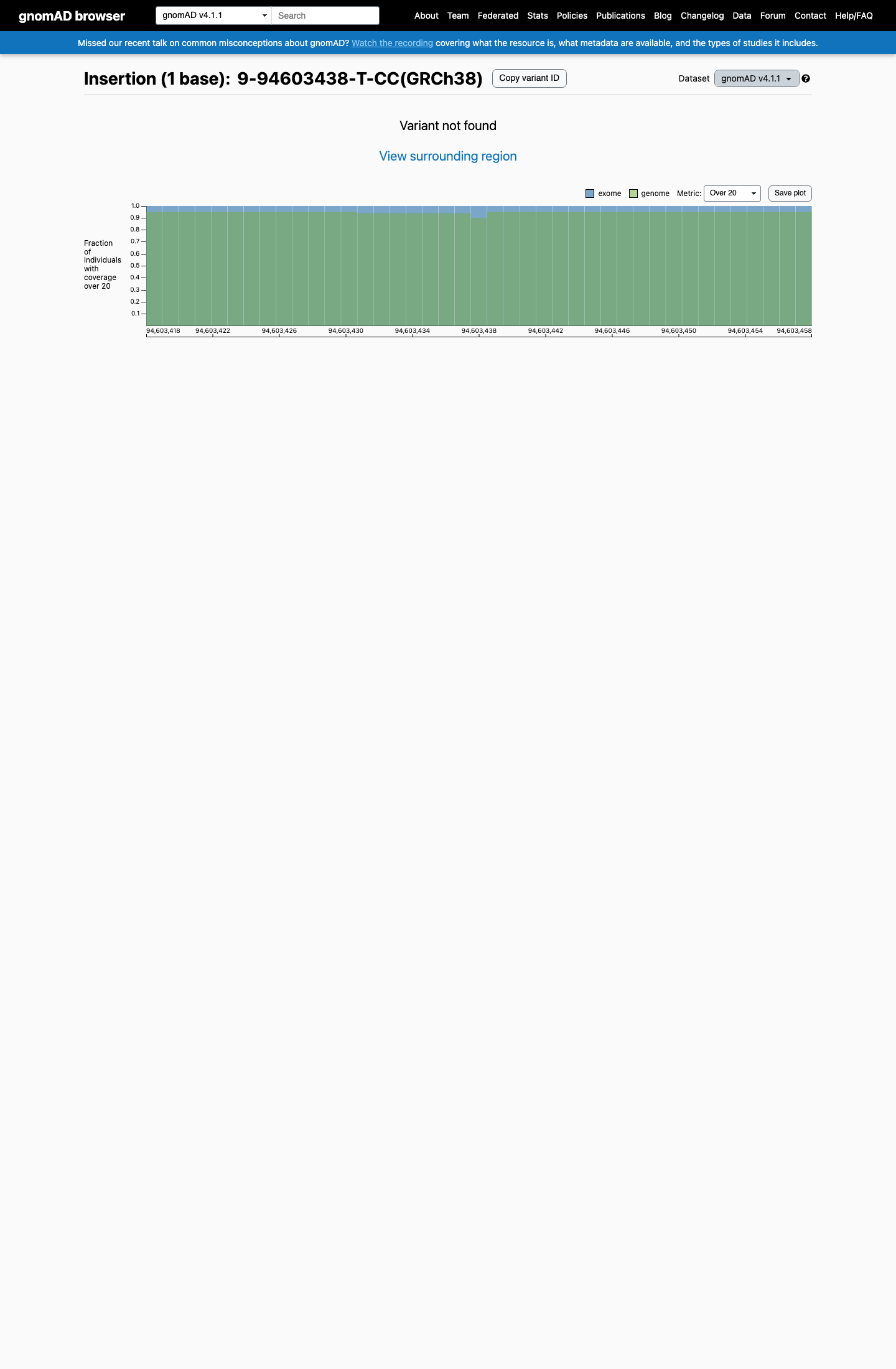
gnomAD v4.1
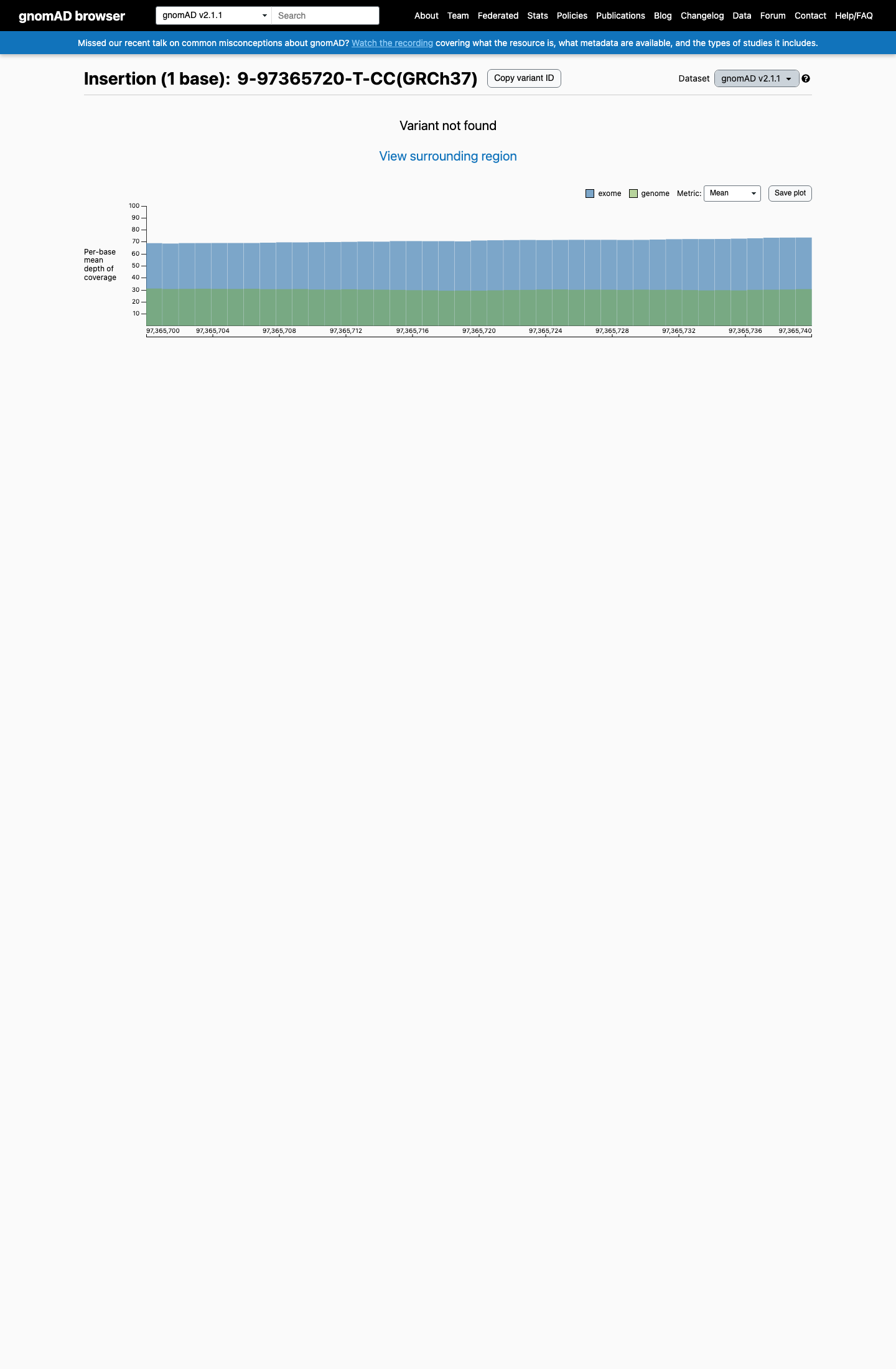
gnomAD v2.1
v4.1
Absent from gnomAD v4.1.
v2.1
Absent from gnomAD v2.1.
🇨🇦 CA
This variant is absent from gnomAD-Canada.
Allele frequency by ancestry
three datasets · side by side
gnomAD v4.1
Absent
· 0 / ?
0 hom
0 hom
Not observed in any ancestry group.
gnomAD v2.1
Absent
· 0 / ?
0 hom
0 hom
Not observed in any ancestry group.
gnomAD Canada 🇨🇦
Absent
· 0 / ?
0 hom
0 hom
Not observed in any ancestry group.
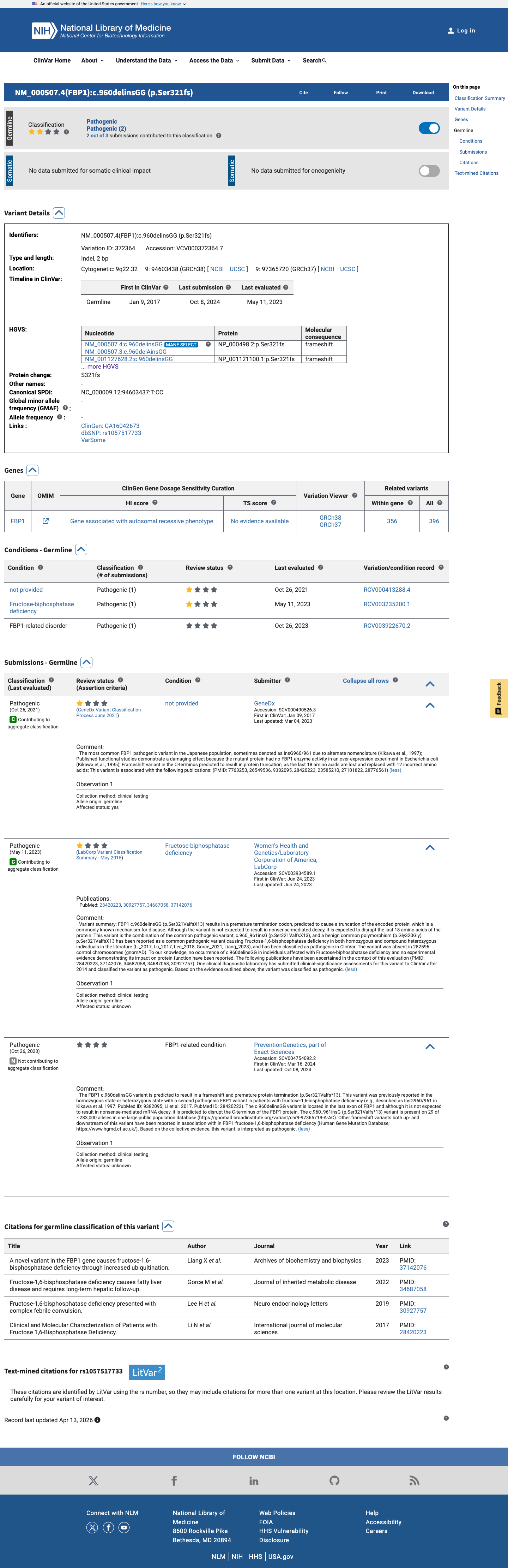
ClinVar
This variant has been reported in ClinVar as Pathogenic (3 clinical laboratories). (ClinVarID = 372364)
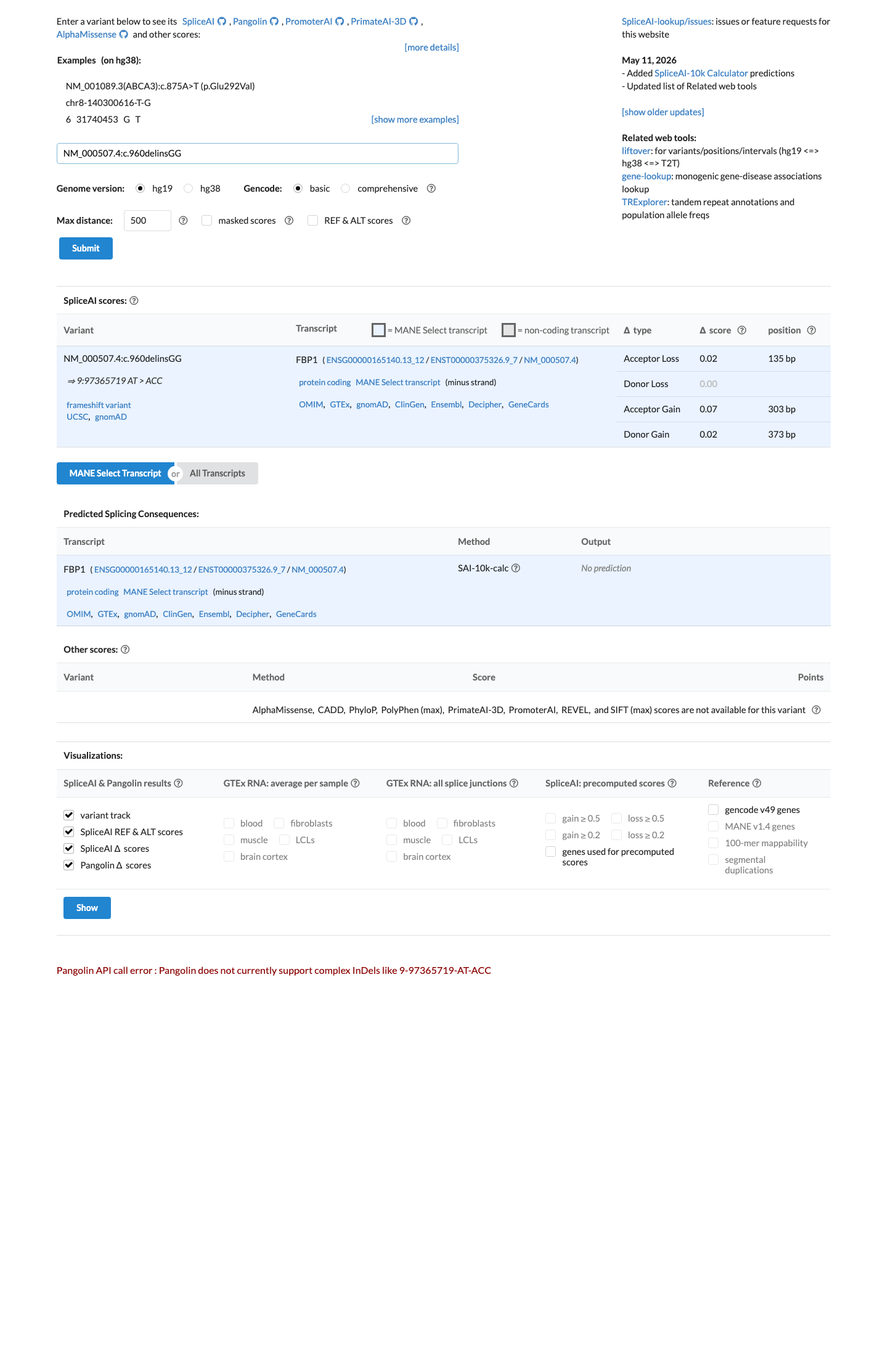
In silico
SpliceAI predicts no significant splice impact for this variant (max delta score = 0.07).
Functional
No data
No calibrated functional assay or RNA evidence was identified for this variant.

COSMIC

Cancer hotspots
Somatic evidence
Not in COSMIC / hotspots
COSMIC
This variant does not lie in a statistically significant hotspot. This variant has not previously been reported in somatic cancers (COSMIC).
Hotspots
This variant does not lie in a statistically significant hotspot.
Sources & reference links
Triaged references · 5 PMIDs not cited in assessment
37142076 ↗
A novel variant in the FBP1 gene causes fructose-1,6-bisphosphatase deficiency through increased ubiquitination.
CLINVAR
28420223 ↗
Clinical and Molecular Characterization of Patients with Fructose 1,6-Bisphosphatase Deficiency.
CLINVAR
30927757 ↗
Fructose-1,6-bisphosphatase deficiency presented with complex febrile convulsion.
CLINVAR
34687058 ↗
Fructose-1,6-bisphosphatase deficiency causes fatty liver disease and requires long-term hepatic follow-up.
CLINVAR