PM1_Supporting: The variant alters Gly153, located within the Walker A motif (GAPGVGKT) of the RAD51C ATPase domain, a critical functional domain where pathogenic missense variants cluster and benign variation is absent in population databases.1 PM2_Supporting: The variant is extremely rare in population databases (gnomAD v2.1 AF=7.95e-06, 2/251,462 alleles; gnomAD v4.1 AF=1.86e-06, 3/1,614,194 alleles; both well below the PM2 threshold of <0.1%).2 PP3_Supporting: Multiple computational tools predict a deleterious effect. REVEL score is 0.635. Both SIFT and PolyPhen predicted G153D as likely pathogenic based on sequence conservation (PMID:21980511).3 PS3 not assessed: Functional studies (PMID:37253112, PMID:36099300, PMID:39299233) describe deleterious effects for variants in the Walker A/ATP-binding region where Gly153 resides, but the abstracts do not confirm that p.Gly153Asp was among the specific variants tested and shown to be functionally deleterious. Full-text review of these papers is required to determine PS3 applicability.4 The variant was identified in germline DNA of BRCA-negative breast and/or ovarian cancer cases in Clague et al. (PMID:21980511), which screened 286 high-risk families and found G153D among six non-synonymous variants. No truncating mutations were identified in this cohort.5 In ClinVar (Variation ID 185444), the majority classification is Uncertain significance (7 clinical laboratories), while three laboratories classify as Likely pathogenic and one as Pathogenic (LOVD, no criteria provided). No ClinGen expert panel review is available.6 Overall assessment: 3 supporting pathogenic criteria met (PM1_Supporting, PM2_Supporting, PP3_Supporting). Per ACMG/AMP 2015 combination rules, a minimum of 2 moderate or 1 moderate + 2 supporting criteria is needed for Likely pathogenic. With only 3 supporting criteria, the classification remains Variant of Uncertain Significance. PS3 assessment (pending full-text review of functional studies) could potentially elevate the classification to Likely pathogenic if moderate-level functional evidence is confirmed.7
RAD51C
Final classification
VUS
RAD51C c.458G>A · p.Gly153Asp
RAD51C
PM1_Supporting: The variant alters Gly153, located within the Walker A motif (GAPGVGKT) of the RAD51C ATPase domain, a critical functional domain where pathogenic missense variants cluster and benign variation is absent in population databases.
ClinGen Hereditary Breast, Ovarian and Pancreatic Cancer Expert Panel Specifications to the ACMG/AMP Variant Interpretation Guidelines for RAD51C Version 1.0.0 v1.0.0 lacked a usable explicit final combination framework, so generic ACMG/AMP 2015 final-combination rules were applied as fallback; applied criteria: PM1 supporting, PM2 supporting, PP3 supporting; combination = 3 supporting, which maps to VUS.
Classification rationale
PM1PM2PP3
VUS
RAD51C c.458G>A
PM1 + PM2 + PP3
→
VUS
3
revelPMID:21980511 ↗
7
generic_acmg_combination_rules
Gene diagram
· NM_058216.3 · variants mapped to exon structure
RAD51C
NM_058216.3
Fetching transcript structure from UCSC…
Applied criteria · 3 met · select any tile
Met
Not met
Not assessed
N/A
Strength
very strong
supporting
Pathogenic evidence
PVS
PS
PM
PP
Benign evidence
BA
BS
BP
—
—
—
Rationale
Select a criterion.
Sources
Evidence used
Gaps remaining
Rule
—
Research & evidence
Population frequency
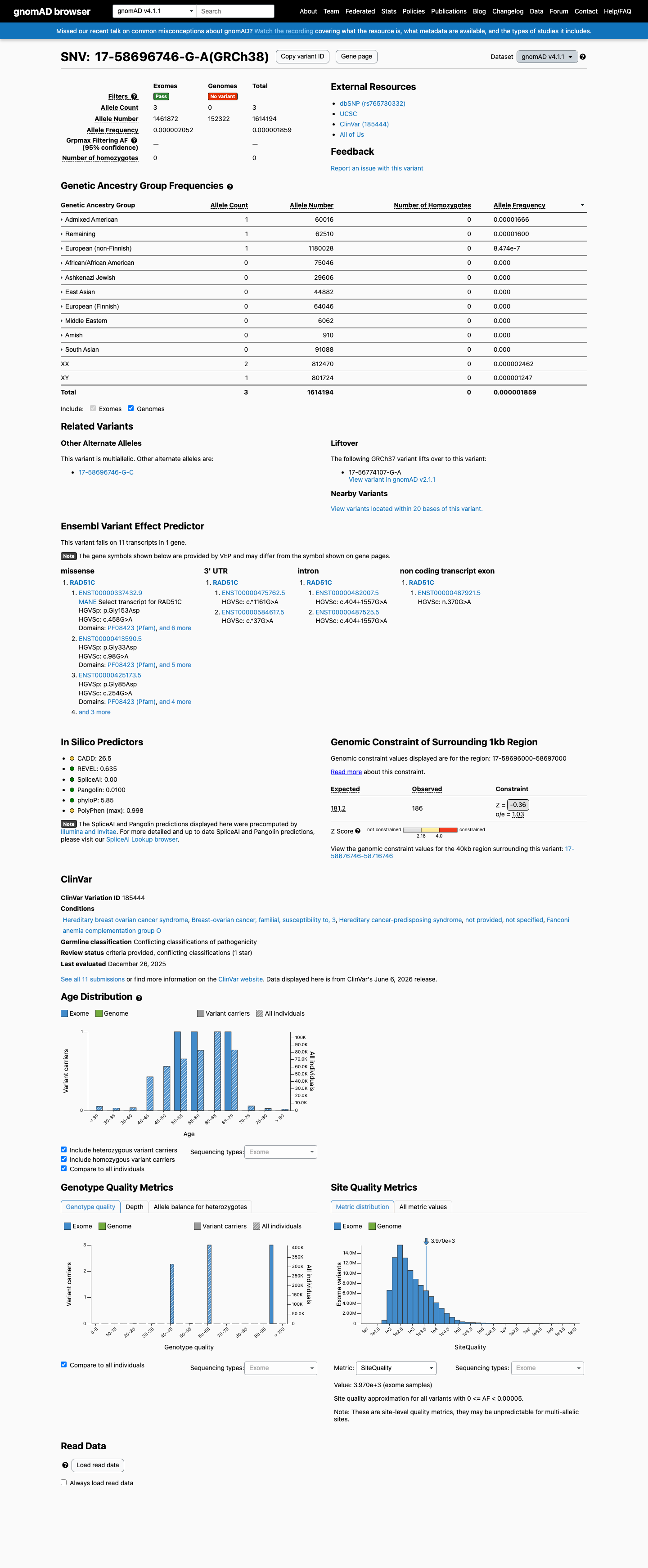
gnomAD v4.1
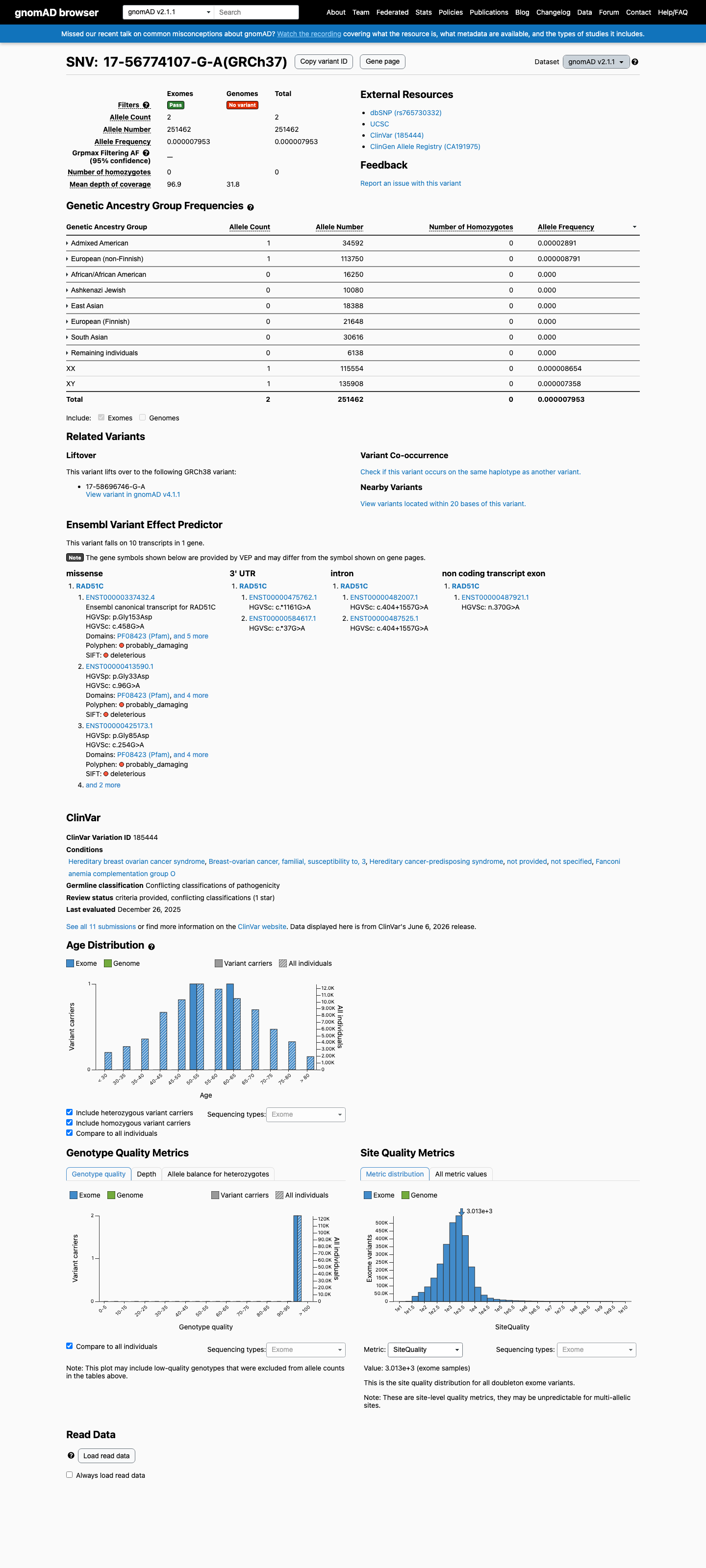
gnomAD v2.1
Population frequency
Overall AF
3 / 1,614,194
0.00019%
Highest · Admixed American
0.0017%
Homozygotes
0
Allele frequency by ancestry — gnomAD v4.1
observed in 2 of 9 groups
| Ancestry | Allele count | Frequency | Homozygotes |
|---|---|---|---|
| Admixed American | 1 / 60,016 | 0.0017% | 0 |
| European (non-Finnish) | 1 / 1,180,028 | 8.5e-05% | 0 |
| European (Finnish) | 0 / 64,046 | — | — |
| Amish | 0 / 910 | — | — |
| East Asian | 0 / 44,882 | — | — |
| Middle Eastern | 0 / 6,062 | — | — |
| South Asian | 0 / 91,088 | — | — |
| Ashkenazi Jewish | 0 / 29,606 | — | — |
| African/African American | 0 / 75,046 | — | — |
“
This variant is present in gnomAD v4.1 (AF= 1.85851e-06; MAF= 0.00019%, 3/1614194 alleles, homozygotes = 0) and has highest observed frequency in the Admixed American population (AF= 1.66622e-05; MAF= 0.00167%, 1/60016 alleles, homozygotes = 0).
Overall AF
2 / 251,462
0.0008%
Highest · Admixed American
0.0029%
Homozygotes
0
Allele frequency by ancestry — gnomAD v2.1
observed in 2 of 8 groups
| Ancestry | Allele count | Frequency | Homozygotes |
|---|---|---|---|
| Admixed American | 1 / 34,592 | 0.0029% | 0 |
| European (non-Finnish) | 1 / 113,750 | 0.00088% | 0 |
| African/African American | 0 / 16,250 | — | — |
| Ashkenazi Jewish | 0 / 10,080 | — | — |
| East Asian | 0 / 18,388 | — | — |
| European (Finnish) | 0 / 21,648 | — | — |
| Remaining individuals | 0 / 6,138 | — | — |
| South Asian | 0 / 30,616 | — | — |
“
This variant is present in gnomAD v2.1 (AF= 7.95349e-06; MAF= 0.00080%, 2/251462 alleles, homozygotes = 0) and has highest observed frequency in the Admixed American population (AF= 2.89084e-05; MAF= 0.00289%, 1/34592 alleles, homozygotes = 0).
“
This variant is absent from gnomAD-Canada.

ClinVar
This variant has been reported in ClinVar as Uncertain significance (7 clinical laboratories) and as Likely pathogenic (3 clinical laboratories). (ClinVarID = 185444)
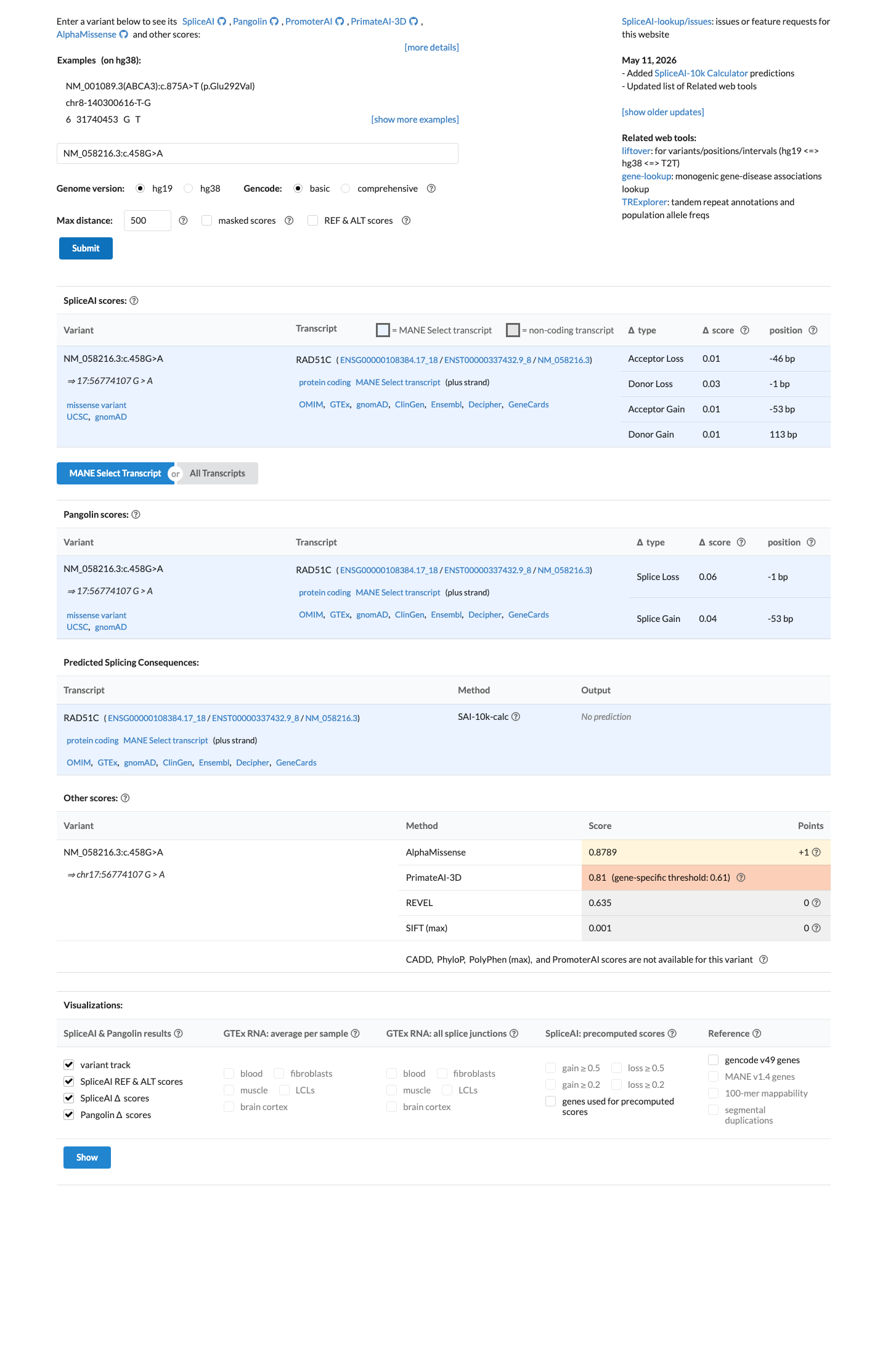
In silico
SpliceAI predicts no significant splice impact for this variant (max delta score = 0.03). REVEL score = 0.635. BayesDel score = 0.233494.
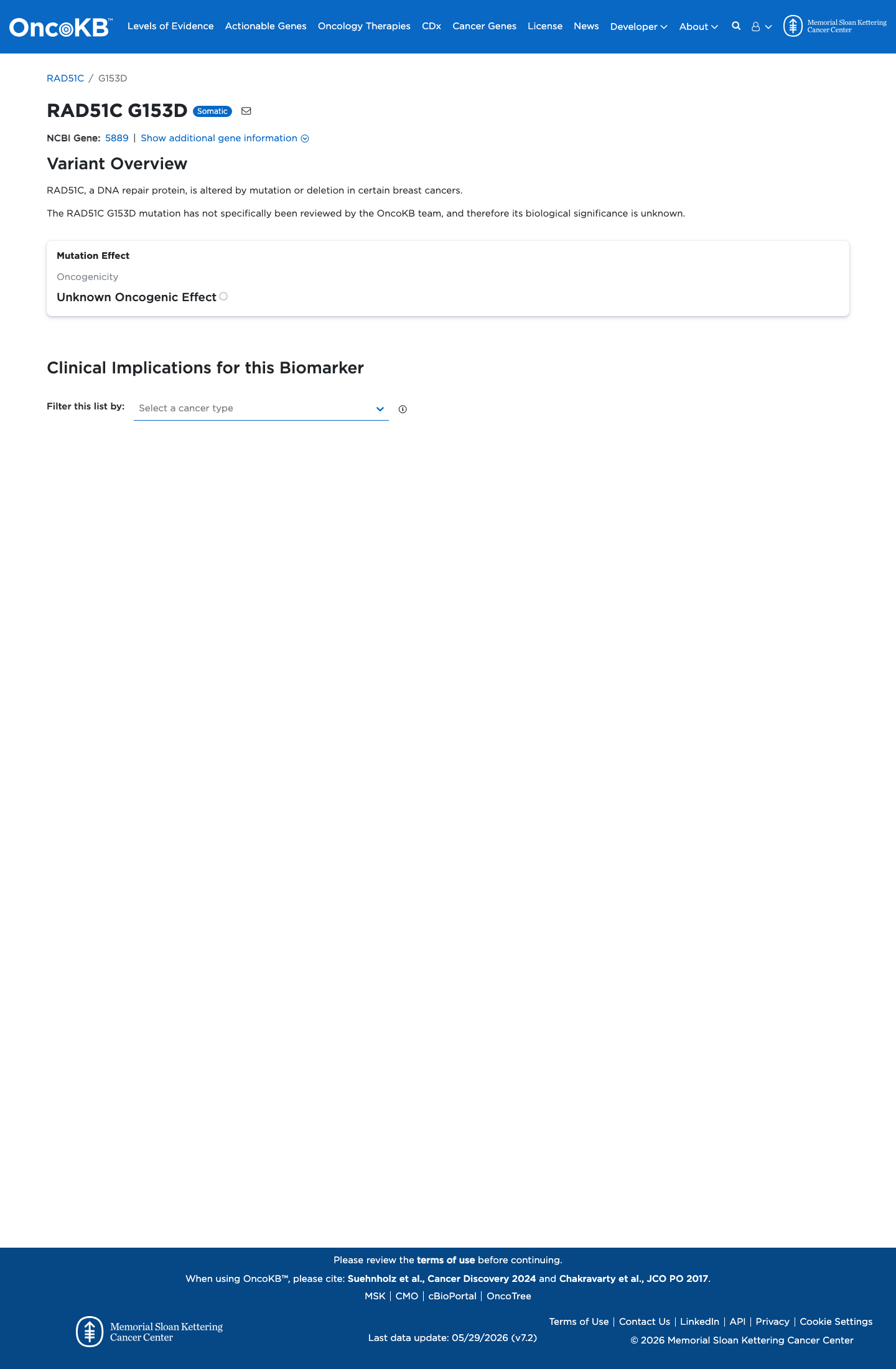
Functional
Unknown Oncogenic Effect
OncoKB did not identify variant-specific reviewed functional evidence for this variant; gene-level curated context is available for reviewer follow-up. RAD51C, a DNA repair protein, is altered by mutation or deletion in certain breast cancers.

COSMIC

Cancer hotspots
Somatic evidence
Not in COSMIC / hotspots
COSMIC
This variant does not lie in a statistically significant hotspot. This variant has not previously been reported in somatic cancers (COSMIC).
Hotspots
This variant does not lie in a statistically significant hotspot.
Literature · 22 PMIDs triaged · 8 high-priority
22papers screened
Papers triaged by theme: functional/splicing/segregation/case_observation. high_priority_papers include abstract snippets. Use these to support PS3/BS3/PS4/PP1/PP3/PP5.
21980511 ↗
splicing rna
RAD51C germline mutations in breast and ovarian cancer cases from high-risk families.
BRCA1 and BRCA2 are the most well-known breast cancer susceptibility genes. Additional genes involved in DNA repair have been identified as predisposing to breast cancer. One such gene, RAD51C, is essential for homologous recombination repair. Several likely pathogenic RAD51C mutations have been identified in BRCA1- and BRCA2-negative breast and ovarian cancer families. We performed complete seque
BP7PP3PP5PS4PVS1
23117857 ↗
splicing rna
Germline mutations in RAD51C in Jewish high cancer risk families.
Germline mutations in BRCA1 and BRCA2 account for ~30 % of inherited breast cancer. RAD51C was reported as an additional breast/ovarian cancer susceptibility gene in some populations. There is a paucity of data on the putative contribution of this gene to inherited breast/ovarian cancer in Jewish high risk families. High risk Jewish women, none of whom was a carrier of the predominant Jewish mutat
BP7PP3PP5PS4PVS1
23918944 ↗
splicing rna
Tamoxifen and risk of contralateral breast cancer for BRCA1 and BRCA2 mutation carriers.
To determine whether adjuvant tamoxifen treatment for breast cancer (BC) is associated with reduced contralateral breast cancer (CBC) risk for BRCA1 and/or BRCA2 mutation carriers. Analysis of pooled observational cohort data, self-reported at enrollment and at follow-up from the International BRCA1, and BRCA2 Carrier Cohort Study, Kathleen Cuningham Foundation Consortium for Research into Familia
BP7PP3PP5PS4PVS1
25741868 ↗
functional
Standards and guidelines for the interpretation of sequence variants: a joint consensus recommendation of the American College of Medical Genetics and Genomics and the Association for Molecular Pathology.
The American College of Medical Genetics and Genomics (ACMG) previously developed guidance for the interpretation of sequence variants.(1) In the past decade, sequencing technology has evolved rapidly with the advent of high-throughput next-generation sequencing. By adopting and leveraging next-generation sequencing, clinical laboratories are now performing an ever-increasing catalogue of genetic
BS3PS3PS4
36099300 ↗
functional
Homologous recombination-deficient mutation cluster in tumor suppressor RAD51C identified by comprehensive analysis of cancer variants.
Mutations in homologous recombination (HR) genes, including BRCA1, BRCA2, and the RAD51 paralog RAD51C, predispose to tumorigenesis and sensitize cancers to DNA-damaging agents and poly(ADP ribose) polymerase inhibitors. However, ∼800 missense variants of unknown significance have been identified for RAD51C alone, impairing cancer risk assessment and therapeutic strategies. Here, we interro
BS3PP5PS3PS4
37253112 ↗
functional
Functional and Clinical Characterization of Variants of Uncertain Significance Identifies a Hotspot for Inactivating Missense Variants in RAD51C.
Pathogenic protein-truncating variants of RAD51C, which plays an integral role in promoting DNA damage repair, increase the risk of breast and ovarian cancer. A large number of RAD51C missense variants of uncertain significance (VUS) have been identified, but the effects of the majority of these variants on RAD51C function and cancer predisposition have not been established. Here, analysis of 173
BS3PP5PS3PS4
39299233 ↗
functional
High-resolution functional mapping of RAD51C by saturation genome editing.
Pathogenic variants in RAD51C confer an elevated risk of breast and ovarian cancer, while individuals homozygous for specific RAD51C alleles may develop Fanconi anemia. Using saturation genome editing (SGE), we functionally assess 9,188 unique variants, including >99.5% of all possible coding sequence single-nucleotide alterations. By computing changes in variant abundance and Gaussian mixture
BS3PP5PS3PS4
12692171 ↗
case observation
American Society of Clinical Oncology policy statement update: genetic testing for cancer susceptibility.
As the leading organization representing cancer specialists involved in patient care and clinical research, the American Society of Clinical Oncology (ASCO) reaffirms its commitment to integrating cancer risk assessment and management, including molecular analysis of cancer predisposition genes, into the practice of oncology and preventive medicine. The primary goal of this effort is to foster exp
PP5PS4
28492532 ↗
background review
Sherloc: a comprehensive refinement of the ACMG-AMP variant classification criteria.
PS3PS4
Sources & reference links