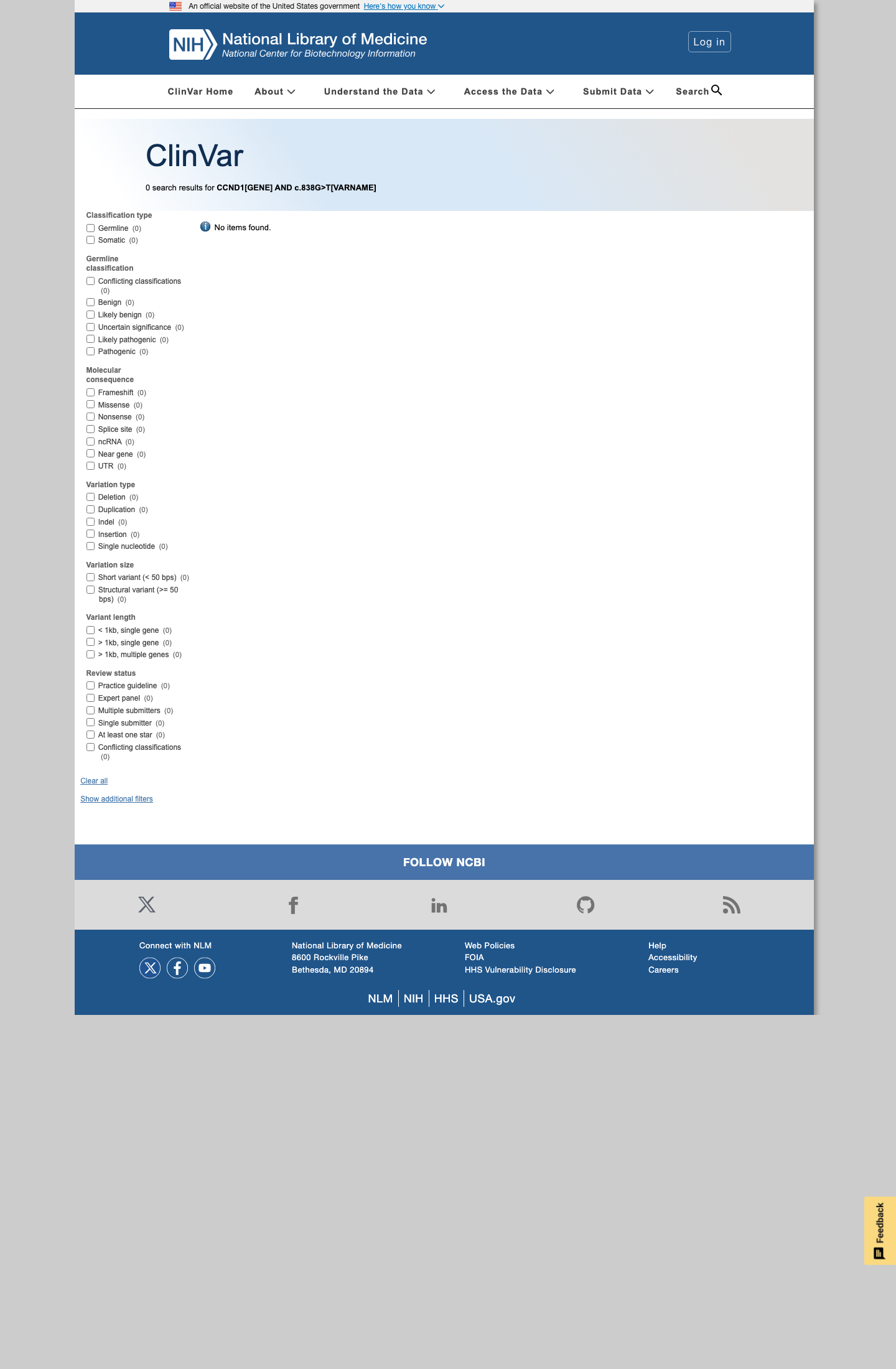
NM_053056.3:c.838G>T (NP_444284.1:p.Glu280Ter) is a nonsense variant in the last exon (exon 5/5) of CCND1, predicted to escape nonsense-mediated decay and produce a truncated protein lacking the terminal 10 amino acids.1 The variant is absent from gnomAD v2.1 and v4.1 population databases, meeting PM2 at supporting strength.2 The variant is absent from ClinVar with no prior germline classifications available.3 The variant has been reported somatically in COSMIC (COSV99919608, n=3) and is classified as Likely Oncogenic by OncoKB with a gain-of-function context, but no variant-specific functional studies or germline case reports are available.4 SpliceAI predicts no splice impact (max delta score 0.00) and BayesDel score of 0.60222 provides borderline in silico evidence, insufficient to meet PP3 or BP4.5 Four CCND1 functional domain papers were reviewed (PMID:16732330, PMID:17299095, PMID:9832503, PMID:9926916); none examined the specific variant p.Glu280Ter, and thus none provide criterion-level evidence for this variant. PVS1 is not applicable because the nonsense variant in the last exon is predicted to escape NMD, and C-terminal truncations in CCND1 are associated with gain-of-function rather than loss-of-function. No other pathogenic or benign criteria were met, resulting in insufficient evidence for definitive classification under generic ACMG/AMP 2015 rules.
Final classification
VUS
PM2
CCND1
c.838G>T
p.Glu280Ter
This variant
NM_053056.3:c.838G>T (NP_444284.1:p.Glu280Ter) is a nonsense variant in the last exon (exon 5/5) of CCND1, predicted to escape nonsense-mediated decay and produce a truncated protein lacking the terminal 10 amino acids.
gene-specific framework lacked a usable explicit final combination framework, so generic ACMG/AMP 2015 final-combination rules were applied as fallback; applied criteria: PM2 supporting; combination = 1 supporting, which maps to VUS.
Classification rationale
PM2
VUS
CCND1 c.838G>T
PM2
→
VUS
LYFE Sciences is an AI system, and it can make mistakes. Criteria
may be applied incorrectly, sources may be misread, and a confident-looking
classification can still be wrong. Double-check every criterion and
its underlying evidence before relying on any call.
Gene diagram
· NM_053056.3 · variants mapped to exon structure
CCND1
NM_053056.3
Fetching transcript structure from UCSC…
Applied criteria · 1 applied · 19 assessed
MetEvidence satisfies this criterion.
Not metEvaluated against available evidence; threshold not reached.
Not assessedApplies in principle, but no evidence was found to evaluate it.
N/ADoesn't apply to this variant type.
Applied · 1
Strength
Supporting
Moderate
Strong
Very strong
PM2
supporting
Pathogenic
The variant is absent from gnomAD v2.1 and v4.1 population databases, meeting the generic ACMG PM2 threshold of allele frequency below 0.1%.
Absent from gnomAD v2.1 (0 alleles across all populations)Absent from gnomAD v4.1 (0 alleles across all populations)
Assessed · not applied
· 19 not met · 0 not assessed
Pathogenic
PS1
No nucleotide change at the same position has been previously established as pathogenic.
PS2
No de novo occurrence of NM_053056.3:c.838G>T has been reported in a patient with a CCND1-related phenotype, and no trio sequencing studies have identified this variant as de novo.
PS3
No well-established functional studies have been performed on the specific variant CCND1 p.Glu280Ter.
PS4
No case-control study comparing the frequency of c.838G>T in affected versus unaffected individuals is available.
PM1
The variant is not located within a statistically significant mutational hotspot per Cancer Hotspots analysis.
PM6
No assumed de novo occurrence of c.838G>T has been reported in the literature without confirmation of paternity and maternity.
PP1
No cosegregation data are available for c.838G>T with a CCND1-associated disease in multiple affected family members.
PP3
Multiple lines of computational evidence do not support a deleterious effect.
PP4
No specific phenotype or family history data are available for the proband carrying this variant.
PP5
No reputable source has definitively classified this variant as pathogenic.
Benign
BA1
The variant is absent from gnomAD v2.1 and v4.1, with an allele frequency of 0%, which does not meet the BA1 threshold of >1%.
BS1
The variant is absent from gnomAD v2.1 and v4.1, with an allele frequency of 0%, which does not meet the BS1 threshold of >0.3%.
BS2
No evidence that this variant has been observed in healthy adults at sufficient frequency to be considered benign.
BS3
No well-established functional studies demonstrate that CCND1 p.Glu280Ter has no damaging effect.
BS4
No lack of cosegregation data are available.
BP2
No observation of CCND1 c.838G>T in trans with a known pathogenic variant in a different gene for a dominantly inherited disorder has been reported.
BP4
Multiple lines of computational evidence do not provide a strong benign signal.
BP5
No case has been reported where this variant is found in a patient with an alternate molecular basis for disease.
BP6
No reputable source has classified this variant as benign.
N/A · 5
PVS1 · PM5 · PP2 · BP1 · BP7
Research & evidence
Population frequency
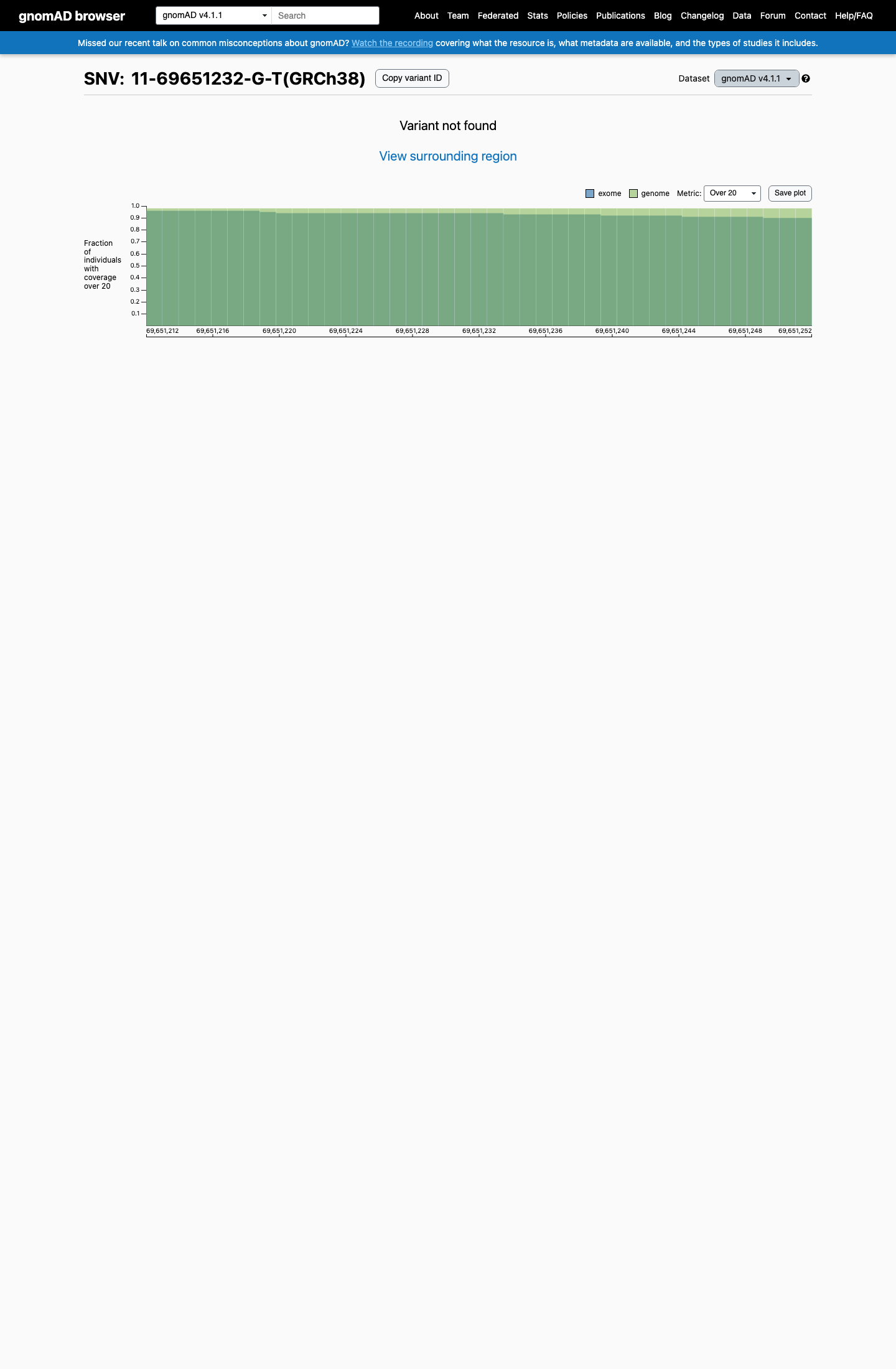
gnomAD v4.1
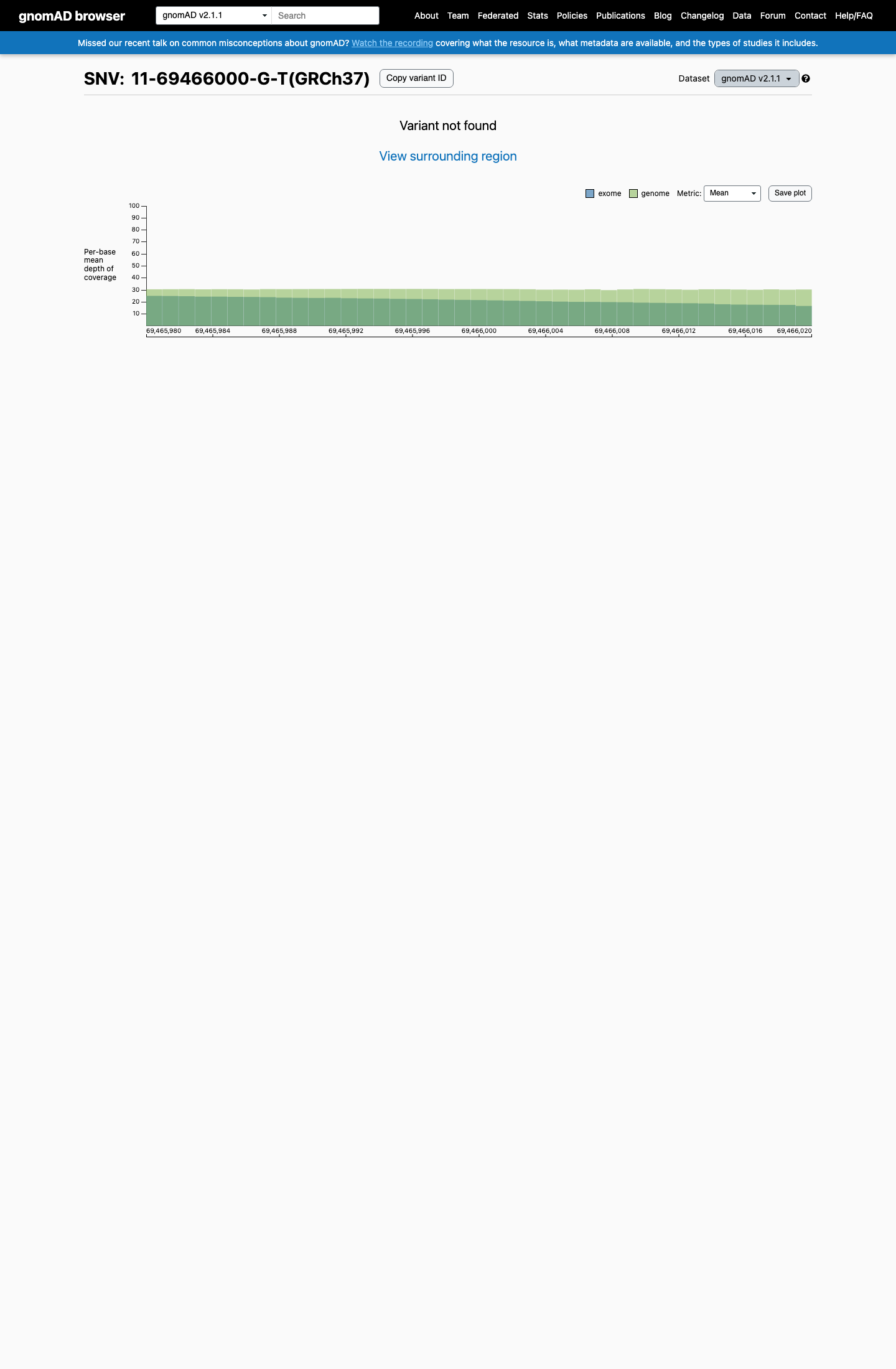
gnomAD v2.1
v4.1
Absent from gnomAD v4.1.
v2.1
Absent from gnomAD v2.1.
🇨🇦 CA
This variant is absent from gnomAD-Canada.
Allele frequency by ancestry
three datasets · side by side
gnomAD v4.1
Absent
· 0 / ?
0 hom
0 hom
Not observed in any ancestry group.
gnomAD v2.1
Absent
· 0 / ?
0 hom
0 hom
Not observed in any ancestry group.
gnomAD Canada 🇨🇦
Absent
· 0 / ?
0 hom
0 hom
Not observed in any ancestry group.
In silico
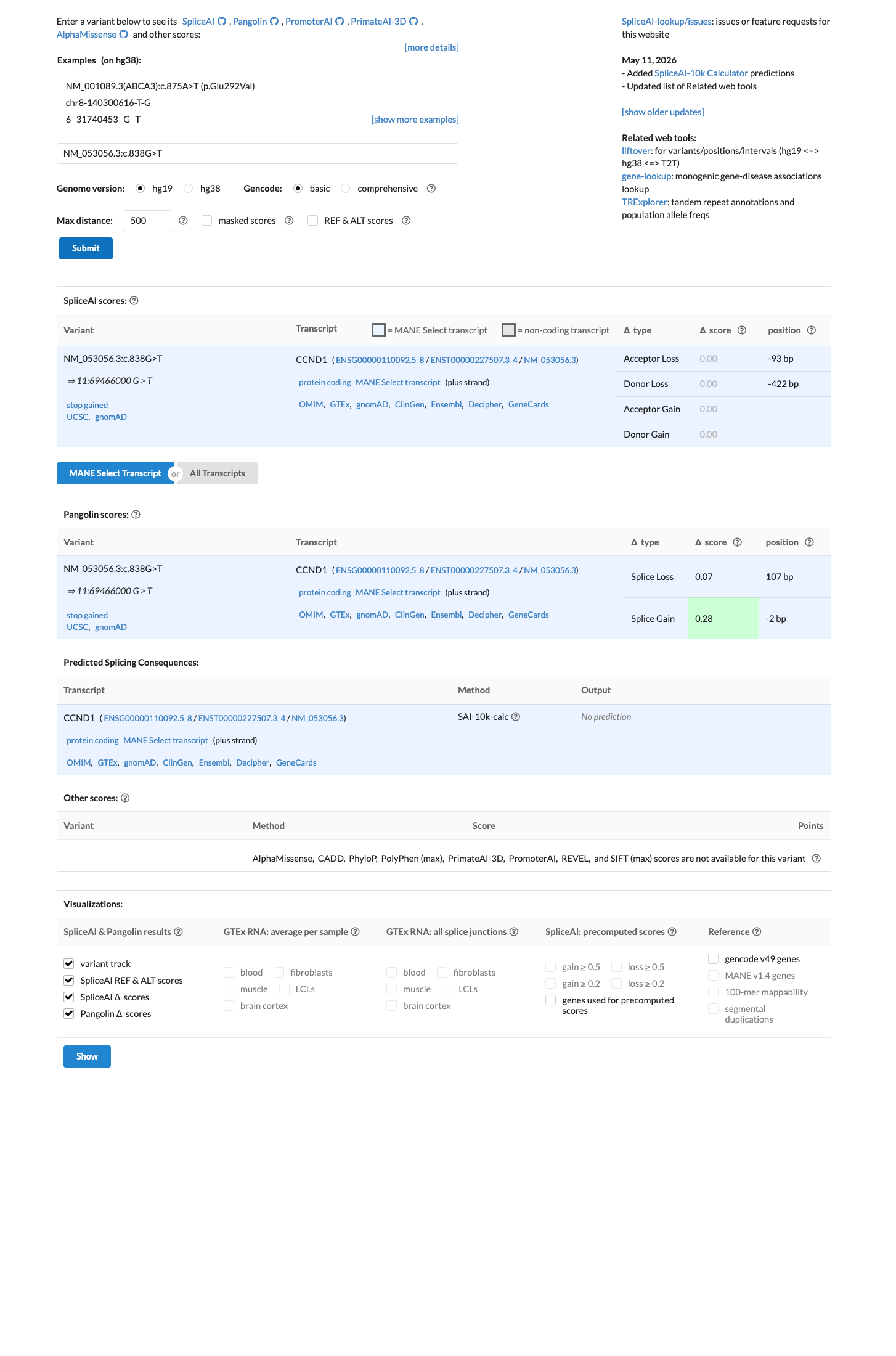
SpliceAI predicts no significant splice impact for this variant (max delta score = 0.00). BayesDel score = 0.60222.
Functional
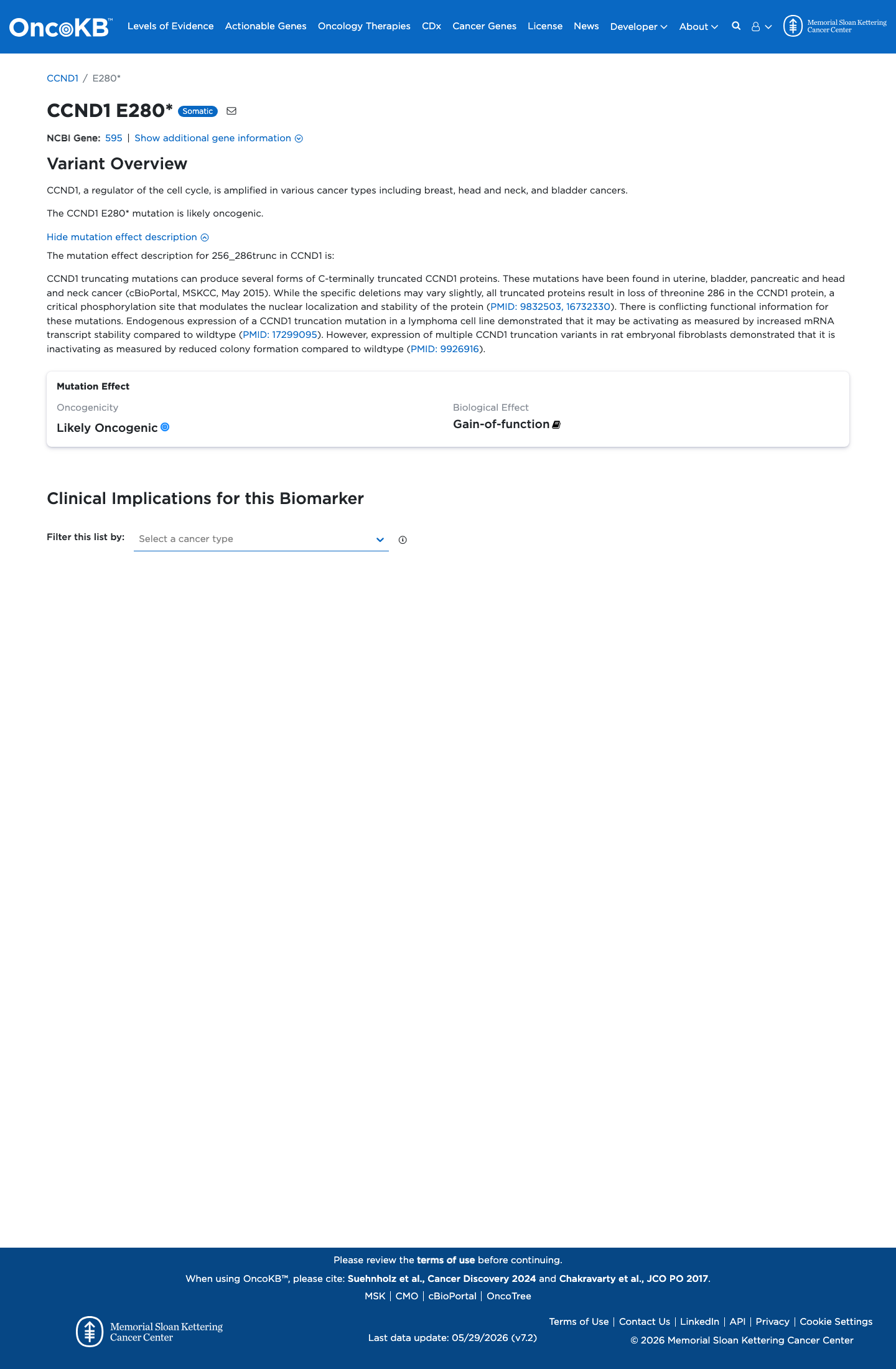
Likely Oncogenic
OncoKB identified variant-specific curated literature and context relevant to functional review; biological-effect context: Gain-of-function; curated oncogenicity label: Likely Oncogenic.
COSMIC

Cancer hotspots
Somatic evidence
Not in COSMIC / hotspots
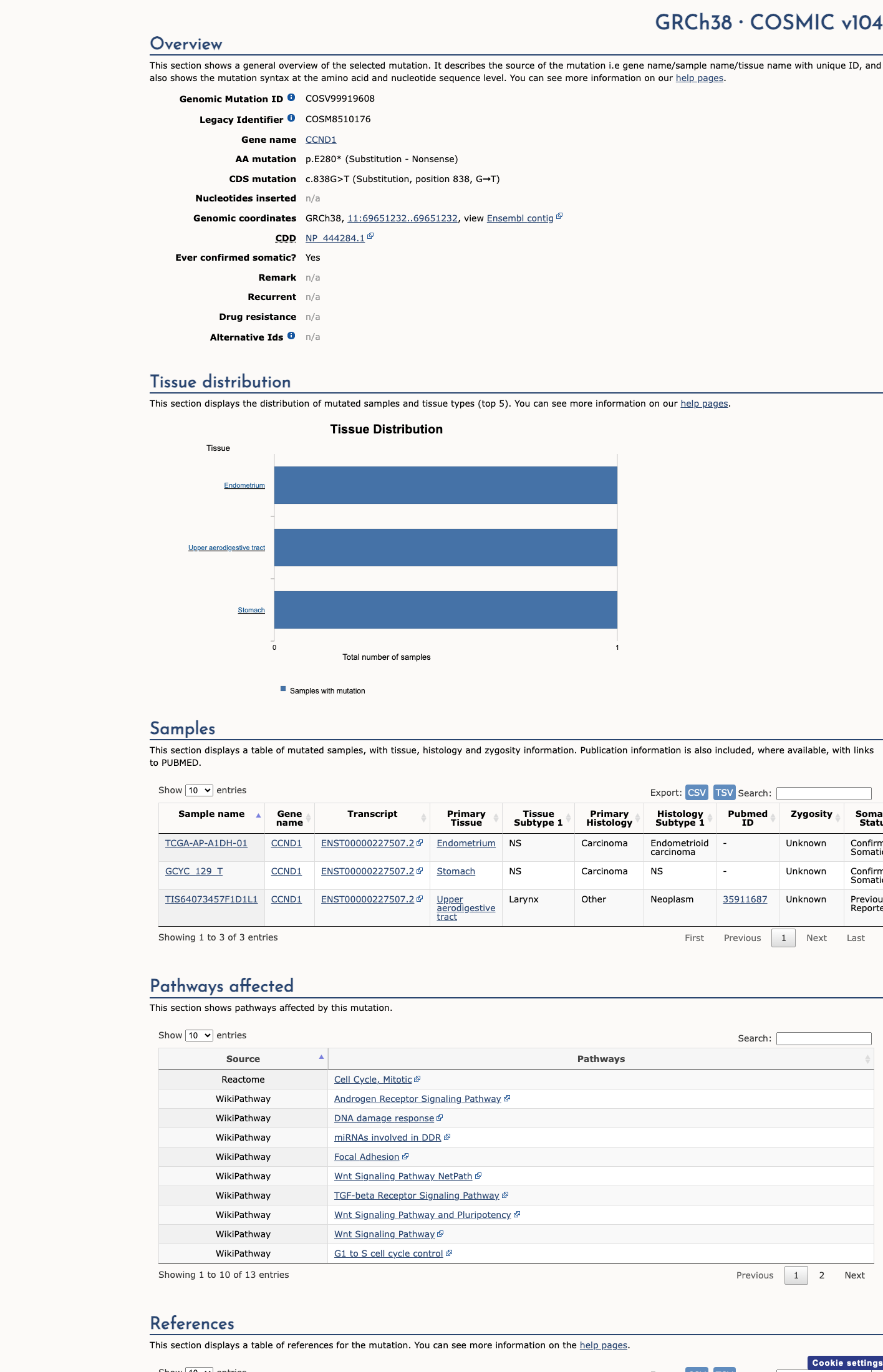
COSMIC
This variant does not lie in a statistically significant hotspot. This variant has previously been reported in somatic cancers (COSMIC; COSV99919608, n = 3 times).
Hotspots
This variant does not lie in a statistically significant hotspot.
Sources & reference links
Triaged references · 4 PMIDs not cited in assessment
16732330 ↗
Identification of mutations that disrupt phosphorylation-dependent nuclear export of cyclin D1.
ONCOKB
17299095 ↗
Point mutations and genomic deletions in CCND1 create stable truncated cyclin D1 mRNAs that are associated with increased proliferation rate and shorter survival.
ONCOKB
9832503 ↗
Glycogen synthase kinase-3beta regulates cyclin D1 proteolysis and subcellular localization.
ONCOKB
9926916 ↗
Functional domains in cyclin D1: pRb-kinase activity is not essential for transformation.
ONCOKB