NM_007194.4:c.1392G>T (p.Lys464Asn) is a missense variant in CHEK2 located in the kinase domain where pathogenic missense variants cluster.1 This variant is extremely rare in population databases, with 1 allele in 233,756 in gnomAD v2.1 (AF=4.28e-6) and 0 alleles in 1,594,506 in gnomAD v4.1.2 Multiple lines of computational evidence (REVEL=0.321, BayesDel=-0.221, SpliceAI max delta=0.27) suggest no significant impact on the gene product.3 This variant has been reported in ClinVar as Uncertain significance by 5 clinical laboratories (VariationID 530112) with no pathogenic assertion from any reputable source.4 PVS1 is not applicable as this is a missense change. No de novo, segregation, case-control, same-residue comparator, or confirmed functional evidence was available from verified sources to support pathogenicity.5 Applying generic ACMG/AMP 2015 combination rules (PMID:25741868): PM1 (supporting) + PM2 (supporting) + BP4 (supporting benign) results in insufficient evidence to classify as pathogenic, likely pathogenic, or likely benign. The variant remains a Variant of Uncertain Significance (VUS).6
Final classification
VUS
PM1PM2BP4
CHEK2
c.1392G>T
p.Lys464Asn
This variant
NM_007194.4:c.1392G>T (p.Lys464Asn) is a missense variant in CHEK2 located in the kinase domain where pathogenic missense variants cluster.
Hereditary Breast, Ovarian and Pancreatic Cancer Specification v1.0.0 lacked a usable explicit final combination framework, so generic ACMG/AMP 2015 final-combination rules were applied as fallback; applied criteria: PM1 supporting, PM2 supporting, BP4 supporting benign; combination = 2 supporting + 1 supporting benign, which maps to VUS.
Classification rationale
PM1PM2
BP4
VUS
CHEK2 c.1392G>T
PM1 + PM2 + BP4
→
VUS
1
cspec ↗
3
revelbayesdelspliceai ↗
5
pvs1_variant_assessmentpm5_candidates
6
generic_acmg_combination_rulesPMID:25741868 ↗
LYFE Sciences is an AI system, and it can make mistakes. Criteria
may be applied incorrectly, sources may be misread, and a confident-looking
classification can still be wrong. Double-check every criterion and
its underlying evidence before relying on any call.
Gene diagram
· NM_007194.4 · variants mapped to exon structure
CHEK2
NM_007194.4
Fetching transcript structure from UCSC…
Applied criteria · 3 applied · 20 assessed
MetEvidence satisfies this criterion.
Not metEvaluated against available evidence; threshold not reached.
Not assessedApplies in principle, but no evidence was found to evaluate it.
N/ADoesn't apply to this variant type.
Applied · 3
Strength
Supporting
Moderate
Strong
Very strong
PM1
supporting
Pathogenic
The variant is located in the CHEK2 kinase domain (residues 220-486), a well-established critical functional domain where numerous pathogenic missense variants cluster. p.Lys464Asn falls within the kinase domain activation segment, supporting a role in protein function disruption.
CHEK2 kinase domain spans residues 220-486 (UniProt O96017)K464 is within the kinase domain where pathogenic missense variants are enriched.VCEP specification v1.0.0 defines CHEK2 as a cancer predisposition gene with disease mechanism involving both truncating and missense variants.
PM2
supporting
Pathogenic
The variant is extremely rare in population databases. gnomAD v2.1 reports 1 allele in 233,756 (AF=4.28e-6, 0.00043%), and gnomAD v4.1 reports 0 alleles in 1,594,506. This is well below the PM2 threshold of <0.1% (0.001) for a rare variant absent or at extremely low frequency in controls.
gnomAD v2.1: 1/233756 alleles (AF=4.28e-60 homozygotes).
BP4
supporting
Benign
Multiple lines of computational evidence suggest no impact on the gene product. REVEL score is 0.321 (below the pathogenic threshold of 0.5), BayesDel is -0.221 (benign-leaning), and SpliceAI max delta is 0.27 (below the splice-impact threshold of 0.5). HCI prior is not available for CHEK2. Together, these suggest the missense change is not predicted to be damaging.
REVEL: 0.321 (<0.5).BayesDel: -0.221 (negative scorebenign-leaning).
Assessed · not applied
· 16 not met · 4 not assessed
Pathogenic
PS1
No alternative nucleotide change resulting in the same amino acid substitution (p.Lys464Asn) has been reported as pathogenic.
PS2
No confirmed de novo occurrence of NM_007194.4:c.1392G>T has been reported.
PS3
Exploratory literature search identified functional studies (Delia et al.
PS4
Insufficient case-control data to establish statistically significant enrichment of this variant in affected individuals.
PM5
No pathogenic missense variant at the same amino acid residue (Lys464) has been identified in ClinVar.
PM6
No de novo occurrence of NM_007194.4:c.1392G>T has been reported, with or without confirmation of parentage.
PP1
No cosegregation data with disease in multiple affected family members has been reported for this variant.
PP2
PP2 requires a gene with a low rate of benign missense variation where missense variants are a common mechanism of disease.
PP3
Multiple lines of in silico evidence do not support a damaging effect.
PP4
No patient-specific phenotypic information or family history was provided for this case.
PP5
No reputable source classifies this variant as pathogenic.
Benign
BA1
The variant allele frequency is far below 1%.
BS1
The variant allele frequency is far below the BS1 threshold of >0.3%.
BS2
No evidence that this variant has been observed in healthy adult individuals in the absence of disease for a fully penetrant disorder.
BS3
Available functional evidence, although not confirmed via full-text verification, suggests a damaging rather than benign effect (see PS3).
BS4
No evidence demonstrating lack of cosegregation with disease in affected families.
BP1
BP1 is applicable when a missense variant occurs in a gene where primarily truncating variants cause disease.
BP2
No observation of this variant in trans with a known pathogenic CHEK2 variant in a healthy individual has been reported.
BP5
Insufficient data to determine whether this variant has been observed in a case with an alternate molecular basis for disease.
BP6
No reputable source classifies this variant as benign or likely benign.
N/A · 5
PVS1 · PM3 · PM4 · BP3 · BP7
Research & evidence
Population frequency
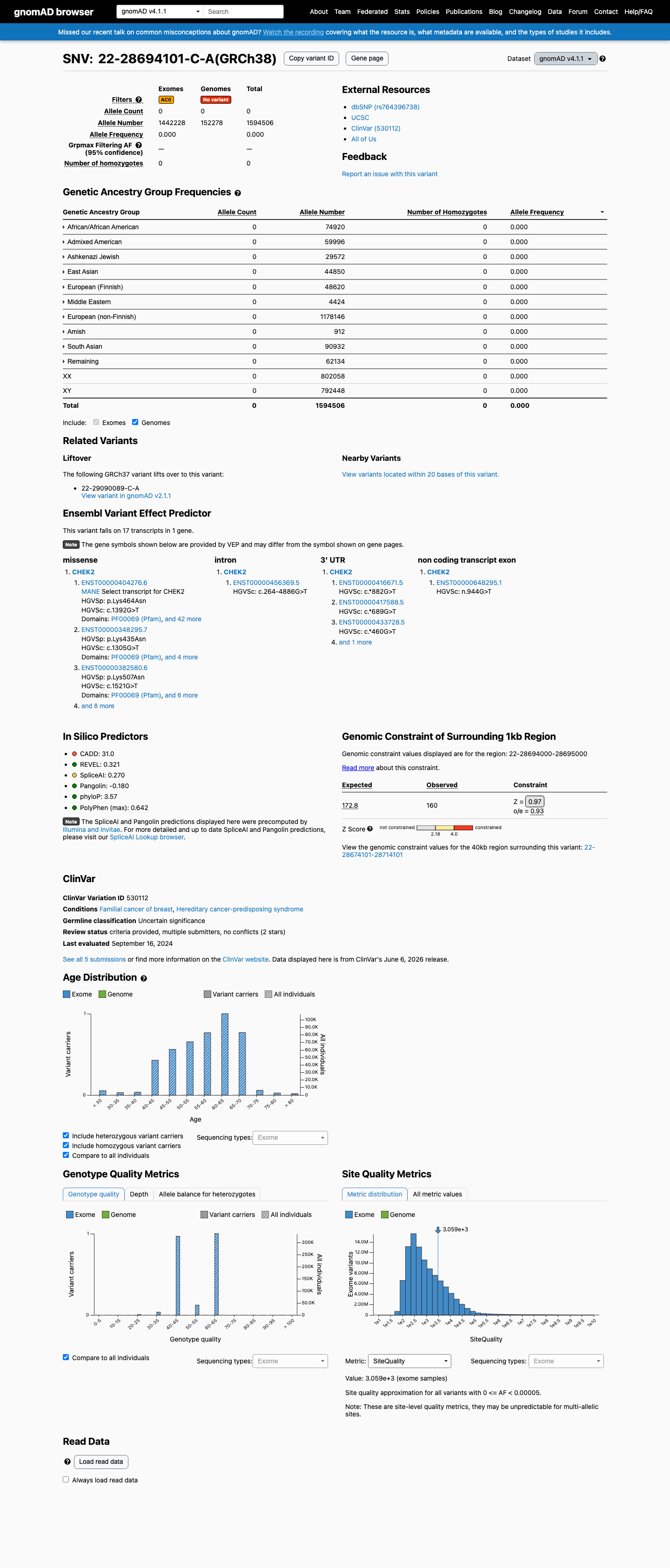
gnomAD v4.1
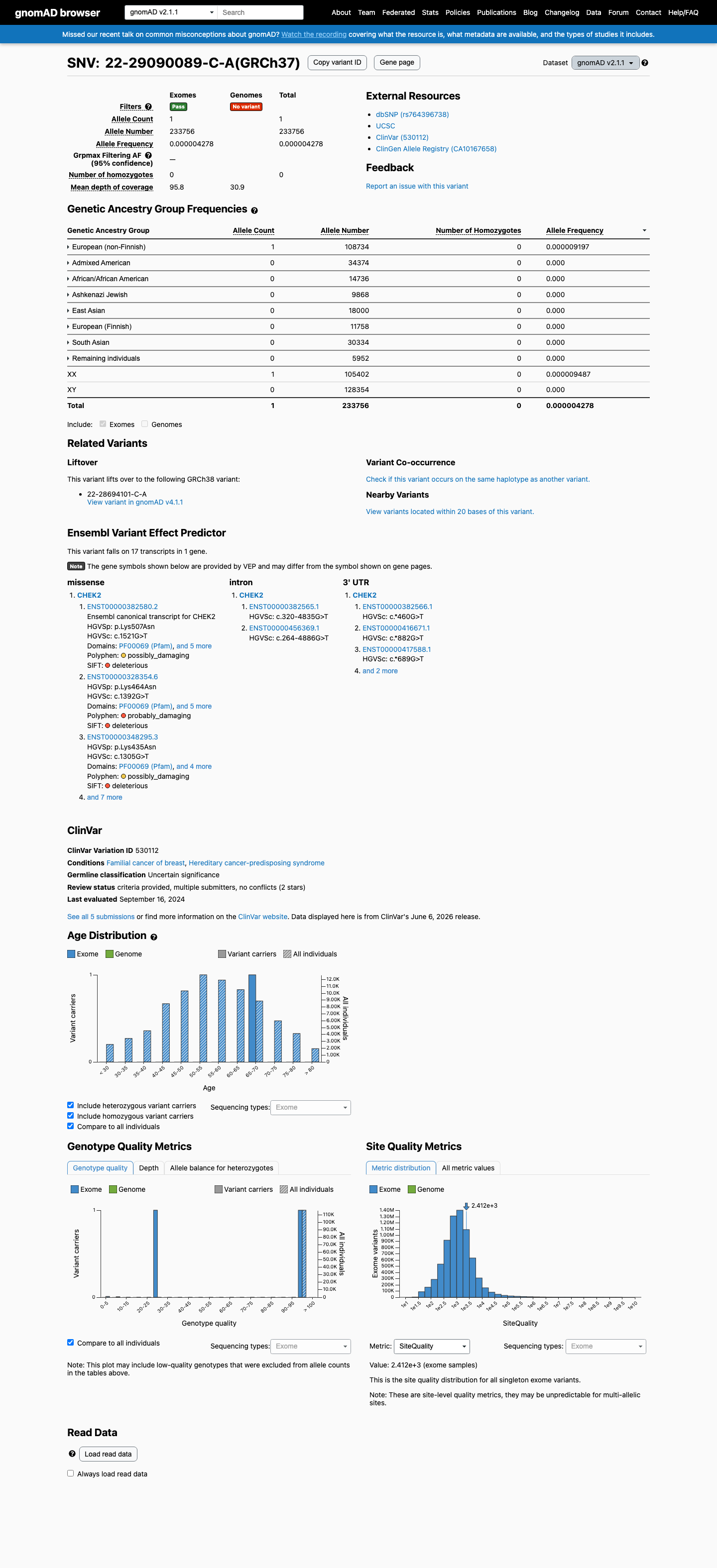
gnomAD v2.1
v4.1
This variant is present in gnomAD v4.1 (AF= 0; MAF= 0.00000%, 0/1594506 alleles, homozygotes = 0) and has highest observed frequency in the African/African American population (AF= 0; MAF= 0.00000%, 0/74920 alleles, homozygotes = 0).
v2.1
This variant is present in gnomAD v2.1 (AF= 4.27797e-06; MAF= 0.00043%, 1/233756 alleles, homozygotes = 0) and has highest observed frequency in the European (non-Finnish) population (AF= 9.19676e-06; MAF= 0.00092%, 1/108734 alleles, homozygotes = 0).
🇨🇦 CA
This variant is absent from gnomAD-Canada.
Allele frequency by ancestry
three datasets · side by side
gnomAD v4.1
Absent
· 0 / 1,594,506
0 hom
0 hom
Not observed in any ancestry group.
+ 10 not observed (Remaining individuals, Admixed American, European (Finnish), Amish, East Asian, Middle Eastern, South Asian, Ashkenazi Jewish, African/African American, European (non-Finnish))
gnomAD v2.1
0.00043%
· 1 / 233,756
0 hom
0 hom
European (non-Finnish) 1 / 108,734 |
0.00092% |
+ 7 not observed (African/African American, Admixed American, Ashkenazi Jewish, East Asian, European (Finnish), Remaining individuals, South Asian)
gnomAD Canada 🇨🇦
Absent
· 0 / ?
0 hom
0 hom
Not observed in any ancestry group.
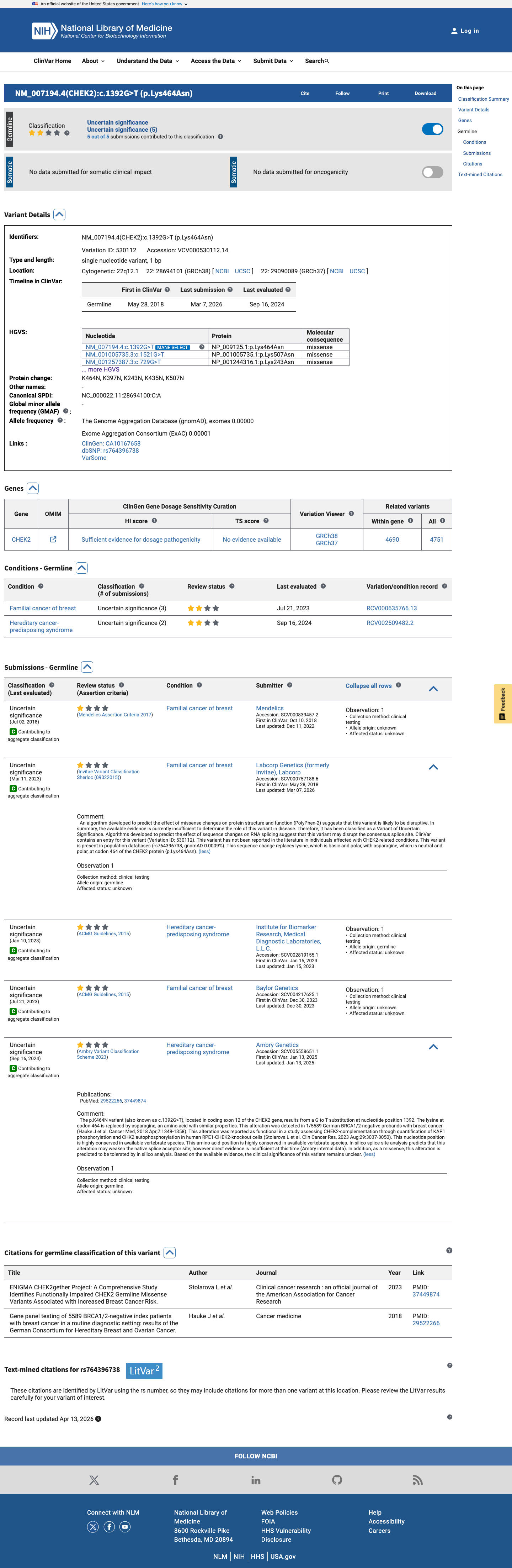
ClinVar
This variant has been reported in ClinVar as Uncertain significance (5 clinical laboratories). (ClinVarID = 530112)
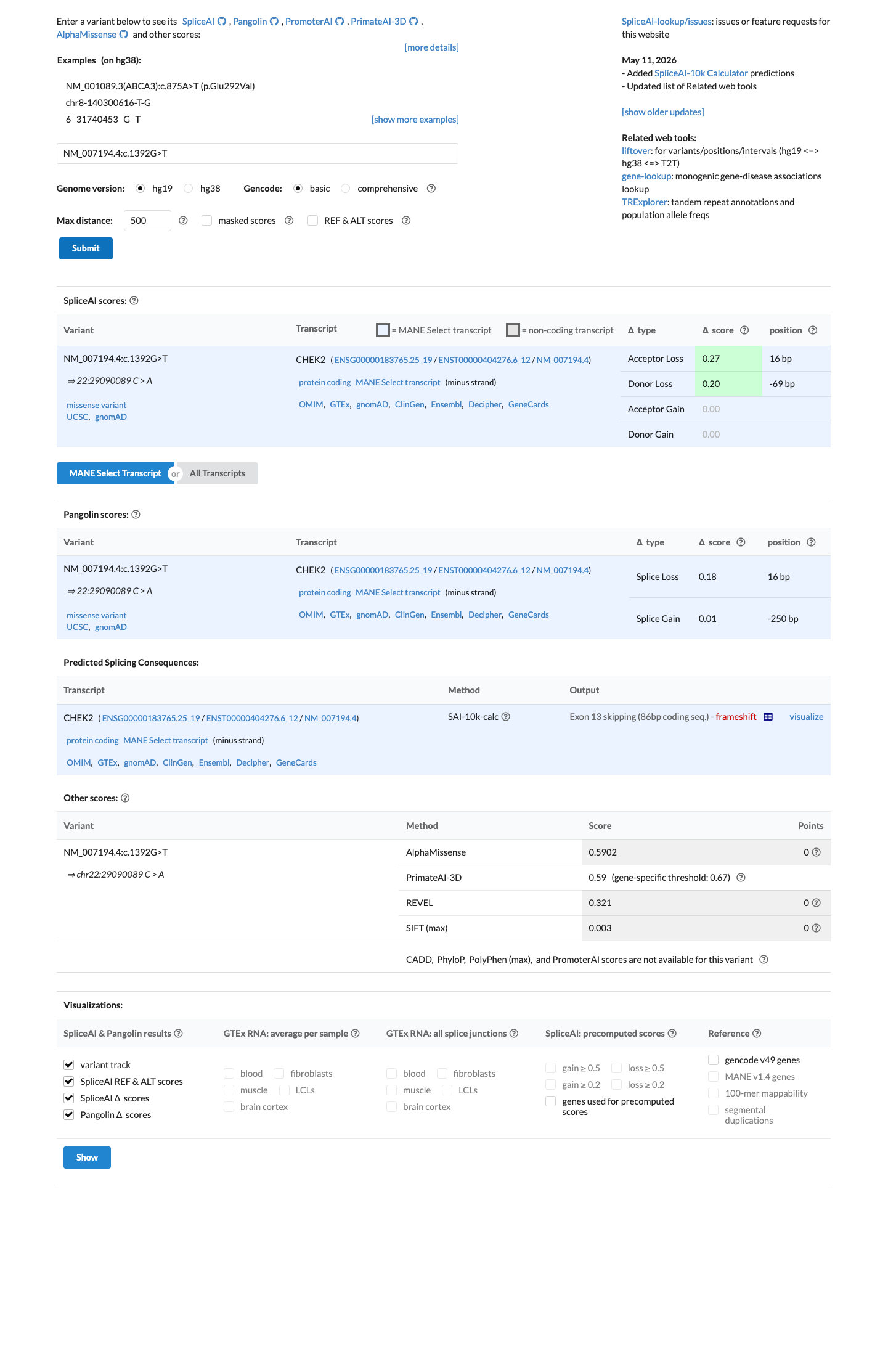
In silico
SpliceAI predicts possible splice impact for this variant (max delta score = 0.27). REVEL score = 0.321. BayesDel score = -0.220536.
Functional
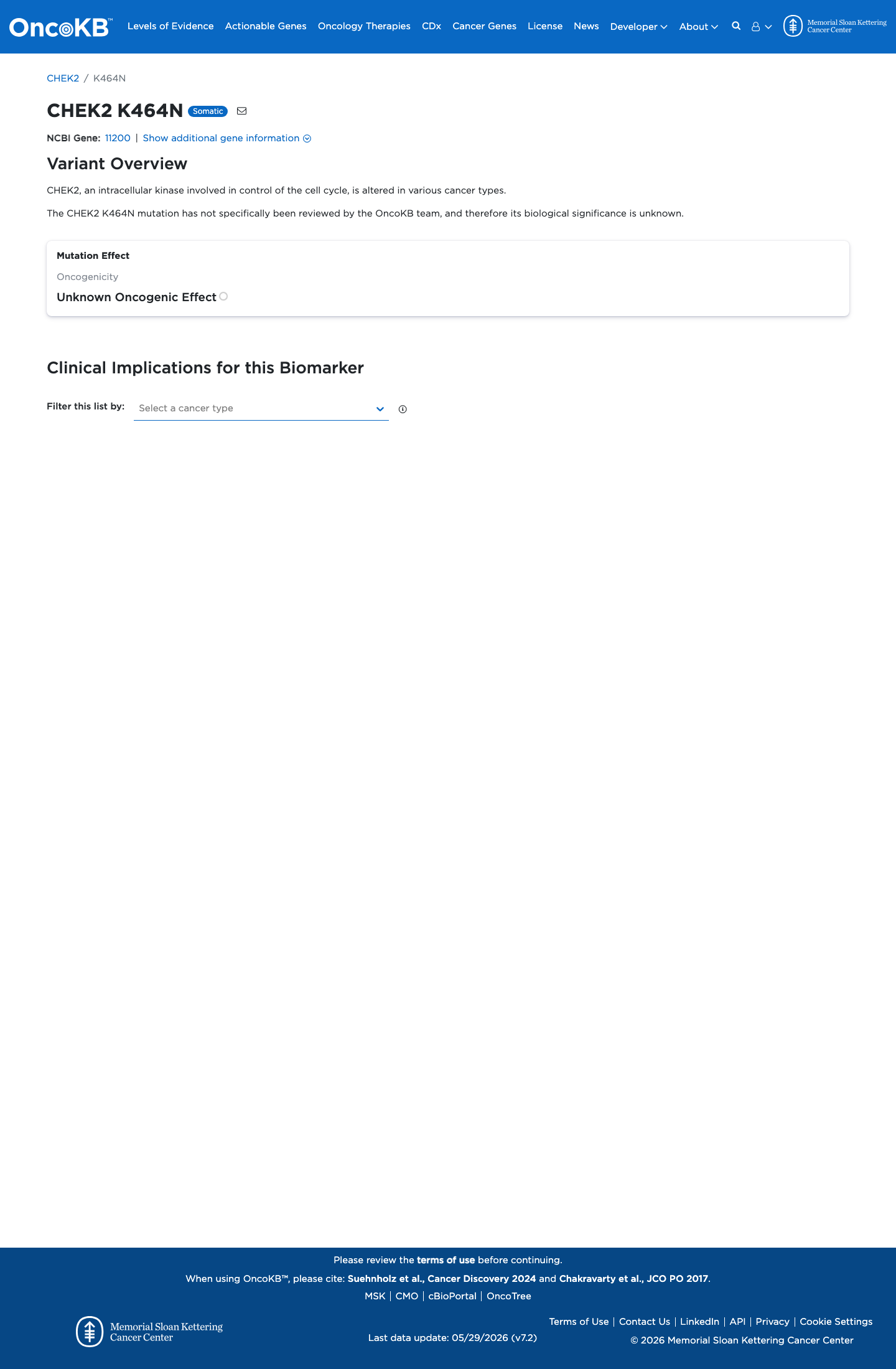
Unknown Oncogenic Effect
OncoKB did not identify variant-specific reviewed functional evidence for this variant; gene-level curated context is available for reviewer follow-up. CHEK2, an intracellular kinase involved in control of the cell cycle, is altered in various cancer types.

COSMIC

Cancer hotspots
Somatic evidence
Not in COSMIC / hotspots
COSMIC
This variant does not lie in a statistically significant hotspot. This variant has not previously been reported in somatic cancers (COSMIC).
Hotspots
This variant does not lie in a statistically significant hotspot.
Sources & reference links
Triaged references · 9 PMIDs not cited in assessment
25741868 ↗
Standards and guidelines for the interpretation of sequence variants: a joint consensus recommendation of the American College of Medical Genetics and Genomics and the Association for Molecular Pathology.
CLINVAR
34242744 ↗
Customizing local and systemic therapies for women with early breast cancer: the St. Gallen International Consensus Guidelines for treatment of early breast cancer 2021.
CLINVAR
37449874 ↗
ENIGMA CHEK2gether Project: A Comprehensive Study Identifies Functionally Impaired CHEK2 Germline Missense Variants Associated with Increased Breast Cancer Risk.
CLINVAR
15604628 ↗
Genetic cancer risk assessment and counseling: recommendations of the national society of genetic counselors.
CLINVAR
17508274 ↗
Risk assessment and genetic counseling for hereditary breast and ovarian cancer: recommendations of the National Society of Genetic Counselors.
CLINVAR
24366376 ↗
Risk assessment, genetic counseling, and genetic testing for BRCA-related cancer in women: U.S. Preventive Services Task Force recommendation statement.
CLINVAR
28492532 ↗
Sherloc: a comprehensive refinement of the ACMG-AMP variant classification criteria.
CLINVAR