NM_000051.4:c.6572+11C>T is an intronic variant located at position +11 in intron 45 of ATM, outside the canonical splice donor site. SpliceAI predicts no splicing impact (max delta score = 0.00), satisfying BP4 (supporting). The variant position at +11 is further than +7 from the donor site, meeting the ATM VCEP definition of a deep intronic variant for BP7 (supporting).1 This variant is present in gnomAD v4.1 at an allele frequency of 0.00818% (132/1,613,760 alleles; grpmax FAF = 0.0102%) and in gnomAD v2.1 at 0.00495% (14/282,814 alleles). The frequency exceeds the VCEP PM2_Supporting threshold of ≤0.001% but does not reach BS1 (>0.05%) or BA1 (>0.5%) thresholds.2 This variant has been reported in ClinVar as Likely benign by four clinical laboratories and as Benign by one clinical laboratory (ClinVar Variation ID: 490663). While ClinVar consensus favors a benign interpretation, the ATM VCEP does not permit use of BP6, and this evidence is noted for context only.3 No functional studies, case-control data, segregation data, or de novo observations were identified for this variant. PVS1 is not applicable as the variant lies outside the canonical ±1,2 splice sites. PS1 cannot be applied without a PP3 baseline (SpliceAI <0.2).4 Applying the ATM VCEP v1.5.0 ACMG/AMP combination rules: BP4_Supporting and BP7_Supporting are both met (2 benign supporting criteria). Rule 19 (≥2 Benign Supporting) yields a classification of Likely Benign.5
Final classification
Likely Benign
BP4BP7
ATM
c.6572+11C>T
p.?
This variant
NM_000051.4:c.6572+11C>T is an intronic variant located at position +11 in intron 45 of ATM, outside the canonical splice donor site. SpliceAI predicts no splicing impact (max delta score = 0.00), satisfying BP4 (supporting). The variant position at +11 is further than +7 from the donor site, meeting the ATM VCEP definition of a deep intronic variant for BP7 (supporting).
Richards et.al., 2015 - Combining rules v1.5.0 criteria-combination framework: matched Rule19 (Benign.Supporting >=2) with applied criteria: BP4 supporting, BP7 supporting; maps to Likely Benign.
Classification rationale
BP4BP7
Likely Benign
ATM c.6572+11C>T
BP4 + BP7
→
Likely Benign
4
spliceai ↗vcep_atm_pvs1_1_5vcep_atm_ps1_1_5
5
cspec ↗
LYFE Sciences is an AI system, and it can make mistakes. Criteria
may be applied incorrectly, sources may be misread, and a confident-looking
classification can still be wrong. Double-check every criterion and
its underlying evidence before relying on any call.
Gene diagram
· NM_000051.4 · variants mapped to exon structure
ATM
NM_000051.4
Fetching transcript structure from UCSC…
Applied criteria · 2 applied · 11 assessed
MetEvidence satisfies this criterion.
Not metEvaluated against available evidence; threshold not reached.
Not assessedApplies in principle, but no evidence was found to evaluate it.
N/ADoesn't apply to this variant type.
Applied · 2
Strength
Supporting
Moderate
Strong
Very strong
BP4
supporting
Benign
SpliceAI predicts no splicing impact for this intronic variant (max delta = 0.00). This meets the ATM VCEP BP4_Supporting threshold for splicing (SpliceAI ≤0.1).
SpliceAI max delta = 0.00no predicted splicing impact
BP7
supporting
Benign
NM_000051.4:c.6572+11C>T is an intronic variant at position +11, which is further than +7 from the donor site. The ATM VCEP BP7 rule applies to deep intronic variants defined as further than (but not including) +7 at donor sites. SpliceAI predicts no splicing impact (max delta = 0.00), consistent with a lack of aberrant splicing.
Intronic variant at +11further than +7 from donor siteSpliceAI max delta = 0.00
Assessed · not applied
· 6 not met · 5 not assessed
Pathogenic
PVS1
NM_000051.4:c.6572+11C>T is an intronic variant at position +11, outside the canonical ±1,2 splice donor/acceptor dinucleotides.
PS1
The ATM PS1 splicing table requires a PP3 baseline (SpliceAI ≥0.2) for variants located outside donor/acceptor ±1,2 positions.
PS3
No functional studies evaluating ATM kinase activity or radiosensitivity rescue for NM_000051.4:c.6572+11C>T were identified.
PS4
No case-control studies with adequate statistical power were identified for NM_000051.4:c.6572+11C>T.
PM2
The ATM VCEP PM2_Supporting threshold is ≤0.001% (≤0.00001) in gnomAD v4.
PP1
No segregation data in affected relatives was identified for NM_000051.4:c.6572+11C>T.
PP3
The ATM VCEP PP3 threshold for splicing prediction is SpliceAI ≥0.2 for intronic variants outside donor/acceptor ±1,2 sites.
Benign
BA1
The ATM VCEP BA1 (Stand Alone) threshold is grpmax filtering AF >0.5% in gnomAD v4.
BS1
The ATM VCEP BS1 (Benign Strong) threshold is grpmax filtering AF >0.05% in gnomAD v4.
BS3
No functional studies demonstrating rescue of ATM-specific features and/or radiosensitivity were identified for NM_000051.4:c.6572+11C>T.
BP2
No proband data for unaffected individuals (≥18 years, no A-T) with this variant observed in trans or homozygous with a pathogenic/likely pathogenic ATM variant was identified.
N/A · 15
PS2 · PM1 · PM3 · PM4 · PM5 · PM6 · PP2 · PP4 · PP5 · BS2 · BS4 · BP1 · BP3 · BP5 · BP6
Research & evidence
Population frequency · supports benign
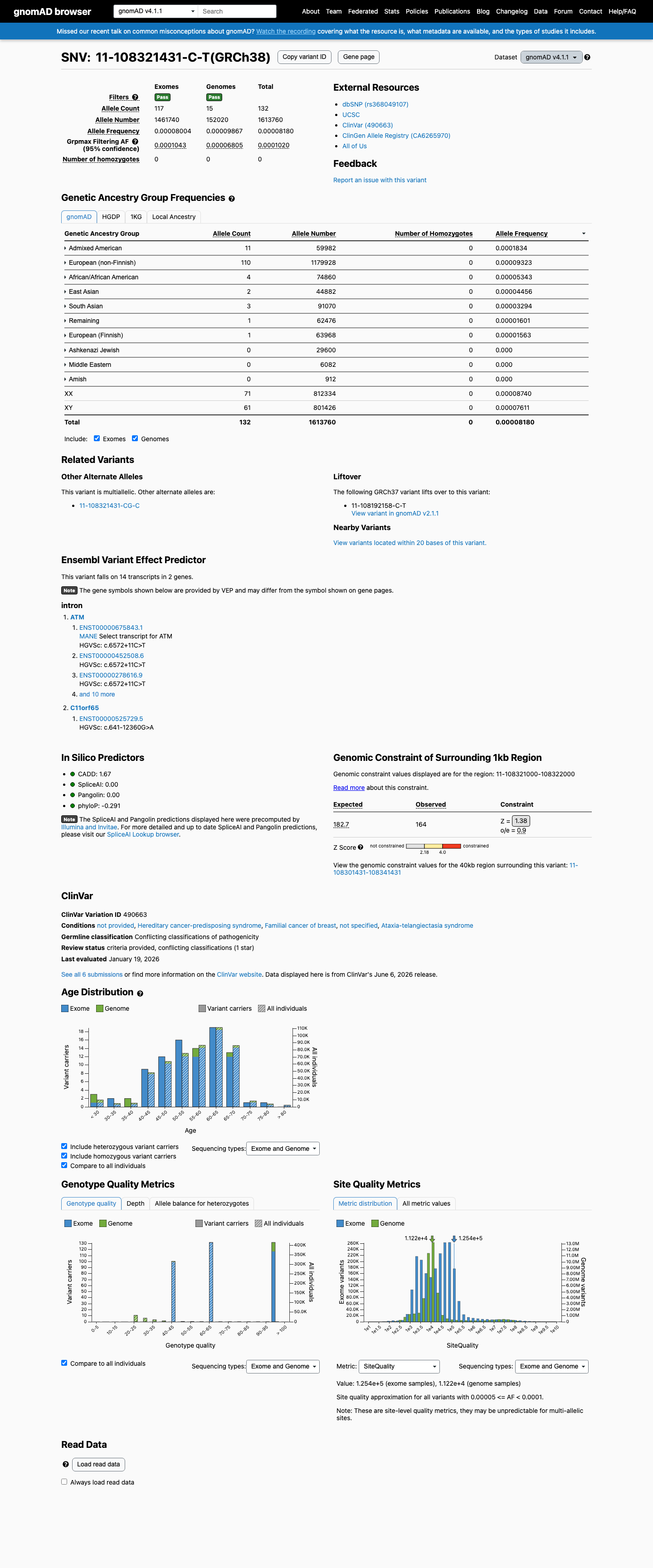
gnomAD v4.1
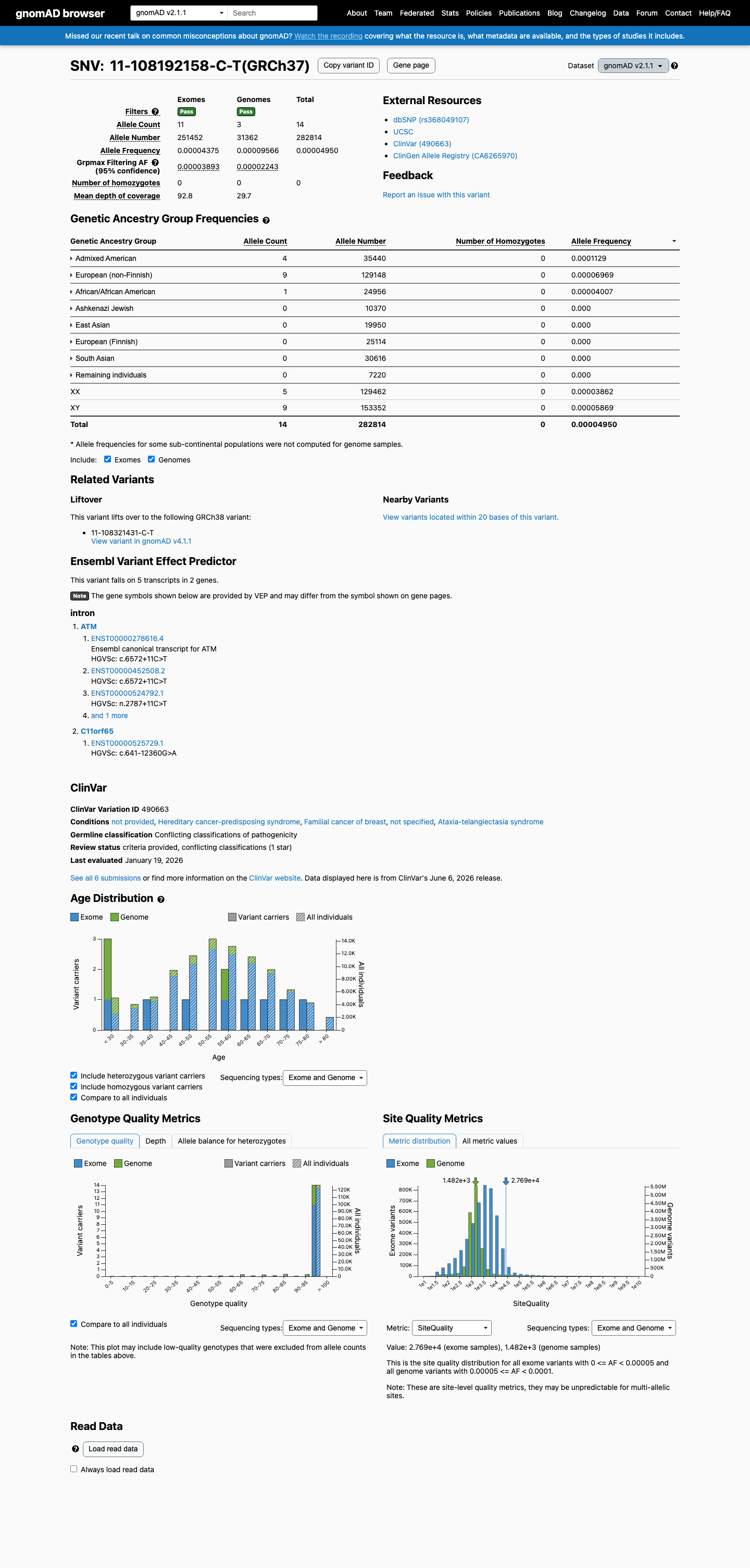
gnomAD v2.1
v4.1
This variant is present in gnomAD v4.1 (AF= 8.17965e-05; MAF= 0.00818%, 132/1613760 alleles, homozygotes = 0) and has highest observed frequency in the Admixed American population (AF= 0.000183388; MAF= 0.01834%, 11/59982 alleles, homozygotes = 0); grpmax FAF= 0.00010205.
v2.1
This variant is present in gnomAD v2.1 (AF= 4.95025e-05; MAF= 0.00495%, 14/282814 alleles, homozygotes = 0) and has highest observed frequency in the Admixed American population (AF= 0.000112867; MAF= 0.01129%, 4/35440 alleles, homozygotes = 0); grpmax FAF= 3.893e-05.
🇨🇦 CA
This variant is absent from gnomAD-Canada.
Allele frequency by ancestry
three datasets · side by side
gnomAD v4.1
0.0082%
· 132 / 1,613,760
0 hom · FAF 0.01%
0 hom · FAF 0.01%
Admixed American 11 / 59,982 |
0.018% |
European (non-Finnish) 110 / 1,179,928 |
0.0093% |
African/African American 4 / 74,860 |
0.0053% |
East Asian 2 / 44,882 |
0.0045% |
South Asian 3 / 91,070 |
0.0033% |
Remaining individuals 1 / 62,476 |
0.0016% |
European (Finnish) 1 / 63,968 |
0.0016% |
+ 3 not observed (Amish, Middle Eastern, Ashkenazi Jewish)
gnomAD v2.1
0.005%
· 14 / 282,814
0 hom · FAF 0.0039%
0 hom · FAF 0.0039%
Admixed American 4 / 35,440 |
0.011% |
European (non-Finnish) 9 / 129,148 |
0.007% |
African/African American 1 / 24,956 |
0.004% |
+ 5 not observed (Ashkenazi Jewish, East Asian, European (Finnish), Remaining individuals, South Asian)
gnomAD Canada 🇨🇦
Absent
· 0 / ?
0 hom
0 hom
Not observed in any ancestry group.
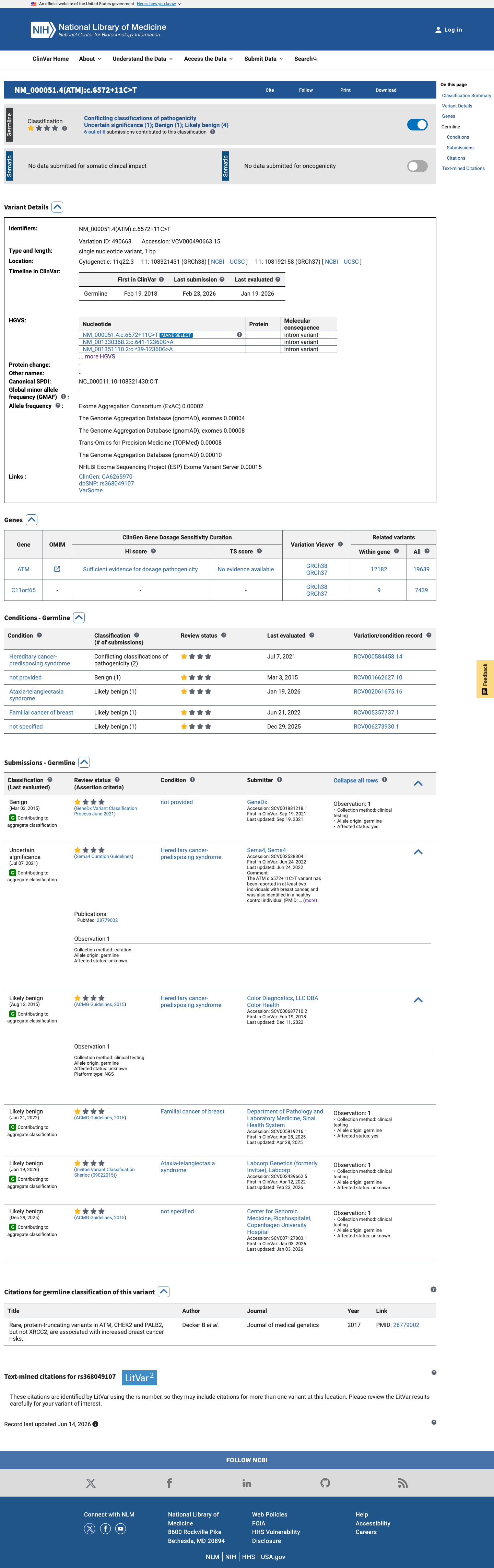
ClinVar
This variant has been reported in ClinVar as Likely benign (4 clinical laboratories) and as Benign (1 clinical laboratory). (ClinVarID = 490663)
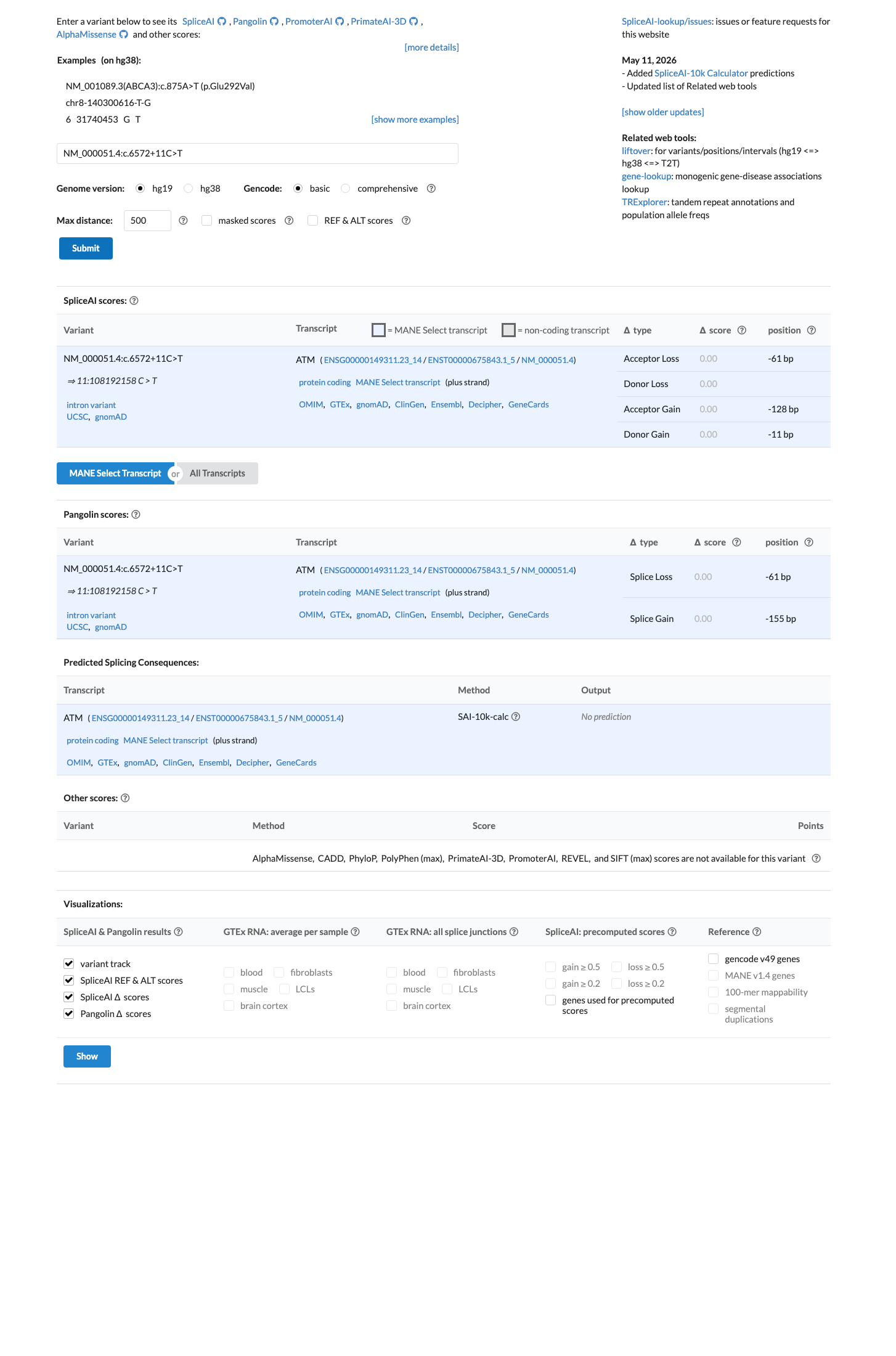
In silico
SpliceAI predicts no significant splice impact for this variant (max delta score = 0.00).
Functional
No data
No calibrated functional assay or RNA evidence was identified for this variant.

COSMIC
Somatic evidence
COSMIC
This variant has not previously been reported in somatic cancers (COSMIC).
Hotspots
This variant does not lie in a statistically significant cancer hotspot.
Sources & reference links
Triaged references · 10 PMIDs not cited in assessment
25741868 ↗
Standards and guidelines for the interpretation of sequence variants: a joint consensus recommendation of the American College of Medical Genetics and Genomics and the Association for Molecular Pathology.
CLINVAR
28779002 ↗
Rare, protein-truncating variants in ATM, CHEK2 and PALB2, but not XRCC2, are associated with increased breast cancer risks.
CLINVAR
34242744 ↗
Customizing local and systemic therapies for women with early breast cancer: the St. Gallen International Consensus Guidelines for treatment of early breast cancer 2021.
CLINVAR
15604628 ↗
Genetic cancer risk assessment and counseling: recommendations of the national society of genetic counselors.
CLINVAR
17508274 ↗
Risk assessment and genetic counseling for hereditary breast and ovarian cancer: recommendations of the National Society of Genetic Counselors.
CLINVAR
28492532 ↗
Sherloc: a comprehensive refinement of the ACMG-AMP variant classification criteria.
CLINVAR