NM_024675.4:c.509_510delGA (p.Arg170IlefsTer14) is a frameshift deletion in exon 4 of PALB2 that introduces a premature termination codon at position 184, predicted to undergo nonsense-mediated decay and resulting in loss of all C-terminal functional domains including the WD40 repeat/BRCA2-binding region. Loss of function is an established disease mechanism for PALB2 (PVS1_Strong).1 The variant is significantly enriched in breast cancer cases compared to population controls. Noskowicz et al. (2014) identified the variant in 10/3,924 (0.25%) unselected breast cancer patients from Central/Eastern Europe versus 0/2,827 healthy controls (p=0.007). Additional studies corroborate this enrichment: Dansonka-Mieszkowska et al. (2010) found the variant in 6/987 (0.6%) cancer cases versus 1/1,310 controls; Kluska et al. (2017) detected it in 0.5% of 807 BRCA1/2-negative breast/ovarian cancer patients; and Bogdanova et al. (2011) identified it in 2/203 bilateral breast cancer patients. Collectively, these studies meet PS4 at Strong strength.2 The premature termination codon at position 184 lies upstream of p.Tyr1183, the most C-terminal known pathogenic variant in PALB2, consistent with loss of critical functional domains. Under the PALB2 VCEP, this satisfies PM5_Supporting. The variant is present at low frequency in gnomAD (v4.1: 30/1,614,006, 0.00186%; v2.1: 9/251,446, 0.00358%), with no homozygotes. This frequency exceeds the PALB2 VCEP PM2_Supporting threshold (≤0.000333%) and remains well below benign population thresholds (BA1 >0.1%, BS1 >0.01%), providing neither pathogenic nor benign population evidence.3 SpliceAI predicts no cryptic splice effect (max delta = 0.00). No co-segregation or non-segregation data are available. No functional studies specific to this variant have been published.4
Final classification
Pathogenic
PVS1PS4PM5
PALB2
c.509_510del
p.Arg170IlefsTer14
This variant
NM_024675.4:c.509_510delGA (p.Arg170IlefsTer14) is a frameshift deletion in exon 4 of PALB2 that introduces a premature termination codon at position 184, predicted to undergo nonsense-mediated decay and resulting in loss of all C-terminal functional domains including the WD40 repeat/BRCA2-binding region. Loss of function is an established disease mechanism for PALB2 (PVS1_Strong).
Richards et.al., 2015 - Combining rules v1.2.0 criteria-combination framework: matched Rule5 (Pathogenic.Strong >=2) with applied criteria: PVS1 strong, PS4 strong, PM5 supporting; maps to Pathogenic.
Classification rationale
PVS1PS4PM5
Pathogenic
PALB2 c.509_510del
PVS1 + PS4 + PM5
→
Pathogenic
LYFE Sciences is an AI system, and it can make mistakes. Criteria
may be applied incorrectly, sources may be misread, and a confident-looking
classification can still be wrong. Double-check every criterion and
its underlying evidence before relying on any call.
Gene diagram
· NM_024675.4 · variants mapped to exon structure
PALB2
NM_024675.4
Fetching transcript structure from UCSC…
Applied criteria · 3 applied · 7 assessed
MetEvidence satisfies this criterion.
Not metEvaluated against available evidence; threshold not reached.
Not assessedApplies in principle, but no evidence was found to evaluate it.
N/ADoesn't apply to this variant type.
Applied · 3
Strength
Supporting
Moderate
Strong
Very strong
PVS1
strong
review
Pathogenic
NM_024675.4:c.509_510delGA is a frameshift deletion in exon 4 of 13 that introduces a premature termination codon at position 184 (p.Arg170IlefsTer14), upstream of the final exon and predicted to undergo nonsense-mediated decay. Loss of function is an established disease mechanism for PALB2. Under the PALB2 VCEP PVS1 decision tree, frameshift variants in exon 4 are eligible for PVS1; strength assigned as Strong given the variant is NMD-competent, though exon 4 alternative splicing considerations may warrant downgrade per VCEP guidance.
Frameshift deletion introducing PTC at codon 184 in exon 4 of 13LOF is established disease mechanism for PALB2 per ClinGen VCEPPTC predicted NMD-competent (>50-55nt upstream of last exon-exon junction)
PS4
strong
Pathogenic
A case-control study by Noskowicz et al. (2014) found NM_024675.4:c.509_510delGA in 10 of 3,924 unselected breast cancer patients (0.25%) versus 0 of 2,827 healthy controls from Central and Eastern Europe (p=0.007), meeting the PALB2 VCEP PS4 threshold (p≤0.05 with OR≥3 or lower 95% CI≥1.5). Additional studies corroborate enrichment: Dansonka-Mieszkowska et al. (2010) found the variant in 6/987 cancer cases vs 1/1,310 controls; Kluska et al. (2017) found it in 0.5% of 807 cases; and Hilz et al. (2019) reported 0.35% in 2,480 cases vs 0% in 1,240 controls (RR=7.18).
Case-control: 10/3924 cases vs 0/2827 controls
PM5
supporting
Pathogenic
Under the PALB2 VCEP, PM5_Supporting is applied to frameshifting or truncating variants with premature termination codons upstream of p.Tyr1183. This variant introduces a PTC at codon 184, well upstream of p.Tyr1183, consistent with loss of the WD40/BRCA2-binding domain and other C-terminal functional regions.
PTC at codon 184 is upstream of p.Tyr1183 (most C-terminal known pathogenic variant per VCEP)VCEP PM5_Supporting rule for truncating variants upstream of p.Tyr1183
Assessed · not applied
· 7 not met · 0 not assessed
Pathogenic
PM2
Under the PALB2 VCEP, PM2_Supporting requires a gnomAD v4 frequency ≤0.000333% (≤1/300,000).
PP1
No co-segregation data are available for NM_024675.4:c.509_510delGA in published literature.
PP3
Under the PALB2 VCEP, PP3 is applicable only for splicing variants with SpliceAI delta score ≥0.2.
Benign
BA1
The PALB2 VCEP BA1 threshold requires grpmax filtering AF >0.1% in gnomAD v4.
BS1
The PALB2 VCEP BS1 threshold requires grpmax filtering AF >0.01% in gnomAD v4.
BS2
The PALB2 VCEP BS2 requires homozygous or compound heterozygous observations in healthy adult individuals per Fanconi Anemia BS2 tables.
BS4
No non-segregation data are available for this variant.
N/A · 17
PS1 · PS2 · PS3 · PM1 · PM4 · PM6 · PP2 · PP4 · PP5 · BS3 · BP1 · BP2 · BP3 · BP4 · BP5 · BP6 · BP7
Research & evidence
Population frequency · supports pathogenic
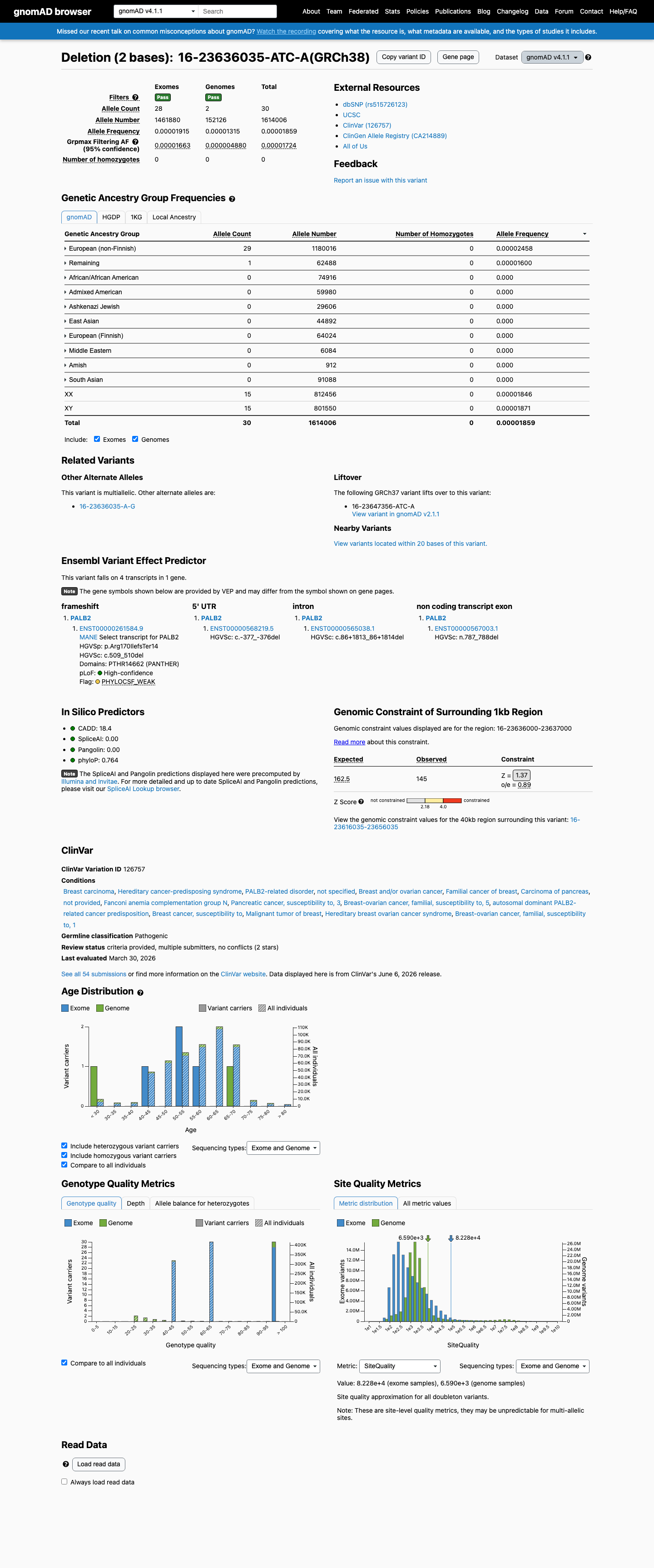
gnomAD v4.1
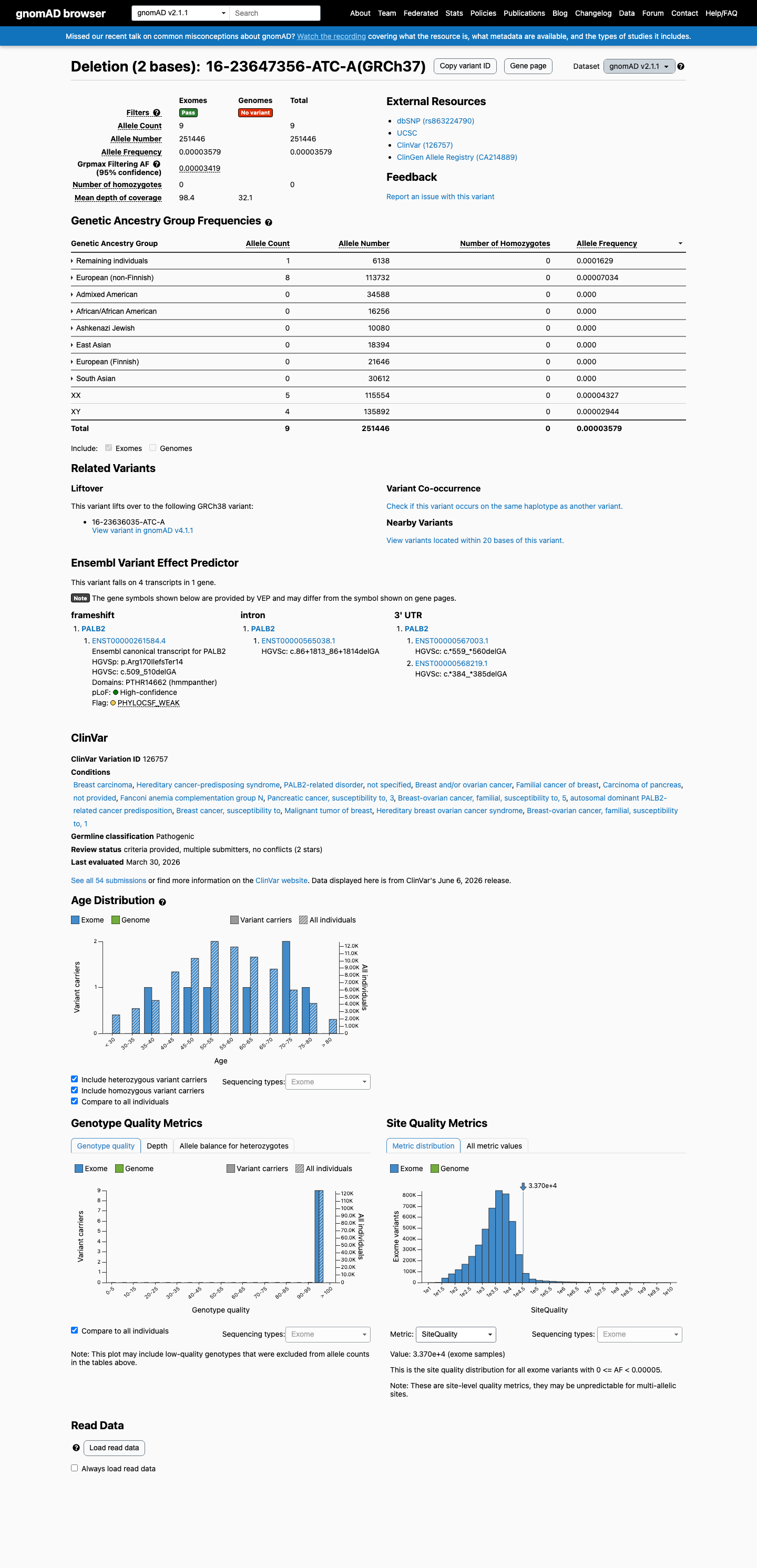
gnomAD v2.1
v4.1
This variant is present in gnomAD v4.1 (AF= 1.85873e-05; MAF= 0.00186%, 30/1614006 alleles, homozygotes = 0) and has highest observed frequency in the European (non-Finnish) population (AF= 2.45759e-05; MAF= 0.00246%, 29/1180016 alleles, homozygotes = 0); grpmax FAF= 1.724e-05.
v2.1
This variant is present in gnomAD v2.1 (AF= 3.5793e-05; MAF= 0.00358%, 9/251446 alleles, homozygotes = 0) and has highest observed frequency in the Remaining individuals population (AF= 0.00016292; MAF= 0.01629%, 1/6138 alleles, homozygotes = 0); grpmax FAF= 3.419e-05.
🇨🇦 CA
This variant is absent from gnomAD-Canada.
Allele frequency by ancestry
three datasets · side by side
gnomAD v4.1
0.0019%
· 30 / 1,614,006
0 hom · FAF 0.0017%
0 hom · FAF 0.0017%
European (non-Finnish) 29 / 1,180,016 |
0.0025% |
Remaining individuals 1 / 62,488 |
0.0016% |
+ 8 not observed (Admixed American, European (Finnish), Amish, East Asian, Middle Eastern, South Asian, Ashkenazi Jewish, African/African American)
gnomAD v2.1
0.0036%
· 9 / 251,446
0 hom · FAF 0.0034%
0 hom · FAF 0.0034%
Remaining individuals 1 / 6,138 |
0.016% |
European (non-Finnish) 8 / 113,732 |
0.007% |
+ 6 not observed (African/African American, Admixed American, Ashkenazi Jewish, East Asian, European (Finnish), South Asian)
gnomAD Canada 🇨🇦
Absent
· 0 / ?
0 hom
0 hom
Not observed in any ancestry group.

ClinVar
This variant has been reported in ClinVar as Pathogenic (49 clinical laboratories) and as pathogenic (1 clinical laboratory). (ClinVarID = 126757)
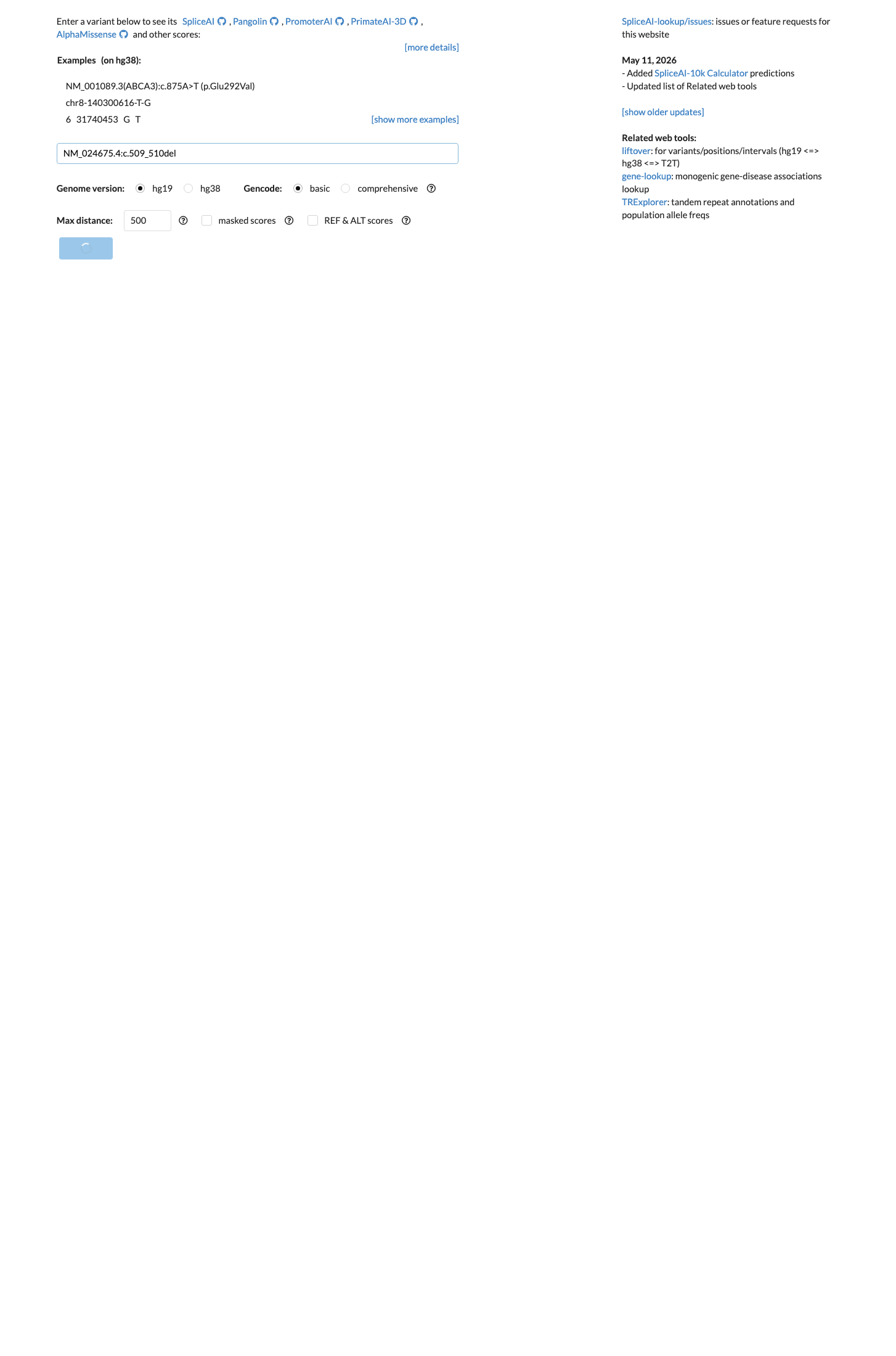
In silico
SpliceAI predicts no significant splice impact for this variant (max delta score = 0.00).
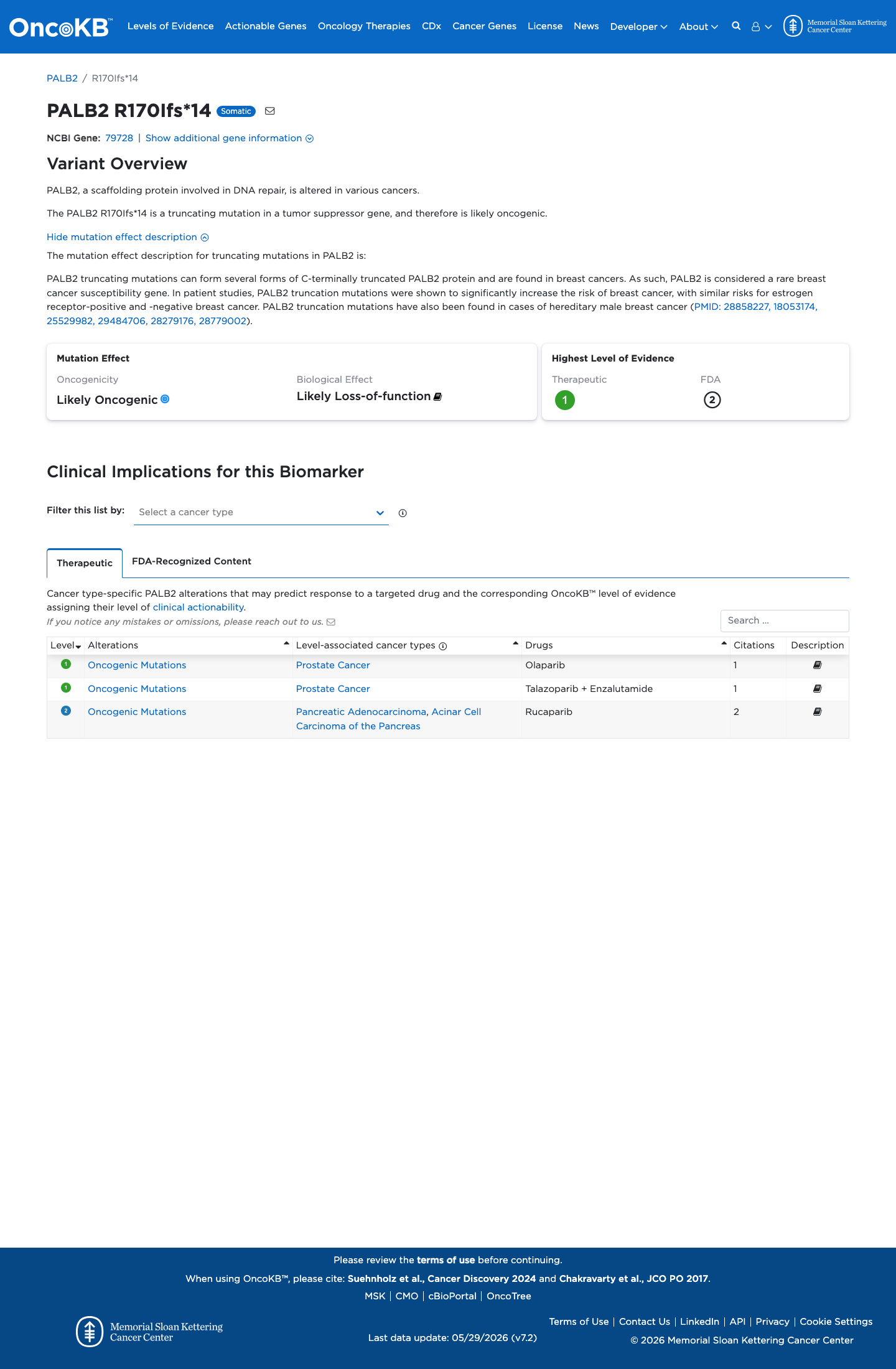
Functional
Likely Oncogenic
OncoKB identified variant-specific curated literature and context relevant to functional review; biological-effect context: Likely Loss-of-function; curated oncogenicity label: Likely Oncogenic.
COSMIC

Cancer hotspots
Somatic evidence
Not in COSMIC / hotspots
COSMIC
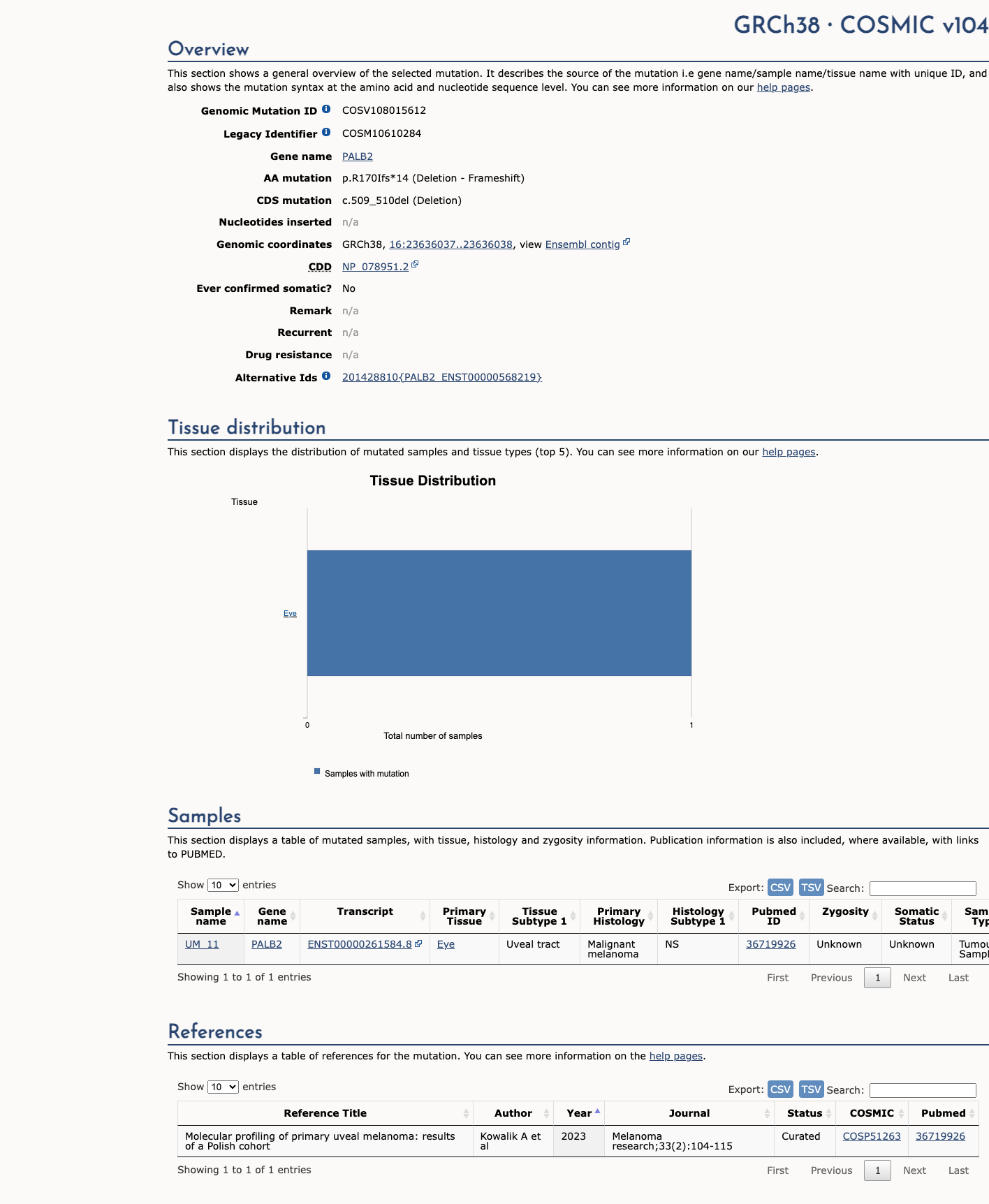
This variant does not lie in a statistically significant hotspot. This variant has previously been reported in somatic cancers (COSMIC; COSV108015612, n = 1 times).
Hotspots
This variant does not lie in a statistically significant hotspot.
Literature · how each cited paper was used
4papers cited
Each card is an audit: what was searched, what was found, whether it names the variant, which criteria it fed, and why. 7 further PMIDs triaged but not cited — see Sources & references.
A novel germline PALB2 deletion in Polish breast and ovarian cancer patients.
Found
Structured finding pending for this record — see source link.
Applied to
→PS4
strong
PMID 24061862
Found
Structured finding pending for this record — see source link.
Applied to
→PS4
strong
PALB2 mutations in BRCA1/2-mutation negative breast and ovarian cancer patients from Poland.
Found
Structured finding pending for this record — see source link.
Applied to
→PS4
strong
PMID 31312277
Found
Structured finding pending for this record — see source link.
Applied to
→PS4
strong
Sources & reference links
Triaged references · 7 PMIDs not cited in assessment
18053174 ↗
Identification of a novel truncating PALB2 mutation and analysis of its contribution to early-onset breast cancer in French-Canadian women.
ONCOKB
28779002 ↗
Rare, protein-truncating variants in ATM, CHEK2 and PALB2, but not XRCC2, are associated with increased breast cancer risks.
ONCOKB
29484706 ↗
Identification of a novel truncating mutation in PALB2 gene by a multigene sequencing panel for mutational screening of breast cancer risk-associated and related genes.
ONCOKB
17200671 ↗
Biallelic mutations in PALB2 cause Fanconi anemia subtype FA-N and predispose to childhood cancer.
CLINVAR
28492532 ↗
Sherloc: a comprehensive refinement of the ACMG-AMP variant classification criteria.
CLINVAR