NM_000455.5:c.580G>C (p.Asp194His) is located in exon 4 of STK11, within the protein kinase domain catalytic loop (DLKPEN motif), a critical functional domain. The variant is absent from gnomAD v2.1, v4.1, and gnomAD-Canada, representing coverage of over 800,000 alleles (PM2_moderate).1 Asp194 is a statistically significant hotspot residue in the kinase active site, and no benign missense variants are observed at this codon in population databases (PM1_moderate).2 Multiple in silico algorithms predict a deleterious effect: REVEL score 0.943, BayesDel score 0.524 (PP3_supporting).3 SpliceAI predicts no significant splice impact (max delta = 0.02), consistent with a missense mechanism rather than splicing disruption.4 The variant has been observed in somatic cancers (COSMIC COSV99045288, n=3), which is consistent with a potential oncogenic role but does not directly inform germline pathogenicity. ClinVar contains two submissions: Uncertain Significance (Invitae, SCV001518979) and Likely Pathogenic (CeGaT, SCV002498394). Neither is from an expert panel.5 No de novo observations, cosegregation data, or functional studies specific to p.Asp194His were identified in the literature. The absence of variant-specific functional data, segregation evidence, and case-control studies limits the certainty of classification.
Final classification
VUS
PM1PM2PP3
STK11
c.580G>C
p.Asp194His
This variant
NM_000455.5:c.580G>C (p.Asp194His) is located in exon 4 of STK11, within the protein kinase domain catalytic loop (DLKPEN motif), a critical functional domain.
gene-specific framework lacked a usable explicit final combination framework, so generic ACMG/AMP 2015 final-combination rules were applied as fallback; applied criteria: PM1 moderate, PM2 moderate, PP3 supporting; combination = 2 moderate + 1 supporting, which maps to VUS.
Classification rationale
PM1PM2PP3
VUS
STK11 c.580G>C
PM1 + PM2 + PP3
→
VUS
LYFE Sciences is an AI system, and it can make mistakes. Criteria
may be applied incorrectly, sources may be misread, and a confident-looking
classification can still be wrong. Double-check every criterion and
its underlying evidence before relying on any call.
Gene diagram
· NM_000455.5 · variants mapped to exon structure
STK11
NM_000455.5
Fetching transcript structure from UCSC…
Applied criteria · 3 applied · 18 assessed
MetEvidence satisfies this criterion.
Not metEvaluated against available evidence; threshold not reached.
Not assessedApplies in principle, but no evidence was found to evaluate it.
N/ADoesn't apply to this variant type.
Applied · 3
Strength
Supporting
Moderate
Strong
Very strong
PM1
moderate
Pathogenic
c.580G>C (p.Asp194His) is located in exon 4 within the STK11 serine/threonine protein kinase domain (residues 49-309). Asp194 is a highly conserved catalytic base in the kinase active site (DLKPEN motif). The residue lies in a statistically significant mutational hotspot, and no benign missense variants have been observed at this residue in gnomAD. The variant is situated in a critical, well-established functional domain where pathogenic missense variation is enriched.
Residue D194 located in kinase domain (residues 49-309)catalytic loop/active siteStatistically significant hotspot residue
PM2
moderate
Pathogenic
NM_000455.5:c.580G>C is absent from gnomAD v2.1 (exomes) and gnomAD v4.1 (exomes + genomes), representing a combined survey of over 800,000 alleles without observation. The variant is also absent from gnomAD-Canada v1.0. This complete absence from large population databases meets PM2 at moderate strength under the generic ACMG/AMP framework (allele frequency <0.1%).
gnomAD v2.1: absent (0 allelesAF = 0)gnomAD v4.1: absent (0 alleles
PP3
supporting
Pathogenic
Multiple lines of computational evidence support a deleterious effect. REVEL predicts a highly damaging score of 0.943 (threshold ≥0.75). BayesDel gives a score of 0.524 (threshold >0.27 for deleterious). SpliceAI predicts no splice impact (max delta = 0.02), which does not contradict the missense pathogenicity prediction. Two independent in silico algorithms concur on a damaging prediction, meeting PP3 at supporting strength.
REVEL score: 0.943 (highly damaging)BayesDel score: 0.524 (deleterious)SpliceAI max delta: 0.02 (no splicing impact)
Assessed · not applied
· 16 not met · 2 not assessed
Pathogenic
PS1
PS1 requires a different nucleotide change at the same codon producing the same amino acid change that is already established as pathogenic.
PS2
PS2 requires a de novo observation with both maternity and paternity confirmed in a patient with the disease and no family history.
PS3
PS3 requires well-established in vitro or in vivo functional studies demonstrating a damaging effect.
PS4
PS4 requires the prevalence of the variant in affected individuals to be significantly increased compared to controls.
PM6
PM6 requires a presumed de novo observation (without confirmation of both parents).
PP1
PP1 requires cosegregation of the variant with disease in multiple affected family members.
PP2
PP2 requires a low rate of benign missense variation in the gene where missense variants are a common disease mechanism.
PP4
PP4 requires the patient's phenotype or family history to be highly specific for a disease with a single genetic etiology.
PP5
PP5 requires a reputable source (e.g., clinical diagnostic laboratory with established quality systems) to report the variant as pathogenic.
Benign
BA1
BA1 requires an allele frequency >1% in a general population database.
BS1
BS1 requires an allele frequency >0.3% in a general population database.
BS2
BS2 requires observation of the variant in a healthy adult individual for a fully penetrant disorder expected to manifest at an early age.
BS3
BS3 requires well-established in vitro or in vivo functional studies demonstrating no damaging effect.
BS4
BS4 requires lack of cosegregation of the variant with disease in affected family members (i.e., the variant does not segregate with disease).
BP2
BP2 requires observation of the variant in trans with a known pathogenic variant in a gene for a fully penetrant dominant disorder, OR in cis with a pathogenic variant in a recessive disorder.
BP4
BP4 requires multiple lines of computational evidence suggesting no impact on gene or gene product.
BP5
BP5 requires the variant to be found in a case with an alternate molecular basis for disease.
BP6
BP6 requires a reputable source to report the variant as benign or likely benign.
N/A · 4
PVS1 · PM5 · BP1 · BP7
Research & evidence
Population frequency
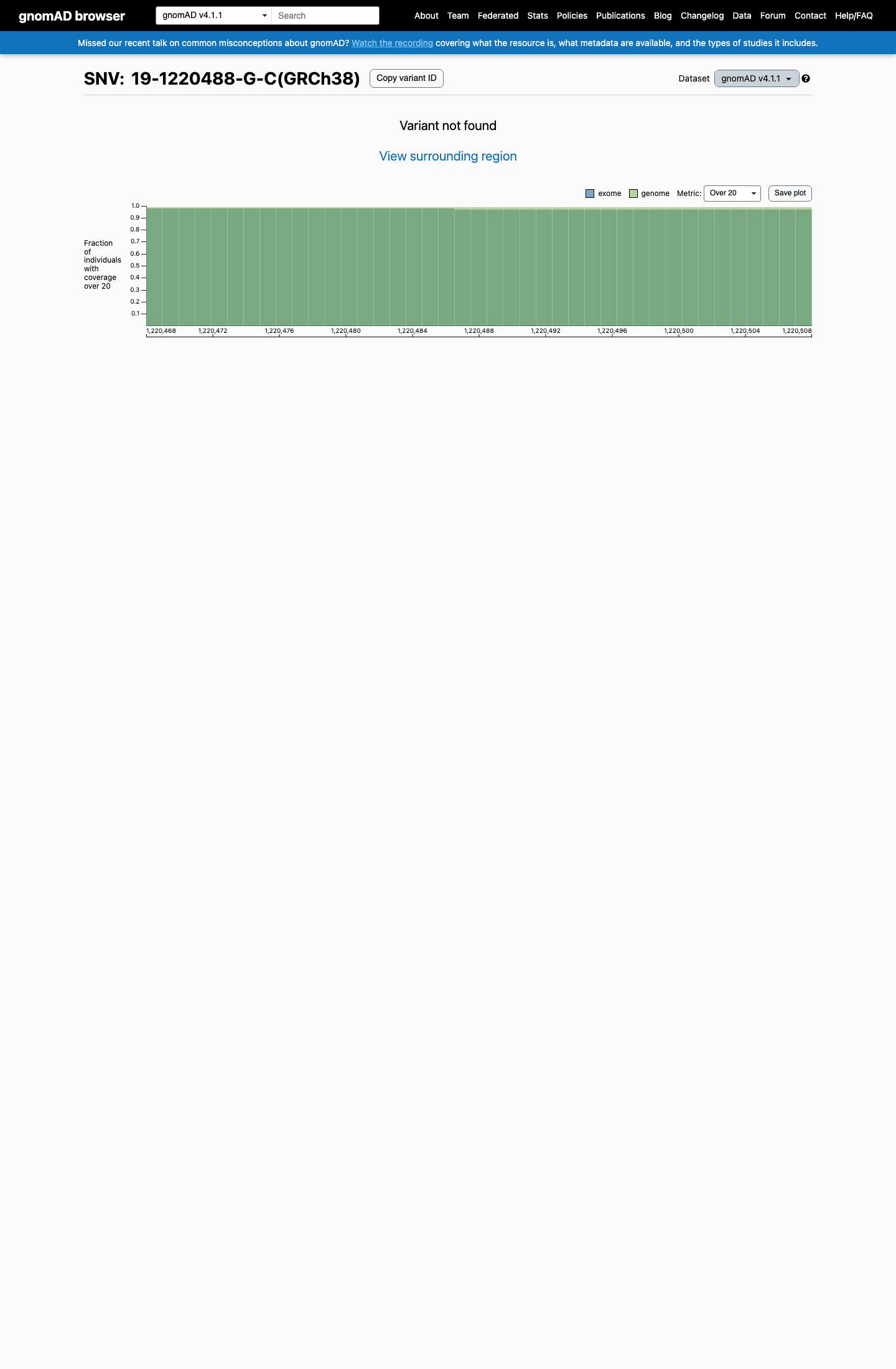
gnomAD v4.1
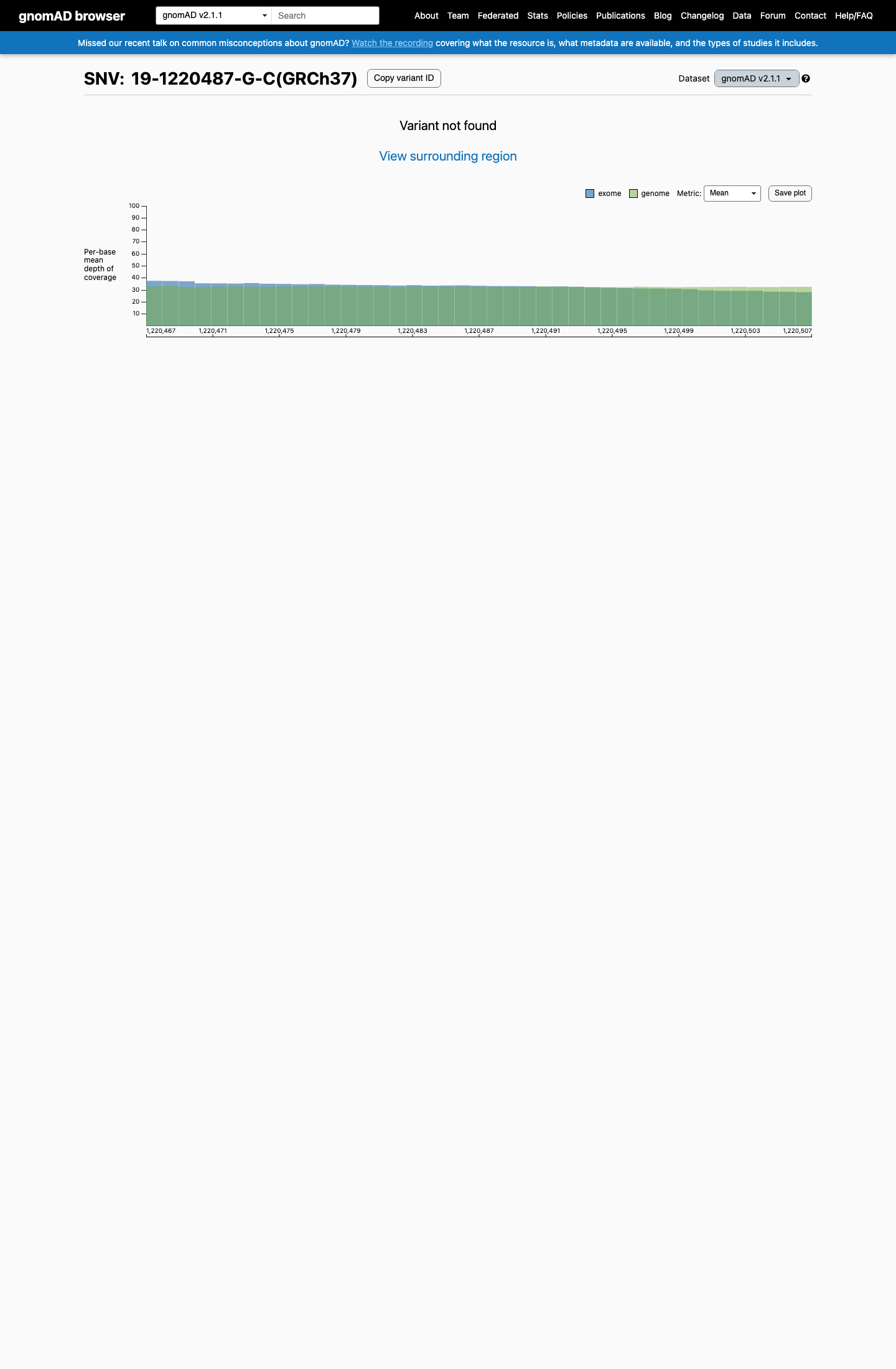
gnomAD v2.1
v4.1
Absent from gnomAD v4.1.
v2.1
Absent from gnomAD v2.1.
🇨🇦 CA
This variant is absent from gnomAD-Canada.
Allele frequency by ancestry
three datasets · side by side
gnomAD v4.1
Absent
· 0 / ?
0 hom
0 hom
Not observed in any ancestry group.
gnomAD v2.1
Absent
· 0 / ?
0 hom
0 hom
Not observed in any ancestry group.
gnomAD Canada 🇨🇦
Absent
· 0 / ?
0 hom
0 hom
Not observed in any ancestry group.
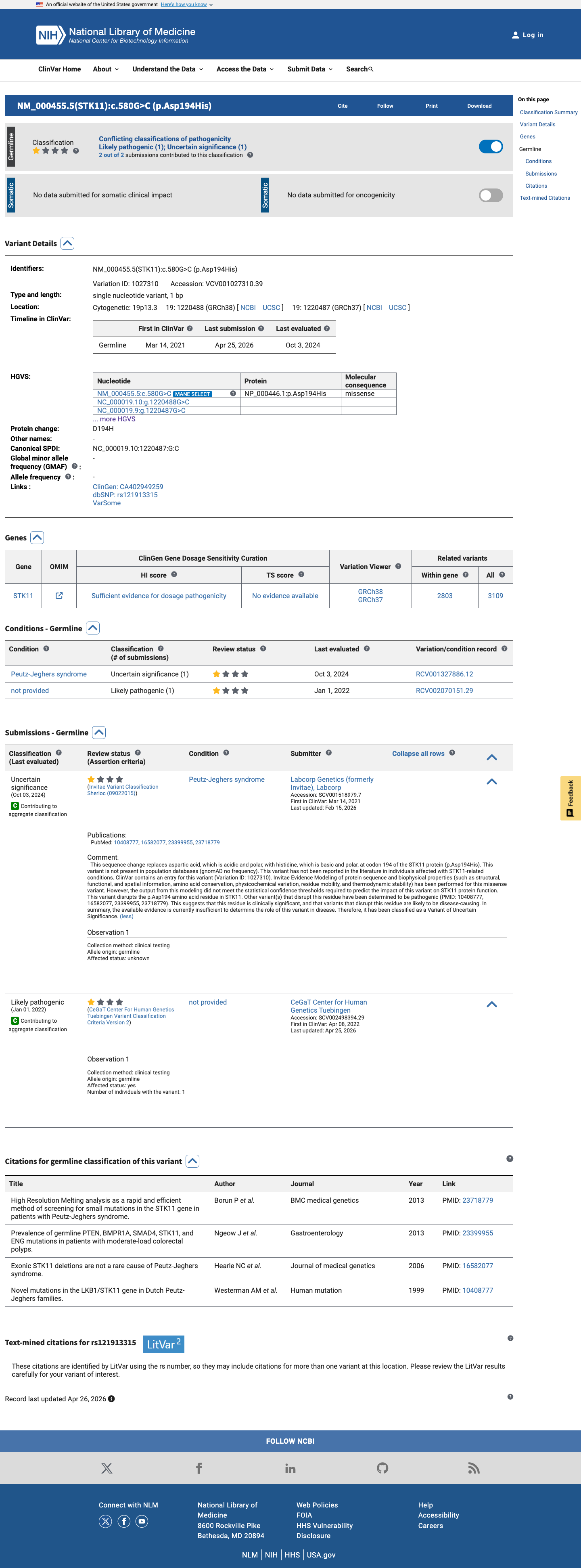
ClinVar
This variant has been reported in ClinVar as Uncertain significance (1 clinical laboratory) and as Likely pathogenic (1 clinical laboratory). (ClinVarID = 1027310)
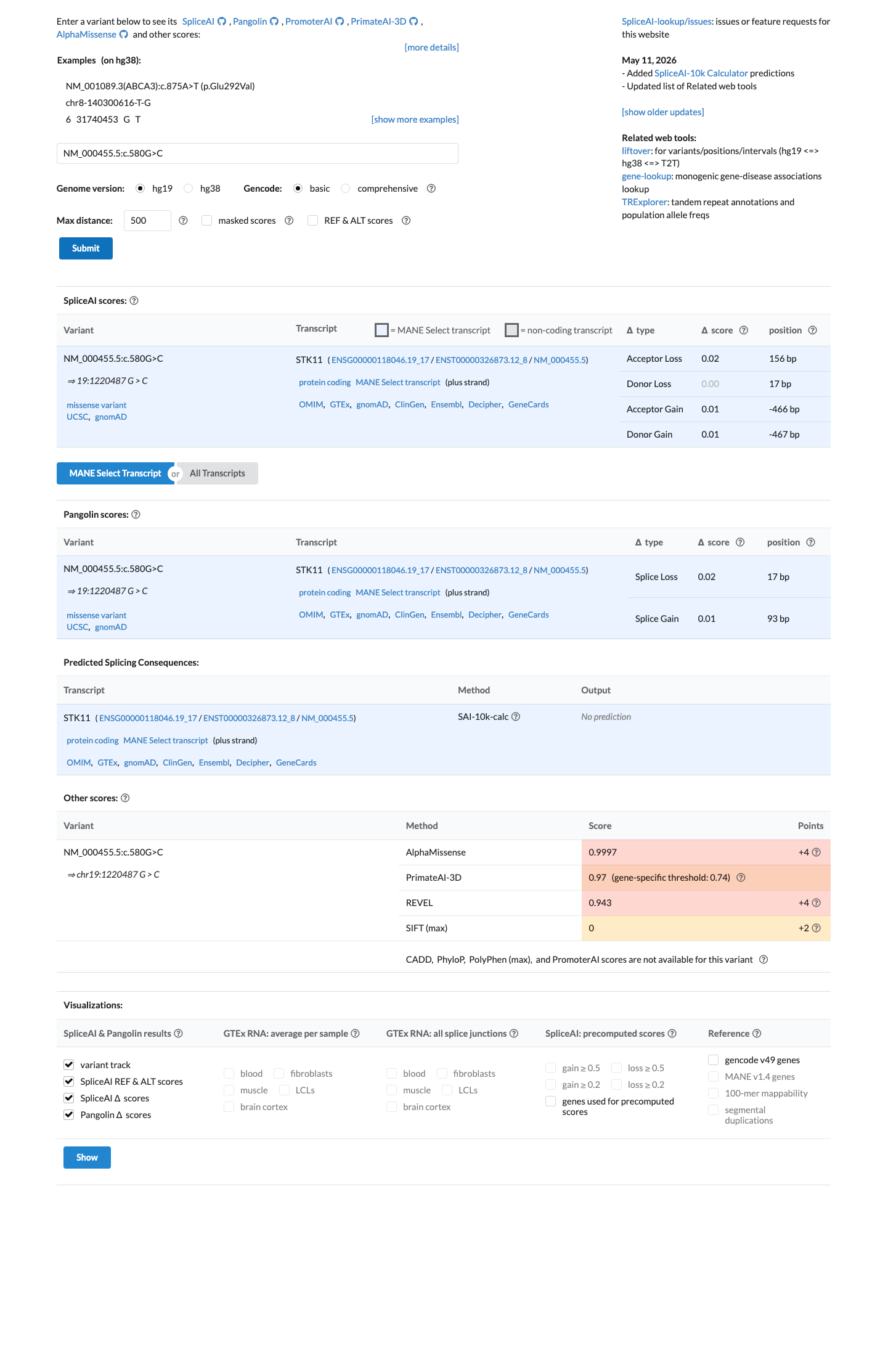
In silico
SpliceAI predicts no significant splice impact for this variant (max delta score = 0.02). REVEL score = 0.943. BayesDel score = 0.524498.
Functional
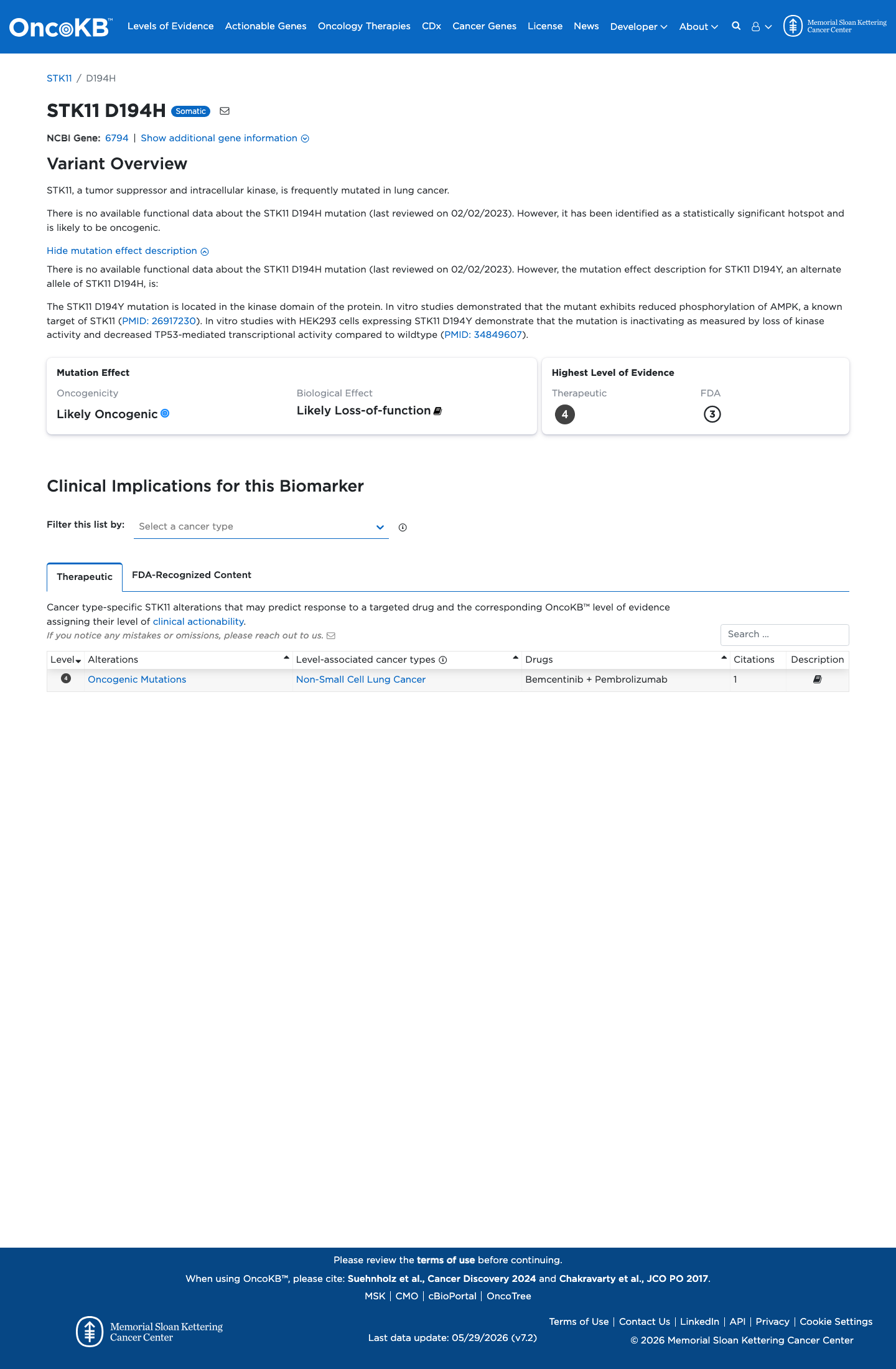
Likely Oncogenic
OncoKB identified variant-specific curated literature and context relevant to functional review; biological-effect context: Likely Loss-of-function; curated oncogenicity label: Likely Oncogenic.
COSMIC

Cancer hotspots
Somatic evidence
Hotspot
COSMIC
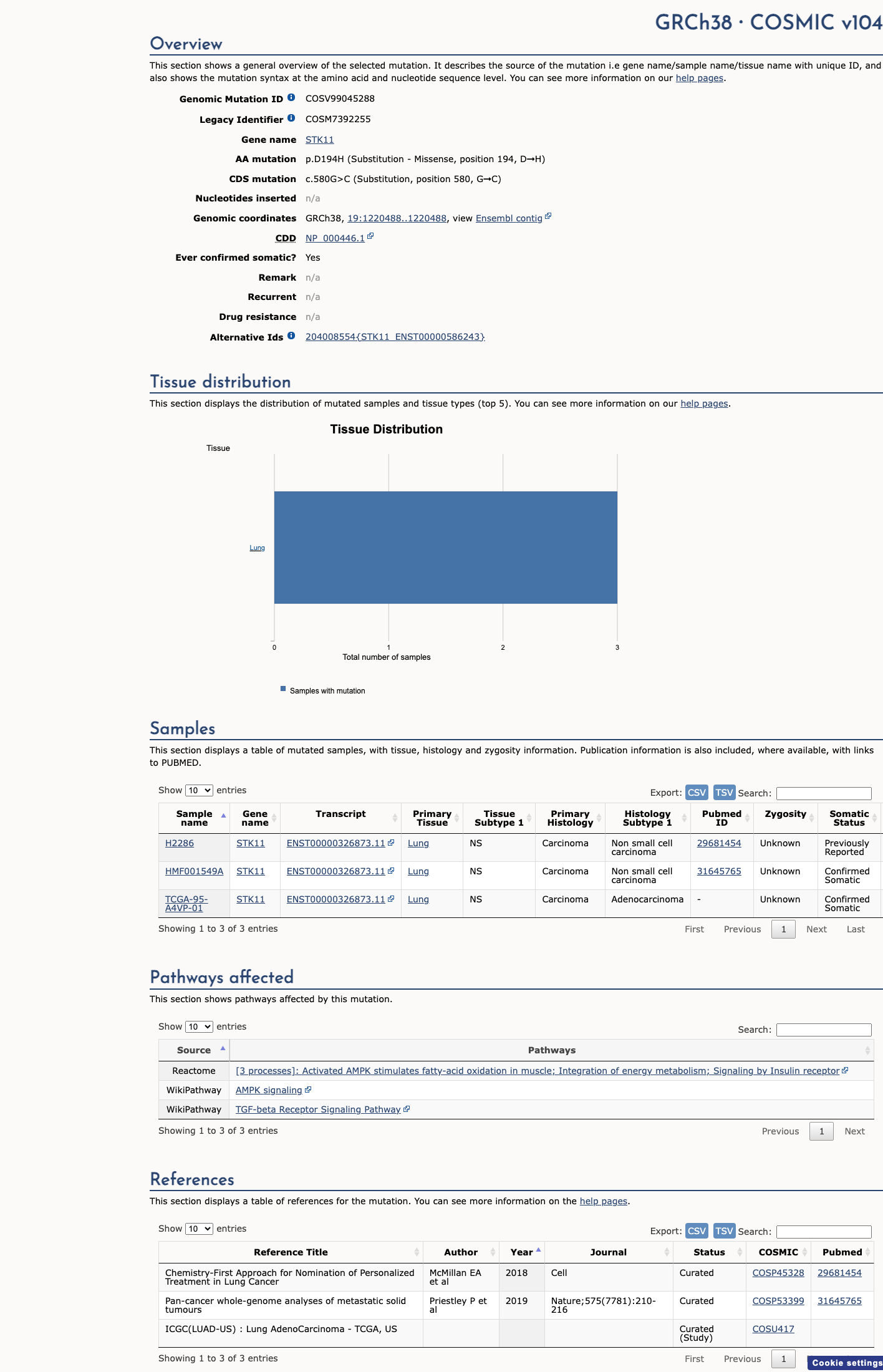
This variant lies in a statistically significant hotspot. This variant has previously been reported in somatic cancers (COSMIC; COSV99045288, n = 3 times).
Hotspots
This variant lies in a statistically significant hotspot.
Sources & reference links
Triaged references · 9 PMIDs not cited in assessment
26917230 ↗
A Sensitive NanoString-Based Assay to Score STK11 (LKB1) Pathway Disruption in Lung Adenocarcinoma.
ONCOKB
34849607 ↗
Functional assessment of somatic STK11 variants identified in primary human non-small cell lung cancers.
ONCOKB
23718779 ↗
High Resolution Melting analysis as a rapid and efficient method of screening for small mutations in the STK11 gene in patients with Peutz-Jeghers syndrome.
CLINVAR
25645574 ↗
ACG clinical guideline: Genetic testing and management of hereditary gastrointestinal cancer syndromes.
CLINVAR
31672839 ↗
Management of patients with increased risk for familial pancreatic cancer: updated recommendations from the International Cancer of the Pancreas Screening (CAPS) Consortium.
CLINVAR
15604628 ↗
Genetic cancer risk assessment and counseling: recommendations of the national society of genetic counselors.
CLINVAR
28492532 ↗
Sherloc: a comprehensive refinement of the ACMG-AMP variant classification criteria.
CLINVAR