NM_003073.4:c.787A>G (p.Ile263Val) is a missense variant in exon 6 of SMARCB1. The variant is absent from gnomAD v2.1 and present at extremely low frequency in gnomAD v4.1 (9.29e-06, 15 heterozygotes, 0 homozygotes), meeting PM2 at supporting level.1 Multiple in silico predictors suggest no significant impact: SpliceAI max delta 0.01, REVEL 0.326, BayesDel -0.137856, meeting BP4 at supporting_benign level.2 This variant has been reported in ClinVar as Uncertain significance by two clinical laboratories.3 No functional studies, segregation data, de novo observations, or case-control data are available for this variant. With one supporting pathogenic criterion (PM2) and one supporting benign criterion (BP4), the evidence is balanced and insufficient to reach a likely pathogenic or likely benign classification.4
Final classification
VUS
PM2BP4
SMARCB1
c.787A>G
p.Ile263Val
This variant
NM_003073.4:c.787A>G (p.Ile263Val) is a missense variant in exon 6 of SMARCB1.
gene-specific framework lacked a usable explicit final combination framework, so generic ACMG/AMP 2015 final-combination rules were applied as fallback; applied criteria: PM2 supporting, BP4 supporting benign; combination = 1 supporting + 1 supporting benign, which maps to VUS.
Classification rationale
PM2
BP4
VUS
SMARCB1 c.787A>G
PM2 + BP4
→
VUS
LYFE Sciences is an AI system, and it can make mistakes. Criteria
may be applied incorrectly, sources may be misread, and a confident-looking
classification can still be wrong. Double-check every criterion and
its underlying evidence before relying on any call.
Gene diagram
· NM_003073.4 · variants mapped to exon structure
SMARCB1
NM_003073.4
Fetching transcript structure from UCSC…
Applied criteria · 2 applied · 19 assessed
MetEvidence satisfies this criterion.
Not metEvaluated against available evidence; threshold not reached.
Not assessedApplies in principle, but no evidence was found to evaluate it.
N/ADoesn't apply to this variant type.
Applied · 2
Strength
Supporting
Moderate
Strong
Very strong
PM2
supporting
Pathogenic
The variant is absent from gnomAD v2.1 and present at extremely low frequency in gnomAD v4.1 (allele frequency = 9.29e-06, 15/1,613,888 alleles, 0 homozygotes; grpmax FAF = 6.88e-06). This is well below the 0.1% PM2 threshold for generic ACMG/AMP. Absent from gnomAD-Canada.
gnomAD v2.1: absent. gnomAD v4.1: AF = 9.29e-06 (15/1613888 alleles
BP4
supporting
Benign
Multiple lines of computational evidence suggest no significant impact on the gene product. SpliceAI max delta score is 0.01 (no predicted splicing impact). REVEL score is 0.326 (below pathogenic threshold of 0.5). BayesDel score is -0.137856 (negative, predicting a benign effect). Three independent in silico predictors concur on no deleterious effect.
SpliceAI max delta: 0.01 (no splice impact). REVEL: 0.326 (below 0.5). BayesDel: -0.137856 (benign prediction).
Assessed · not applied
· 4 not met · 15 not assessed
Pathogenic
PS1
No evidence of a different nucleotide change at codon 263 producing the same amino acid substitution (p.Ile263Val) that has been previously classified as pathogenic.
PS2
No de novo observation data available for this variant.
PS3
No variant-specific functional studies identified.
PS4
No case-control data or variant-specific case counts available.
PM1
The variant does not lie in a statistically significant hotspot per the Cancer Hotspots assessment.
PM6
No de novo observation data available for this variant.
PP1
No segregation data available for this variant.
PP2
No gene-level constraint metrics (e.g., Missense Z-score, gnomAD constraint) were retrieved to establish a low rate of benign missense variation in SMARCB1.
PP3
Multiple lines of computational evidence do not support a deleterious effect.
PP4
No patient-specific phenotypic data available for this variant.
PP5
No reputable source has classified this variant as pathogenic.
Benign
BS1
The variant allele frequency in gnomAD v4.1 is 0.00093% (9.29e-06), far below the 0.3% BS1 threshold for generic ACMG/AMP.
BS2
While the variant is observed in gnomAD v4.1 in 15 heterozygous individuals, gnomAD does not provide individual-level phenotype confirmation of healthy adult status.
BS3
No variant-specific functional assays demonstrating no damaging effect are available.
BS4
No family segregation data available for this variant.
BP1
While loss-of-function is an established disease mechanism for SMARCB1, missense variants are also documented as disease-causing in SMARCB1-related disorders (e.g., Coffin-Siris syndrome, schwannomatosis).
BP2
No data on observation in trans with a pathogenic variant in SMARCB1.
BP5
No data on an alternate molecular basis for disease in an individual carrying this variant.
BP6
No reputable source has classified this variant as benign.
N/A · 7
PVS1 · PM3 · PM4 · PM5 · BA1 · BP3 · BP7
Research & evidence
Population frequency
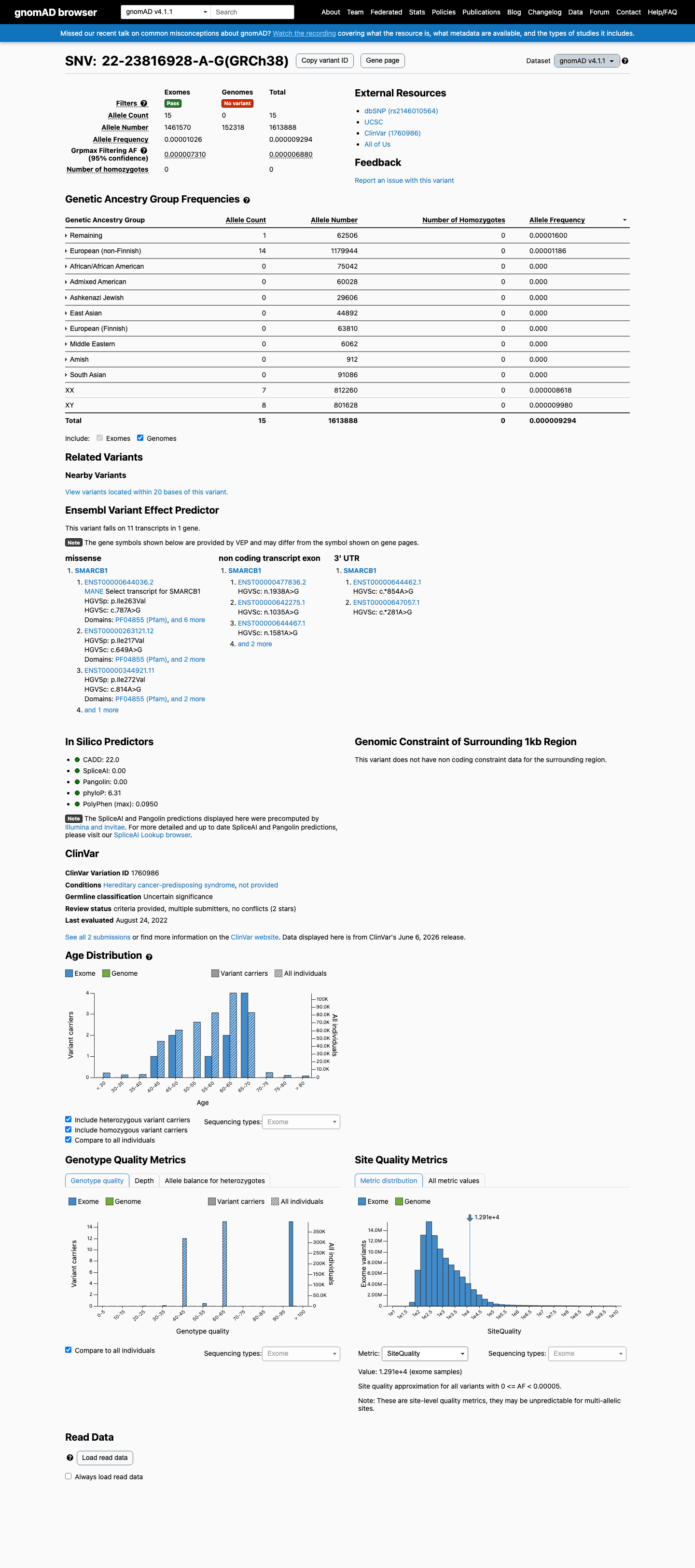
gnomAD v4.1
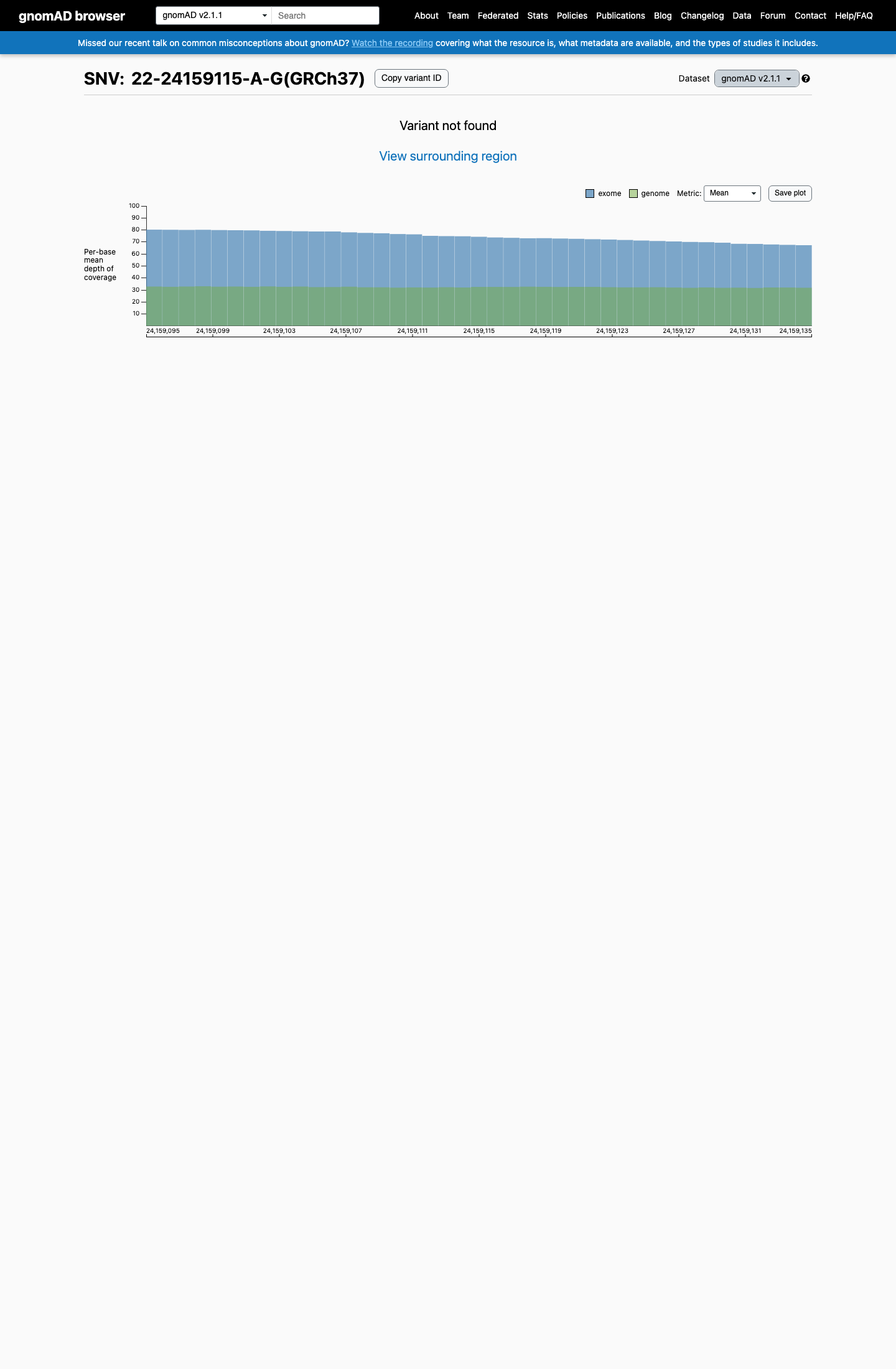
gnomAD v2.1
v4.1
This variant is present in gnomAD v4.1 (AF= 9.29433e-06; MAF= 0.00093%, 15/1613888 alleles, homozygotes = 0) and has highest observed frequency in the Remaining individuals population (AF= 1.59985e-05; MAF= 0.00160%, 1/62506 alleles, homozygotes = 0); grpmax FAF= 6.88e-06.
v2.1
Absent from gnomAD v2.1.
🇨🇦 CA
This variant is absent from gnomAD-Canada.
Allele frequency by ancestry
three datasets · side by side
gnomAD v4.1
0.00093%
· 15 / 1,613,888
0 hom · FAF 0.00069%
0 hom · FAF 0.00069%
Remaining individuals 1 / 62,506 |
0.0016% |
European (non-Finnish) 14 / 1,179,944 |
0.0012% |
+ 8 not observed (Admixed American, European (Finnish), Amish, East Asian, Middle Eastern, South Asian, Ashkenazi Jewish, African/African American)
gnomAD v2.1
Absent
· 0 / ?
0 hom
0 hom
Not observed in any ancestry group.
gnomAD Canada 🇨🇦
Absent
· 0 / ?
0 hom
0 hom
Not observed in any ancestry group.
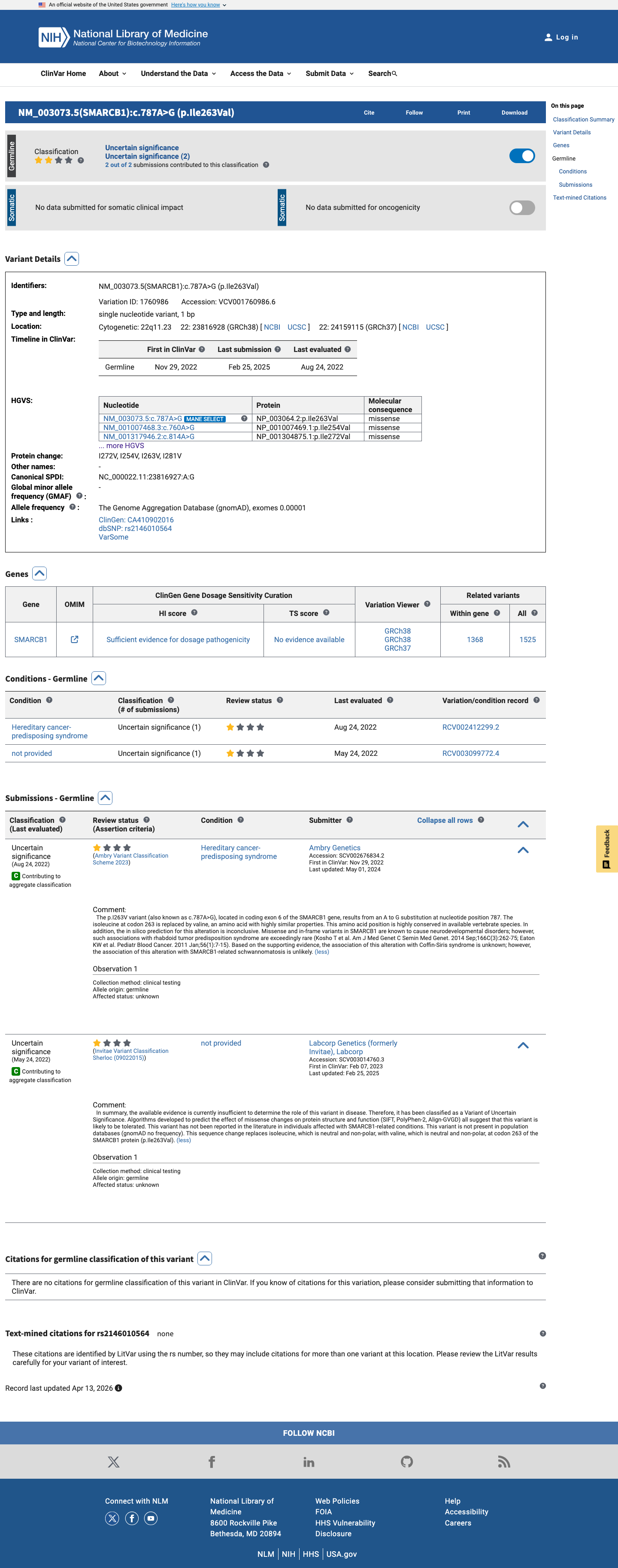
ClinVar
This variant has been reported in ClinVar as Uncertain significance (2 clinical laboratories). (ClinVarID = 1760986)
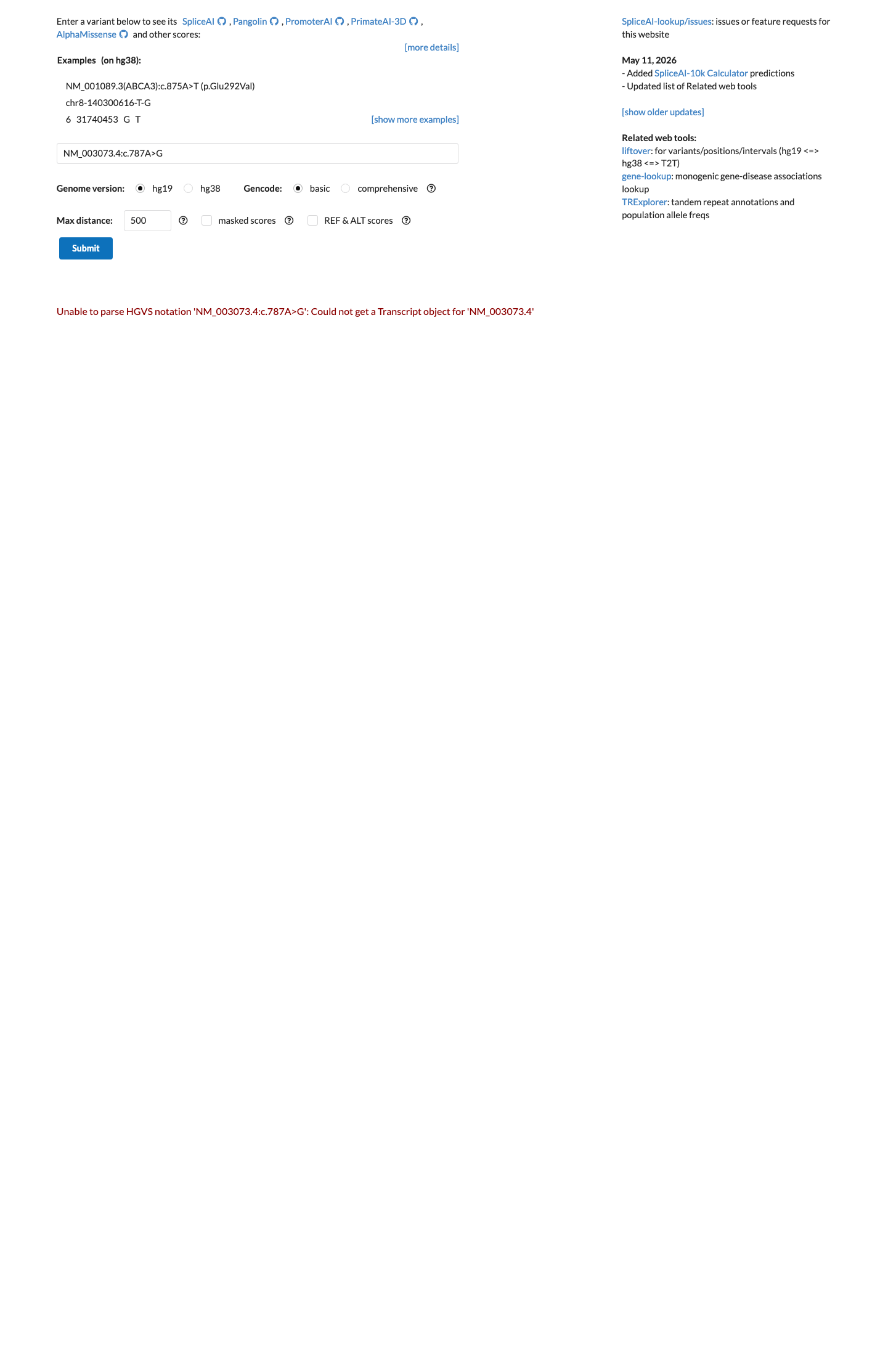
In silico
SpliceAI predicts no significant splice impact for this variant (max delta score = 0.01). REVEL score = 0.326. BayesDel score = -0.137856.
Functional
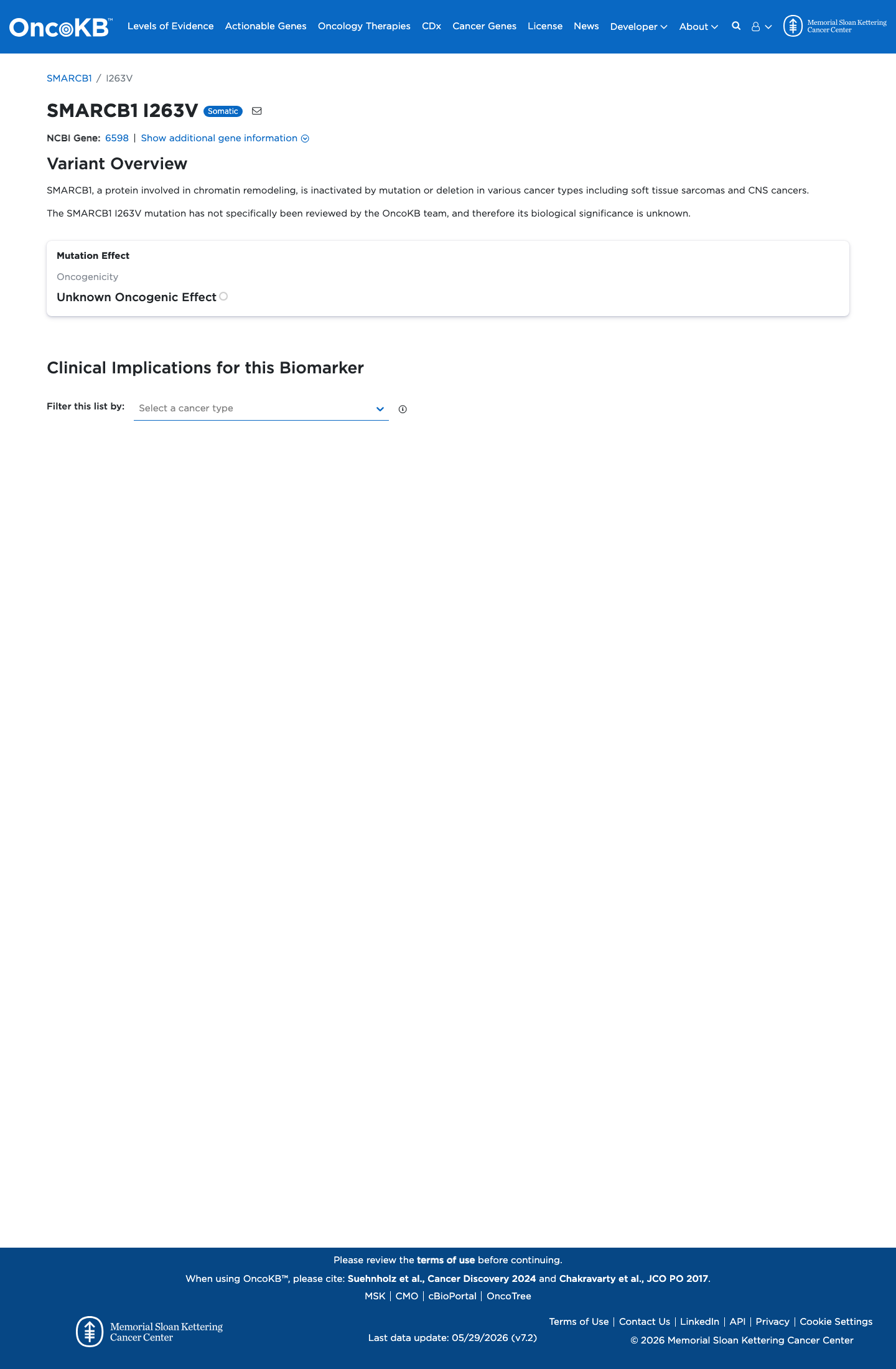
Unknown Oncogenic Effect
OncoKB did not identify variant-specific reviewed functional evidence for this variant; gene-level curated context is available for reviewer follow-up. SMARCB1, a protein involved in chromatin remodeling, is inactivated by mutation or deletion in various cancer types including soft tissue sarcomas and

COSMIC

Cancer hotspots
Somatic evidence
Not in COSMIC / hotspots
COSMIC
This variant does not lie in a statistically significant hotspot. This variant has not previously been reported in somatic cancers (COSMIC).
Hotspots
This variant does not lie in a statistically significant hotspot.
Sources & reference links
Triaged references · 2 PMIDs not cited in assessment
25394175 ↗
A practice guideline from the American College of Medical Genetics and Genomics and the National Society of Genetic Counselors: referral indications for cancer predisposition assessment.
CLINVAR
28492532 ↗
Sherloc: a comprehensive refinement of the ACMG-AMP variant classification criteria.
CLINVAR