PS3_Strong is met (+4 points): N239S is non-functional in the Kato et al. functional assay and shows loss of function in all three other eligible VCEP assays (Giacomelli, Kotler, Funk), meeting the TP53 VCEP criterion for strong pathogenic functional evidence.1 PM5_Strong is met (+4 points): At codon 239, three different missense variants (N239D, N239I, N239T) have been classified as pathogenic (PS3) by the TP53 VCEP, satisfying the requirement of ≥2 different pathogenic missense variants at the same residue.2 PM2_Supporting is met (+1 point): The variant is extremely rare in population databases (gnomAD v4.1 AF = 6.2e-7), well below the VCEP threshold of <0.00003.3 BP4_Supporting is met (-1 point): Per the VCEP PP3-BP4-codes.xlsx, c.716A>G is assigned BP4. BayesDel score 0.10537 with aGVGD Class C45 and no predicted splicing impact (SpliceAI 0.04).4 Tavtigian point total: 4 (PS3) + 4 (PM5) + 1 (PM2) - 1 (BP4) = 8 points. Under the TP53 VCEP v2.4.0 point-based framework, 6-9 points corresponds to Likely Pathogenic.5 The variant has been observed in ClinVar with majority classification as Likely Pathogenic (6 clinical laboratories) and Pathogenic (1 laboratory), consistent with this adjudication.6 N239S has been reported as a somatic mutation in 56 tumor samples in COSMIC and is classified as Oncogenic (Loss-of-function) by OncoKB, though these somatic data are not directly used for germline criterion points under the VCEP framework.7
Final classification
Likely Pathogenic
PS3PM2PM5BP4
TP53
c.716A>G
p.Asn239Ser
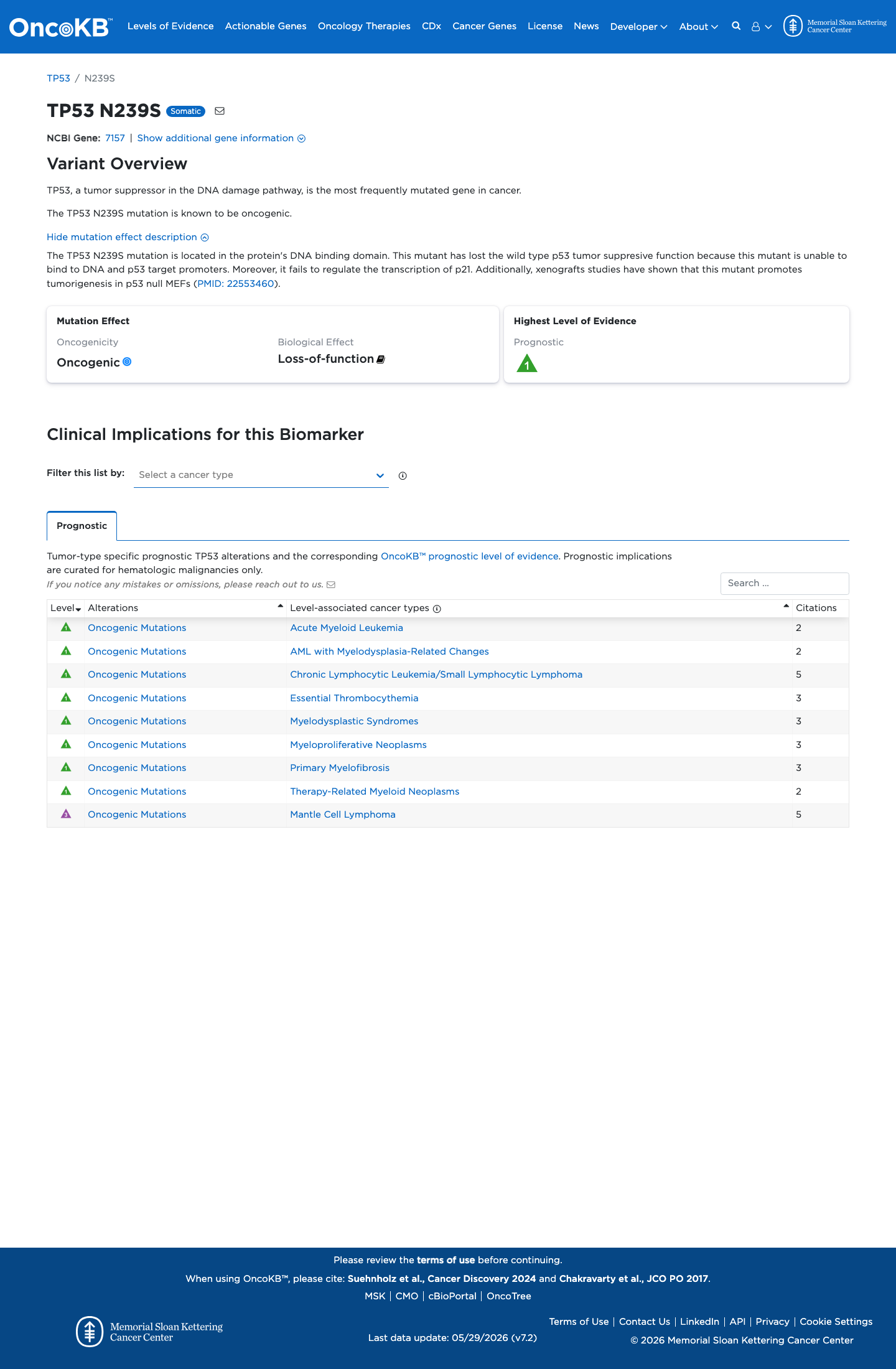
This variant
PS3_Strong is met (+4 points): N239S is non-functional in the Kato et al. functional assay and shows loss of function in all three other eligible VCEP assays (Giacomelli, Kotler, Funk), meeting the TP53 VCEP criterion for strong pathogenic functional evidence.
Tavtigian et.al., 2020 - Bayesian adaptation of Richards et.al., 2015 v2.4.0 point-based framework: PS3 strong (+4) + PM2 supporting (+1) + PM5 strong (+4) + BP4 supporting benign (-1) = 8 points, which maps to Likely Pathogenic.
Classification rationale
PS3PM2PM5
BP4
Likely Pathogenic
TP53 c.716A>G
PS3 + PM2 + PM5 + BP4
→
Likely Pathogenic
1
vcep_functional_worksheetPMID:12826609 ↗
2
vcep_functional_worksheet
4
vcep_pp3_bp4_codesbayesdelspliceai ↗
5
cspec ↗
7
oncokb ↗
LYFE Sciences is an AI system, and it can make mistakes. Criteria
may be applied incorrectly, sources may be misread, and a confident-looking
classification can still be wrong. Double-check every criterion and
its underlying evidence before relying on any call.
Gene diagram
· NM_000546.6 · variants mapped to exon structure
TP53
NM_000546.6
Fetching transcript structure from UCSC…
Applied criteria · 4 applied · 11 assessed
MetEvidence satisfies this criterion.
Not metEvaluated against available evidence; threshold not reached.
Not assessedApplies in principle, but no evidence was found to evaluate it.
N/ADoesn't apply to this variant type.
Applied · 4
Strength
Supporting
Moderate
Strong
Very strong
PS3
strong
Pathogenic
N239S is classified as PS3 by the TP53 VCEP Functional-worksheet (Supplementary Table S3). In the Kato et al. (PMID:12826609) functional assay, N239S is non-functional. In the three other eligible VCEP assays, N239S shows loss of function: Giacomelli (PMID:30224644): LOF; Kotler (PMID:29979965): LOF; Funk (PMID:39774325): LOF. This meets the VCEP PS3_Strong criteria: non-functional on Kato data AND loss of function by the majority of other eligible assays (3/3 LOF).
VCEP Functional-worksheet PS3 assignment for N239SKato et al. assay: Non-functionalGiacomelli et al. assay: LOF
PM2
supporting
Pathogenic
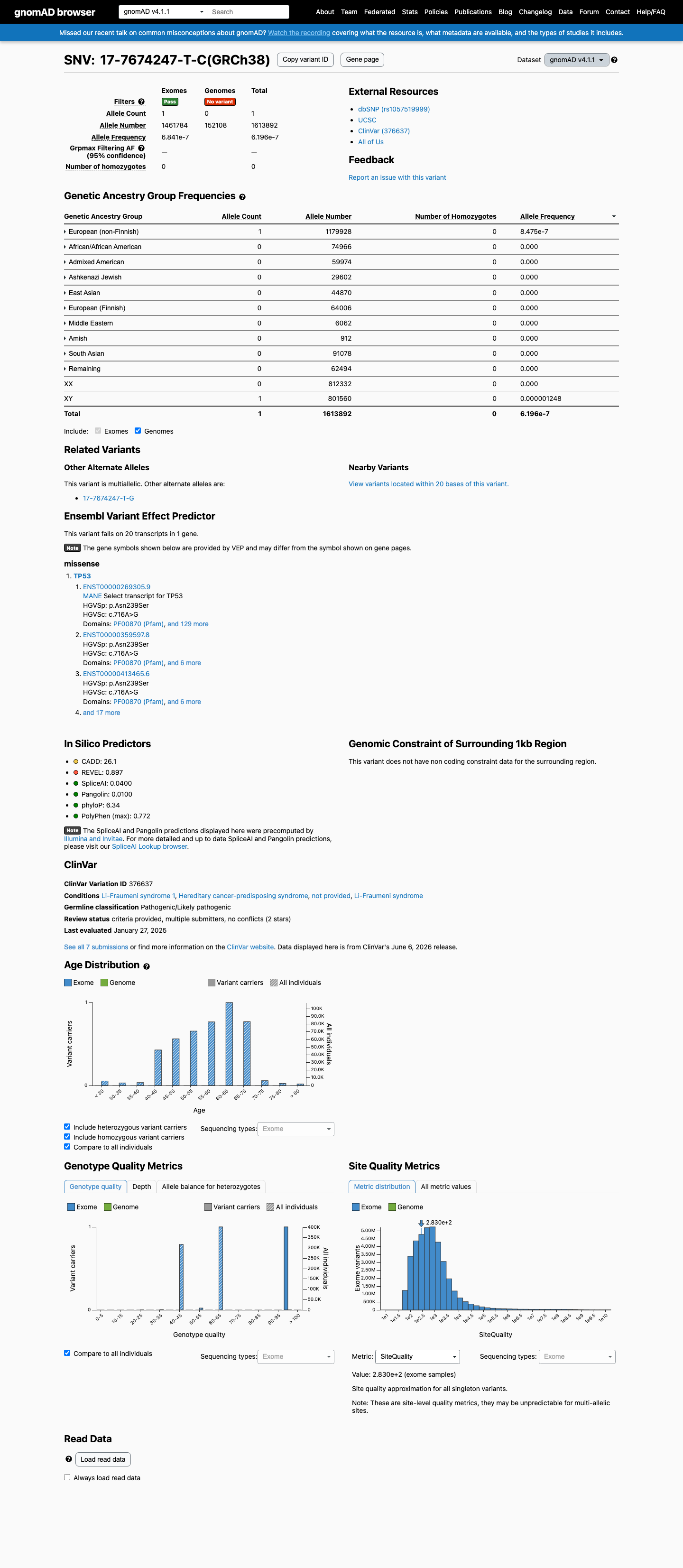
The variant is extremely rare in population databases. In gnomAD v4.1, the global allele frequency is 6.20e-7 (1 allele / 1,613,892 alleles; 0.000062%), with the only allele observed in the European (non-Finnish) subpopulation (AF = 8.48e-7; 1/1,179,928 alleles). This is well below the VCEP PM2_Supporting threshold of <0.00003 (0.003%). The variant is absent from gnomAD v2.1 and gnomAD-Canada v1.0. No homozygotes observed.
gnomAD v4.1: 1 allele in 1613892 (AF = 6.2e-7)
PM5
strong
Pathogenic
At codon 239, at least three different missense variants (N239D, N239I, N239T) have been independently classified as PS3 (Pathogenic) by the TP53 VCEP Functional-worksheet. This satisfies PM5_Strong: ≥2 different missense variants at the same amino acid residue previously determined to be pathogenic per TP53 VCEP specifications.
N239D: VCEP PS3N239I: VCEP PS3N239T: VCEP PS3
BP4
supporting
Benign
Per the TP53 VCEP PP3-BP4-codes.xlsx (Supplementary Table S2), c.716A>G (p.Asn239Ser) is assigned BP4. The variant has BayesDel score 0.10537, which is <0.16 and >-0.008, with aGVGD Class C45 (not C65). SpliceAI max delta = 0.04, indicating no predicted splicing effect (<0.2). This meets the VCEP BP4_Supporting criteria: BayesDel <0.16 and >-0.008 (excluding C65) AND no predicted differences in splicing (SpliceAI <0.2).
VCEP PP3-BP4-codes.xlsx: c.716A>G assigned BP4BayesDel: 0.10537aGVGD Class C45
Assessed · not applied
· 5 not met · 6 not assessed
Pathogenic
PS2
No de novo observation of NM_000546.6:c.716A>G (p.Asn239Ser) with confirmed paternity and maternity was identified in the literature, ClinVar, or published databases reviewed.
PS4
Although the PM2_Supporting prerequisite is satisfied (variant is extremely rare in population databases), no proband-level cancer phenotype data or case-control analysis is available to calculate Li-Fraumeni syndrome cancer points under the TP53 VCEP PS4 scoring system.
PM1
Codon 239 is not among the VCEP-designated PM1 hotspot codons (175, 245, 248, 249, 273, 282).
PP1
No cosegregation data identified for NM_000546.6:c.716A>G.
PP3
Per the TP53 VCEP PP3-BP4-codes.xlsx (Supplementary Table S2), c.716A>G (p.Asn239Ser) is assigned BP4, not PP3.
PP4
The TP53 VCEP PP4 criterion requires variant allele fraction (VAF) data from clinical testing to distinguish constitutional from somatic/clonal hematopoiesis origin.
Benign
BA1
The variant is extremely rare in gnomAD v4.1 (global AF = 6.2e-7).
BS1
The variant is extremely rare in gnomAD v4.1 (global AF = 6.2e-7).
BS2
No data available on unrelated females aged ≥60 years without cancer who carry this variant.
BS3
N239S is non-functional in the Kato et al.
BS4
No evidence of lack of segregation identified.
N/A · 11
PVS1 · PS1 · PM6 · PP2 · PP5 · BP1 · BP2 · BP3 · BP5 · BP6 · BP7
Research & evidence
Population frequency · supports pathogenic
gnomAD v4.1
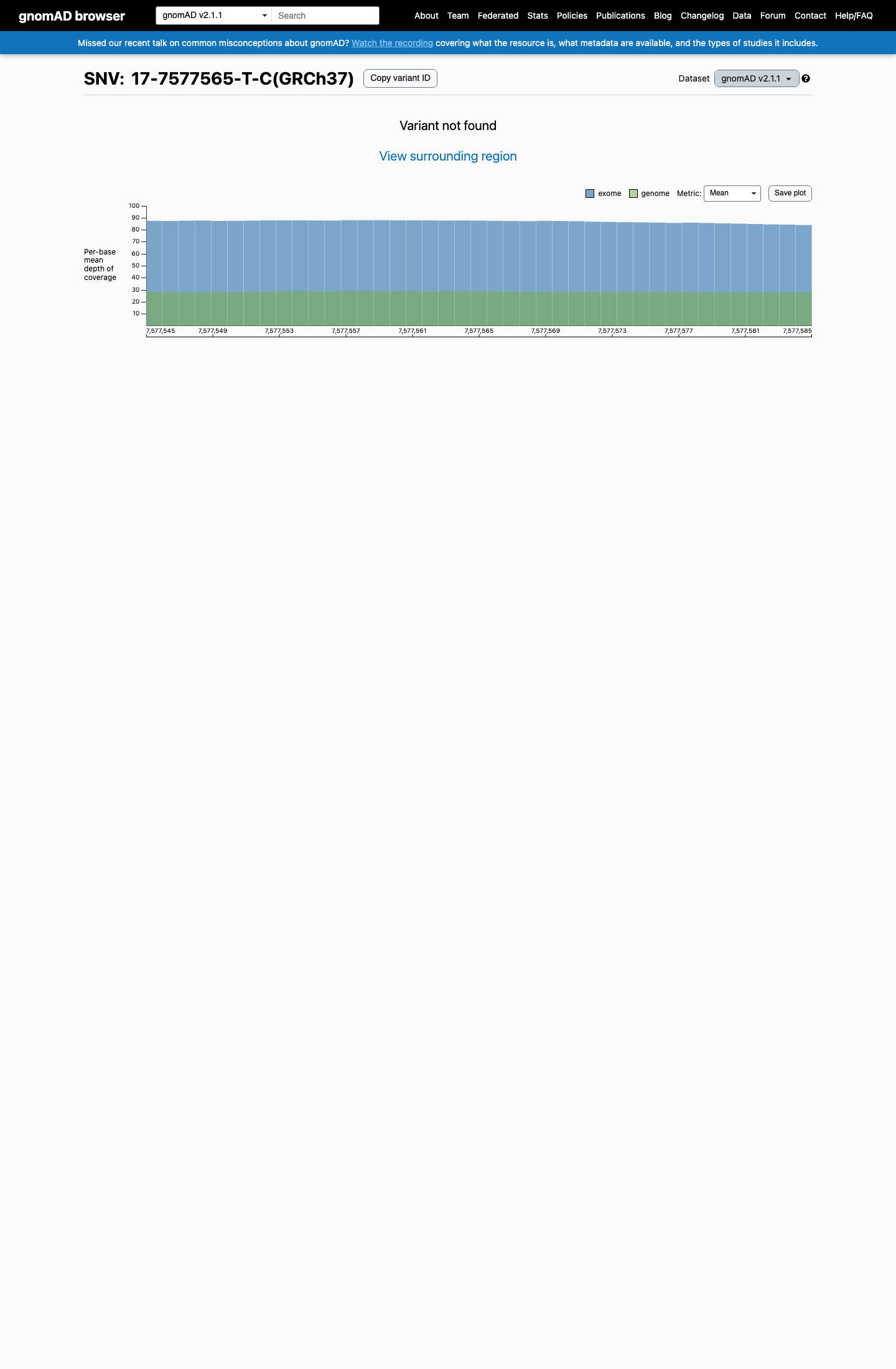
gnomAD v2.1
v4.1
This variant is present in gnomAD v4.1 (AF= 6.1962e-07; MAF= 0.00006%, 1/1613892 alleles, homozygotes = 0) and has highest observed frequency in the European (non-Finnish) population (AF= 8.47509e-07; MAF= 0.00008%, 1/1179928 alleles, homozygotes = 0).
v2.1
Absent from gnomAD v2.1.
🇨🇦 CA
Absent from gnomAD-Canada v1.0.
Allele frequency by ancestry
three datasets · side by side
gnomAD v4.1
6.2e-05%
· 1 / 1,613,892
0 hom
0 hom
European (non-Finnish) 1 / 1,179,928 |
8.5e-05% |
+ 9 not observed (Remaining individuals, Admixed American, European (Finnish), Amish, East Asian, Middle Eastern, South Asian, Ashkenazi Jewish, African/African American)
gnomAD v2.1
Absent
· 0 / ?
0 hom
0 hom
Not observed in any ancestry group.
gnomAD Canada 🇨🇦
Absent
· 0 / ?
0 hom
0 hom
Not observed in any ancestry group.
ClinVar
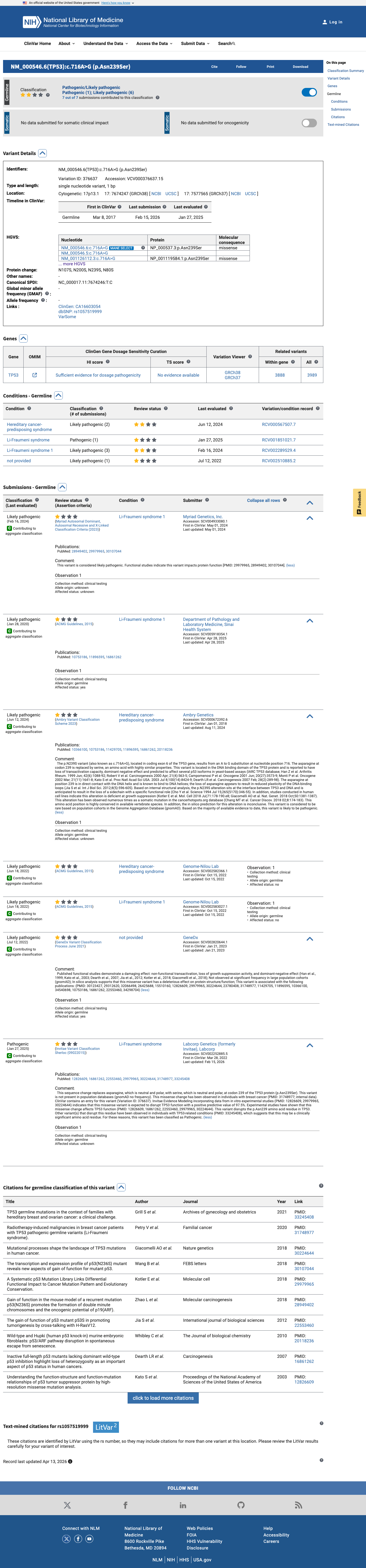
This variant has been reported in ClinVar as Likely pathogenic (6 clinical laboratories) and as Pathogenic (1 clinical laboratory). (ClinVarID = 376637)
In silico
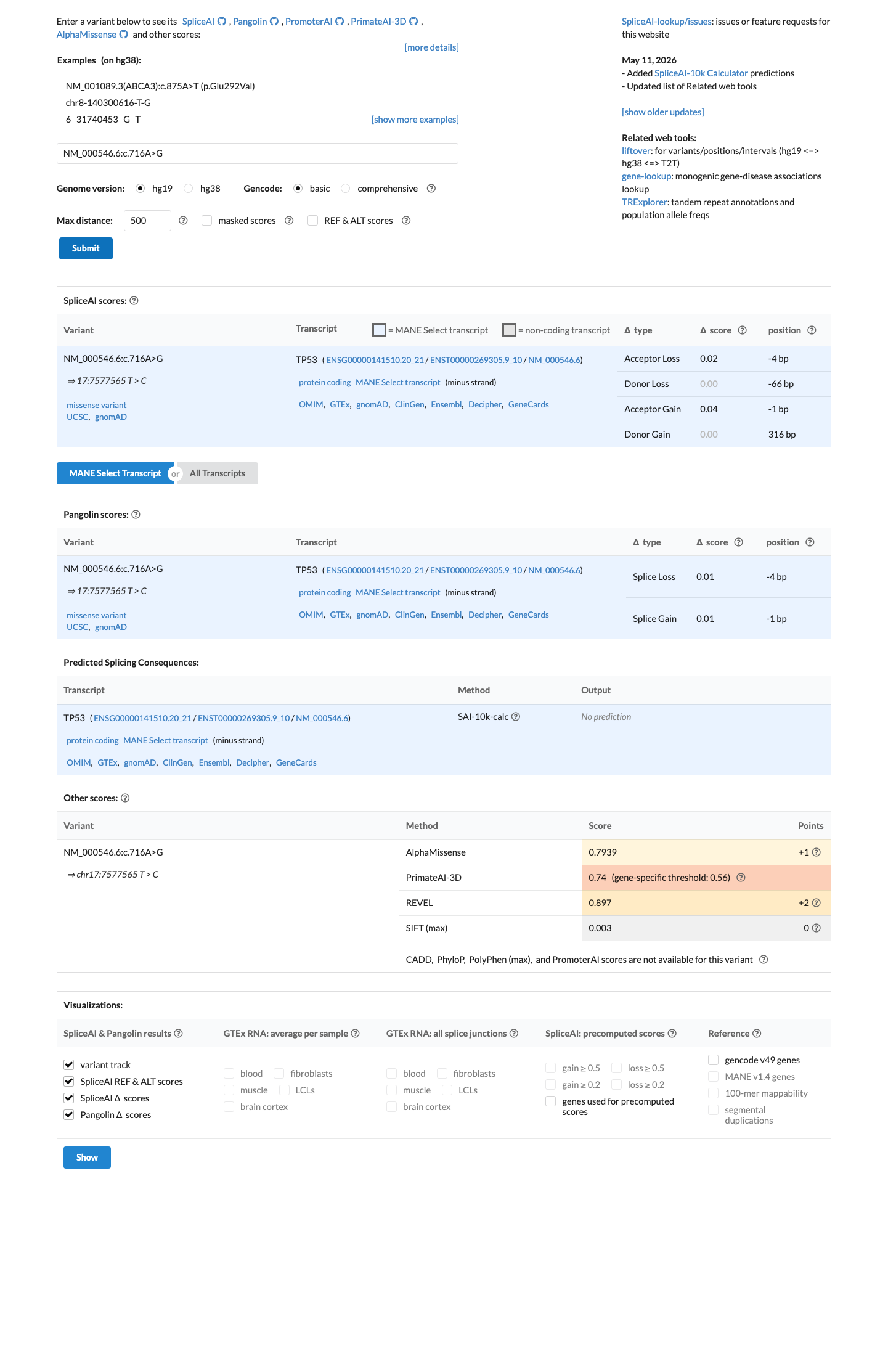
SpliceAI predicts no significant splice impact for this variant (max delta score = 0.04). REVEL score = 0.897. BayesDel score = 0.10537.
Functional
Oncogenic
OncoKB identified variant-specific curated literature and context relevant to functional review; biological-effect context: Loss-of-function; curated oncogenicity label: Oncogenic.
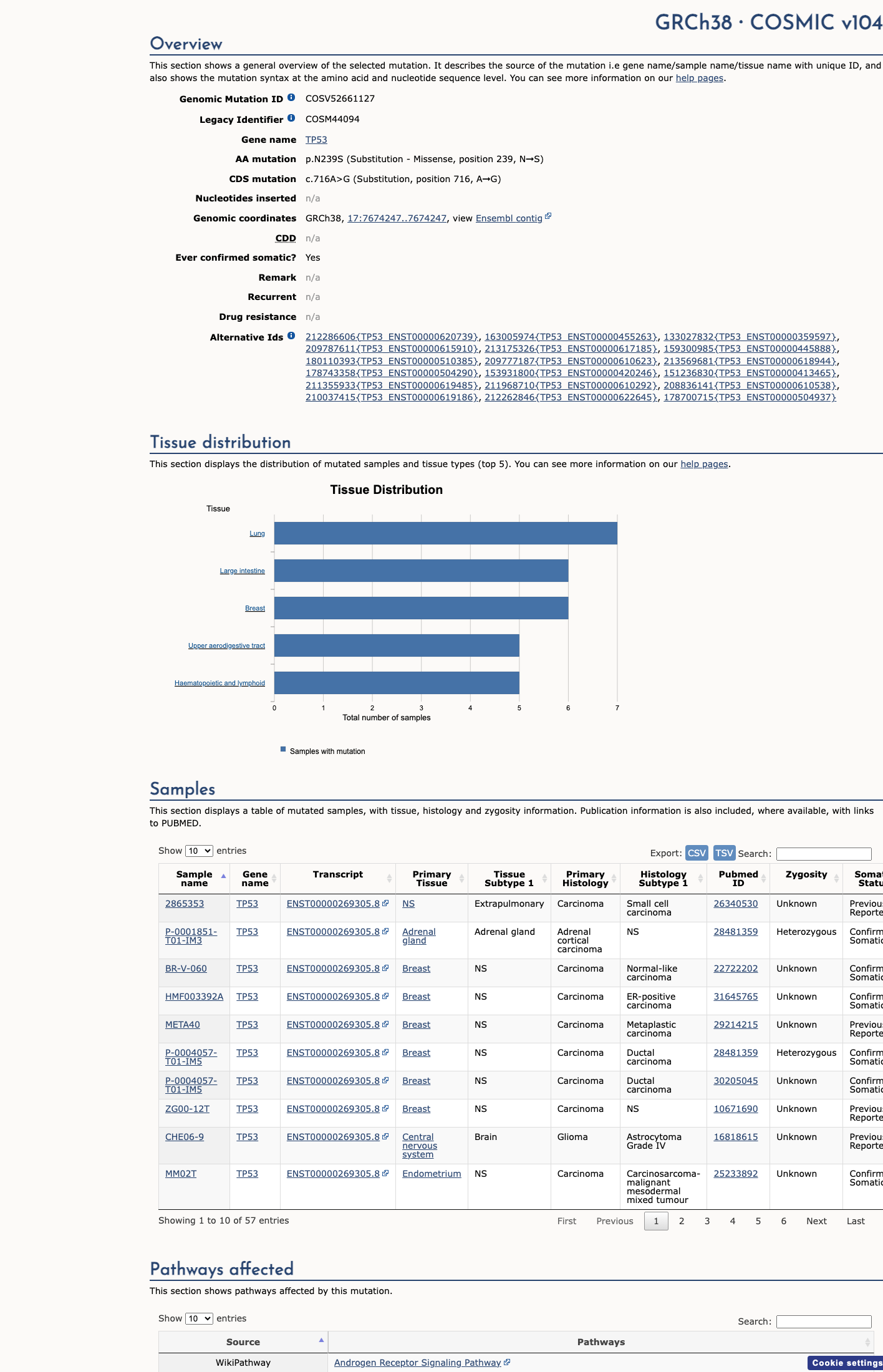
COSMIC

Cancer hotspots
Somatic evidence
Hotspot
COSMIC
This variant lies in a statistically significant hotspot. This variant has previously been reported in somatic cancers (COSMIC; COSV52661127, n = 56 times).
Hotspots
This variant lies in a statistically significant hotspot.
Literature · how each cited paper was used
1papers cited
Each card is an audit: what was searched, what was found, whether it names the variant, which criteria it fed, and why. 7 further PMIDs triaged but not cited — see Sources & references.
The gain of function of p53 mutant p53S in promoting tumorigenesis by cross-talking with H-RasV12.
Searched
N239SAsn239Serp53SN236Sc.716A>G
Found
N239S (referred to as p53S) is the primary subject of this study. The mutant lost DNA binding activity to p21 and PERP promoters by EMSA, lost transactivation of p21, cyclin G1, PUMA, and Bax in response to irradiation by real-time PCR, and did not suppress tumorigenesis. Cooperating with H-RasV12, p53S promoted tumorigenesis in xenograft assays, demonstrating gain-of-function oncogenic properties. N239S is described as a non-functional mutation in yeast and mammalian assays.
Variant
✓ Names this variant — characterised directly
Applied to
→PS3
met
Why
Provides confirmatory functional evidence that N239S is non-functional; consistent with the VCEP PS3 assignment. Data are from somatic/gain-of-function experimental context.
The p53 N236S (p53 N239S in human, p53S) mutation has been shown to lose wild type p53 function by yeast assay. ... Functional assays in yeast and structure-function predictions indicate that p53 N239S is a non-functional mutation.
Location Abstract; Introduction paragraphs 2-5; Results (Figures 1-4); Discussion paragraphs 1-4 · Context Mouse embryonic fibroblasts (p53-/- MEFs), EMSA with in vitro translated proteins, real-time PCR, xenograft in SCID mice, Western blotting, flow cytometry · full text
Sources & reference links
9Sources
Triaged references · 7 PMIDs not cited in assessment
10753186 ↗
High frequency in esophageal cancers of p53 alterations inactivating the regulation of genes involved in cell cycle and apoptosis.
CLINVAR
11429705 ↗
p53 mutants can often transactivate promoters containing a p21 but not Bax or PIG3 responsive elements.
CLINVAR
12826609 ↗
Understanding the function-structure and function-mutation relationships of p53 tumor suppressor protein by high-resolution missense mutation analysis.
CLINVAR
16861262 ↗
Inactive full-length p53 mutants lacking dominant wild-type p53 inhibition highlight loss of heterozygosity as an important aspect of p53 status in human cancers.
CLINVAR
28492532 ↗
Sherloc: a comprehensive refinement of the ACMG-AMP variant classification criteria.
CLINVAR