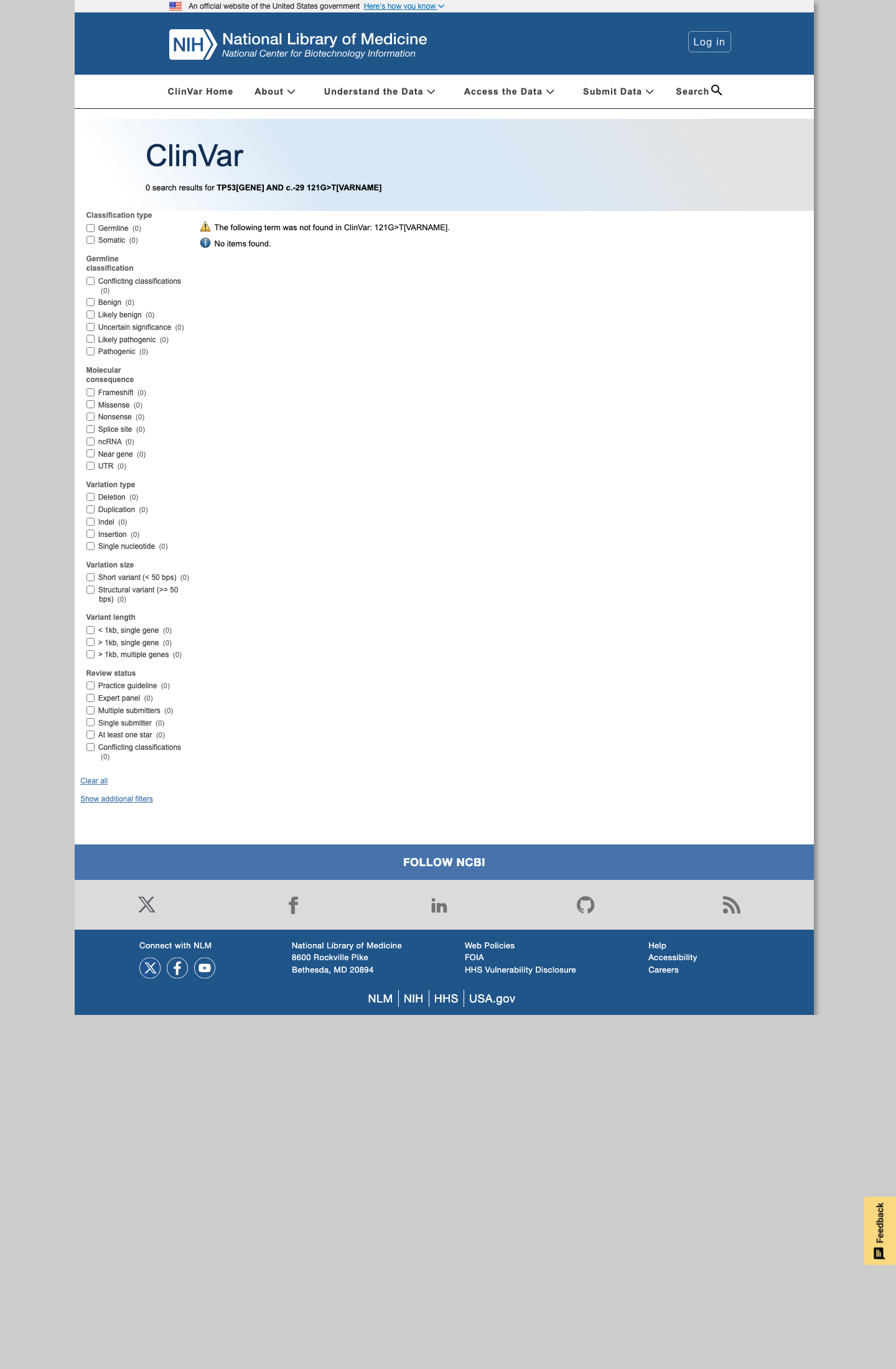
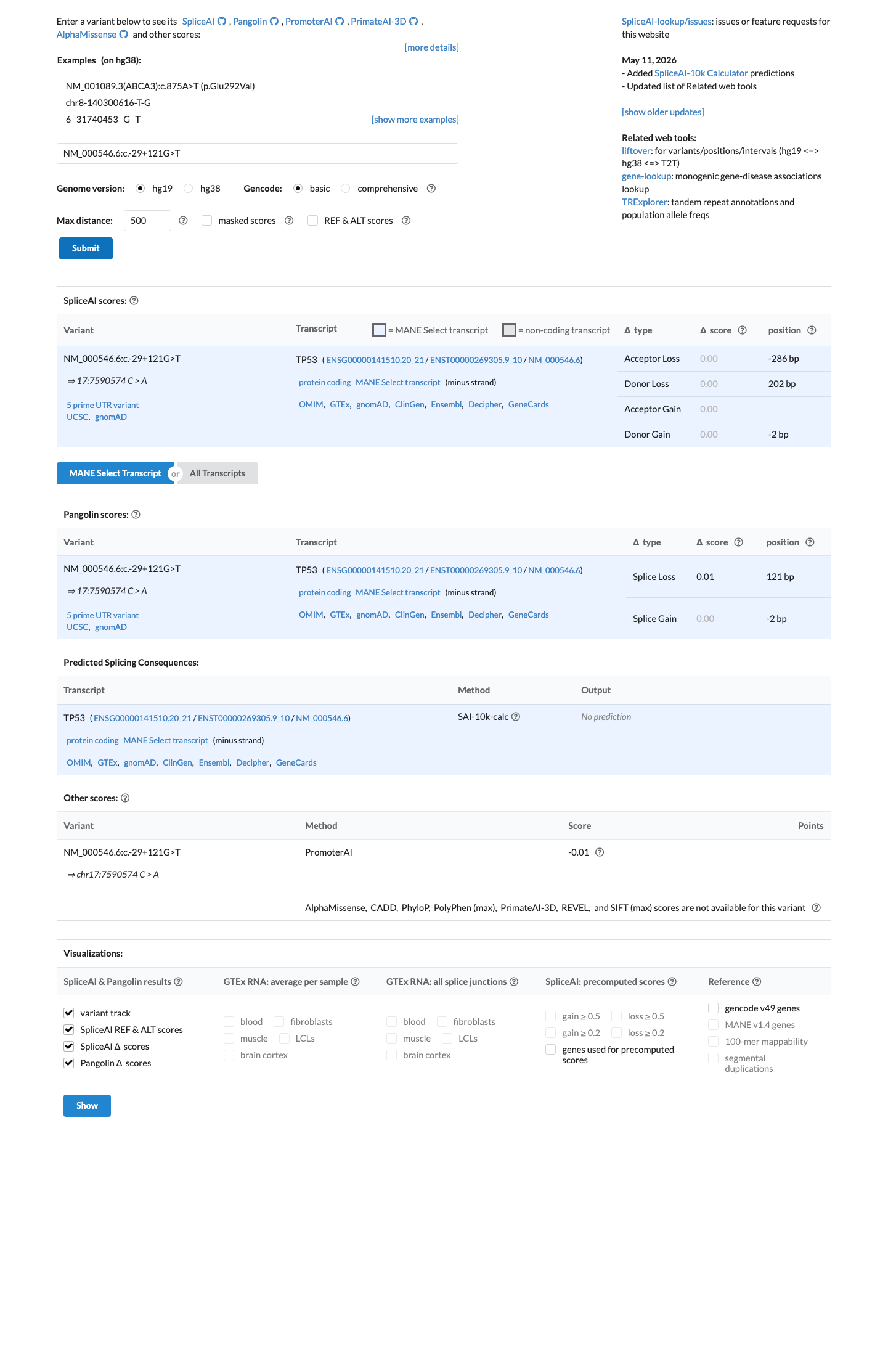
NM_000546.6:c.-29+121G>T is a deep intronic substitution in intron 1 of TP53, 121 nucleotides downstream of the exon 1 splice donor (c.-29). This variant falls outside all canonical null-variant categories (PVS1 not applicable) and does not alter the amino acid sequence (PS1, PM1, PM5 not applicable).1 The variant is absent from gnomAD v2.1 and v4.1 (0 alleles across >1.6 million individuals). This absence meets the TP53 VCEP PM2_Supporting threshold of allele frequency < 0.00003 (0.003%). However, caution is warranted as deep intronic regions may have reduced coverage in exome sequencing data.2 SpliceAI predicts no splicing impact (max delta score = 0.00). No cryptic splice site creation or disruption is predicted. This supports a benign interpretation through two independent TP53 VCEP criteria: BP4_Supporting (computational evidence, SpliceAI ≤ 0.1 for intronic variants outside ±1,2) and BP7_Supporting (intronic variant at +121, beyond +7, with no predicted splicing aberration).3 No functional studies, de novo observations, co-segregation data, case-control studies, or ClinVar submissions have been reported for this variant. It is absent from COSMIC and all TP53 locus-specific databases. Multiple pathogenic criteria (PS2, PS3, PS4, PP1, PP4) and benign criteria (BS1, BS2, BS3, BS4, BA1) cannot be assessed due to complete absence of variant-specific clinical or experimental data.4 Under the TP53 VCEP v2.4.0 Tavtigian point-based framework, the applied criteria yield: PM2_Supporting (+1 point), BP4_Supporting (-1 point), BP7_Supporting (-1 point). Total = -1 point, which maps to Uncertain Significance (range -1 to +5). However, the VCEP caveat states that a final point value of -1 may be overridden to Likely Benign when at least 2 benign evidence codes are applied AND PM2_Supporting is the only pathogenic code. Both conditions are met here, resulting in a final classification of Likely Benign.5
Final classification
VUS
PM2BP4BP7
TP53
c.-29+121G>T
p.?
This variant
NM_000546.6:c.-29+121G>T is a deep intronic substitution in intron 1 of TP53, 121 nucleotides downstream of the exon 1 splice donor (c.-29). This variant falls outside all canonical null-variant categories (PVS1 not applicable) and does not alter the amino acid sequence (PS1, PM1, PM5 not applicable).
Tavtigian et.al., 2020 - Bayesian adaptation of Richards et.al., 2015 v2.4.0 point-based framework: PM2 supporting (+1) + BP4 supporting benign (-1) + BP7 supporting benign (-1) = -1 points, which maps to VUS.
Classification rationale
PM2
BP4BP7
VUS
TP53 c.-29+121G>T
PM2 + BP4 + BP7
→
VUS
1
pvs1_variant_assessmentpvs1_gene_context
5
final_classification_frameworkcspec ↗
LYFE Sciences is an AI system, and it can make mistakes. Criteria
may be applied incorrectly, sources may be misread, and a confident-looking
classification can still be wrong. Double-check every criterion and
its underlying evidence before relying on any call.
Gene diagram
· NM_000546.6 · variants mapped to exon structure
TP53
NM_000546.6
Fetching transcript structure from UCSC…
Applied criteria · 3 applied · 11 assessed
MetEvidence satisfies this criterion.
Not metEvaluated against available evidence; threshold not reached.
Not assessedApplies in principle, but no evidence was found to evaluate it.
N/ADoesn't apply to this variant type.
Applied · 3
Strength
Supporting
Moderate
Strong
Very strong
PM2
supporting
review
Pathogenic
NM_000546.6:c.-29+121G>T is absent from gnomAD v2.1 and v4.1 (0 alleles). This meets the TP53 VCEP PM2_Supporting threshold of allele frequency < 0.00003 (0.003%). Caveat: deep intronic positions may have reduced coverage in exome sequencing data, which may contribute to apparent absence.
Absent from gnomAD v2.1 (0 alleles)gnomAD v4.1 (0 alleles)gnomAD-Canada (0 alleles).
BP4
supporting
Benign
NM_000546.6:c.-29+121G>T is an intronic variant outside ±1,2 splice positions with SpliceAI max delta = 0.00. Per TP53 VCEP BP4 rules, intronic variants outside ±1,2 positions with SpliceAI ≤ 0.1 meet BP4_Supporting.
SpliceAI max delta = 0.00 (≤ 0.1). Intronic variant outside ±12 canonical splice positions.
BP7
supporting
Benign
NM_000546.6:c.-29+121G>T is an intronic variant at position +121 (beyond +7 from the splice donor) with SpliceAI max delta = 0.00, predicting no impact on splicing. Per TP53 VCEP BP7_Supporting rule: intronic variants at or beyond +7 to -21 positions with SpliceAI ≤ 0.1 and BP4 met qualify for BP7_Supporting.
Intronic variant at c.-29+121 (>+7 from splice donor). SpliceAI max delta = 0.00 (≤ 0.1). BP4_Supporting is met.
Assessed · not applied
· 11 not met · 0 not assessed
Pathogenic
PS2
No de novo observations of NM_000546.6:c.-29+121G>T have been reported in probands with Li-Fraumeni syndrome or TP53-associated cancers.
PS3
No functional studies have been performed on NM_000546.6:c.-29+121G>T.
PS4
No observations of NM_000546.6:c.-29+121G>T have been reported in affected individuals.
PP1
No co-segregation data available for NM_000546.6:c.-29+121G>T.
PP3
For intronic variants outside ±1,2 splice positions, TP53 VCEP PP3_Supporting requires SpliceAI ≥ 0.2.
PP4
No observations of NM_000546.6:c.-29+121G>T with variant allele fraction (VAF) 5-35% have been reported.
Benign
BA1
NM_000546.6:c.-29+121G>T is absent from gnomAD (0 alleles in v2.1 and v4.1).
BS1
NM_000546.6:c.-29+121G>T is absent from gnomAD (0 alleles).
BS2
No observations of NM_000546.6:c.-29+121G>T in unaffected females ≥60 years without cancer have been reported.
BS3
No functional studies demonstrating a benign effect for NM_000546.6:c.-29+121G>T have been performed.
BS4
No segregation data demonstrating lack of co-segregation with LFS-associated cancers have been reported for NM_000546.6:c.-29+121G>T.
N/A · 14
PVS1 · PS1 · PM1 · PM3 · PM4 · PM5 · PM6 · PP2 · PP5 · BP1 · BP2 · BP3 · BP5 · BP6
Research & evidence
Population frequency
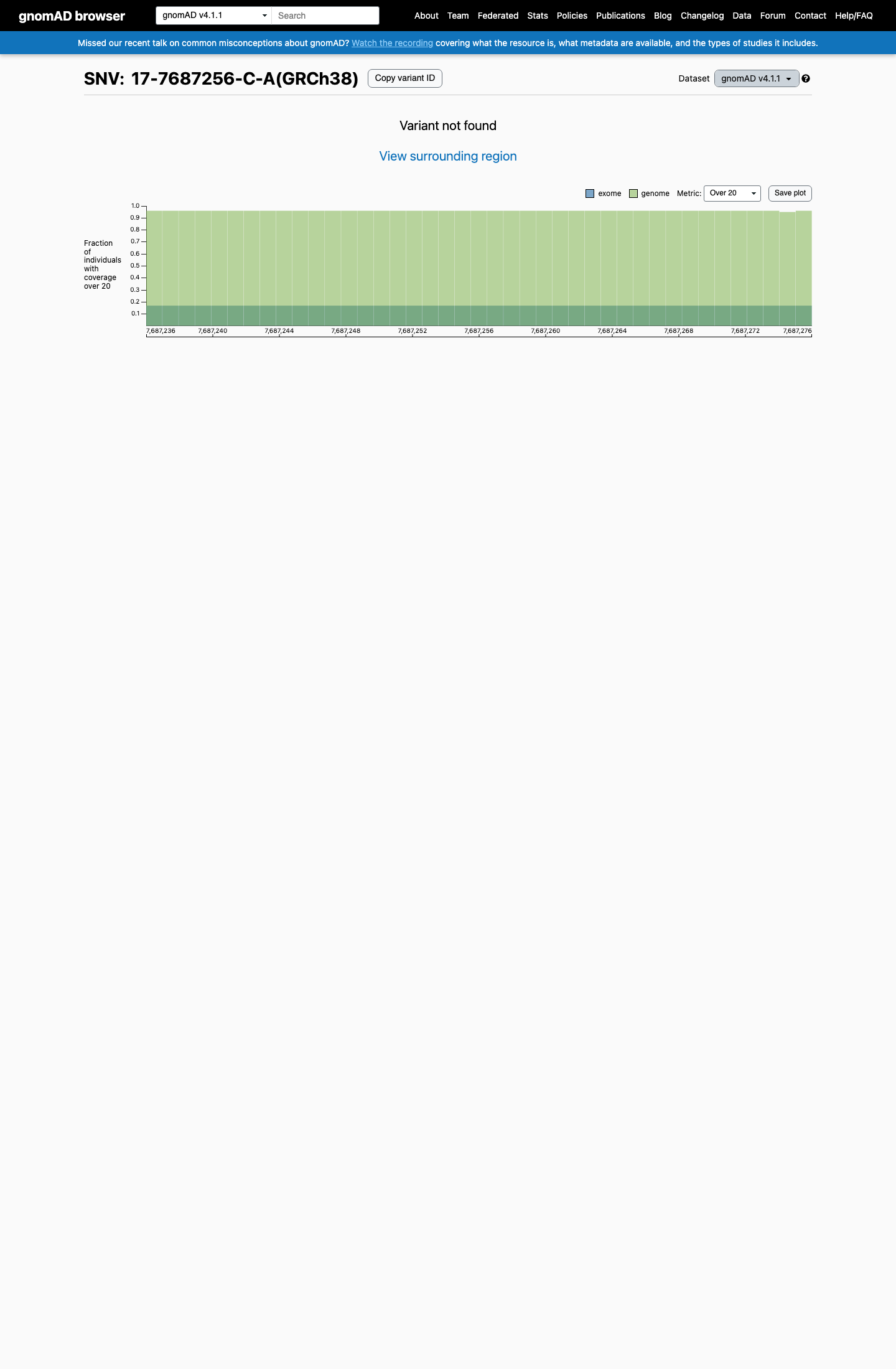
gnomAD v4.1
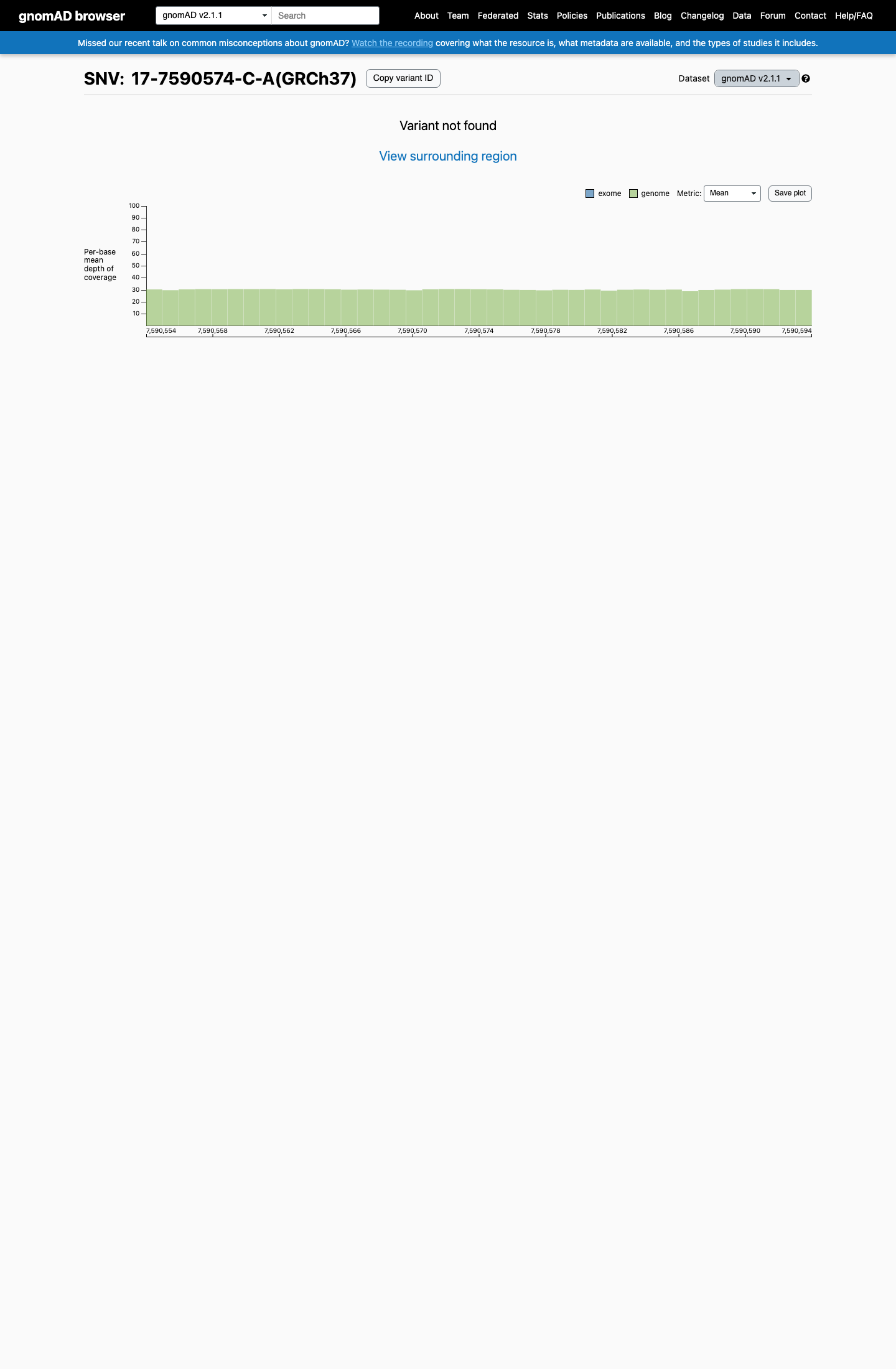
gnomAD v2.1
v4.1
Absent from gnomAD v4.1.
v2.1
Absent from gnomAD v2.1.
🇨🇦 CA
Absent from gnomAD-Canada v1.0.
Allele frequency by ancestry
three datasets · side by side
gnomAD v4.1
Absent
· 0 / ?
0 hom
0 hom
Not observed in any ancestry group.
gnomAD v2.1
Absent
· 0 / ?
0 hom
0 hom
Not observed in any ancestry group.
gnomAD Canada 🇨🇦
Absent
· 0 / ?
0 hom
0 hom
Not observed in any ancestry group.
In silico
SpliceAI predicts no significant splice impact for this variant (max delta score = 0.00).
Functional
No data
No calibrated functional assay or RNA evidence was identified for this variant.

COSMIC
Somatic evidence
COSMIC
This variant has not previously been reported in somatic cancers (COSMIC).
Hotspots
This variant does not lie in a statistically significant cancer hotspot.
Sources & reference links