NM_006218.3:c.2176G>A (p.Glu726Lys) is a missense variant in PIK3CA exon 14 that is absent from gnomAD population databases (PM2_Supporting).1 The variant was identified as a confirmed de novo event in one MCAP patient and as a postzygotic mosaic mutation in two additional unrelated MCAP patients, consistent with the known gain-of-function disease mechanism (PS2_Moderate).2 Four independently reported patients with megalencephaly-capillary malformation syndrome and brain overgrowth phenotypes carry this variant, with strong phenotype specificity for the disorder (PS4_Strong).3 This variant has been classified as Pathogenic by the ClinGen Brain Malformations Variant Curation Expert Panel after expert panel review (ClinVar Variation ID: 376476).4 Using the Brain Malformations VCEP Tavtigian point framework (Path Supporting +1, Path Moderate +2, Path Strong +4, Path Very Strong +8), the assigned criteria yield a total of 7 points, which falls within the Likely Pathogenic range (6 to 9 points). The expert panel classification of Pathogenic likely reflects additional criteria such as PM1 or PS3 applied with access to the VCEP functional assay spreadsheet and Table 2A phenotype point values.5
Final classification
Likely Pathogenic
PS2PS4PM2PP5
PIK3CA
c.2176G>A
p.Glu726Lys
This variant
NM_006218.3:c.2176G>A (p.Glu726Lys) is a missense variant in PIK3CA exon 14 that is absent from gnomAD population databases (PM2_Supporting).
Brain Malformations Specification Tavtigian point framework v1.1.0 point-based framework: PS2 moderate (+2) + PS4 strong (+4) + PM2 supporting (+1) + PP5 supporting (+1) = 8 points, which maps to Likely Pathogenic.
Classification rationale
PS2PS4PM2PP5
Likely Pathogenic
PIK3CA c.2176G>A
PS2 + PS4 + PM2 + PP5
→
Likely Pathogenic
5
cspec ↗final_classification_framework
LYFE Sciences is an AI system, and it can make mistakes. Criteria
may be applied incorrectly, sources may be misread, and a confident-looking
classification can still be wrong. Double-check every criterion and
its underlying evidence before relying on any call.
Gene diagram
· NM_006218.3 · variants mapped to exon structure
PIK3CA
NM_006218.3
Fetching transcript structure from UCSC…
Applied criteria · 4 applied · 11 assessed
MetEvidence satisfies this criterion.
Not metEvaluated against available evidence; threshold not reached.
Not assessedApplies in principle, but no evidence was found to evaluate it.
N/ADoesn't apply to this variant type.
Applied · 4
Strength
Supporting
Moderate
Strong
Very strong
PS2
moderate
Pathogenic
The variant was identified as de novo in one MCAP patient (162-001P) with confirmed maternity and paternity, satisfying PS2_Moderate per VCEP Criteria 1. Postzygotic mosaicism was demonstrated in two additional unrelated MCAP patients (LR08-261 at 12% in blood and 41% in buccal swab; LR06-333 at 14% in LCL), fulfilling the mosaic nature expected for this disorder.
162-001P: de novo c.2176G>A (p.Glu726Lys) with confirmed parentage in MCAP patient (PMID:22729224 Table 1)LR08-261: mosaic12% mutant allele in blood
PS4
strong
review
Pathogenic
The variant has been observed in four independently reported MCAP patients with megalencephaly and brain malformations, all absent from population controls (PM2 met). Multiple cases with a highly specific phenotype (megalencephaly-capillary malformation with brain overgrowth) support PS4_Strong under the Brain Malformations VCEP point-based framework.
3 MCAP patients in PMID:22729224: 162-001PLR08-261LR06-333 all with megalencephaly
PM2
supporting
Pathogenic
The variant is absent from gnomAD v2.1, v4.1, and gnomAD-Canada, meeting the VCEP PM2_Supporting threshold (absent/rare in controls, ≤1 individual).
Absent from gnomAD v2.1Absent from gnomAD v4.1Absent from gnomAD-Canada v1.0
Assessed · not applied
· 9 not met · 2 not assessed
Pathogenic
PS1
No alternate nucleotide change producing the same p.Glu726Lys amino acid substitution has been identified as a previously established pathogenic variant.
PS3
No variant-specific functional assay data for NM_006218.3:c.2176G>A (p.Glu726Lys) meeting VCEP BMVCEP quality criteria was identified.
PM1
Residue Glu726 lies outside both PIK3CA critical functional domains specified in VCEP Table 4 (kinase domain AA 322-483 and kinase domain AA 797-1068).
PM5
No pathogenic missense variant at residue Glu726, other than the queried E726K, was identified in ClinVar or the reviewed literature.
PP2
The VCEP specifies PP2_Supporting for PIK3CA when the missense z-score exceeds 3.09.
Benign
BA1
The variant is absent from gnomAD.
BS1
The variant is absent from gnomAD.
BS2
The variant is absent from gnomAD with zero homozygotes.
BS3
No well-established in vitro or in vivo functional studies demonstrate a benign effect for this variant.
BP2
No evidence was identified that this variant has been observed in cis or trans with a known pathogenic variant in PIK3CA.
BP5
No evidence was identified that any affected individual carrying this variant has an alternate molecular basis for disease.
N/A · 10
PVS1 · PM6 · PP1 · PP3 · PP4 · BS4 · BP1 · BP4 · BP6 · BP7
Research & evidence
Population frequency · supports pathogenic
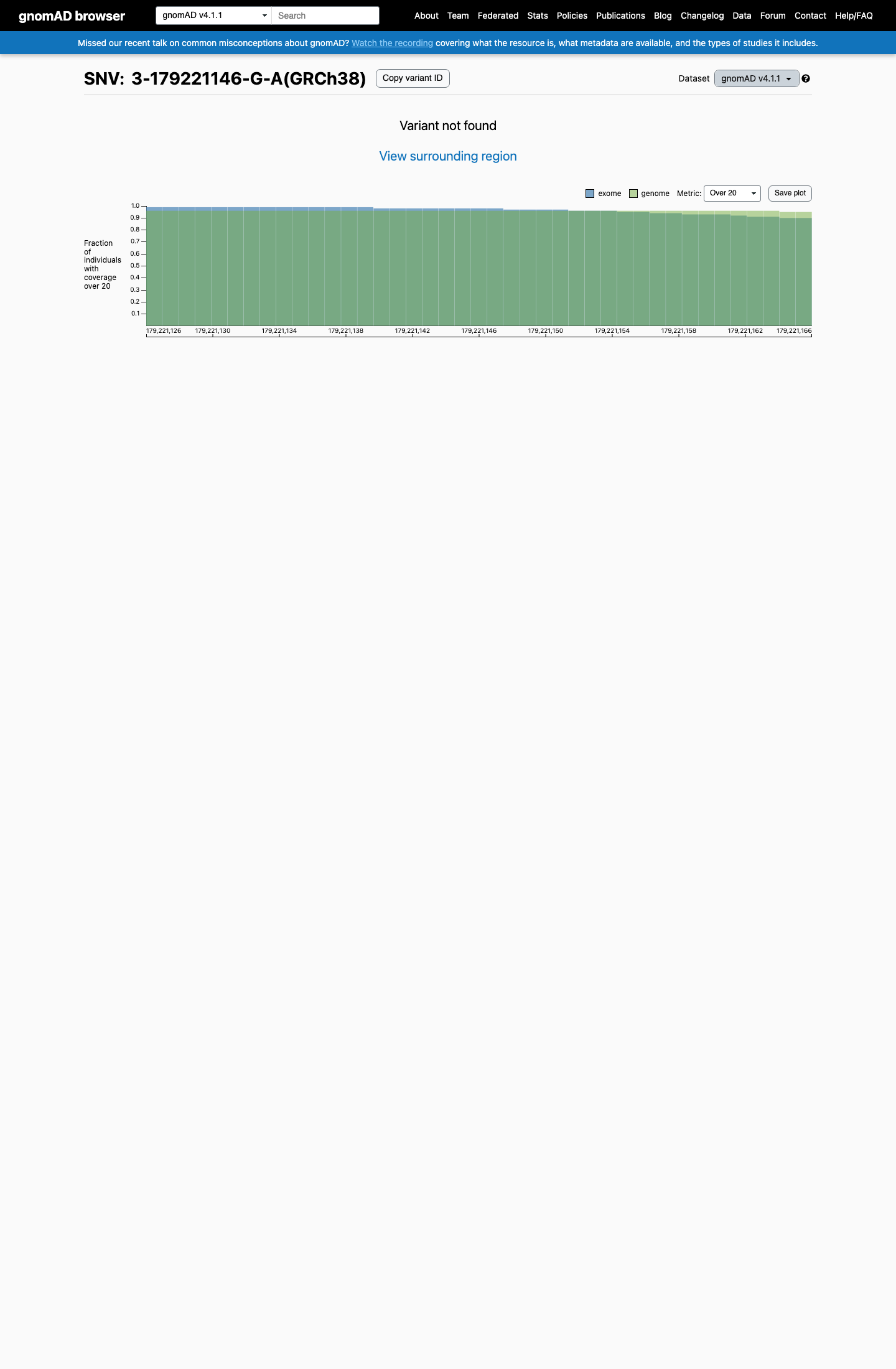
gnomAD v4.1
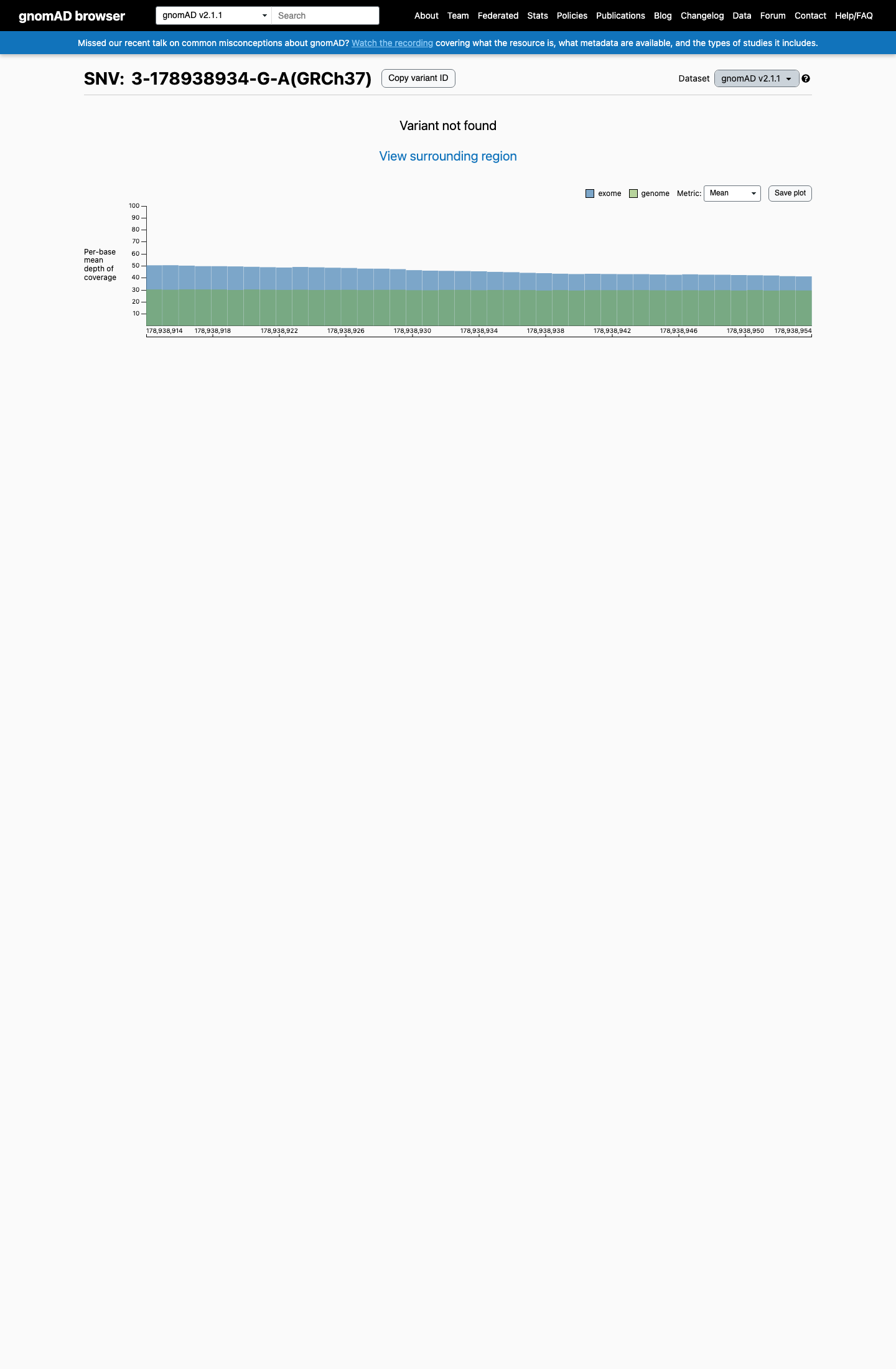
gnomAD v2.1
v4.1
Absent from gnomAD v4.1.
v2.1
Absent from gnomAD v2.1.
🇨🇦 CA
Absent from gnomAD-Canada v1.0.
Allele frequency by ancestry
three datasets · side by side
gnomAD v4.1
Absent
· 0 / ?
0 hom
0 hom
Not observed in any ancestry group.
gnomAD v2.1
Absent
· 0 / ?
0 hom
0 hom
Not observed in any ancestry group.
gnomAD Canada 🇨🇦
Absent
· 0 / ?
0 hom
0 hom
Not observed in any ancestry group.

ClinVar
This variant has been reported in ClinVar as Pathogenic (8 clinical laboratories) and as Pathogenic by ClinGen Brain Malformations Variant Curation Expert Panel (expert panel). (ClinVarID = 376476)

In silico
SpliceAI predicts no significant splice impact for this variant (max delta score = 0.02). REVEL score = 0.442. BayesDel score = 0.266518.
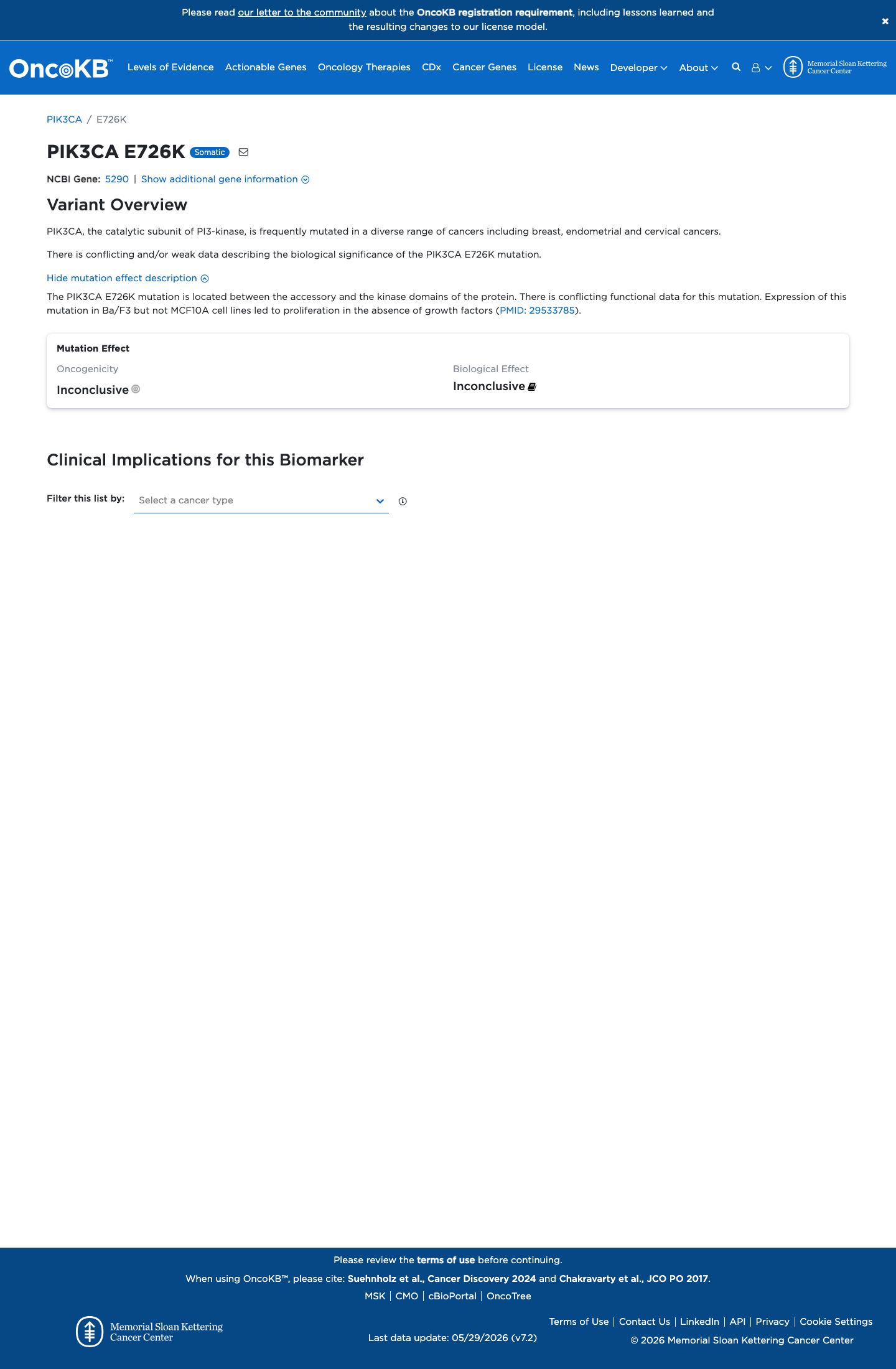
Functional
Inconclusive
OncoKB identified variant-specific curated literature and context relevant to functional review; biological-effect context: Inconclusive; curated oncogenicity label: Inconclusive.
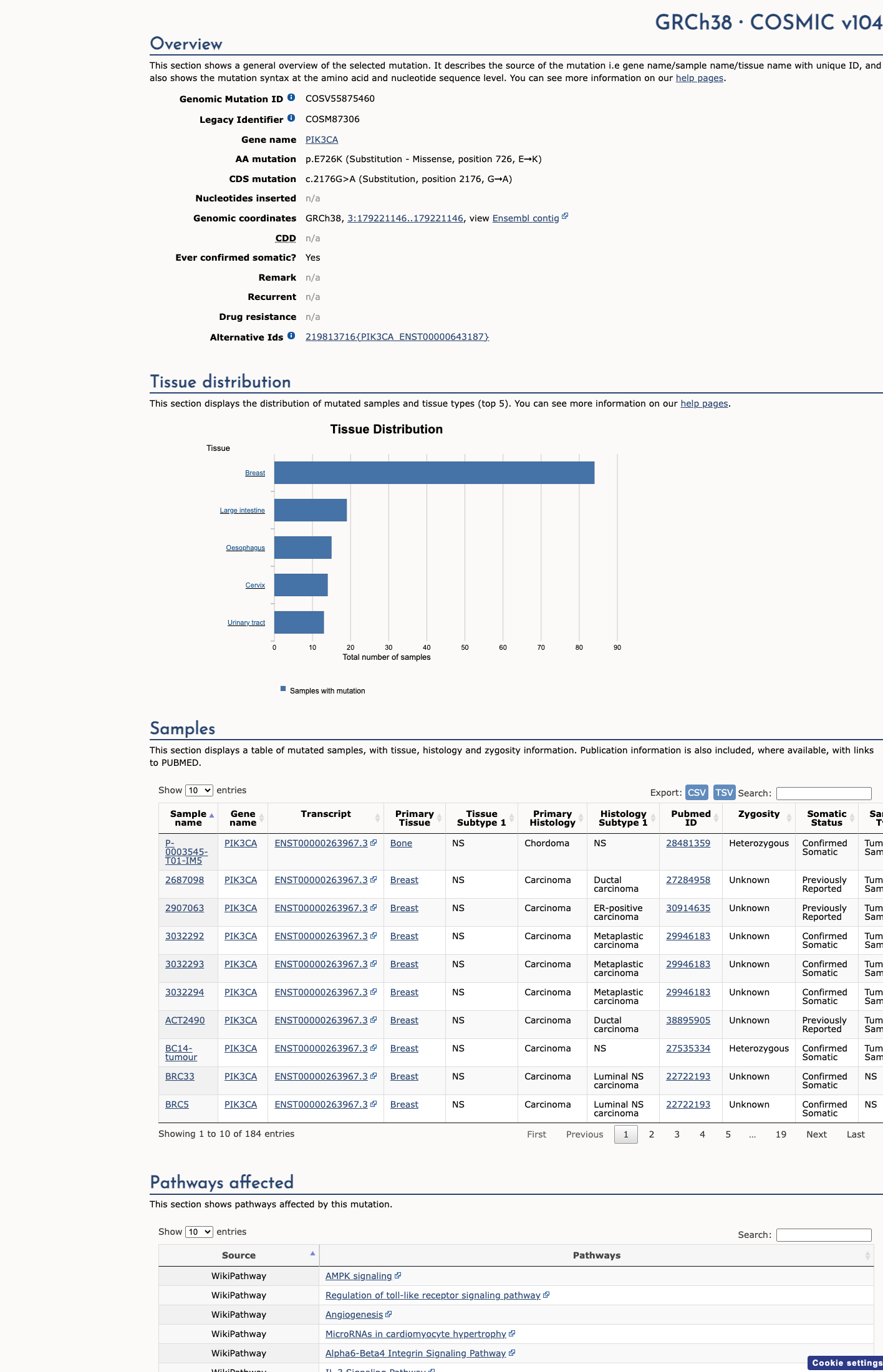
COSMIC

Cancer hotspots
Somatic evidence
Hotspot
COSMIC
This variant lies in a statistically significant hotspot. This variant has previously been reported in somatic cancers (COSMIC; COSV55875460, n = 167 times).
Hotspots
This variant lies in a statistically significant hotspot.
Literature · how each cited paper was used
2papers cited
Each card is an audit: what was searched, what was found, whether it names the variant, which criteria it fed, and why. 8 further PMIDs triaged but not cited — see Sources & references.
De novo germline and postzygotic mutations in AKT3, PIK3R2 and PIK3CA cause a spectrum of related megalencephaly syndromes.
Searched
c.2176G>Ap.Glu726LysE726K2176
Found
NM_006218.3:c.2176G>A (p.Glu726Lys) identified as a de novo or postzygotic mosaic mutation in three unrelated MCAP patients (162-001P, LR08-261, LR06-333). Deep sequencing confirmed mosaicism with mutant allele fractions ranging from 12% to 41% across tissues. Functional assays on lymphoblastoid lines from other PIK3CA mutation carriers demonstrated increased PIP3 levels and elevated PI3K-mTOR signaling, consistent with gain of function.
Variant
✓ Names this variant — characterised directly
Applied to
→PS2
met
→PS4
met
Why
Variant directly reported as de novo and mosaic in MCAP patients; provides strong evidence for PS2_Moderate and case-level evidence for PS4.
MCAP 162-001P PIK3CA chr3:178938934 G>A c.2176G>A p.Glu726Lys De novo
Location Table 1 (mutation list, 3 occurrences of c.2176G>A); Table 2 (deep sequencing confirmation of mosaicism for LR08-261 and LR06-333); Results para 2 · Context Lymphoblastoid cell lines from MCAP patients with other PIK3CA mutations; PIP3 immunostaining, S6/4E-BP1 phosphorylation western blots; PI3K inhibitor PI-103 treatment · full text
In vitro efficacy of ARQ 092, an allosteric AKT inhibitor, on primary fibroblast cells derived from patients with PIK3CA-related overgrowth spectrum (PROS).
Searched
c.2176G>Ap.Glu726LysE726K2176
Found
NM_006218.3:c.2176G>A identified in Patient 3 (MCAP), a 17-year-old boy with focal hemimegalencephaly, perisylvian polymicrogyria, capillary malformations, and refractory seizures. Mutation present at 37% allele frequency in cultured primary fibroblasts from affected skin. The paper focused functional characterization on Patient 1 (H1047R) and did not report variant-specific functional data for E726K.
Variant
✓ Names this variant — characterised directly
Applied to
→PS4
met
Why
Variant directly identified in a fourth independent MCAP patient, contributing to PS4 case count. No variant-specific functional data reported; not cited for PS3.
3 MCAP c.2176G > A p.Glu726Gly 37 37 N/A N/A
Location Table 1 (Patient 3: MCAP, c.2176G>A, p.Glu726Gly [sic - likely typo for Lys], 37% in biopsy/cells); Subjects and Methods, Patient 3 description · Context Primary fibroblasts from affected skin biopsies; targeted deep sequencing of 21 PI3K/AKT/mTOR pathway genes; AKT inhibitor ARQ 092 treatment; WST-1 proliferation assays; western blot for pAKT/pAKT1S1/pRPS6 · full text
Sources & reference links
9Sources
Triaged references · 8 PMIDs not cited in assessment
24497998 ↗
Megalencephaly syndromes: exome pipeline strategies for detecting low-level mosaic mutations.
CLINVAR
25626707 ↗
Whole-genome sequencing in newborn screening? A statement on the continued importance of targeted approaches in newborn screening programmes.
CLINVAR
25730230 ↗
Expanded carrier screening in reproductive medicine-points to consider: a joint statement of the American College of Medical Genetics and Genomics, American College of Obstetricians and Gynecologists, National Society of Genetic Counselors, Perinatal Quality Foundation, and Society for Maternal-Fetal Medicine.
CLINVAR
25741868 ↗
Standards and guidelines for the interpretation of sequence variants: a joint consensus recommendation of the American College of Medical Genetics and Genomics and the Association for Molecular Pathology.
CLINVAR
23037933 ↗
Including the initial newborn screening bloodspot collection device serial number on birth certificates: basis and recommendations from the Secretary of Health and Human Services' Advisory Committee on Heritable Disorders in Newborns and Children.
CLINVAR
24394680 ↗
Parental permission for pilot newborn screening research: guidelines from the NBSTRN.
CLINVAR