NM_000264.5:c.3141T>G is a synonymous variant in PTCH1 present in gnomAD at an allele frequency of 2.33% with 307 homozygotes in v2.1, meeting BA1 (stand-alone benign) criterion.1 The variant is classified as Benign in ClinVar by 12 clinical laboratories (Variation ID 255681), meeting BP6 (supporting benign).2 As a synonymous variant with no predicted splice impact (SpliceAI max delta = 0.06), BP7 (supporting benign) is met.3 Observation of 307 homozygotes in gnomAD v2.1 meets BS2 (strong benign); homozygous pathogenic PTCH1 variants are incompatible with viability in an autosomal dominant cancer predisposition syndrome.4 Per the generic ACMG/AMP 2015 classification rules, a single BA1 (stand-alone benign) criterion is sufficient for a Benign classification, independent of other criteria.5 The sole publication identifying this variant (Musani et al., 2013, PMID:23313819) described it as a rare polymorphism found in 1/28 ovarian carcinoma cases with no functional characterization, and concluded its frequency was too low to draw conclusions about a role in ovarian tumor development.6
PTCH1
Final classification
Benign
PTCH1 c.3141T>G · p.Leu1047=
PTCH1
NM_000264.5:c.3141T>G is a synonymous variant in PTCH1 present in gnomAD at an allele frequency of 2.33% with 307 homozygotes in v2.1, meeting BA1 (stand-alone benign) criterion.
gene-specific framework lacked a usable explicit final combination framework, so generic ACMG/AMP 2015 final-combination rules were applied as fallback; applied criteria: BA1 stand-alone benign, BS1 strong benign, BS2 strong benign, BP4 supporting benign, BP6 supporting benign, BP7 supporting benign; combination = 1 stand-alone benign + 2 strong benign + 3 supporting benign, which maps to Benign.
Classification rationale
BA1BS1BS2BP4BP6BP7
Benign
PTCH1 c.3141T>G
BA1 + BS1 + BS2 + BP4 + BP6 + BP7
→
Benign
5
generic_acmg_combination_rules
Gene diagram
· NM_000264.5 · variants mapped to exon structure
PTCH1
NM_000264.5
Fetching transcript structure from UCSC…
Applied criteria · 6 applied · 14 assessed
Applied · 6
Strength
Supporting
Moderate
Strong
Very strong
✓
BA1
stand-alone
Benign
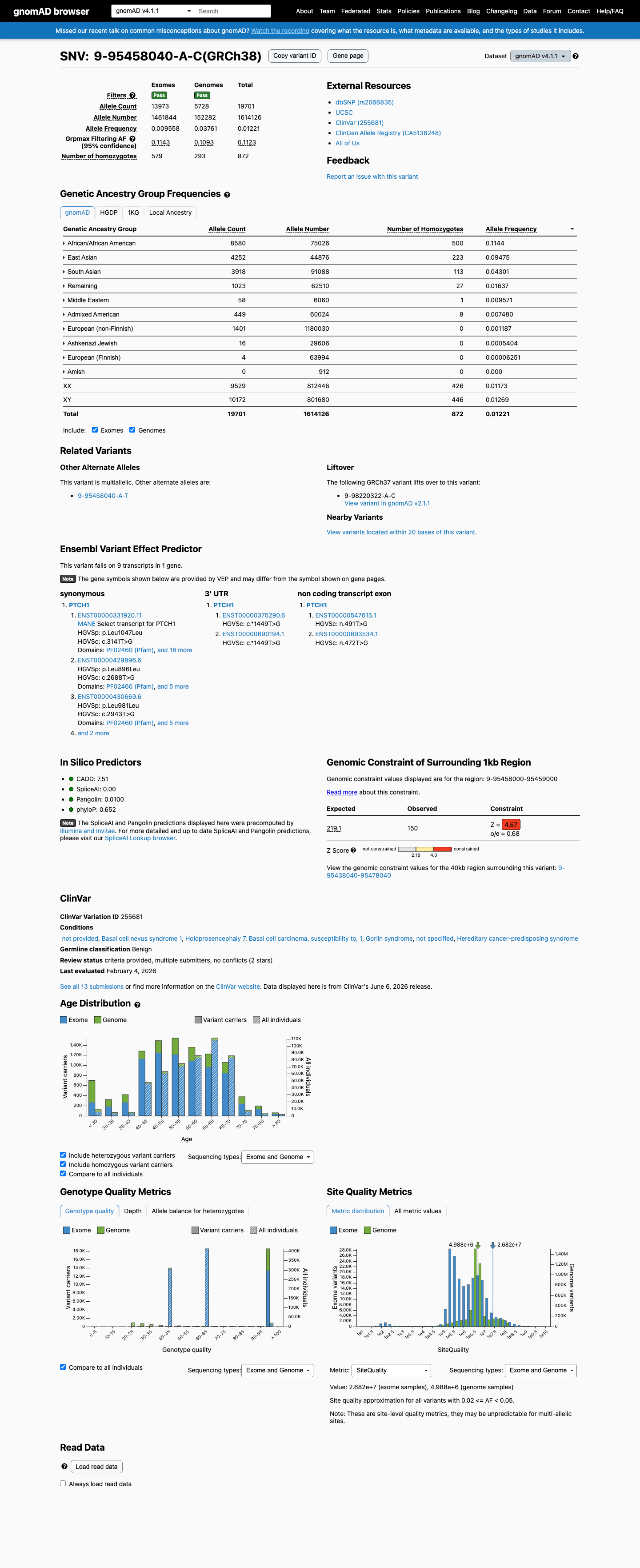
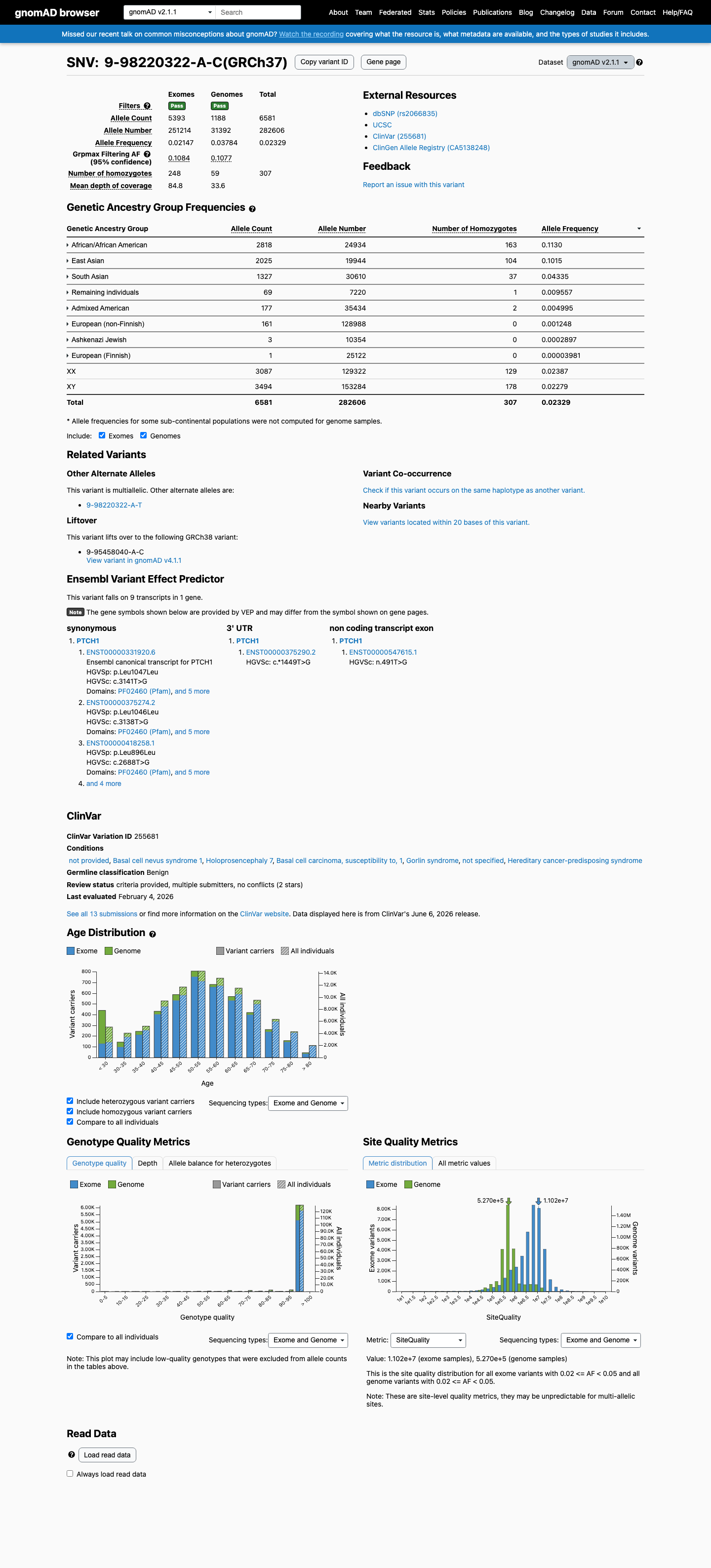
The variant is present in gnomAD v2.1 at an allele frequency of 2.33% (grpmax filtering AF=10.84% in the African/African American population), far exceeding the BA1 threshold of >1%. A total of 307 homozygotes are observed in gnomAD v2.1. In gnomAD v4.1, AF=1.22% with 872 homozygotes. For an autosomal dominant disorder (Gorlin syndrome) with high penetrance, this frequency is incompatible with pathogenicity.
gnomAD v2.1: AF=2.33% (6581/282606 alleles)307 homozygotesgrpmax FAF=0.1084
✓
BS1
strong
Benign
The variant allele frequency of 2.33% in gnomAD v2.1 exceeds the BS1 threshold of >0.3% for a dominantly inherited disorder. This frequency alone is sufficient strong evidence for a benign classification, though it is subsumed by the stand-alone BA1 criterion.
gnomAD v2.1: AF=2.33%far exceeding 0.3% BS1 thresholdgnomAD v4.1: AF=1.22%
✓
BS2
strong
Benign
The variant is observed in the homozygous state in 307 individuals in gnomAD v2.1 and 872 in gnomAD v4.1. For PTCH1, which causes Gorlin syndrome (an autosomal dominant disorder with high penetrance and significant morbidity), observation of homozygosity in healthy population databases is incompatible with pathogenicity. A homozygous pathogenic PTCH1 variant would be expected to be lethal or cause severe disease.
gnomAD v2.1: 307 homozygotes observedgnomAD v4.1: 872 homozygotes observedGorlin syndrome is autosomal dominant with high penetrance
✓
BP4
supporting
Benign
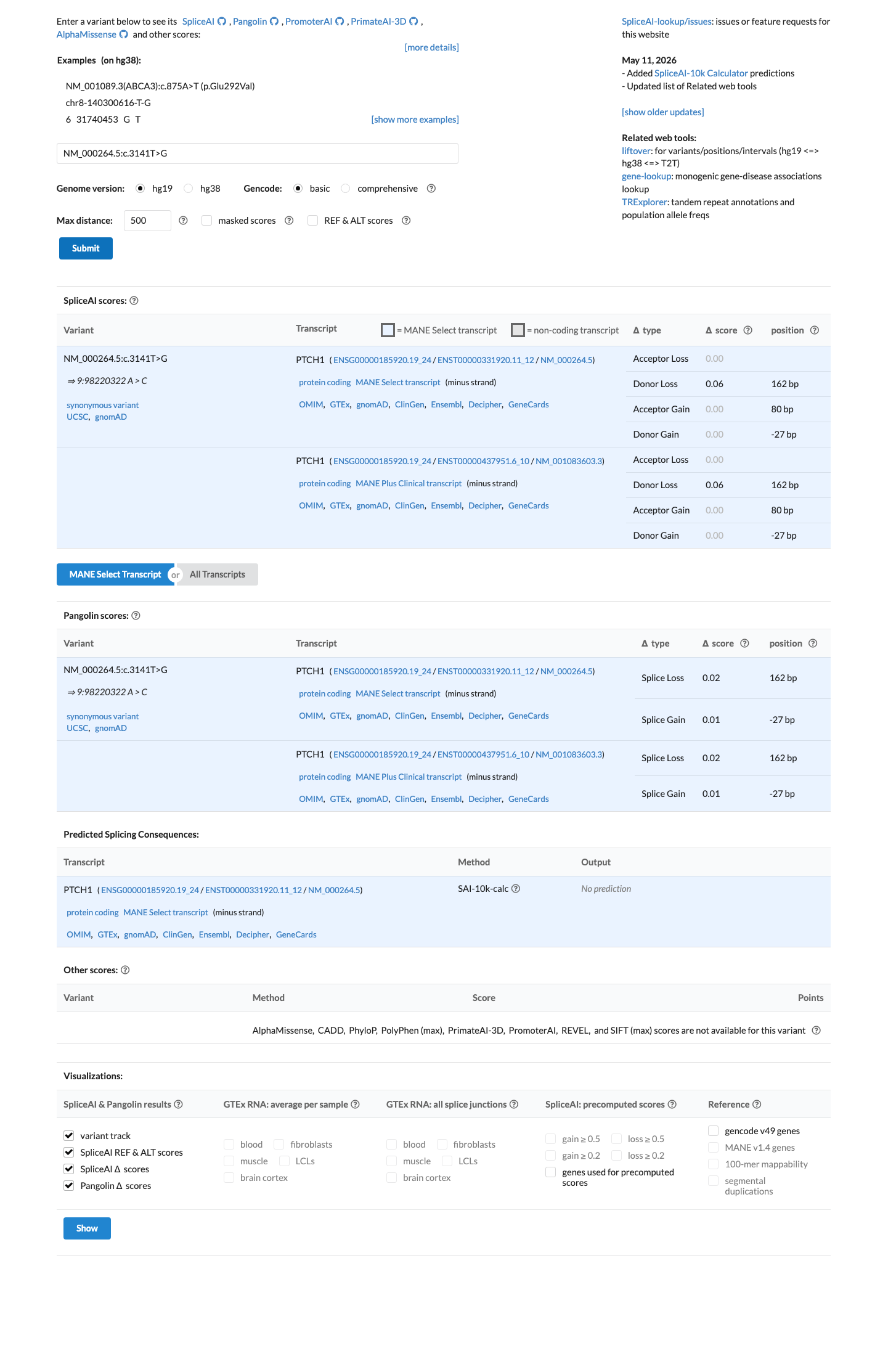
SpliceAI predicts no significant splicing impact (max delta score = 0.06, well below the clinically significant threshold of 0.1). Multiple in silico splicing prediction tools cited in the ClinVar submission concur that the variant does not affect normal splicing. This supports a benign interpretation for this synonymous variant.
SpliceAI max delta = 0.06 (no predicted splicing impact)LabCorp ClinVar submission: 5/5 in silico splicing programs predict no effect
✓
BP6
supporting
Benign
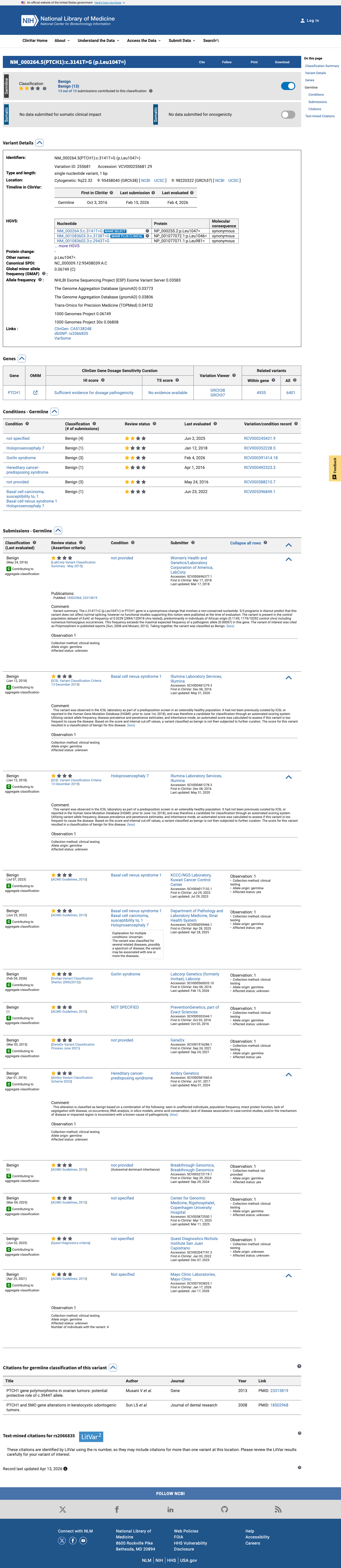
This variant is classified as Benign in ClinVar by 12 clinical diagnostic laboratories (Variation ID 255681), with criteria provided. Multiple submitters independently reached a benign classification, consistent with a reputable source classification for BP6.
ClinVar Variation ID 255681: Benign (12 clinical laboratories)Review status: criteria providedsingle submitter
✓
BP7
supporting
Benign
NM_000264.5:c.3141T>G is a synonymous variant (p.Leu1047=). SpliceAI predicts no splicing impact (max delta = 0.06, well below 0.1 threshold). The high population frequency (AF=2.33%) is inconsistent with evolutionary conservation at this position. These findings satisfy BP7 criteria for a synonymous variant with no predicted impact on splicing or protein function.
Synonymous variant p.Leu1047= with no amino acid changeSpliceAI max delta = 0.06 (no predicted splicing impact)High population frequency (AF=2.33%) indicates lack of evolutionary constraint
Assessed · not applied
Pathogenic
PS2
No de novo data are available for this variant.
PS3
No well-established functional studies demonstrate a damaging effect for NM_000264.5:c.3141T>G.
PS4
The variant is common in the general population (gnomAD v2.1 AF=2.33%, 307 homozygotes), making it statistically incompatible with significant enrichment in affected individuals.
PM1
The variant does not lie in a statistically significant mutational hot spot in PTCH1.
PM2
The variant is present in gnomAD at high frequency (AF=2.33% in v2.1, 307 homozygotes), far exceeding the PM2 absence threshold of <0.1%.
PM6
No de novo data are available for this variant.
PP1
No cosegregation data are available for this variant.
PP3
SpliceAI predicts no significant splicing impact (max delta score = 0.06).
PP4
No data on the patient's phenotype or family history are available.
PP5
ClinVar classifies this variant as Benign by 12 clinical laboratories, not pathogenic.
Benign
BS3
No well-established functional studies directly demonstrate that NM_000264.5:c.3141T>G has no damaging effect on protein function or splicing.
BS4
No segregation data are available for this variant.
BP2
No data are available regarding observation of this variant in trans with a known pathogenic PTCH1 variant.
BP5
No data are available regarding an alternate molecular basis for disease in individuals carrying this variant.
N/A · 5
PVS1 · PS1 · PM5 · PP2 · BP1
Research & evidence
Population frequency · supports benign
gnomAD v4.1
gnomAD v2.1
v4.1
This variant is present in gnomAD v4.1 (AF= 0.0122054; MAF= 1.22054%, 19701/1614126 alleles, homozygotes = 872) and has highest observed frequency in the African/African American population (AF= 0.11436; MAF= 11.43604%, 8580/75026 alleles, homozygotes = 500); grpmax FAF= 0.112337.
v2.1
This variant is present in gnomAD v2.1 (AF= 0.0232868; MAF= 2.32868%, 6581/282606 alleles, homozygotes = 307) and has highest observed frequency in the African/African American population (AF= 0.113018; MAF= 11.30184%, 2818/24934 alleles, homozygotes = 163); grpmax FAF= 0.108406.
🇨🇦 CA
This variant is present in gnomAD-Canada v1.0 (AF= 0.018894559669888154, 348/18418 alleles, homozygotes = 10).
Allele frequency by ancestry
three datasets · side by side
gnomAD v4.1
1.2%
· 19701 / 1,614,126
872 hom · FAF 11%
872 hom · FAF 11%
African/African American 8580 / 75,026 |
11% 500 hom |
East Asian 4252 / 44,876 |
9.5% 223 hom |
South Asian 3918 / 91,088 |
4.3% 113 hom |
Remaining individuals 1023 / 62,510 |
1.6% 27 hom |
Middle Eastern 58 / 6,060 |
0.96% 1 hom |
Admixed American 449 / 60,024 |
0.75% 8 hom |
European (non-Finnish) 1401 / 1,180,030 |
0.12% |
Ashkenazi Jewish 16 / 29,606 |
0.054% |
European (Finnish) 4 / 63,994 |
0.0063% |
+ 1 not observed (Amish)
gnomAD v2.1
2.3%
· 6581 / 282,606
307 hom · FAF 11%
307 hom · FAF 11%
African/African American 2818 / 24,934 |
11% 163 hom |
East Asian 2025 / 19,944 |
10% 104 hom |
South Asian 1327 / 30,610 |
4.3% 37 hom |
Remaining individuals 69 / 7,220 |
0.96% 1 hom |
Admixed American 177 / 35,434 |
0.5% 2 hom |
European (non-Finnish) 161 / 128,988 |
0.12% |
Ashkenazi Jewish 3 / 10,354 |
0.029% |
European (Finnish) 1 / 25,122 |
0.004% |
gnomAD Canada 🇨🇦
1.9%
· 348 / 18,418
10 hom · FAF 9.1%
10 hom · FAF 9.1%
indel · split
African/African American 109 / 1,020 |
11% 3 hom |
East Asian 131 / 1,338 |
9.8% 7 hom |
South Asian 61 / 1,362 |
4.5% |
Middle Eastern 3 / 144 |
2.1% |
Remaining individuals 14 / 1,138 |
1.2% |
Latino/Admixed American 7 / 838 |
0.84% |
European (non-Finnish) 23 / 11,738 |
0.2% |
+ 2 not observed (Ashkenazi Jewish, European (Finnish))
ClinVar
This variant has been reported in ClinVar as Benign (11 clinical laboratories) and as benign (1 clinical laboratory). (ClinVarID = 255681)
In silico
SpliceAI predicts no significant splice impact for this variant (max delta score = 0.06).
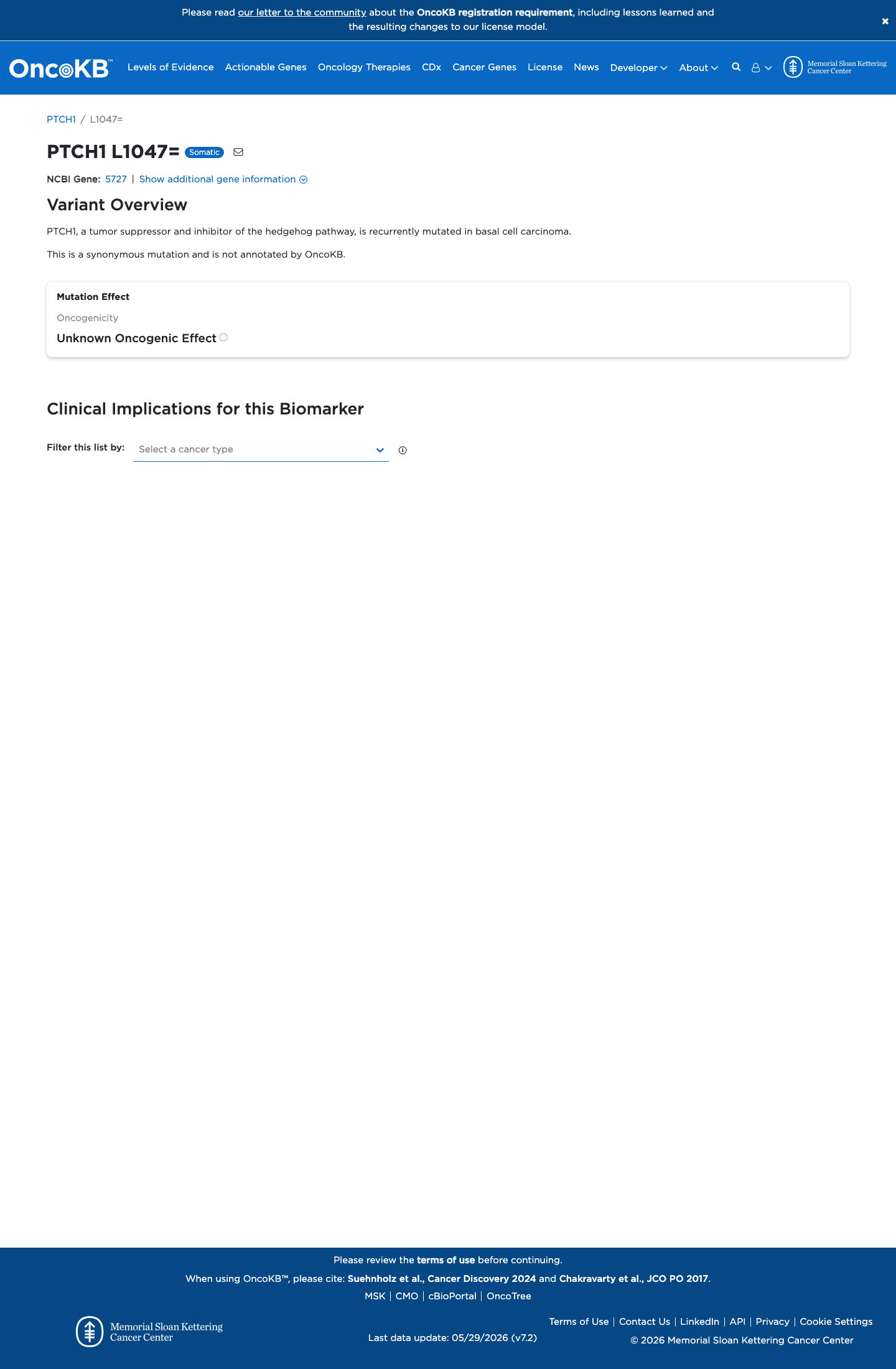
Functional
Unknown Oncogenic Effect
OncoKB identified curated literature and non-variant-specific oncogenicity context for review; listed oncogenicity label: Unknown Oncogenic Effect.
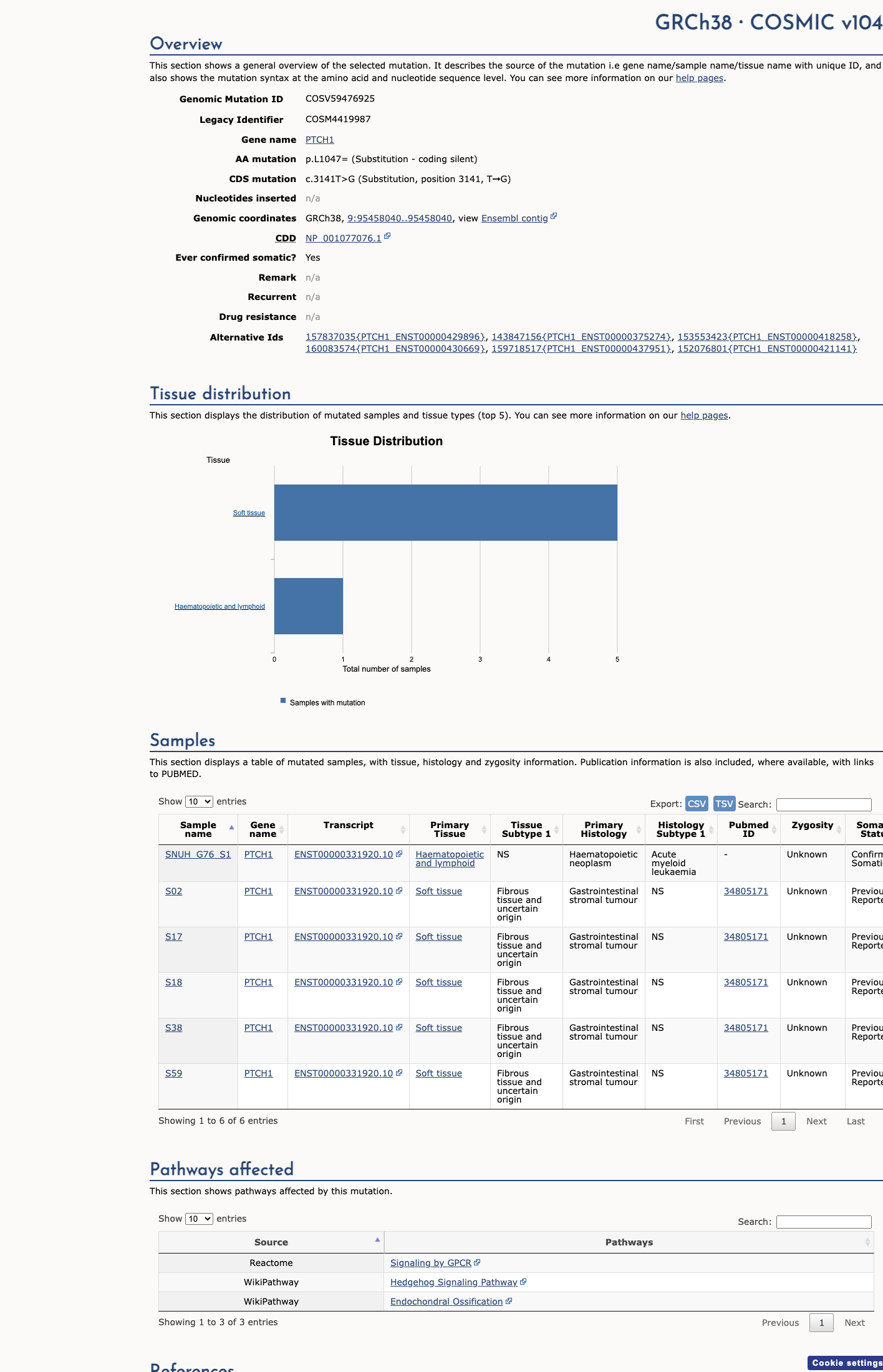
COSMIC

Cancer hotspots
Somatic evidence
Not in COSMIC / hotspots
COSMIC
This variant does not lie in a statistically significant hotspot. This variant has previously been reported in somatic cancers (COSMIC; COSV59476925, n = 6 times).
Hotspots
This variant does not lie in a statistically significant hotspot.
Sources & reference links
Triaged references · 9 PMIDs not cited in assessment
25741868 ↗
Standards and guidelines for the interpretation of sequence variants: a joint consensus recommendation of the American College of Medical Genetics and Genomics and the Association for Molecular Pathology.
CLINVAR
26467025 ↗
A Standardized DNA Variant Scoring System for Pathogenicity Assessments in Mendelian Disorders.
CLINVAR
15604628 ↗
Genetic cancer risk assessment and counseling: recommendations of the national society of genetic counselors.
CLINVAR
23313819 ↗
PTCH1 gene polymorphisms in ovarian tumors: potential protective role of c.3944T allele.
CLINVAR
25394175 ↗
A practice guideline from the American College of Medical Genetics and Genomics and the National Society of Genetic Counselors: referral indications for cancer predisposition assessment.
CLINVAR
26389258 ↗
Cancer Genetics Risk Assessment and Counseling (PDQ®): Health Professional Version.
CLINVAR
28492532 ↗
Sherloc: a comprehensive refinement of the ACMG-AMP variant classification criteria.
CLINVAR