NM_015450.3:c.1884A>C is a synonymous variant (p.Thr628=) in POT1 classified as Benign based on the ACMG/AMP 2015 guidelines.1 This variant is present at high frequency in population databases: gnomAD v2.1 reports an allele frequency of 1.07% (2980/279114 alleles, 157 homozygotes), with the highest subpopulation frequency of 11.1% in the African/African American population (grpmax FAF 10.7%); gnomAD v4.1 reports an allele frequency of 0.59% (9370/1588362 alleles, 477 homozygotes), with grpmax FAF of 11.0%. This frequency meets the stand-alone benign criterion BA1.2 ClinVar classifies this variant as Benign based on consensus from 7 clinical laboratories (ClinVar variation ID: 475068), providing supporting evidence for a benign classification (BP6).3 SpliceAI predicts no impact on splicing (max delta score = 0.00), and the high population frequency indicates the nucleotide is not conserved, satisfying BP7 for this synonymous variant.4 No variant-specific functional studies, de novo observations, segregation data, or case-control evidence were identified for this variant. The ClinVar-cited publications (PMID:25741868, PMID:26467025, PMID:28492532) are methodology and guideline papers that do not mention NM_015450.3:c.1884A>C.
POT1
Final classification
Benign
POT1 c.1884A>C · p.Thr628=
POT1
NM_015450.3:c.1884A>C is a synonymous variant (p.Thr628=) in POT1 classified as Benign based on the ACMG/AMP 2015 guidelines.
gene-specific framework lacked a usable explicit final combination framework, so generic ACMG/AMP 2015 final-combination rules were applied as fallback; applied criteria: BA1 stand-alone benign, BP6 supporting benign, BP7 supporting benign; combination = 1 stand-alone benign + 2 supporting benign, which maps to Benign.
Classification rationale
BA1BP6BP7
Benign
POT1 c.1884A>C
BA1 + BP6 + BP7
→
Benign
1
generic_acmg_combination_rules
Gene diagram
· NM_015450.3 · variants mapped to exon structure
POT1
NM_015450.3
Fetching transcript structure from UCSC…
Applied criteria · 3 applied · 17 assessed
Applied · 3
Strength
Supporting
Moderate
Strong
Very strong
✓
BA1
stand-alone
Benign
NM_015450.3:c.1884A>C is present at an allele frequency exceeding 1% in gnomAD. In gnomAD v2.1, the total AF is 1.07% (2980/279114 alleles) with 157 homozygotes observed. The grpmax filtering AF is 10.72% in the African/African American population. In gnomAD v4.1, the total AF is 0.59% with 477 homozygotes, and the grpmax FAF is 11.04%. The total AF in v2.1 exceeds the 1% BA1 threshold and is far above the ACMG/AMP 2015 threshold of 5% in the highest subpopulation. This frequency is incompatible with a rare Mendelian disease-causing variant.
gnomAD v2.1 total AF=1.07% (2980/279114 alleles157 homozygotes)grpmax FAF=10.72% (African/African American). gnomAD v4.1 total AF=0.59% (9370/1588362 alleles
✓
BP6
supporting
Benign
NM_015450.3:c.1884A>C is classified as Benign in ClinVar by 7 clinical laboratories (6 reporting 'Benign', 1 reporting 'benign'). Although individual submissions have review status 'criteria provided, single submitter', the concordance across multiple independent clinical laboratories provides supporting evidence for a benign classification.
ClinVar classifies as Benign by 7 clinical laboratories (GeneDxAmbry GeneticsRigshospitalet
✓
BP7
supporting
Benign
NM_015450.3:c.1884A>C is a synonymous variant (p.Thr628=). SpliceAI predicts no impact on splicing (max delta score = 0.00). The nucleotide is not highly conserved, as evidenced by the high population frequency (>10% in the African/African American population). BP7 criteria are satisfied: synonymous variant with no predicted splice impact at a non-conserved nucleotide.
Synonymous variant p.(Thr628=)SpliceAI max delta 0.00 (no predicted donor/acceptor gain or loss)gnomAD grpmax FAF 10.7-11.0% indicates the nucleotide is not highly conserved.
Assessed · not applied
Pathogenic
PS2
No de novo observation data are available for NM_015450.3:c.1884A>C.
PS3
No variant-specific functional studies have been performed for NM_015450.3:c.1884A>C.
PS4
No case-control or prevalence data demonstrate a statistically significant enrichment of NM_015450.3:c.1884A>C in affected individuals compared to controls.
PM1
NM_015450.3:c.1884A>C is not located in a statistically significant mutational hotspot or a critical functional domain where benign variation is absent.
PM2
NM_015450.3:c.1884A>C is common in population databases.
PM6
No de novo observation data are available for NM_015450.3:c.1884A>C.
PP1
No co-segregation data are available for NM_015450.3:c.1884A>C.
PP3
In silico tools do not predict a damaging effect for NM_015450.3:c.1884A>C.
PP4
No patient phenotype or clinical syndrome specificity data are available for NM_015450.3:c.1884A>C.
PP5
ClinVar classifies NM_015450.3:c.1884A>C as Benign, not Pathogenic.
Benign
BS1
BS1 is superseded by BA1, which provides a stronger level of evidence (stand-alone benign vs.
BS2
BS2 requires observation in a healthy adult individual for a disorder with full penetrance expected at an early age.
BS3
No variant-specific functional studies have been performed for NM_015450.3:c.1884A>C demonstrating no damaging effect on protein function or splicing.
BS4
No data on lack of segregation are available for NM_015450.3:c.1884A>C.
BP2
No data are available regarding co-occurrence of NM_015450.3:c.1884A>C in trans with a pathogenic POT1 variant (for a dominant disorder) or in cis with a pathogenic variant.
BP4
BP4 is not applied because BP7 is the more specific criterion for synonymous variants.
BP5
No evidence is available that NM_015450.3:c.1884A>C is found in a case with an alternate molecular basis for disease.
N/A · 5
PVS1 · PS1 · PM5 · PP2 · BP1
Research & evidence
Population frequency · supports benign
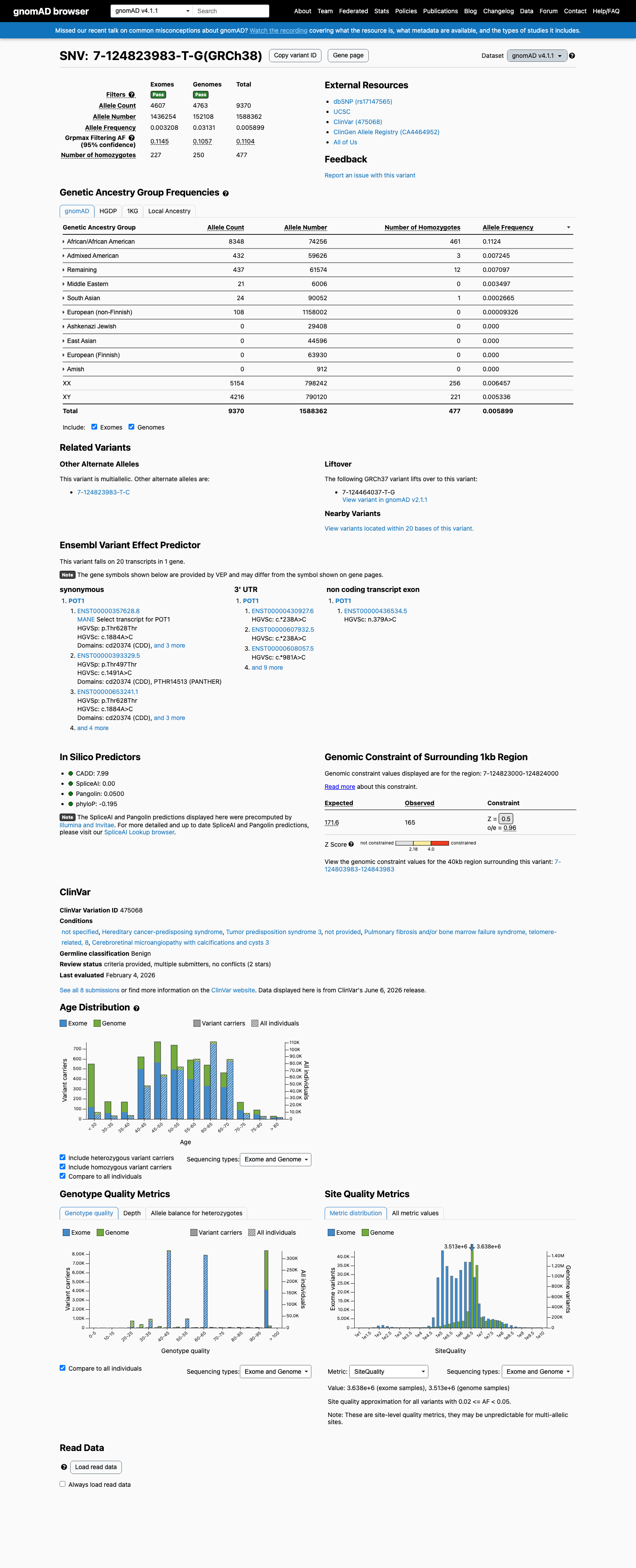
gnomAD v4.1
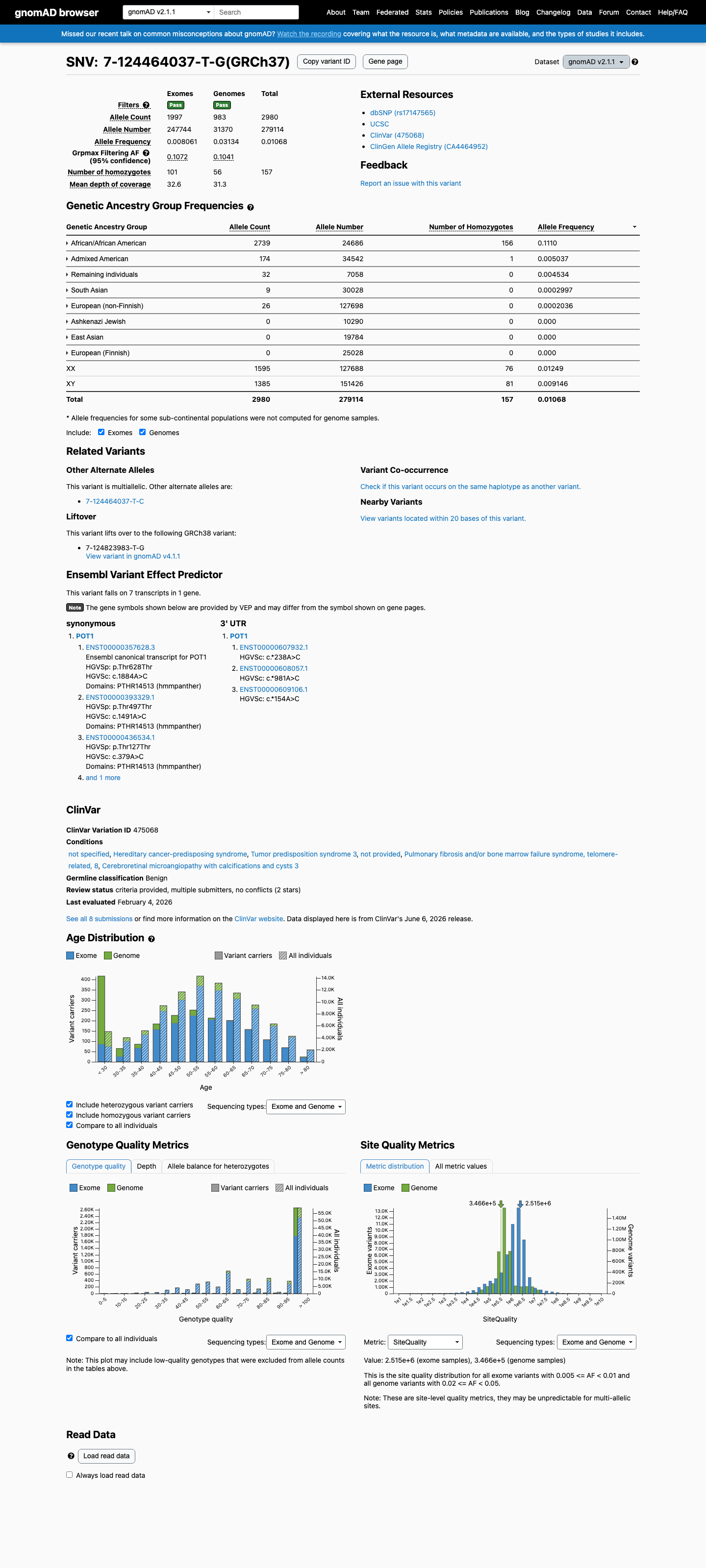
gnomAD v2.1
v4.1
This variant is present in gnomAD v4.1 (AF= 0.00589916; MAF= 0.58992%, 9370/1588362 alleles, homozygotes = 477) and has highest observed frequency in the African/African American population (AF= 0.112422; MAF= 11.24219%, 8348/74256 alleles, homozygotes = 461); grpmax FAF= 0.110405.
v2.1
This variant is present in gnomAD v2.1 (AF= 0.0106766; MAF= 1.06766%, 2980/279114 alleles, homozygotes = 157) and has highest observed frequency in the African/African American population (AF= 0.110954; MAF= 11.09536%, 2739/24686 alleles, homozygotes = 156); grpmax FAF= 0.107247.
🇨🇦 CA
This variant is present in gnomAD-Canada v1.0 (AF= 0.0068403908794788275, 126/18420 alleles, homozygotes = 9).
Allele frequency by ancestry
three datasets · side by side
gnomAD v4.1
0.59%
· 9370 / 1,588,362
477 hom · FAF 11%
477 hom · FAF 11%
African/African American 8348 / 74,256 |
11% 461 hom |
Admixed American 432 / 59,626 |
0.72% 3 hom |
Remaining individuals 437 / 61,574 |
0.71% 12 hom |
Middle Eastern 21 / 6,006 |
0.35% |
South Asian 24 / 90,052 |
0.027% 1 hom |
European (non-Finnish) 108 / 1,158,002 |
0.0093% |
+ 4 not observed (European (Finnish), Amish, East Asian, Ashkenazi Jewish)
gnomAD v2.1
1.1%
· 2980 / 279,114
157 hom · FAF 11%
157 hom · FAF 11%
African/African American 2739 / 24,686 |
11% 156 hom |
Admixed American 174 / 34,542 |
0.5% 1 hom |
Remaining individuals 32 / 7,058 |
0.45% |
South Asian 9 / 30,028 |
0.03% |
European (non-Finnish) 26 / 127,698 |
0.02% |
+ 3 not observed (Ashkenazi Jewish, East Asian, European (Finnish))
gnomAD Canada 🇨🇦
0.68%
· 126 / 18,420
9 hom · FAF 9.7%
9 hom · FAF 9.7%
African/African American 116 / 1,020 |
11% 9 hom |
Latino/Admixed American 7 / 838 |
0.84% |
Remaining individuals 2 / 1,138 |
0.18% |
South Asian 1 / 1,362 |
0.073% |
+ 5 not observed (Ashkenazi Jewish, East Asian, European (Finnish), Middle Eastern, European (non-Finnish))
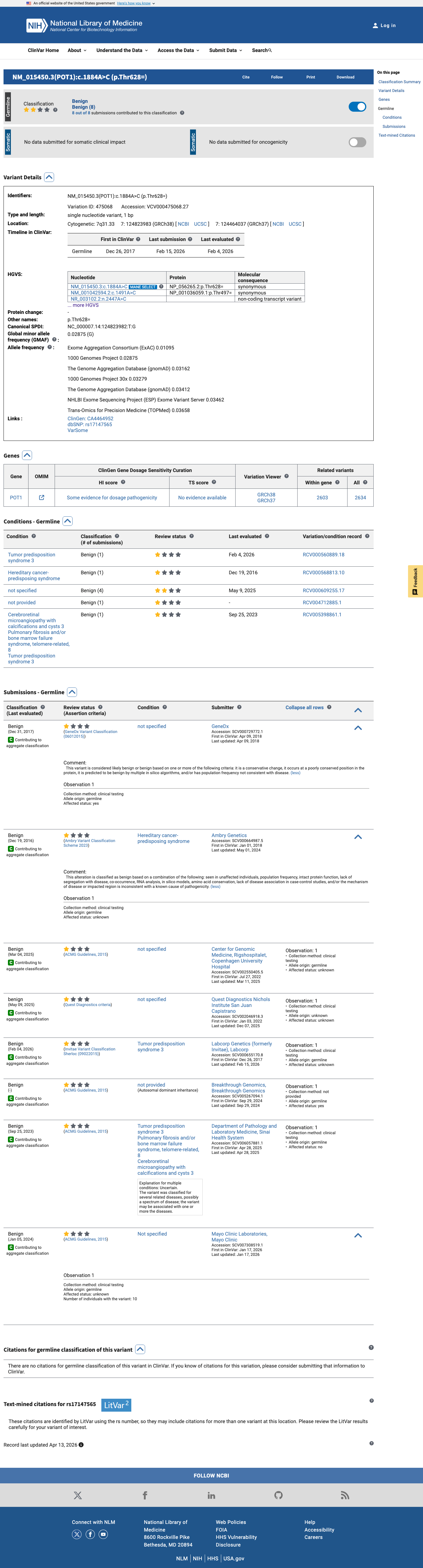
ClinVar
This variant has been reported in ClinVar as Benign (6 clinical laboratories) and as benign (1 clinical laboratory). (ClinVarID = 475068)

In silico
SpliceAI predicts no significant splice impact for this variant (max delta score = 0.00). REVEL score = 0.039.
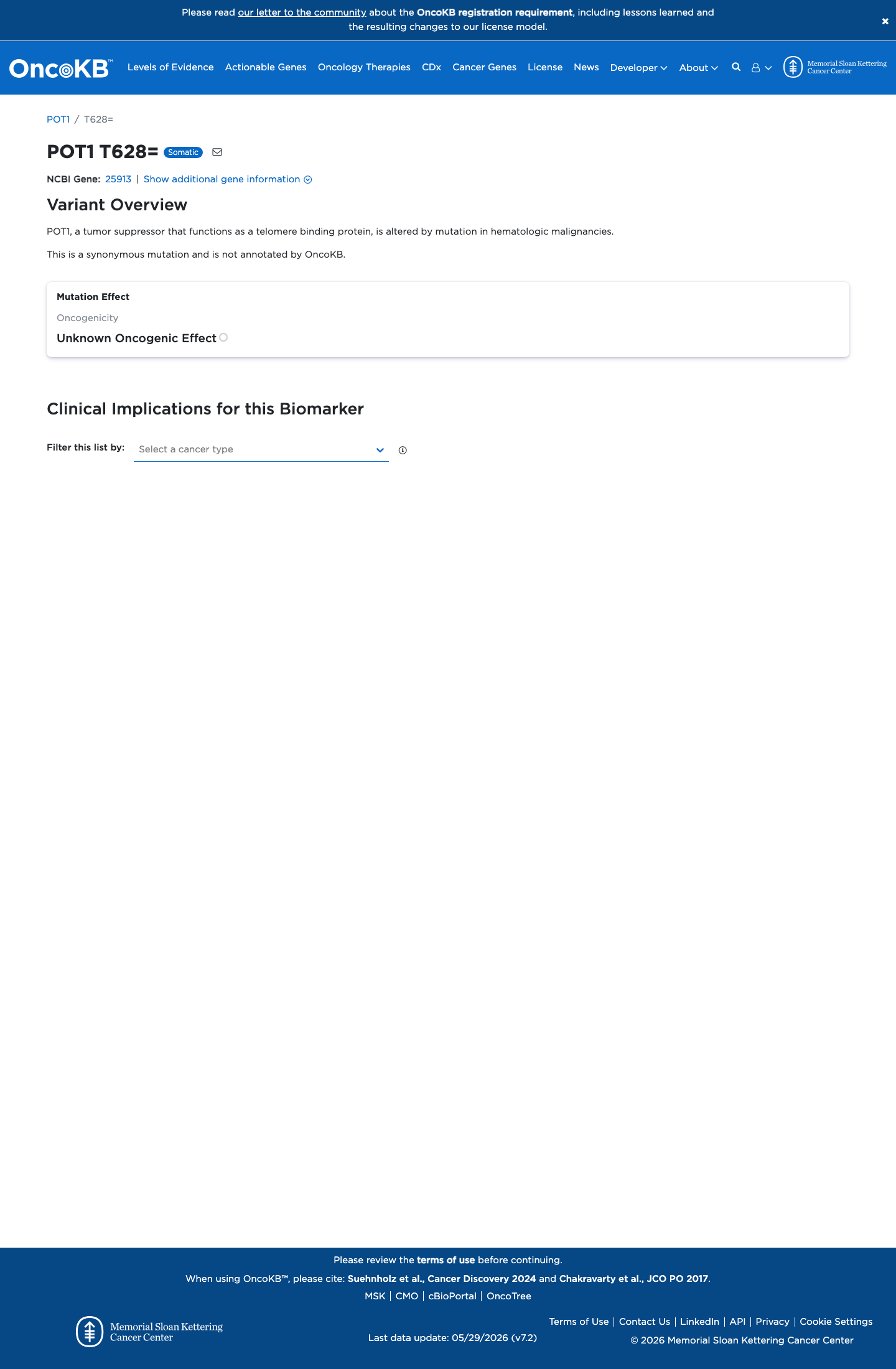
Functional
Unknown Oncogenic Effect
OncoKB identified curated literature and non-variant-specific oncogenicity context for review; listed oncogenicity label: Unknown Oncogenic Effect.

COSMIC

Cancer hotspots
Somatic evidence
Not in COSMIC / hotspots
COSMIC
This variant does not lie in a statistically significant hotspot. This variant has not previously been reported in somatic cancers (COSMIC).
Hotspots
This variant does not lie in a statistically significant hotspot.
Sources & reference links
Triaged references · 5 PMIDs not cited in assessment
25741868 ↗
Standards and guidelines for the interpretation of sequence variants: a joint consensus recommendation of the American College of Medical Genetics and Genomics and the Association for Molecular Pathology.
CLINVAR
26467025 ↗
A Standardized DNA Variant Scoring System for Pathogenicity Assessments in Mendelian Disorders.
CLINVAR
25394175 ↗
A practice guideline from the American College of Medical Genetics and Genomics and the National Society of Genetic Counselors: referral indications for cancer predisposition assessment.
CLINVAR
28492532 ↗
Sherloc: a comprehensive refinement of the ACMG-AMP variant classification criteria.
CLINVAR