NM_000545.6:c.341G>A (p.Arg114His) is a missense variant in HNF1A, a gene in which loss-of-function variants cause autosomal dominant monogenic diabetes (MODY3). This variant is present in gnomAD v2.1 at a grpmax filtering allele frequency of 9.374e-05 (14/282,682 alleles) and in gnomAD v4.1 at 4.428e-05 (78/1,614,100 alleles), exceeding the CSPEC BS1_Strong threshold of 1:30,000 (0.000033).1 Functional characterization by Najmi et al. (2017) demonstrated that p.Arg114His retains 83% of wild-type transactivation activity in a luciferase reporter assay and shows normal nuclear localization (81%), meeting the CSPEC BS3_Supporting threshold of ≥75% activity.2 The variant is located at codon 114, which lies within the CSPEC-defined DNA binding domain subset (codons 107-174), supporting application of PM1_Supporting. However, Arg114 is not among the directly DNA-binding residues specified for PM1_Moderate.3 In silico predictions are indeterminate: REVEL score is 0.58 (below the CSPEC PP3 threshold of 0.70; above the BP4 threshold of 0.15); SpliceAI predicts no splicing impact (max delta 0.01).4 The variant has been reported in ClinVar as Uncertain significance by 5 clinical laboratories and Likely benign by 1 laboratory (VariationID: 134508). No expert panel classification is available.5 Applying the CSPEC v3.1.0 combination rules: BS1 (Strong Benign) and BS3 (Supporting Benign) are met on the benign side, while PM1 (Supporting Pathogenic) is met on the pathogenic side. Per Rule 24 (≥1 Benign Strong + ≥1 Pathogenic Supporting), the evidence is conflicting, resulting in a classification of Uncertain Significance.6
Final classification
Likely Benign
PM1BS1BS3
HNF1A
c.341G>A
p.Arg114His
This variant
NM_000545.6:c.341G>A (p.Arg114His) is a missense variant in HNF1A, a gene in which loss-of-function variants cause autosomal dominant monogenic diabetes (MODY3).
ClinGen Monogenic Diabetes Expert Panel Specifications to the ACMG/AMP Variant Interpretation Guidelines for HNF1A Version 3.1.0 v3.1.0 criteria-combination framework: matched Rule18 (1 Benign.Strong + 1 Benign.Supporting) with applied criteria: PM1 supporting, BS1 strong benign, BS3 supporting benign; maps to Likely Benign.
Classification rationale
PM1
BS1BS3
Likely Benign
HNF1A c.341G>A
PM1 + BS1 + BS3
→
Likely Benign
LYFE Sciences is an AI system, and it can make mistakes. Criteria
may be applied incorrectly, sources may be misread, and a confident-looking
classification can still be wrong. Double-check every criterion and
its underlying evidence before relying on any call.
Gene diagram
· NM_000545.6 · variants mapped to exon structure
HNF1A
NM_000545.6
Fetching transcript structure from UCSC…
Applied criteria · 3 applied · 15 assessed
MetEvidence satisfies this criterion.
Not metEvaluated against available evidence; threshold not reached.
Not assessedApplies in principle, but no evidence was found to evaluate it.
N/ADoesn't apply to this variant type.
Applied · 3
Strength
Supporting
Moderate
Strong
Very strong
PM1
supporting
Pathogenic
Codon 114 lies within the DNA binding domain subset (codons 107-174) defined by the HNF1A CSPEC for PM1_Supporting. The variant is not in the directly DNA-binding residue list for PM1_Moderate. Located in a statistically significant hotspot (evidence_brief).
Residue Arg114 falls within CSPEC-defined DNA binding domain region (codons 107-174)PM1_Supporting applies
BS1
strong
Benign
CSPEC BS1_Strong requires gnomAD grpmax FAF ≥ 1:30,000 (≥ 0.000033). The variant has gnomAD v2.1 grpmax FAF of 9.374e-05, which exceeds this threshold by approximately 2.8-fold. This allele frequency is greater than expected for HNF1A-MODY, a rare monogenic disorder.
gnomAD v2.1 grpmax FAF = 9.374e-05 (14/282682 alleles0 homozygotes)gnomAD v4.1 grpmax FAF = 4.428e-05 (78/1614100 alleles
BS3
supporting
Benign
CSPEC BS3_Supporting requires luciferase transactivation assay showing ≥ 75% of wild-type activity. In PMID:27899486 (Najmi et al. 2017), the p.Arg114His variant demonstrated 83% transactivation activity compared to wild-type in a validated luciferase reporter assay in transfected HeLa cells, with normal nuclear localization (81% of cells with nuclear accumulation). This meets the CSPEC threshold for benign functional evidence.
Luciferase transactivation assay in HeLa cells: 83% of wild-type activity (≥ 75% BS3 threshold)nuclear localization: 81% (normal)
Assessed · not applied
· 15 not met · 0 not assessed
Pathogenic
PS1
No previously classified pathogenic variant encoding the same amino acid change (p.Arg114His) has been identified.
PS2
No de novo occurrence data are available for this variant.
PS3
CSPEC PS3_Supporting requires transactivation ≤40% of wild-type.
PS4
CSPEC requires PM2_Supporting as a prerequisite for applying PS4 at any level.
PM2
CSPEC PM2_Supporting requires gnomAD grpmax FAF ≤ 1:333,000 (≤ 0.000003).
PM5
No previously classified pathogenic or likely pathogenic missense variants at residue Arg114 were identified.
PP1
No cosegregation data are available for this variant.
PP3
CSPEC PP3_Supporting requires REVEL score ≥ 0.70.
PP4
No patient-specific phenotype data are available for this adjudication.
Benign
BA1
CSPEC BA1 requires gnomAD grpmax FAF ≥ 1:10,000 (≥ 0.0001).
BS2
CSPEC BS2 requires observation in normoglycemic individuals aged 70 or older.
BS4
CSPEC BS4 applies to family members without the variant who have MPC score >50% (genotype-negative, phenotype-positive).
BP2
No evidence that this variant has been observed in cis or in trans with a pathogenic or likely pathogenic HNF1A variant.
BP4
CSPEC BP4_Supporting requires REVEL score ≤ 0.15.
BP5
No evidence that a pathogenic or likely pathogenic variant in an alternative monogenic diabetes gene has been identified in a proband carrying this variant.
N/A · 8
PVS1 · PM6 · PP2 · PP5 · BP1 · BP3 · BP6 · BP7
Research & evidence
Population frequency · supports benign
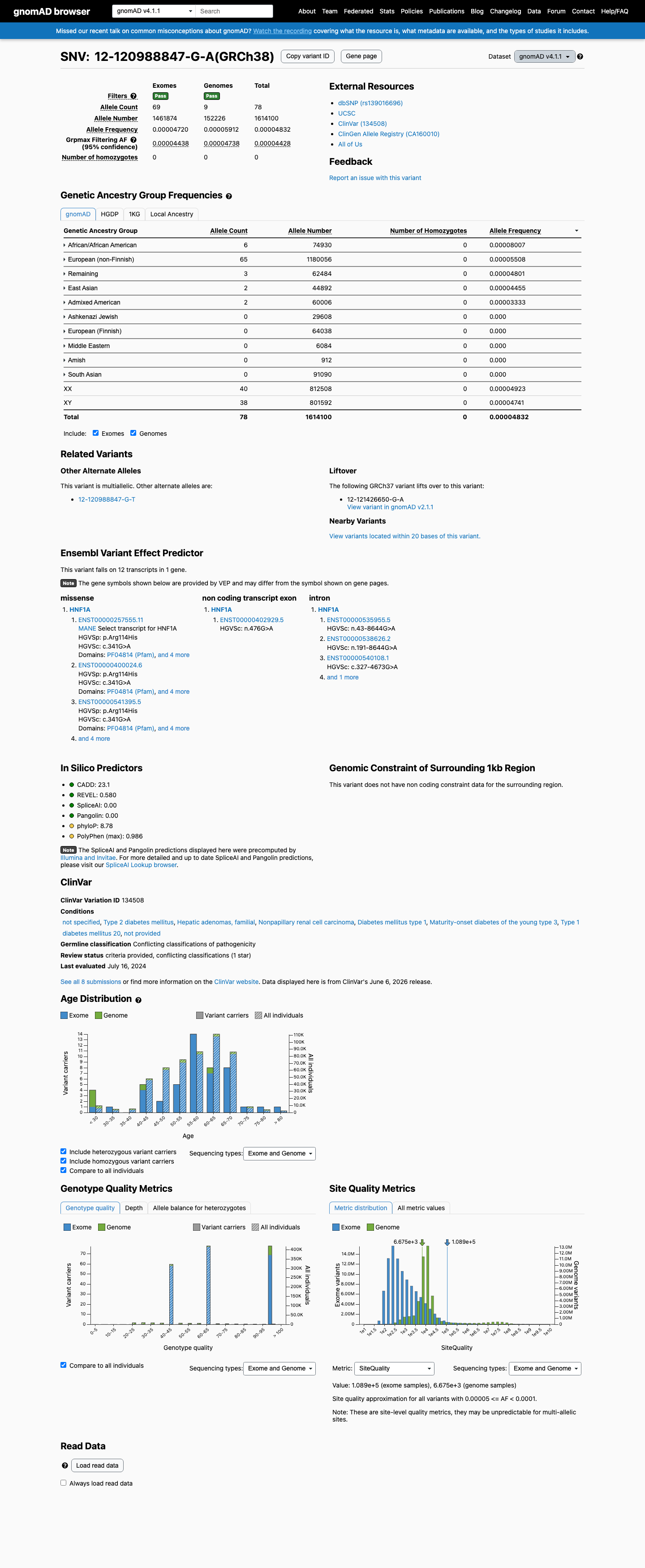
gnomAD v4.1
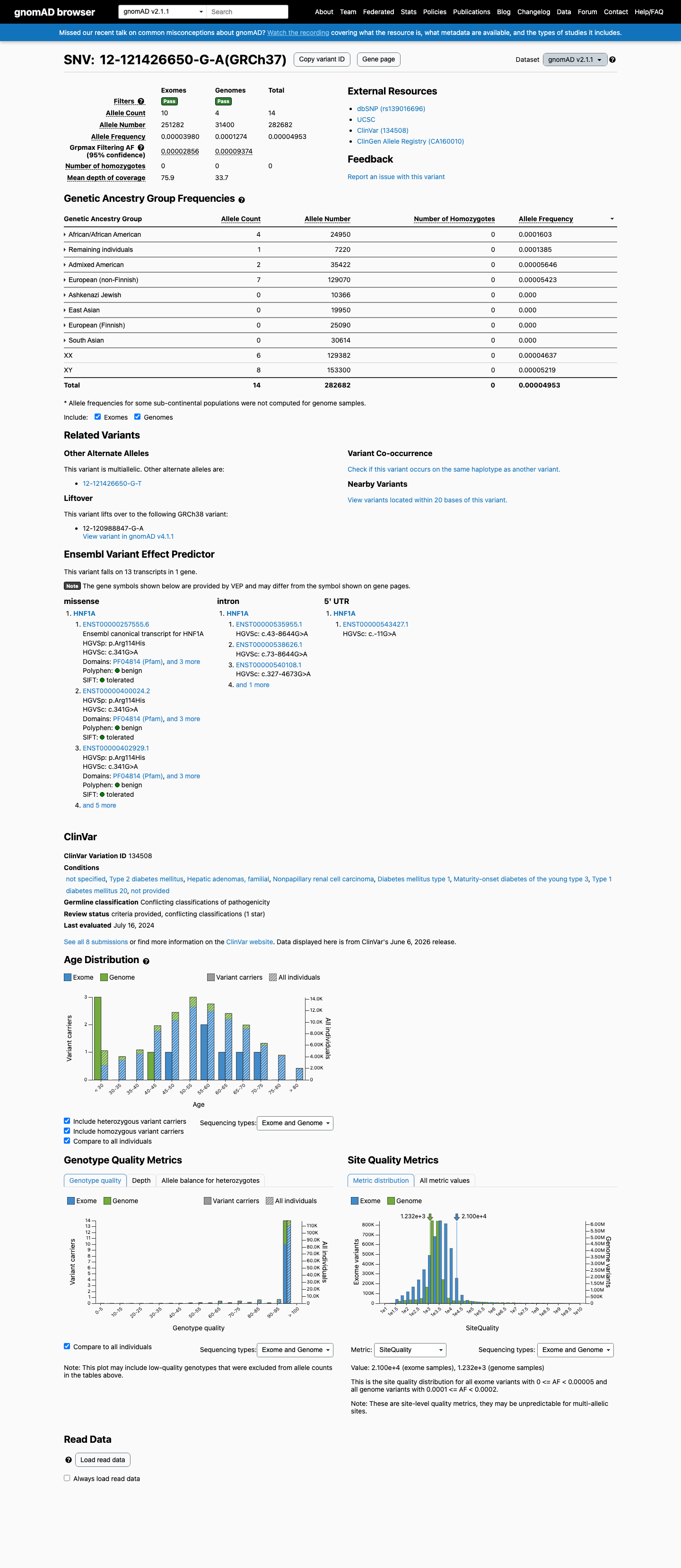
gnomAD v2.1
v4.1
This variant is present in gnomAD v4.1 (AF= 4.83241e-05; MAF= 0.00483%, 78/1614100 alleles, homozygotes = 0) and has highest observed frequency in the African/African American population (AF= 8.00747e-05; MAF= 0.00801%, 6/74930 alleles, homozygotes = 0); grpmax FAF= 4.428e-05.
v2.1
This variant is present in gnomAD v2.1 (AF= 4.95256e-05; MAF= 0.00495%, 14/282682 alleles, homozygotes = 0) and has highest observed frequency in the African/African American population (AF= 0.000160321; MAF= 0.01603%, 4/24950 alleles, homozygotes = 0); grpmax FAF= 9.374e-05.
🇨🇦 CA
Not available in gnomAD-Canada v1.0.
Allele frequency by ancestry
three datasets · side by side
gnomAD v4.1
0.0048%
· 78 / 1,614,100
0 hom · FAF 0.0044%
0 hom · FAF 0.0044%
African/African American 6 / 74,930 |
0.008% |
European (non-Finnish) 65 / 1,180,056 |
0.0055% |
Remaining individuals 3 / 62,484 |
0.0048% |
East Asian 2 / 44,892 |
0.0045% |
Admixed American 2 / 60,006 |
0.0033% |
+ 5 not observed (European (Finnish), Amish, Middle Eastern, South Asian, Ashkenazi Jewish)
gnomAD v2.1
0.005%
· 14 / 282,682
0 hom · FAF 0.0094%
0 hom · FAF 0.0094%
African/African American 4 / 24,950 |
0.016% |
Remaining individuals 1 / 7,220 |
0.014% |
Admixed American 2 / 35,422 |
0.0056% |
European (non-Finnish) 7 / 129,070 |
0.0054% |
+ 4 not observed (Ashkenazi Jewish, East Asian, European (Finnish), South Asian)
gnomAD Canada 🇨🇦
Absent
· 0 / ?
0 hom
0 hom
Not observed in any ancestry group.

ClinVar
This variant has been reported in ClinVar as Uncertain significance (5 clinical laboratories) and as Likely benign (1 clinical laboratory). (ClinVarID = 134508)

In silico
SpliceAI predicts no significant splice impact for this variant (max delta score = 0.01). REVEL score = 0.58. BayesDel score = 0.00692358.
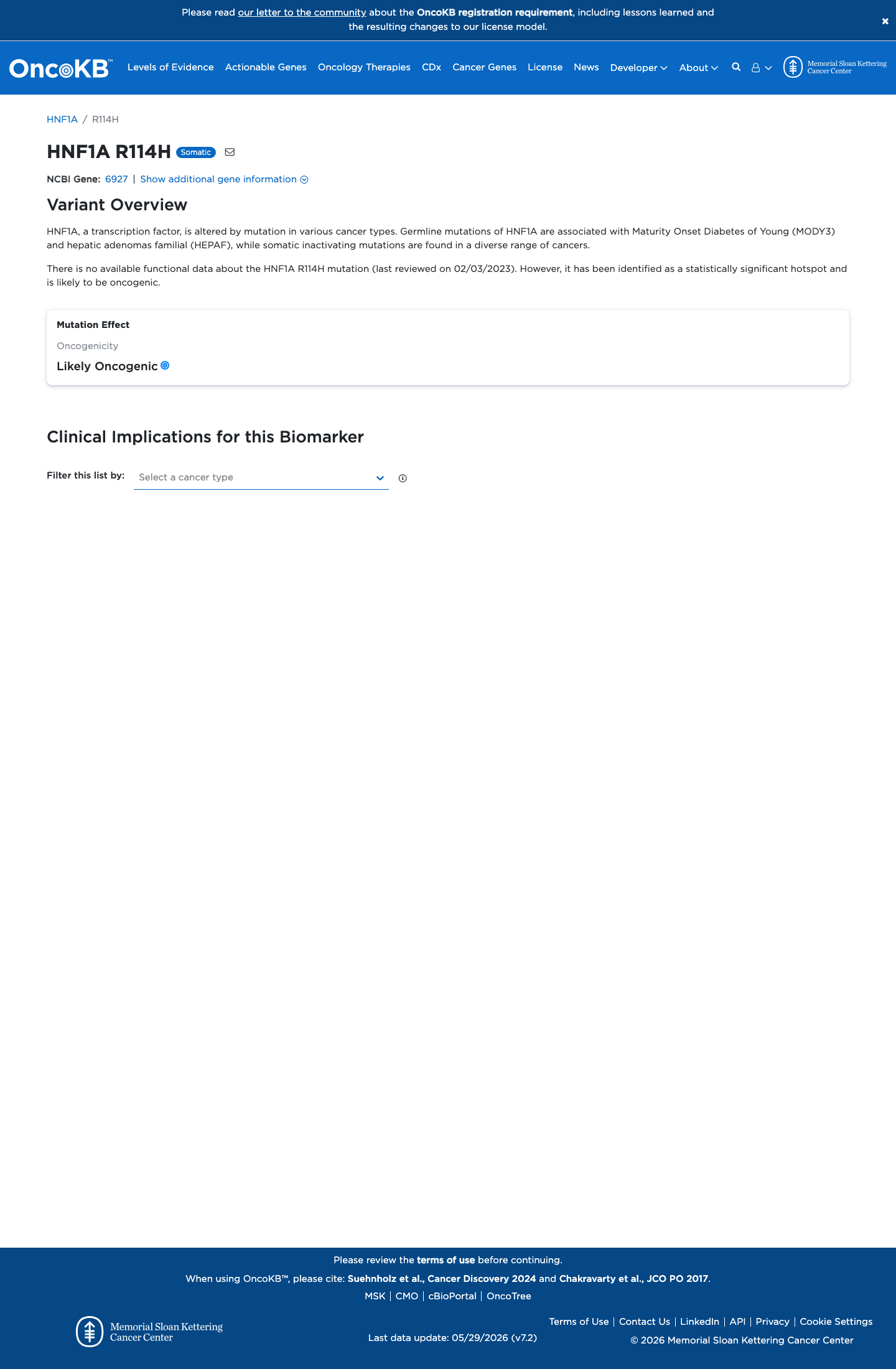
Functional
Likely Oncogenic
OncoKB identified variant-specific curated literature and context relevant to functional review; curated oncogenicity label: Likely Oncogenic.
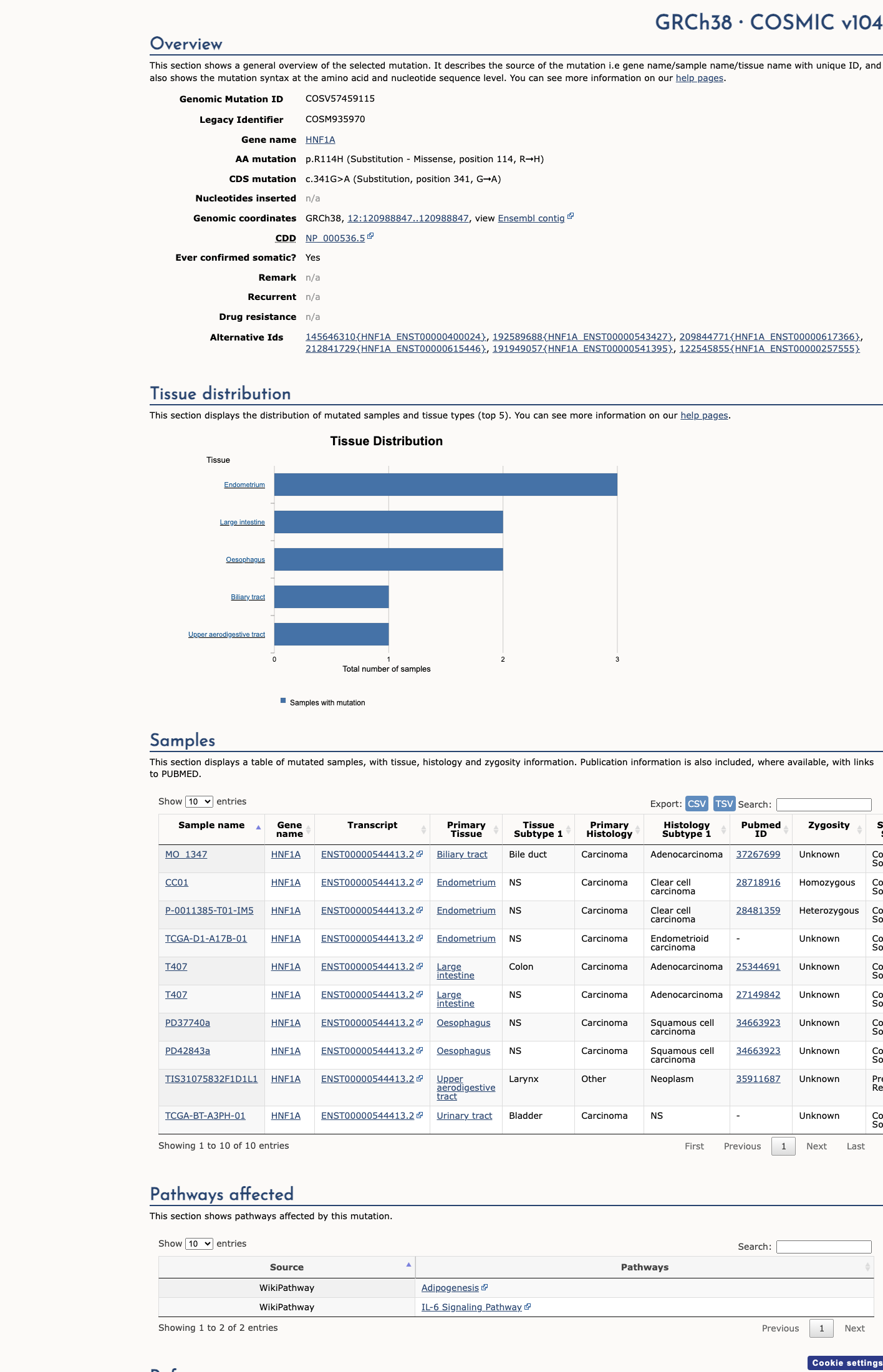
COSMIC

Cancer hotspots
Somatic evidence
Hotspot
COSMIC
This variant lies in a statistically significant hotspot. This variant has previously been reported in somatic cancers (COSMIC; COSV57459115, n = 10 times).
Hotspots
This variant lies in a statistically significant hotspot.
Literature · how each cited paper was used
1papers cited
Each card is an audit: what was searched, what was found, whether it names the variant, which criteria it fed, and why. 8 further PMIDs triaged but not cited — see Sources & references.
Functional Investigations of HNF1A Identify Rare Variants as Risk Factors for Type 2 Diabetes in the General Population.
Searched
c.341G>AR114HArg114HisArg114
Found
Najmi et al. (2017) functionally characterized p.Arg114His (c.341G>A) among 27 rare HNF1A variants. In a luciferase reporter assay in HeLa cells, the variant demonstrated 83% transactivation activity compared to wild-type and 81% nuclear localization. It was classified as bioinformatically unlikely pathogenic (1/5 tools) and did not reduce transactivation below the 60% diabetes risk threshold. The variant was identified in 1 individual with diabetes and 1 control in the study cohorts.
Variant
✓ Names this variant — characterised directly
Applied to
→BS3
met
Why
Transactivation activity (83%) meets CSPEC BS3_Supporting threshold (≥75%); does not meet PS3 threshold (≤40%). Referenced in BS3 and PS3 assessments.
c.341G>A R114H 83 — 81 Uncertain MODY/NA NA MODY (74, 75) Tol Ben C0 Polymorphism 22,9 3.318 × 10^-5 — Unlikely pathogenic (1/5) Class 3
Location Table 1; Results section 'Functional Evaluation'; Supplementary Table 1 · Context Luciferase reporter assay (pGL3-RA rat albumin promoter) and immunofluorescence nuclear localization in transiently transfected HeLa cells · full text
Sources & reference links
9Sources
Triaged references · 8 PMIDs not cited in assessment
25741868 ↗
Standards and guidelines for the interpretation of sequence variants: a joint consensus recommendation of the American College of Medical Genetics and Genomics and the Association for Molecular Pathology.
CLINVAR
38093550 ↗
An alternative approach using hs-CRP levels and age of onset in diagnostics of HNF1A-MODY.
CLINVAR
22962670 ↗
Evaluation and treatment of hypertriglyceridemia: an Endocrine Society clinical practice guideline.
CLINVAR
23771925 ↗
Prevalence, characteristics and clinical diagnosis of maturity onset diabetes of the young due to mutations in HNF1A, HNF4A, and glucokinase: results from the SEARCH for Diabetes in Youth.
CLINVAR
24728327 ↗
Germline variation in cancer-susceptibility genes in a healthy, ancestrally diverse cohort: implications for individual genome sequencing.
CLINVAR
23492873 ↗
Recommendations from the EGAPP Working Group: does genomic profiling to assess type 2 diabetes risk improve health outcomes?
CLINVAR