This missense variant (c.233C>G, p.Pro78Arg) in FANCL is absent from gnomAD v2.1 and present at extremely low frequency in gnomAD v4.1 (AF=0.000496%, 8/1,612,860 alleles, no homozygotes), meeting PM2 at supporting strength.1 Multiple lines of computational evidence (REVEL 0.105, BayesDel -0.364706, SpliceAI max delta 0.04) suggest no damaging impact on the gene product, meeting BP4 at supporting benign strength.2 This variant has been reported in ClinVar as Uncertain significance by two clinical laboratories with no expert panel classification; no case-control, functional, or segregation data specific to this variant were identified.3 With one supporting pathogenic criterion (PM2) and one supporting benign criterion (BP4), the evidence is balanced and the variant is classified as Uncertain significance per ACMG/AMP 2015 combination rules (PMID:25741868).4
FANCL
Final classification
VUS
FANCL c.233C>G · p.Pro78Arg
FANCL
This missense variant (c.233C>G, p.Pro78Arg) in FANCL is absent from gnomAD v2.1 and present at extremely low frequency in gnomAD v4.1 (AF=0.000496%, 8/1,612,860 alleles, no homozygotes), meeting PM2 at supporting strength.
gene-specific framework lacked a usable explicit final combination framework, so generic ACMG/AMP 2015 final-combination rules were applied as fallback; applied criteria: PM2 supporting, BP4 supporting benign; combination = 1 supporting + 1 supporting benign, which maps to VUS.
Classification rationale
PM2
BP4
VUS
FANCL c.233C>G
PM2 + BP4
→
VUS
Gene diagram
· NM_018062.3 · variants mapped to exon structure
FANCL
NM_018062.3
Fetching transcript structure from UCSC…
Applied criteria · 2 applied · 19 assessed
Applied · 2
Strength
Supporting
Moderate
Strong
Very strong
✓
PM2
supporting
Pathogenic
This variant is absent from gnomAD v2.1 and present at extremely low frequency in gnomAD v4.1 (global AF=0.000496%, 8/1,612,860 alleles, no homozygotes; grpmax FAF=1.065e-05), meeting the PM2 threshold of <0.1% for a rare variant.
Absent from gnomAD v2.1.gnomAD v4.1: AF=4.96e-06 (8/1612
✓
BP4
supporting
Benign
Multiple lines of computational evidence suggest no impact on the gene product: REVEL score 0.105, BayesDel score -0.364706, and SpliceAI max delta score 0.04 (no predicted splicing impact).
REVEL: 0.105 (supports benign).BayesDel: -0.364706 (supports benign).SpliceAI: max delta 0.04 (no splicing impact).
Assessed · not applied
Pathogenic
PS1
No data available on other missense variants at the same amino acid position (Pro78) with an established pathogenic classification.
PS2
No de novo occurrence data available for this variant.
PS3
No variant-specific functional studies were identified.
PS4
No case-control studies demonstrating significantly increased prevalence of this variant in affected individuals compared to controls were identified.
PM1
This variant does not lie in a statistically significant mutational hotspot.
PM6
No de novo occurrence data available for this variant.
PP1
No cosegregation data available for this variant.
PP2
HCI prior data are not available for FANCL; unable to assess the rate of benign missense variation in this gene relative to disease-causing missense variants.
PP3
Multiple in silico tools predict a benign effect: REVEL score 0.105 (below the commonly used 0.5 threshold), BayesDel score -0.364706 (negative score supports benign), and SpliceAI max delta score 0.04 (no predicted splicing impact).
PP4
No patient phenotype or family history data available for assessment.
PP5
This variant is classified as Uncertain significance in ClinVar by two clinical laboratories (review status: criteria provided, single submitter).
Benign
BA1
This variant has a global allele frequency of 0.000496% in gnomAD v4.1 (grpmax FAF=1.065e-05), well below the BA1 threshold of >1%.
BS1
This variant has a global allele frequency of 0.000496% in gnomAD v4.1 (grpmax FAF=1.065e-05), below the BS1 threshold of >0.3% for a disorder of this prevalence.
BS2
No data on observation of this variant in healthy adults beyond population database representation.
BS3
No variant-specific functional studies demonstrating no damaging effect on protein function or splicing were identified.
BS4
No nonsegregation data available for this variant.
BP2
No data on this variant observed in trans with a pathogenic variant in FANCL, which would be expected for a recessive disorder.
BP5
No data on this variant observed in a case with an alternate molecular basis for disease.
BP6
This variant is classified as Uncertain significance in ClinVar by two clinical laboratories; no reputable source has classified this variant as benign.
N/A · 4
PVS1 · PM5 · BP1 · BP7
Research & evidence
Population frequency
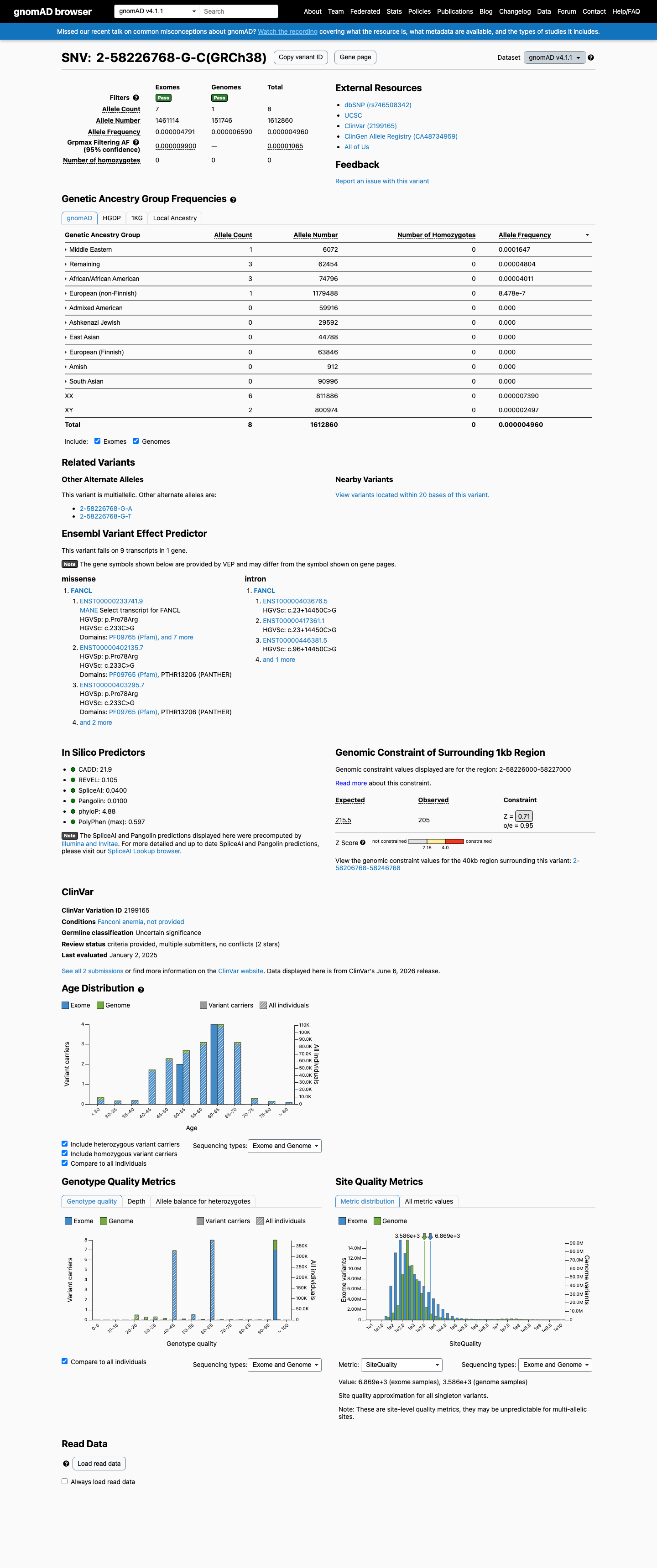
gnomAD v4.1
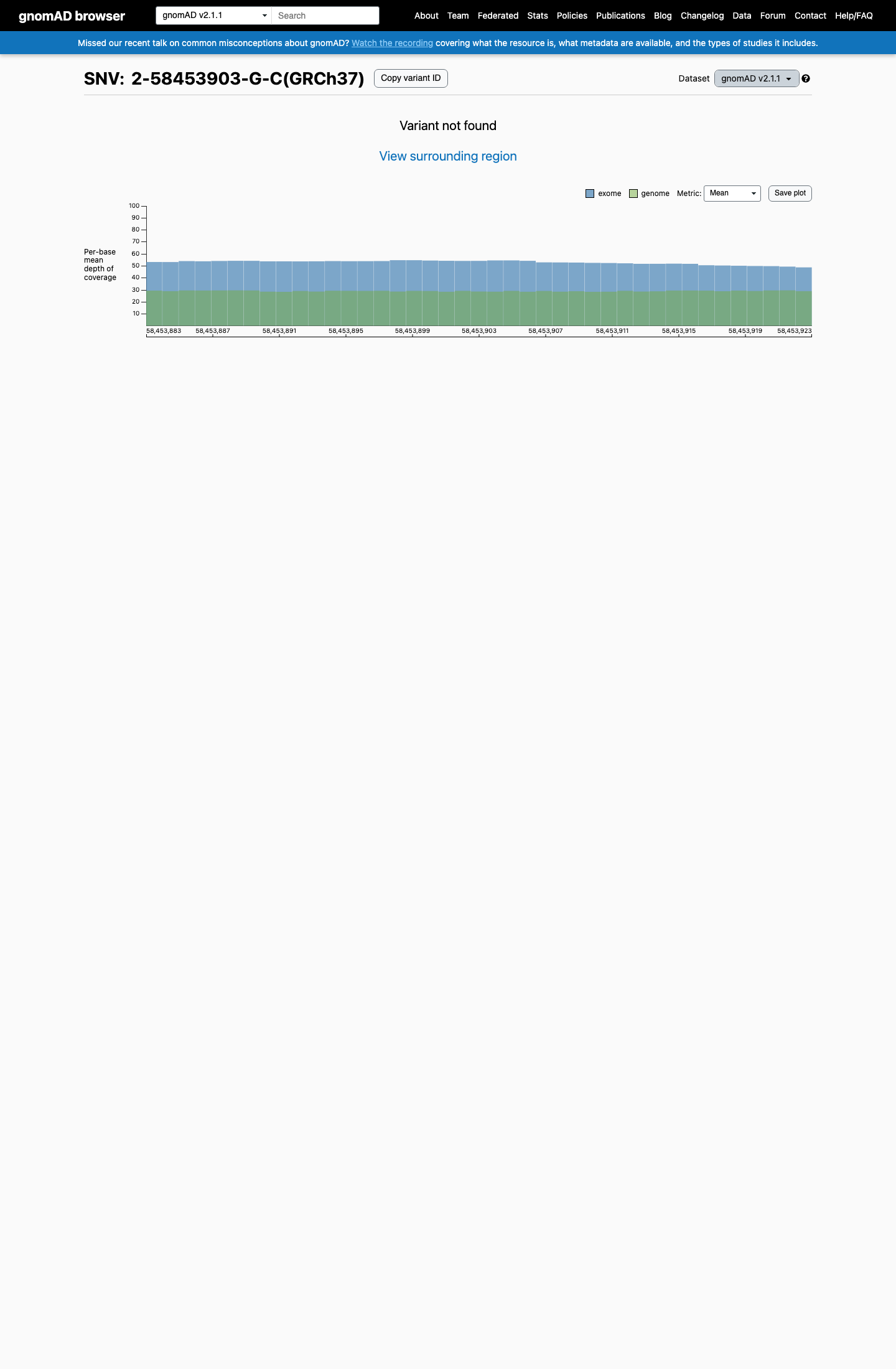
gnomAD v2.1
v4.1
This variant is present in gnomAD v4.1 (AF= 4.96013e-06; MAF= 0.00050%, 8/1612860 alleles, homozygotes = 0) and has highest observed frequency in the Middle Eastern population (AF= 0.00016469; MAF= 0.01647%, 1/6072 alleles, homozygotes = 0); grpmax FAF= 1.065e-05.
v2.1
Absent from gnomAD v2.1.
🇨🇦 CA
Not available in gnomAD-Canada v1.0.
Allele frequency by ancestry
three datasets · side by side
gnomAD v4.1
0.0005%
· 8 / 1,612,860
0 hom · FAF 0.0011%
0 hom · FAF 0.0011%
Middle Eastern 1 / 6,072 |
0.016% |
Remaining individuals 3 / 62,454 |
0.0048% |
African/African American 3 / 74,796 |
0.004% |
European (non-Finnish) 1 / 1,179,488 |
8.5e-05% |
+ 6 not observed (Admixed American, European (Finnish), Amish, East Asian, South Asian, Ashkenazi Jewish)
gnomAD v2.1
Absent
· 0 / ?
0 hom
0 hom
Not observed in any ancestry group.
gnomAD Canada 🇨🇦
Absent
· 0 / ?
0 hom
0 hom
Not observed in any ancestry group.
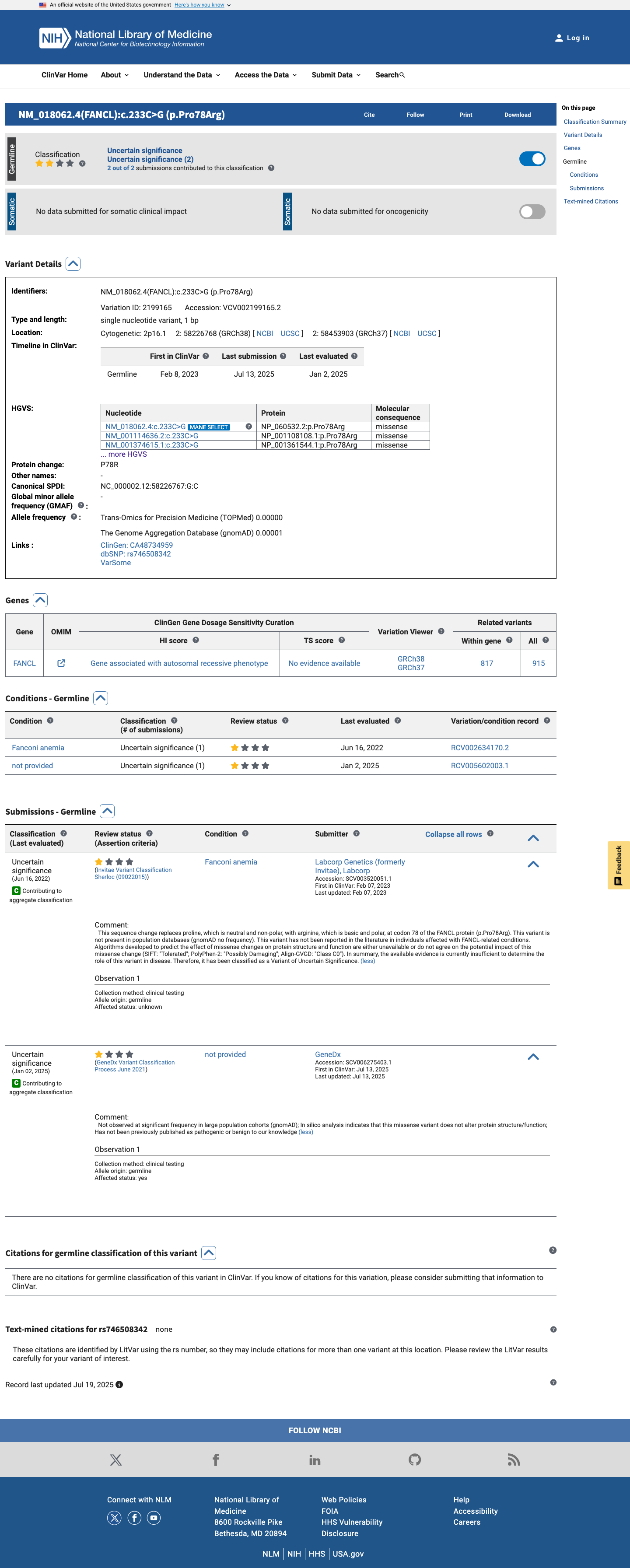
ClinVar
This variant has been reported in ClinVar as Uncertain significance (2 clinical laboratories). (ClinVarID = 2199165)
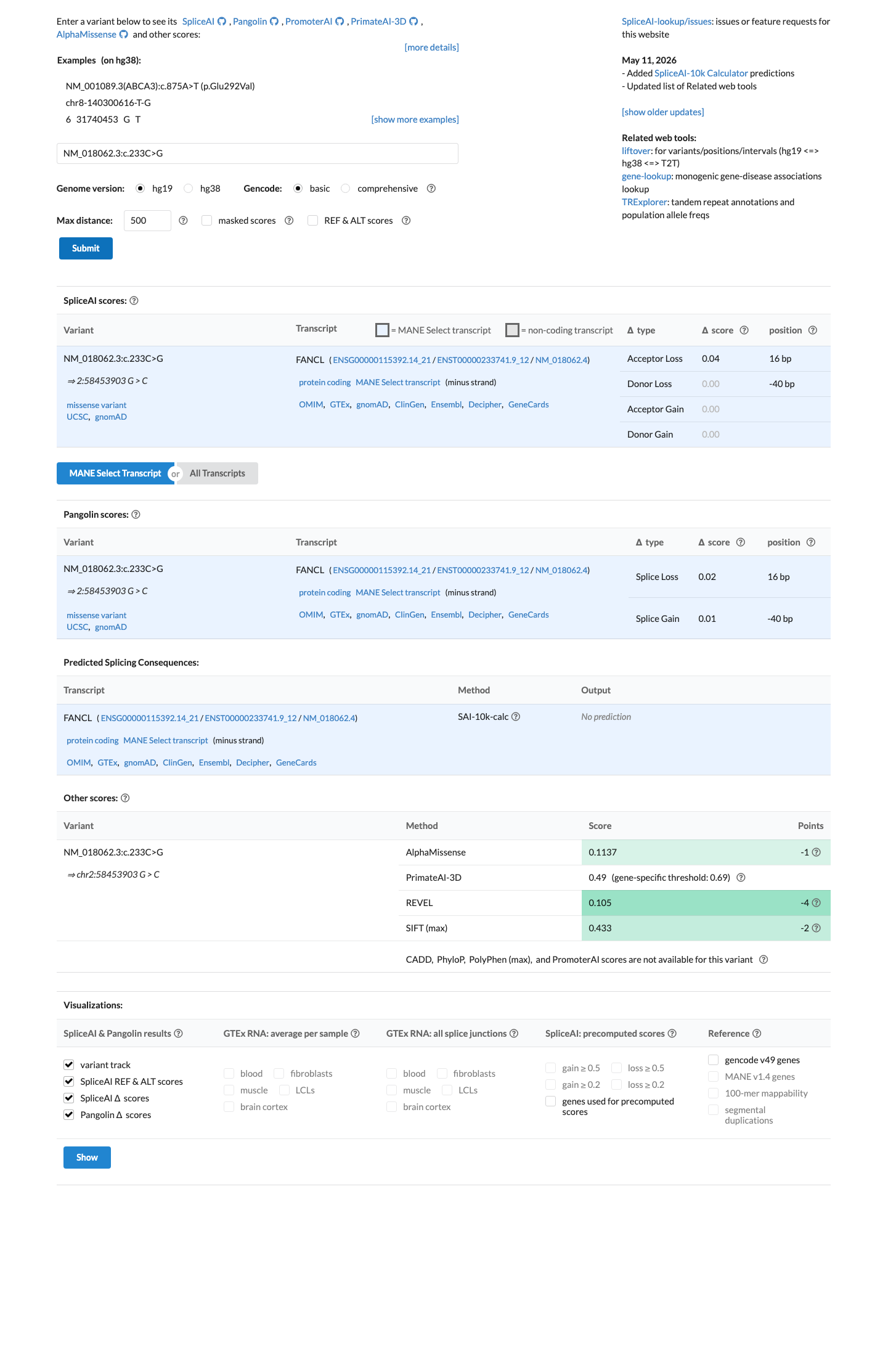
In silico
SpliceAI predicts no significant splice impact for this variant (max delta score = 0.04). REVEL score = 0.105. BayesDel score = -0.364706.
Functional
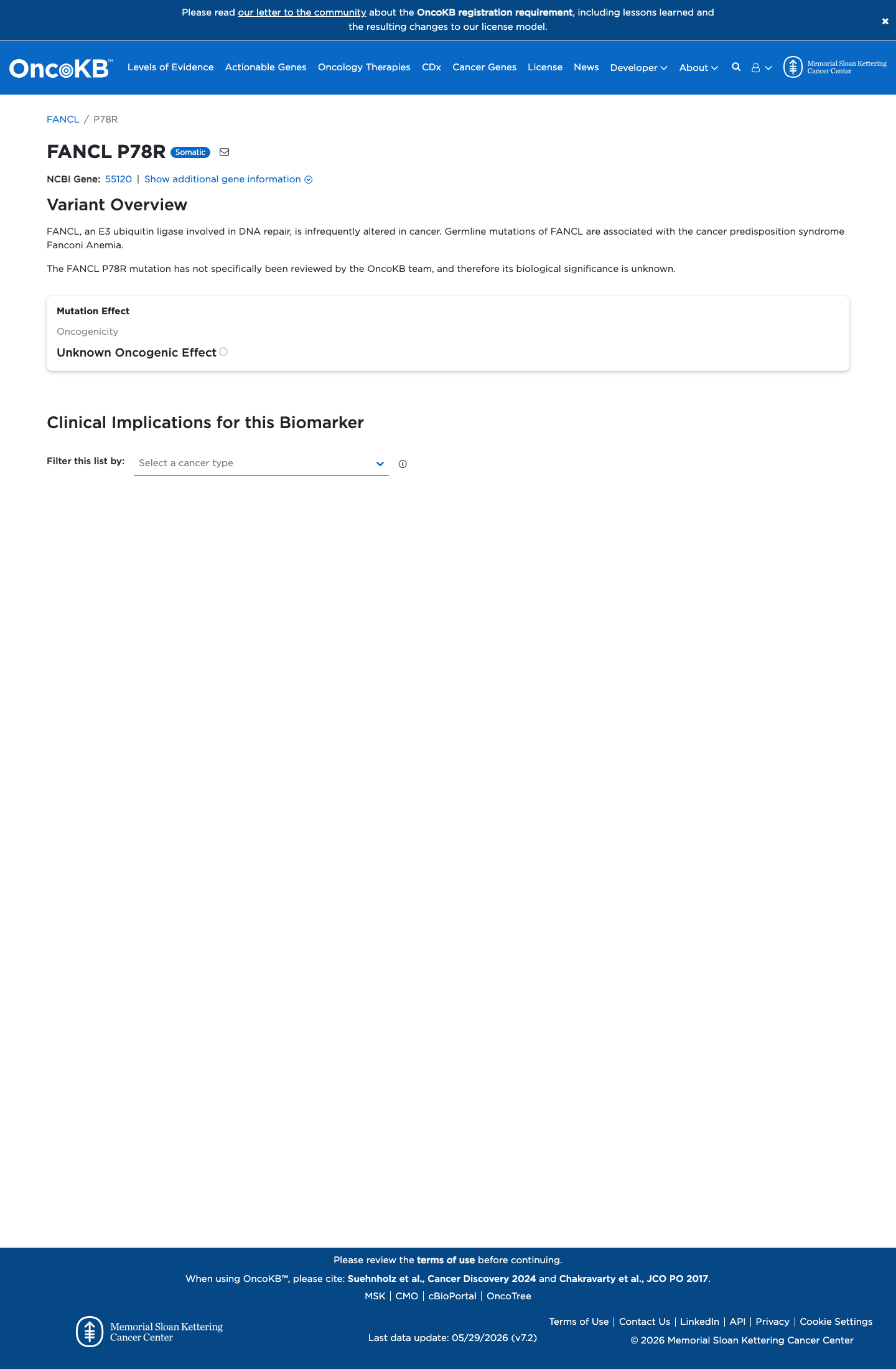
Unknown Oncogenic Effect
OncoKB did not identify variant-specific reviewed functional evidence for this variant; gene-level curated context is available for reviewer follow-up. FANCL, an E3 ubiquitin ligase involved in DNA repair, is infrequently altered in cancer. Germline mutations of FANCL are associated with the cancer pr

COSMIC

Cancer hotspots
Somatic evidence
Not in COSMIC / hotspots
COSMIC
This variant does not lie in a statistically significant hotspot. This variant has not previously been reported in somatic cancers (COSMIC).
Hotspots
This variant does not lie in a statistically significant hotspot.
Sources & reference links
Triaged references · 5 PMIDs not cited in assessment
19888064 ↗
ACOG Committee Opinion No. 442: Preconception and prenatal carrier screening for genetic diseases in individuals of Eastern European Jewish descent.
CLINVAR
26389258 ↗
Cancer Genetics Risk Assessment and Counseling (PDQ®): Health Professional Version.
CLINVAR