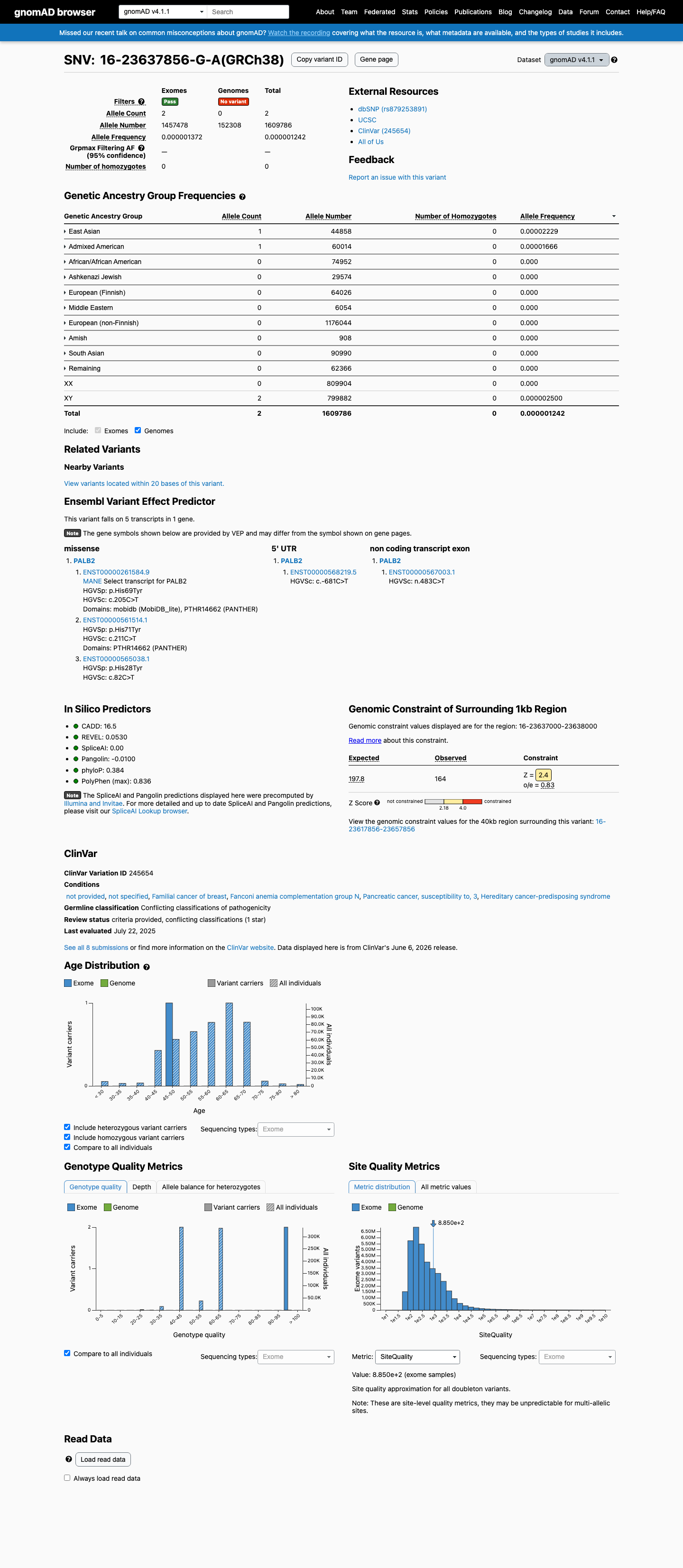
NM_024675.4:c.205C>T (p.His69Tyr) is a missense variant in PALB2 exon 3. Under the ClinGen Hereditary Breast, Ovarian and Pancreatic Cancer Expert Panel specification for PALB2 v1.2.0, missense variants are not a confirmed mechanism of disease.1 BP1_Supporting is met: the VCEP applies BP1 to all PALB2 missense variants given the very low likelihood that missense variants are pathogenic.2 PM2_Supporting is not applied: while the overall gnomAD v4.1 frequency (0.000124%) is below the VCEP threshold (≤0.000333%), the variant is observed in the East Asian subpopulation at 0.00223% (1/44,858 alleles), triggering the VCEP exception for under-represented sub-populations with frequency >0.0003%.3 The variant is present in gnomAD v4.1 at extremely low frequency (2/1,609,786 alleles; 0 homozygotes). It is absent from gnomAD v2.1.4 This variant has been reported in ClinVar (ID 245654) as Uncertain significance by 6 clinical laboratories and Likely benign by 2 clinical laboratories. No expert panel classification is available.5 SpliceAI predicts no splicing impact (max delta score 0.00). REVEL (0.053) and BayesDel (-0.387659) are consistent with a benign computational prediction, though in silico predictors are not used for PALB2 missense variants under this VCEP.6 Multiple criteria are not applicable under the PALB2 VCEP for missense variants: PVS1 (not a null variant), PS1 (missense excluded), PM1 (missense pathogenicity not confirmed), PM5 (missense excluded), PP2 (missense not confirmed), PP3 (missense excluded), BP4 (missense excluded), BP7 (missense excluded). PS2, PM6, PS3, BS3, PP4, PP5, BP2, BP5, BP6 are not applicable per VCEP specification.7 No variant-specific functional, segregation, case-control, or Fanconi Anemia proband data were identified in the reviewed literature or databases.8
Final classification
VUS
BP1
PALB2
c.205C>T
p.His69Tyr
This variant
NM_024675.4:c.205C>T (p.His69Tyr) is a missense variant in PALB2 exon 3. Under the ClinGen Hereditary Breast, Ovarian and Pancreatic Cancer Expert Panel specification for PALB2 v1.2.0, missense variants are not a confirmed mechanism of disease.
Richards et.al., 2015 - Combining rules v1.2.0 criteria-combination framework was evaluated deterministically with applied criteria: BP1 supporting benign; no rule matched the adjudicated criteria.
Classification rationale
BP1
VUS
PALB2 c.205C>T
BP1
→
VUS
LYFE Sciences is an AI system, and it can make mistakes. Criteria
may be applied incorrectly, sources may be misread, and a confident-looking
classification can still be wrong. Double-check every criterion and
its underlying evidence before relying on any call.
Gene diagram
· NM_024675.4 · variants mapped to exon structure
PALB2
NM_024675.4
Fetching transcript structure from UCSC…
Applied criteria · 1 applied · 7 assessed
MetEvidence satisfies this criterion.
Not metEvaluated against available evidence; threshold not reached.
Not assessedApplies in principle, but no evidence was found to evaluate it.
N/ADoesn't apply to this variant type.
Applied · 1
Strength
Supporting
Moderate
Strong
Very strong
BP1
supporting
Benign
PALB2 VCEP BP1 specifies application to all missense variants in PALB2. Based on published and unpublished functional studies, PALB2 has a low rate of missense variants that are non-functional in relevant assays, and true pathogenic missense variants are thought to be exceedingly rare.
VCEP BP1: 'Apply to all missense variants' — BP1_Supporting assigned automaticallyPALB2 missense pathogenic variants not confirmed as a mechanism of disease
Assessed · not applied
· 7 not met · 0 not assessed
Pathogenic
PS4
No case-control study meeting the PALB2 VCEP threshold (p≤0.05 and OR≥3 or lower 95% CI≥1.5) was identified for this variant.
PM2
The variant is present in gnomAD v4.1 at very low frequency (AF=0.000124%, 2/1,609,786 alleles), which is below the PALB2 VCEP PM2_Supporting threshold of ≤0.000333%.
PP1
No co-segregation data (LOD scores, Bayes factors, or affected relative counts) were identified for this variant.
Benign
BA1
The variant does not meet the PALB2 VCEP BA1 threshold of Grpmax Filtering AF >0.1% in gnomAD v4.
BS1
The variant does not meet the PALB2 VCEP BS1 threshold of Grpmax Filtering AF >0.01% in gnomAD v4.
BS2
No Fanconi Anemia proband data are available to assign BS2 points under the PALB2 VCEP BS2 tables.
BS4
No quantitative co-segregation data (LOD scores or Bayes factors) demonstrating lack of segregation are available for this variant.
N/A · 17
PVS1 · PS1 · PS2 · PS3 · PM1 · PM5 · PM6 · PP2 · PP3 · PP4 · PP5 · BS3 · BP2 · BP4 · BP5 · BP6 · BP7
Research & evidence
Population frequency
gnomAD v4.1
gnomAD v2.1
v4.1
This variant is present in gnomAD v4.1 (AF= 1.2424e-06; MAF= 0.00012%, 2/1609786 alleles, homozygotes = 0) and has highest observed frequency in the East Asian population (AF= 2.22926e-05; MAF= 0.00223%, 1/44858 alleles, homozygotes = 0).
v2.1
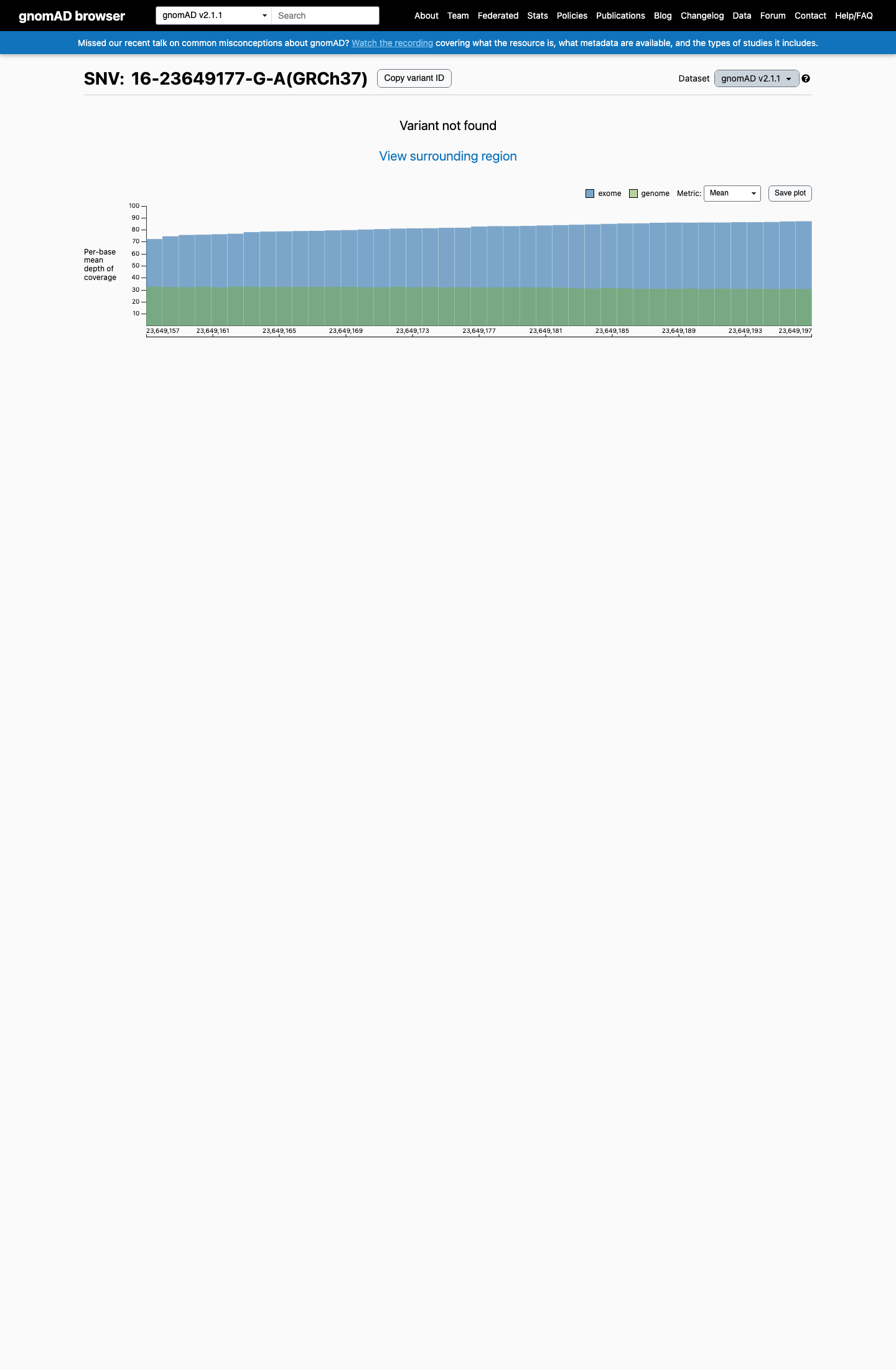
Absent from gnomAD v2.1.
🇨🇦 CA
Not available in gnomAD-Canada v1.0.
Allele frequency by ancestry
three datasets · side by side
gnomAD v4.1
0.00012%
· 2 / 1,609,786
0 hom
0 hom
East Asian 1 / 44,858 |
0.0022% |
Admixed American 1 / 60,014 |
0.0017% |
+ 8 not observed (Remaining individuals, European (Finnish), Amish, Middle Eastern, South Asian, Ashkenazi Jewish, African/African American, European (non-Finnish))
gnomAD v2.1
Absent
· 0 / ?
0 hom
0 hom
Not observed in any ancestry group.
gnomAD Canada 🇨🇦
Absent
· 0 / ?
0 hom
0 hom
Not observed in any ancestry group.
ClinVar
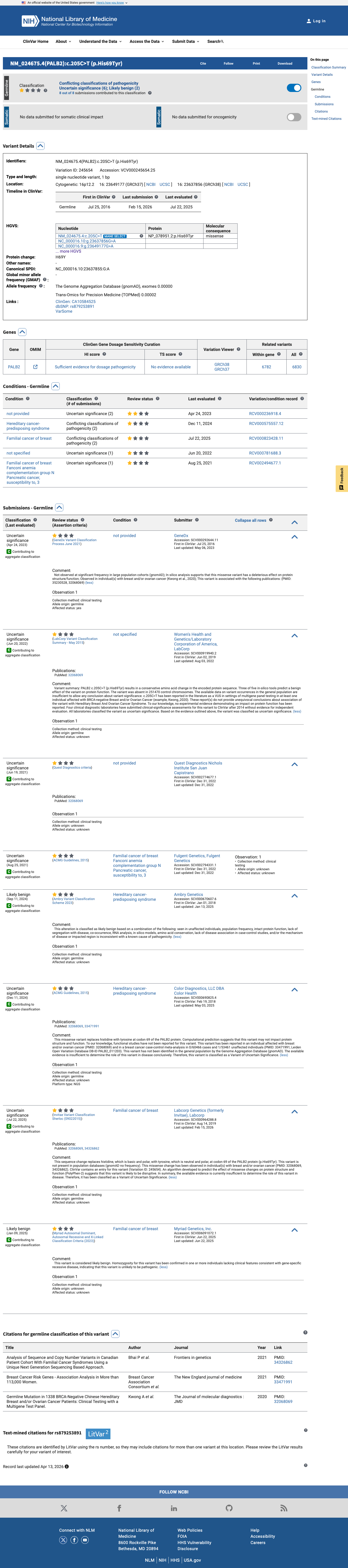
This variant has been reported in ClinVar as Uncertain significance (6 clinical laboratories) and as Likely benign (2 clinical laboratories). (ClinVarID = 245654)
In silico
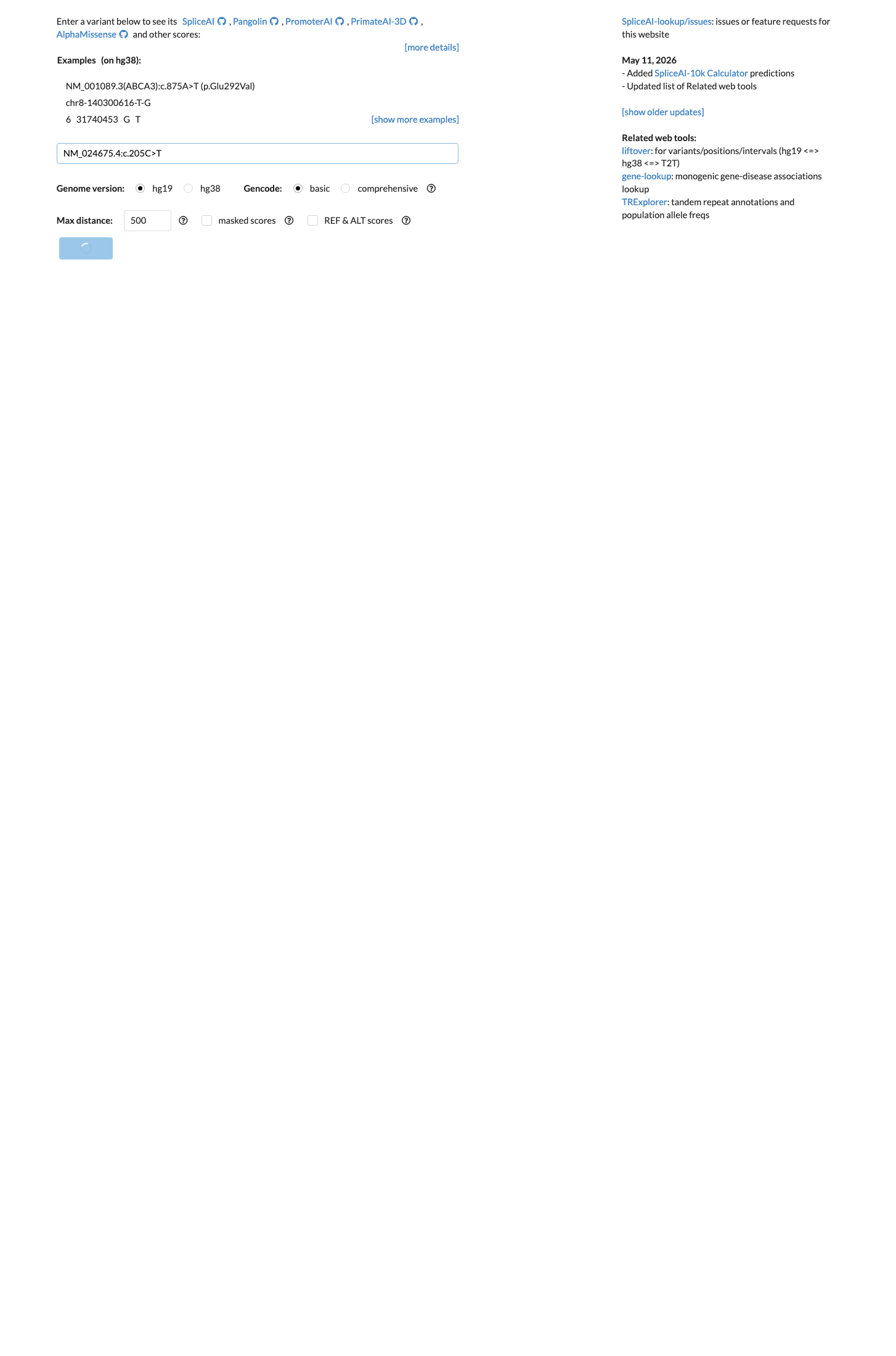
SpliceAI predicts no significant splice impact for this variant (max delta score = 0.00). REVEL score = 0.053. BayesDel score = -0.387659.
Functional
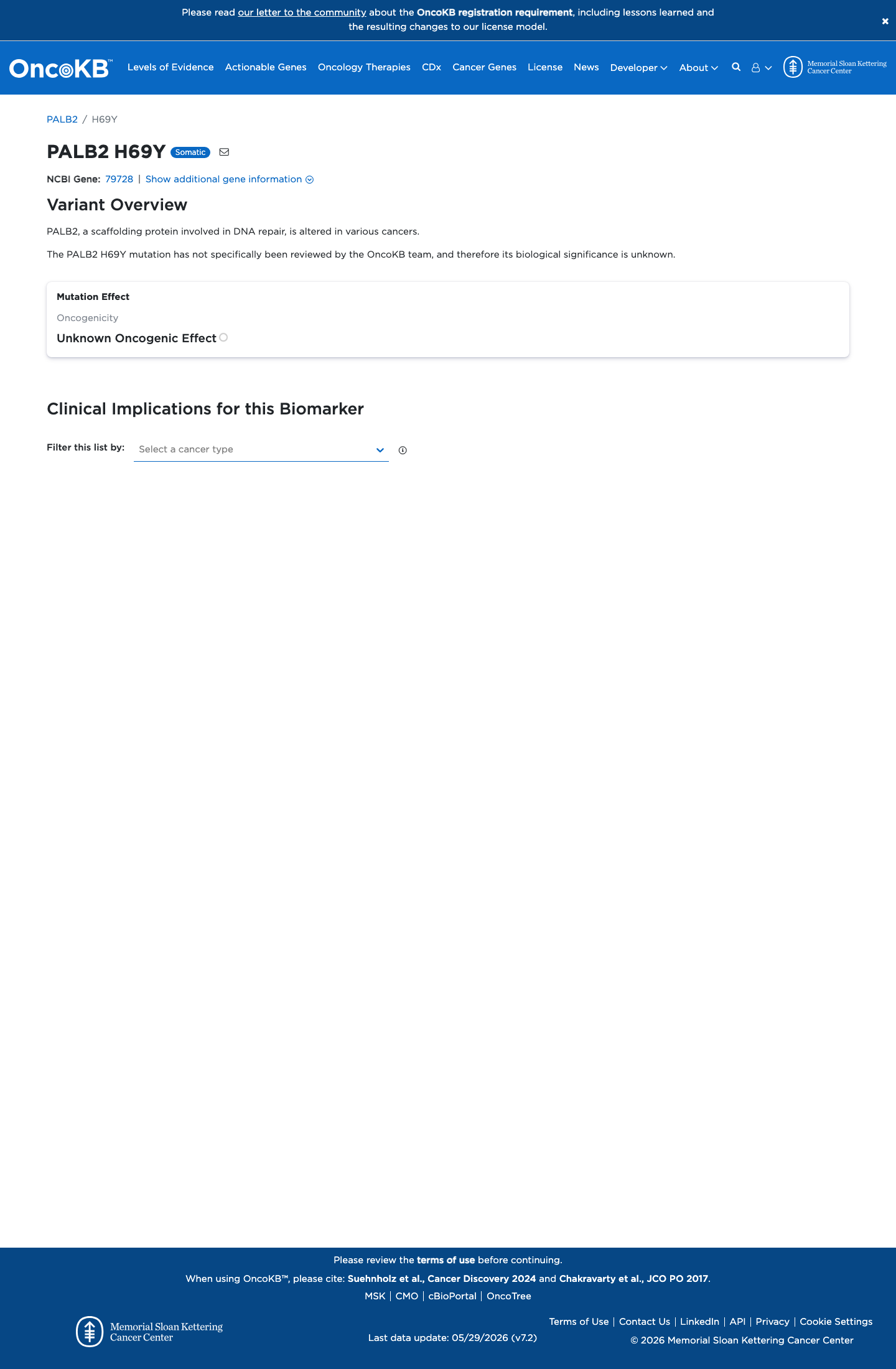
Unknown Oncogenic Effect
OncoKB did not identify variant-specific reviewed functional evidence for this variant; gene-level curated context is available for reviewer follow-up. PALB2, a scaffolding protein involved in DNA repair, is altered in various cancers.

COSMIC

Cancer hotspots
Somatic evidence
Not in COSMIC / hotspots
COSMIC
This variant does not lie in a statistically significant hotspot. This variant has not previously been reported in somatic cancers (COSMIC).
Hotspots
This variant does not lie in a statistically significant hotspot.
Sources & reference links
9Sources
Triaged references · 8 PMIDs not cited in assessment
25741868 ↗
Standards and guidelines for the interpretation of sequence variants: a joint consensus recommendation of the American College of Medical Genetics and Genomics and the Association for Molecular Pathology.
CLINVAR
26467025 ↗
A Standardized DNA Variant Scoring System for Pathogenicity Assessments in Mendelian Disorders.
CLINVAR
34326862 ↗
Analysis of Sequence and Copy Number Variants in Canadian Patient Cohort With Familial Cancer Syndromes Using a Unique Next Generation Sequencing Based Approach.
CLINVAR
31429903 ↗
Risk Assessment, Genetic Counseling, and Genetic Testing for BRCA-Related Cancer: US Preventive Services Task Force Recommendation Statement.
CLINVAR