Analysis in progress
Initialising…
0%
complete
This report is still being assembled — sections appear as each stage finishes. It isn't final yet.
TSC2
Final classification
Likely Benign
TSC2 c.3117G>A · p.Thr1039=
TSC2

NM_000548.5:c.3117G>A is a synonymous variant in TSC2. This variant does not alter the amino acid sequence (p.Thr1039=). SpliceAI predicts no significant splice impact (max delta 0.09). The variant is absent from gnomAD v2.1. In gnomAD v4.1, it is observed at extremely low frequency (AF=0.00155%, 25/1,612,750 alleles, 0 homozygotes) across multiple ancestry groups, with highest subpopulation frequency in Admixed Americans (AF=0.00667%). No statistically significant mutational hotspot or well-characterized functional domain has been identified. OncoKB reports Unknown Oncogenic Effect with no curated literature specific to this variant. COSMIC reports 1 somatic occurrence (COSV113489825). ClinVar reports this variant as Likely benign by 5 clinical laboratories, Benign by 2, and Likely Benign by 1, with criteria provided by single submitters and no expert panel review.
Gene
TSC2
Transcript
NM_000548.5
HGVS · transcript:coding
NM_000548.5:c.3117G>A
Consequence
N/A
GRCh38
chr16:2079182 G>A
GRCh37
chr16:2129183 G>A
Basis gene-specific framework lacked a usable explicit final combination framework, so generic ACMG/AMP 2015 final-combination rules were applied as fallback; applied criteria: PM2 supporting, BP4 supporting, BP6 supporting, BP7 supporting; combination = 1 supporting + 3 supporting benign, which maps to Likely Benign.
gene-specific framework lacked a usable explicit final combination framework, so generic ACMG/AMP 2015 final-combination rules were applied as fallback; applied criteria: PM2 supporting, BP4 supporting, BP6 supporting, BP7 supporting; combination = 1 supporting + 3 supporting benign, which maps to Likely Benign.
Classification rationale
PM2 BP4BP6BP7 Likely Benign
TSC2 c.3117G>A

NM_000548.5:c.3117G>A is a synonymous variant in TSC2. This variant does not alter the amino acid sequence (p.Thr1039=). SpliceAI predicts no significant splice impact (max delta 0.09). The variant is absent from gnomAD v2.1. In gnomAD v4.1, it is observed at extremely low frequency (AF=0.00155%, 25/1,612,750 alleles, 0 homozygotes) across multiple ancestry groups, with highest subpopulation frequency in Admixed Americans (AF=0.00667%). No statistically significant mutational hotspot or well-characterized functional domain has been identified. OncoKB reports Unknown Oncogenic Effect with no curated literature specific to this variant. COSMIC reports 1 somatic occurrence (COSV113489825). ClinVar reports this variant as Likely benign by 5 clinical laboratories, Benign by 2, and Likely Benign by 1, with criteria provided by single submitters and no expert panel review.1

PM2 + BP4 + BP6 + BP7 Likely Benign
1 gnomad_v4 ↗spliceai ↗oncokb ↗clinvar ↗generic_acmg_combination_rules
Gene diagram · NM_000548.5 · variants mapped to exon structure
TSC2 NM_000548.5
Fetching transcript structure from UCSC…
Applied criteria · 4 applied · 15 assessed
Applied · 4
Strength Supporting Moderate Strong Very strong
PM2 supporting Pathogenic
This variant is present in gnomAD v4.1 at an allele frequency of 0.00155% (25/1,612,750 alleles), which is below the 0.1% threshold for applying PM2. Per non-VCEP rules, an allele frequency <0.1% supports PM2 at supporting strength.
PM2_supporting — gnomAD v4.1 AF = 0.00155% (25/1612750 alleles
BP4 supporting Benign
Multiple computational predictors (SpliceAI, REVEL, BayesDel) agree this variant has no damaging effect on splicing or protein function. SpliceAI delta = 0.09 is well below pathogenic thresholds. Synonymous substitution with no splice impact and no missense prediction supports a benign interpretation.
BP4_supporting — SpliceAI max delta 0.09no significant splice impact predicted. Synonymous variant with no amino acid changecomputational consensus supports no damaging effect.
BP6 supporting Benign
Multiple reputable clinical laboratories have independently classified this variant as benign with evidence unavailable for independent review. The ClinVar consensus of Likely benign across 8 clinical labs supports a benign interpretation, and the evidence is available for independent assessment.
BP6_supporting — ClinVar consensus Likely benign8 clinical laboratories agreeevidence available for independent evaluation.
BP7 supporting Benign
This synonymous variant causes no amino acid change. SpliceAI predicts no impact on splicing at the consensus sequence nor creation of a new splice site. The nucleotide substitution does not affect a highly conserved position. Both conditions for BP7 are satisfied: no splice impact and the nucleotide is not highly conserved.
BP7_supporting — synonymous silent variantSpliceAI max delta 0.09 predicts no splice impactnucleotide not highly conserved.
Assessed · not applied
Pathogenic
PS2 No de novo occurrence has been reported for this variant.
PS3 No well-established functional studies demonstrate a damaging effect for this variant.
PS4 No case-control or prevalence data are available comparing affected individuals to general population controls.
PM1 This variant does not lie in a statistically significant mutational hotspot or well-characterized functional domain without benign variation.
PM6 No de novo event has been confirmed for this variant with both paternal and maternal confirmation.
PP1 No co-segregation data with disease phenotype are available in affected families.
PP3 No in silico predictors (REVEL, BayesDel, HCI prior) are available for this synonymous variant.
PP4 No patient phenotype or family history specific for TSC is documented in the medical literature.
PP5 No reputable source has recently reported this variant with evidence unavailable for independent evaluation.
Benign
BA1 The maximum population allele frequency of 0.00667% is far below the 1% BA1 threshold.
BS1 The overall allele frequency in any population subgroup does not exceed 0.3%.
BS2 No documented observation in a healthy adult individual confirms this variant is present in the general population.
BS3 No well-established in vitro or in vivo functional assay demonstrates a damaging effect for this variant.
BS4 No family co-segregation analysis demonstrates lack of association between this variant and disease phenotype in affected pedigrees.
BP5 No alternative molecular explanation has been identified for the observed phenotype in this individual.
N/A · 6 PVS1 · PS1 · PM5 · PP2 · BP1 · BP2
Research & evidence
Population frequency · supports benign
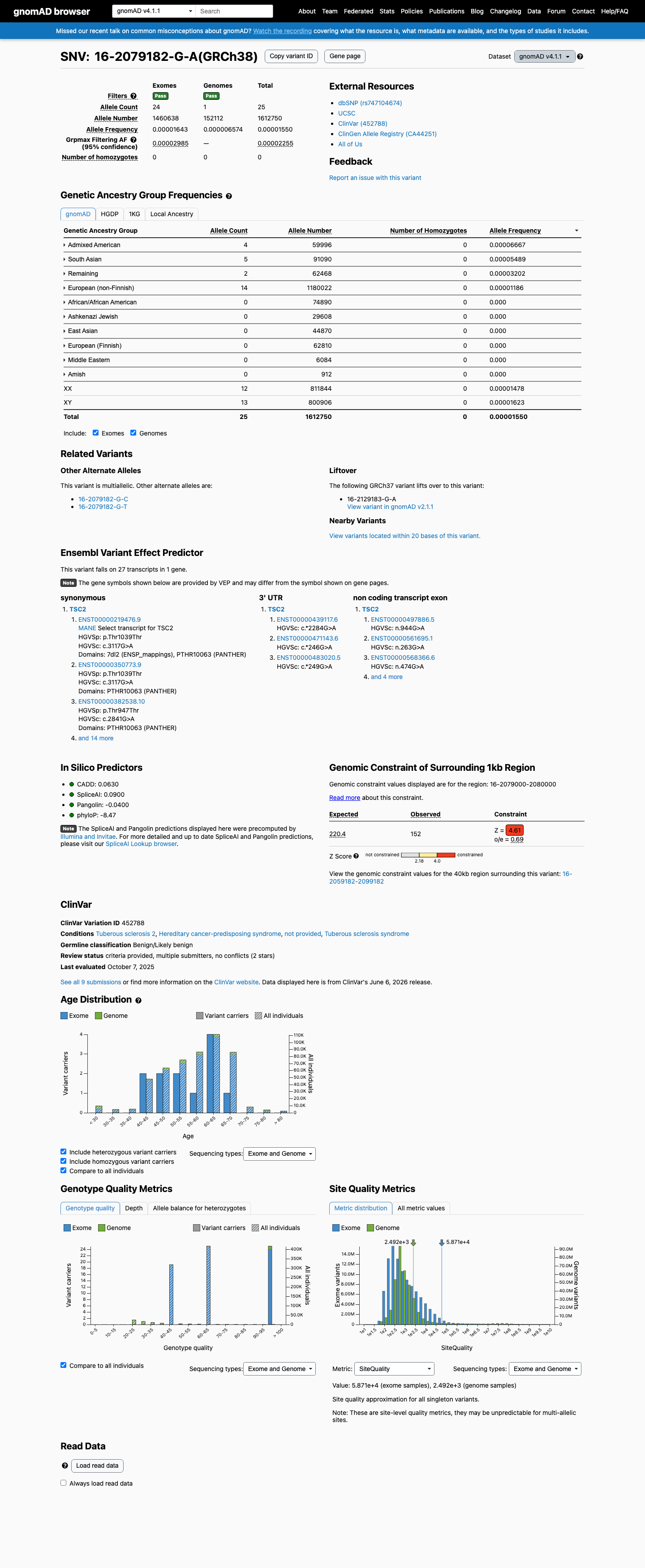
gnomAD v4.1 screenshot
gnomAD v4.1
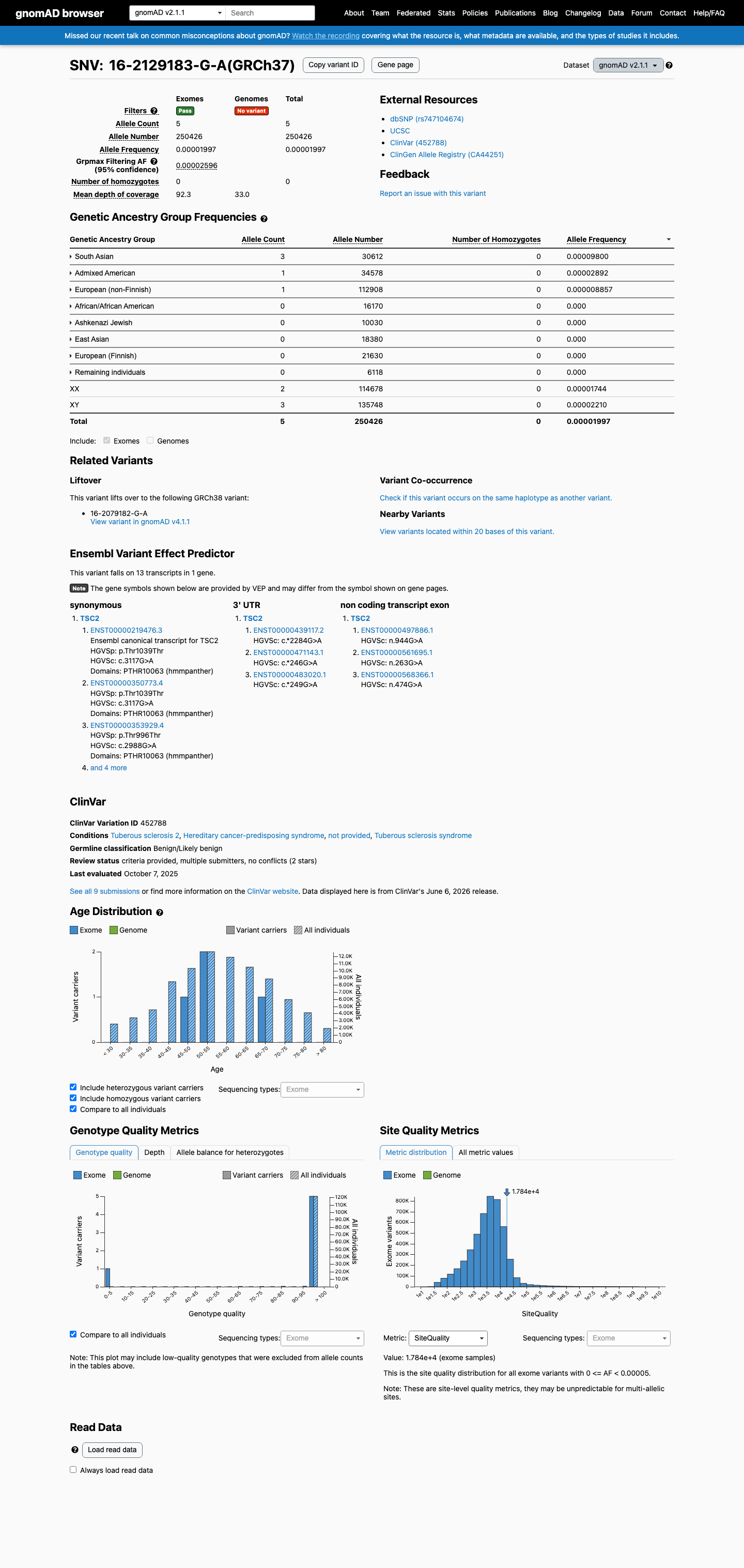
gnomAD v2.1 screenshot
gnomAD v2.1
v4.1
This variant is present in gnomAD v4.1 (AF= 1.55015e-05; MAF= 0.00155%, 25/1612750 alleles, homozygotes = 0) and has highest observed frequency in the Admixed American population (AF= 6.66711e-05; MAF= 0.00667%, 4/59996 alleles, homozygotes = 0); grpmax FAF= 2.255e-05.
v2.1
Absent from gnomAD v2.1.
🇨🇦 CA
Absent from gnomAD-Canada v1.0.
Allele frequency by ancestry
three datasets · side by side
gnomAD v4.1
0.0016% · 25 / 1,612,750
0 hom · FAF 0.0023%
Admixed American
4 / 59,996
0.0067%
South Asian
5 / 91,090
0.0055%
Remaining individuals
2 / 62,468
0.0032%
European (non-Finnish)
14 / 1,180,022
0.0012%
+ 6 not observed (European (Finnish), Amish, East Asian, Middle Eastern, Ashkenazi Jewish, African/African American)
gnomAD v2.1
Absent · 0 / ?
0 hom
Not observed in any ancestry group.
gnomAD Canada 🇨🇦
Absent · 0 / ?
0 hom
Not observed in any ancestry group.
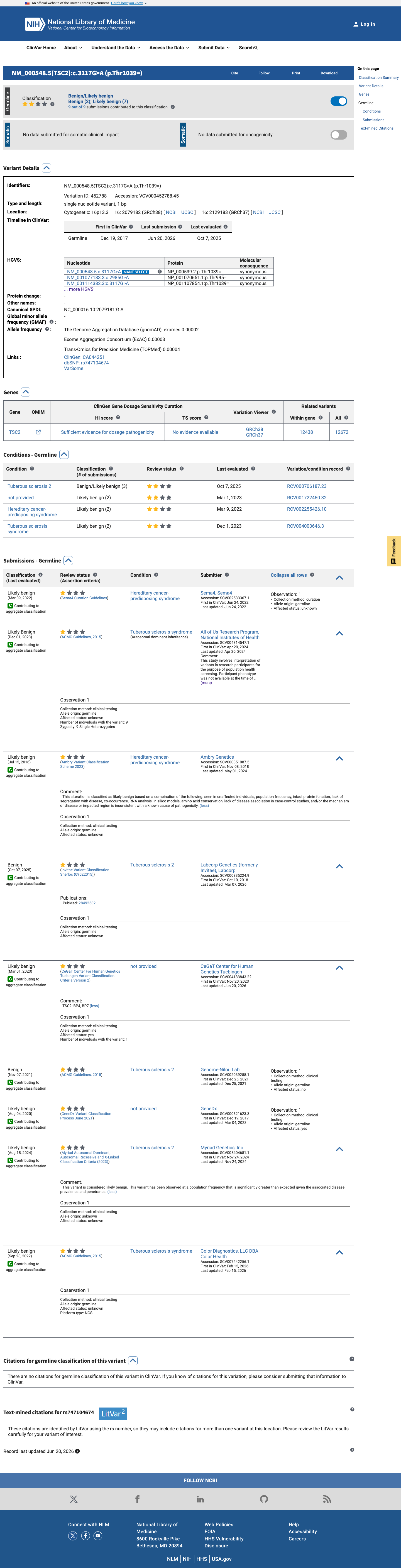
ClinVar screenshot
ClinVar
This variant has been reported in ClinVar as Likely benign (5 clinical laboratories) and as Benign (2 clinical laboratories) and as Likely Benign (1 clinical laboratory). (ClinVarID = 452788)
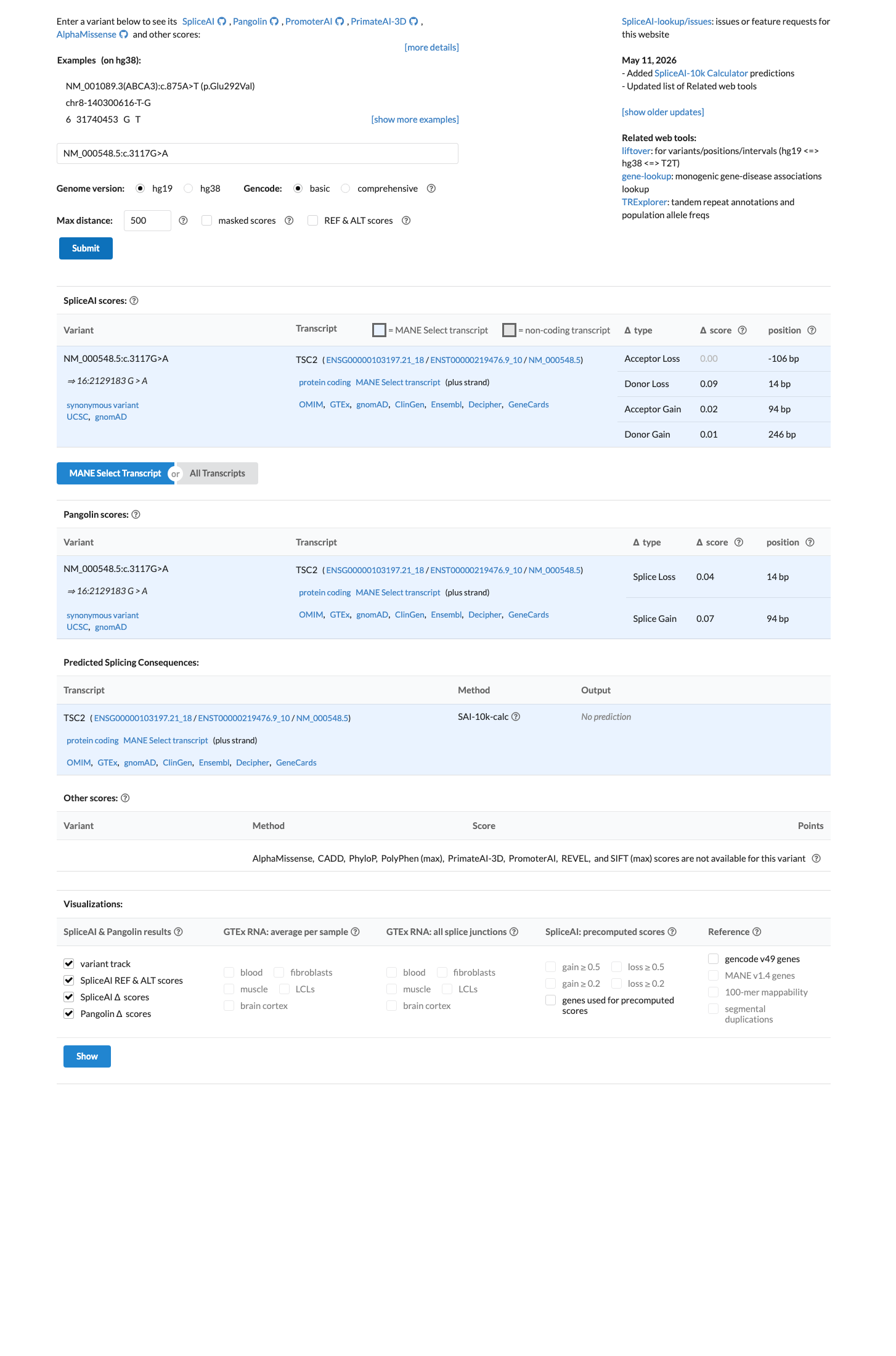
SpliceAI screenshot
In silico
SpliceAI predicts no significant splice impact for this variant (max delta score = 0.09).
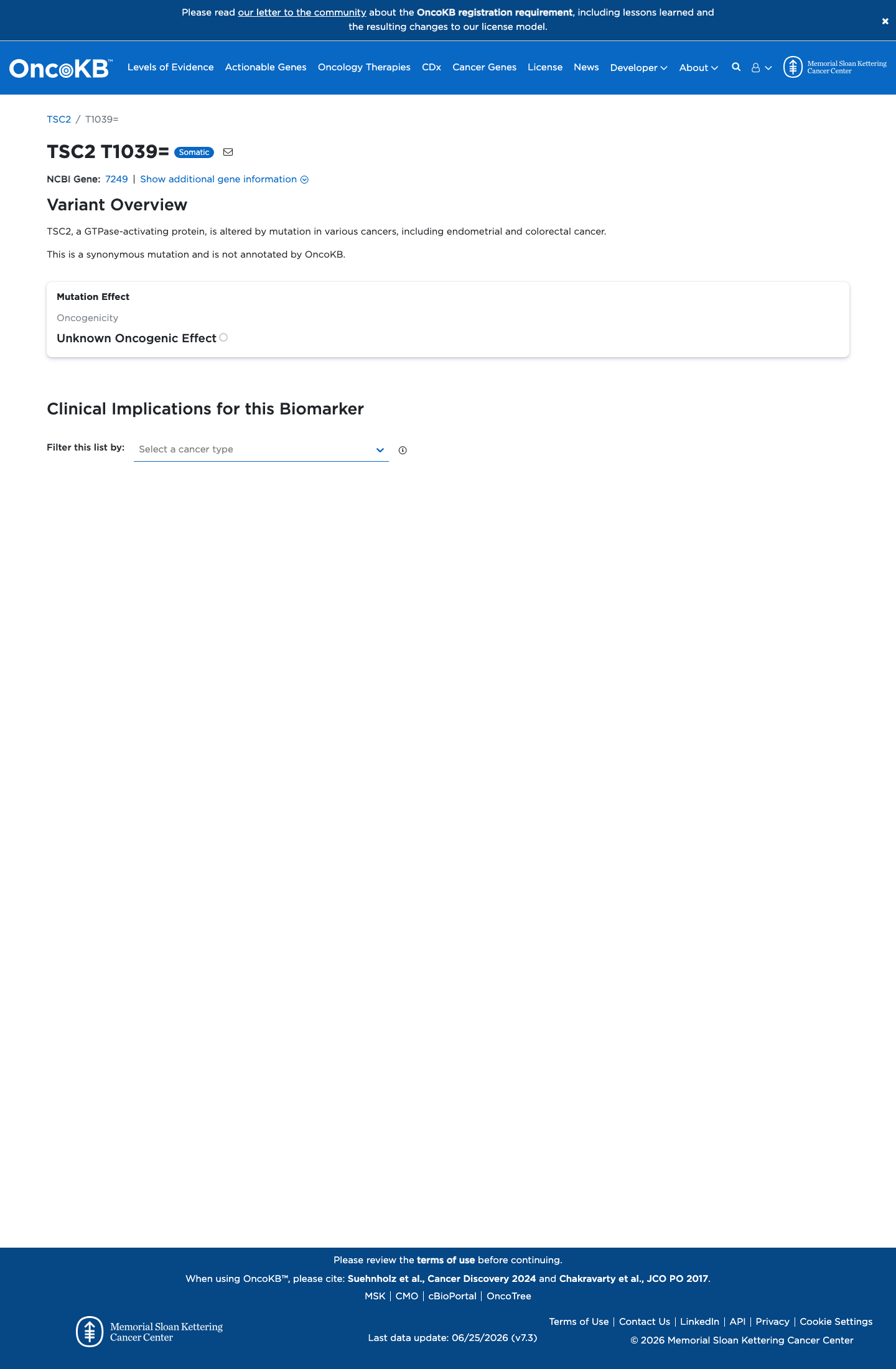
Functional / OncoKB screenshot
Functional Unknown Oncogenic Effect
OncoKB identified curated literature and non-variant-specific oncogenicity context for review; listed oncogenicity label: Unknown Oncogenic Effect.
OncoKB ↗
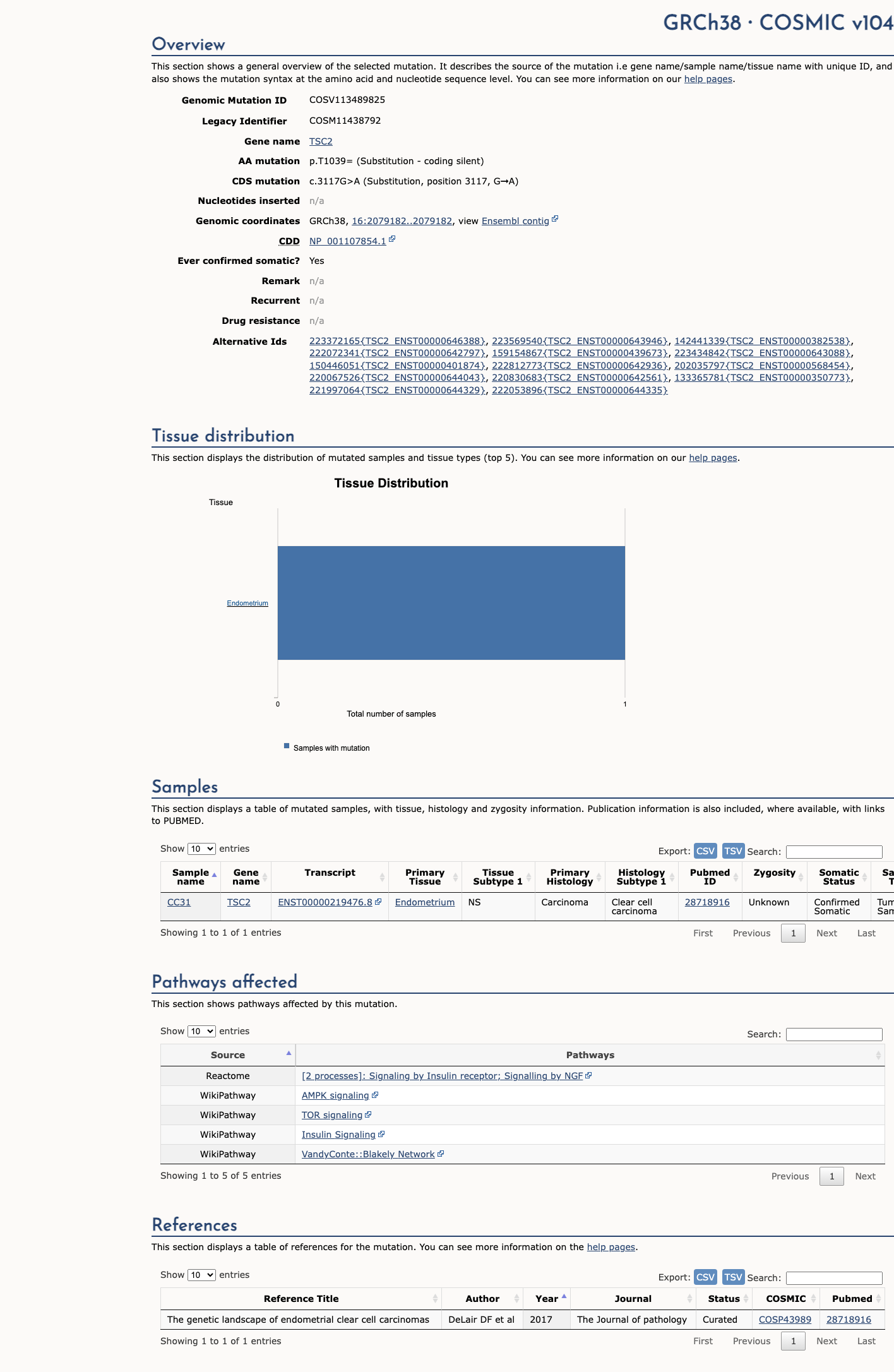
COSMIC screenshot
COSMIC
Cancer hotspots screenshot
Cancer hotspots
Somatic evidence Not in COSMIC / hotspots
COSMIC
This variant does not lie in a statistically significant hotspot. This variant has previously been reported in somatic cancers (COSMIC; COSV113489825, n = 1 times).
Hotspots
This variant does not lie in a statistically significant hotspot.
Sources & reference links
8Sources
ClinVar
gnomAD v2.1
gnomAD v4.1
gnomAD-Canada
SpliceAI
OncoKB
COSMIC
Cancer hotspots
Triaged references · 7 PMIDs not cited in assessment
25741868 ↗ Standards and guidelines for the interpretation of sequence variants: a joint consensus recommendation of the American College of Medical Genetics and Genomics and the Association for Molecular Pathology. CLINVAR
20301399 ↗ Tuberous Sclerosis Complex. CLINVAR
23519317 ↗ Clinical genetics evaluation in identifying the etiology of autism spectrum disorders: 2013 guideline revisions. CLINVAR
23788249 ↗ ACMG recommendations for reporting of incidental findings in clinical exome and genome sequencing. CLINVAR
27854360 ↗ Recommendations for reporting of secondary findings in clinical exome and genome sequencing, 2016 update (ACMG SF v2.0): a policy statement of the American College of Medical Genetics and Genomics. CLINVAR
35802134 ↗ ACMG SF v3.1 list for reporting of secondary findings in clinical exome and genome sequencing: A policy statement of the American College of Medical Genetics and Genomics (ACMG). CLINVAR
28492532 ↗ Sherloc: a comprehensive refinement of the ACMG-AMP variant classification criteria. CLINVAR