NM_006445.3:c.471T>C is a synonymous variant (p.Asp157=) in PRPF8 that is present at extremely low frequency in population databases (gnomAD v2.1: 6/282,676 alleles, AF=0.00212%; gnomAD v4.1: 17/1,613,606 alleles, AF=0.00105%).1 SpliceAI predicts no splicing impact for this variant (max delta score = 0.00), consistent with a synonymous change that does not alter the protein sequence or mRNA processing.2 This variant has been reported in ClinVar as Likely benign by Labcorp Genetics (formerly Invitae), a reputable clinical laboratory, with criteria provided (ClinVar Variation ID: 1133865, SCV001672660).3 No published literature identifies NM_006445.3:c.471T>C in association with disease; the sole ClinVar-cited reference (PMID:28492532, Sherloc framework paper) does not mention this specific variant.4 Three supporting benign criteria (BP4, BP6, BP7) outweigh one supporting pathogenic criterion (PM2). Under ACMG/AMP 2015 combination rules (PMID:25741868), this yields a final classification of Likely benign.5
PRPF8
Final classification
Likely Benign
PRPF8 c.471T>C · p.Asp157=
PRPF8
NM_006445.3:c.471T>C is a synonymous variant (p.Asp157=) in PRPF8 that is present at extremely low frequency in population databases (gnomAD v2.1: 6/282,676 alleles, AF=0.00212%; gnomAD v4.1: 17/1,613,606 alleles, AF=0.00105%).
gene-specific framework lacked a usable explicit final combination framework, so generic ACMG/AMP 2015 final-combination rules were applied as fallback; applied criteria: PM2 supporting, BP4 supporting benign, BP6 supporting benign, BP7 supporting benign; combination = 1 supporting + 3 supporting benign, which maps to Likely Benign.
Classification rationale
PM2
BP4BP6BP7
Likely Benign
PRPF8 c.471T>C
PM2 + BP4 + BP6 + BP7
→
Likely Benign
5
generic_acmg_combination_rules
Gene diagram
· NM_006445.3 · variants mapped to exon structure
PRPF8
NM_006445.3
Fetching transcript structure from UCSC…
Applied criteria · 4 applied · 16 assessed
Applied · 4
Strength
Supporting
Moderate
Strong
Very strong
✓
PM2
supporting
Pathogenic
This variant is present in gnomAD at extremely low allele frequency: 6/282,676 alleles (AF=0.00212%) in v2.1 and 17/1,613,606 alleles (AF=0.00105%) in v4.1, both well below the non-VCEP threshold of 0.1%. No homozygotes observed.
gnomAD v2.1: 6/282676 alleles (AF=0.00212%)gnomAD v4.1: 17/1613606 alleles (AF=0.00105%)no homozygotes.
✓
BP4
supporting
Benign
SpliceAI predicts no splicing impact for this synonymous variant (max delta score = 0.00). Multiple lines of computational evidence suggest no effect on the gene product.
SpliceAI max delta = 0.00no predicted effect on splicingsynonymous variant with no amino acid change.
✓
BP6
supporting
Benign
This variant has been reported in ClinVar as Likely benign by Labcorp Genetics (formerly Invitae), a reputable clinical diagnostic laboratory, with criteria provided (SCV001672660).
ClinVar: Likely benigncriteria providedsingle submitter (Labcorp/Invitae
✓
BP7
supporting
Benign
This is a synonymous variant (p.Asp157=) with SpliceAI delta score of 0.00, indicating no predicted impact on splicing. The nucleotide substitution is not predicted to affect mRNA processing.
Synonymous variant at c.471T>C (p.Asp157=)SpliceAI max delta = 0.00no predicted splicing alteration.
Assessed · not applied
Pathogenic
PS2
No de novo data are available for this variant in any reviewed source.
PS3
No well-established functional studies have been identified for this variant.
PS4
No case-control prevalence data are available.
PM1
This variant is not located in a recognized mutational hotspot or well-established critical functional domain.
PM6
No de novo data are available for this variant.
PP1
No segregation data are available for this variant.
PP3
No in silico tools predict a deleterious effect.
PP4
No patient phenotype data are available to assess specificity for a PRPF8-associated disorder.
PP5
ClinVar reports this variant as Likely benign, not pathogenic.
Benign
BA1
Allele frequency in gnomAD is 0.002% (v2.1) and 0.001% (v4.1), well below the 1% threshold for BA1.
BS1
Allele frequency in gnomAD is 0.002% (v2.1) and 0.001% (v4.1), below the non-VCEP threshold of 0.3% for BS1.
BS2
No homozygotes have been observed in gnomAD, and no data are available on co-occurrence with a known pathogenic variant in trans.
BS3
No well-established functional studies demonstrate no damaging effect for this specific variant.
BS4
No segregation data are available to assess non-segregation with disease.
BP2
No data are available on co-occurrence of this variant in trans with a known pathogenic variant or in cis with a pathogenic variant in a recessive disorder gene.
BP5
No data are available on an alternative molecular basis for disease in a case harboring this variant.
N/A · 8
PVS1 · PS1 · PM3 · PM4 · PM5 · PP2 · BP1 · BP3
Research & evidence
Population frequency · supports benign
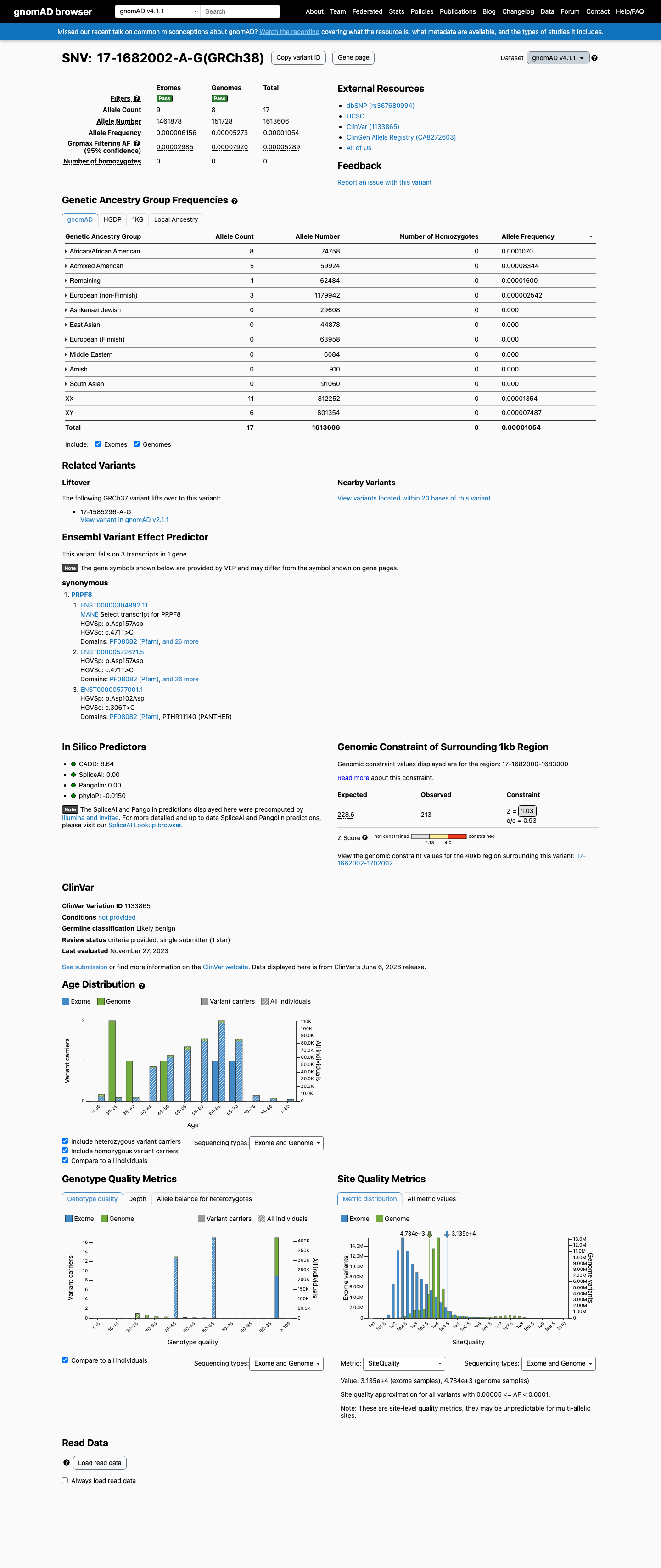
gnomAD v4.1
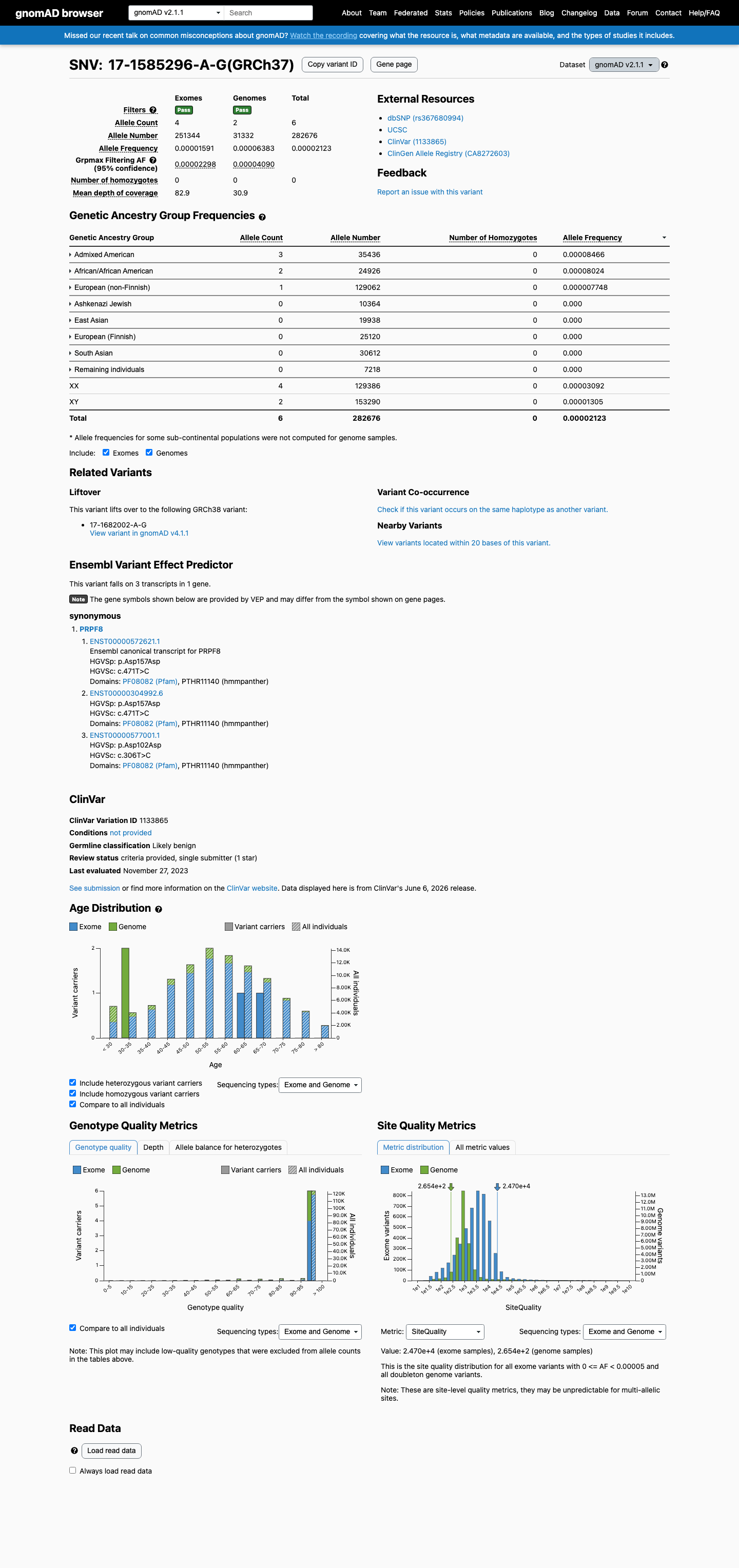
gnomAD v2.1
v4.1
This variant is present in gnomAD v4.1 (AF= 1.05354e-05; MAF= 0.00105%, 17/1613606 alleles, homozygotes = 0) and has highest observed frequency in the African/African American population (AF= 0.000107012; MAF= 0.01070%, 8/74758 alleles, homozygotes = 0); grpmax FAF= 5.289e-05.
v2.1
This variant is present in gnomAD v2.1 (AF= 2.12257e-05; MAF= 0.00212%, 6/282676 alleles, homozygotes = 0) and has highest observed frequency in the Admixed American population (AF= 8.46597e-05; MAF= 0.00847%, 3/35436 alleles, homozygotes = 0); grpmax FAF= 4.09e-05.
🇨🇦 CA
Not available in gnomAD-Canada v1.0.
Allele frequency by ancestry
three datasets · side by side
gnomAD v4.1
0.0011%
· 17 / 1,613,606
0 hom · FAF 0.0053%
0 hom · FAF 0.0053%
African/African American 8 / 74,758 |
0.011% |
Admixed American 5 / 59,924 |
0.0083% |
Remaining individuals 1 / 62,484 |
0.0016% |
European (non-Finnish) 3 / 1,179,942 |
0.00025% |
+ 6 not observed (European (Finnish), Amish, East Asian, Middle Eastern, South Asian, Ashkenazi Jewish)
gnomAD v2.1
0.0021%
· 6 / 282,676
0 hom · FAF 0.0041%
0 hom · FAF 0.0041%
Admixed American 3 / 35,436 |
0.0085% |
African/African American 2 / 24,926 |
0.008% |
European (non-Finnish) 1 / 129,062 |
0.00077% |
+ 5 not observed (Ashkenazi Jewish, East Asian, European (Finnish), Remaining individuals, South Asian)
gnomAD Canada 🇨🇦
Absent
· 0 / ?
0 hom
0 hom
Not observed in any ancestry group.
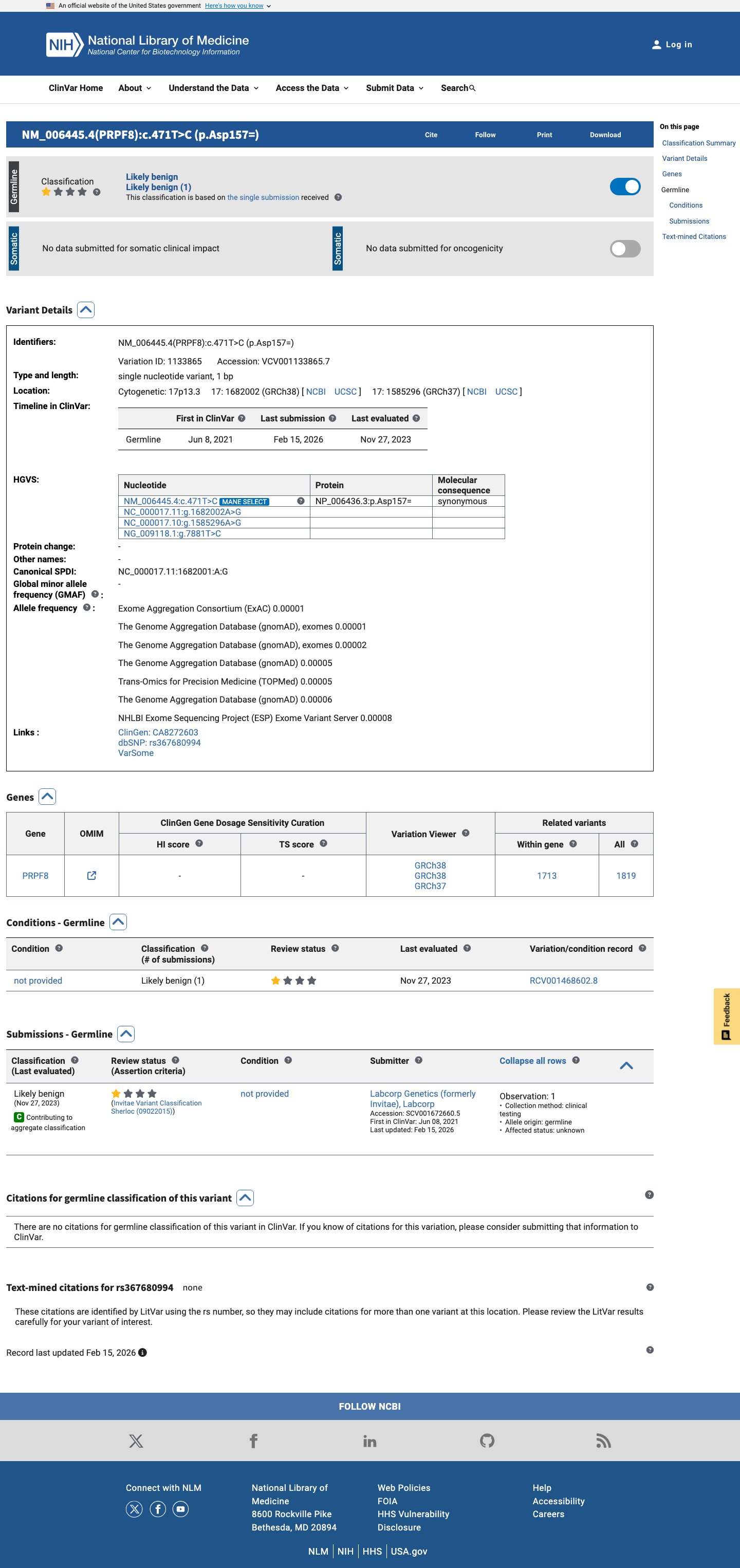
ClinVar
This variant has been reported in ClinVar as Likely benign (1 clinical laboratory). (ClinVarID = 1133865)
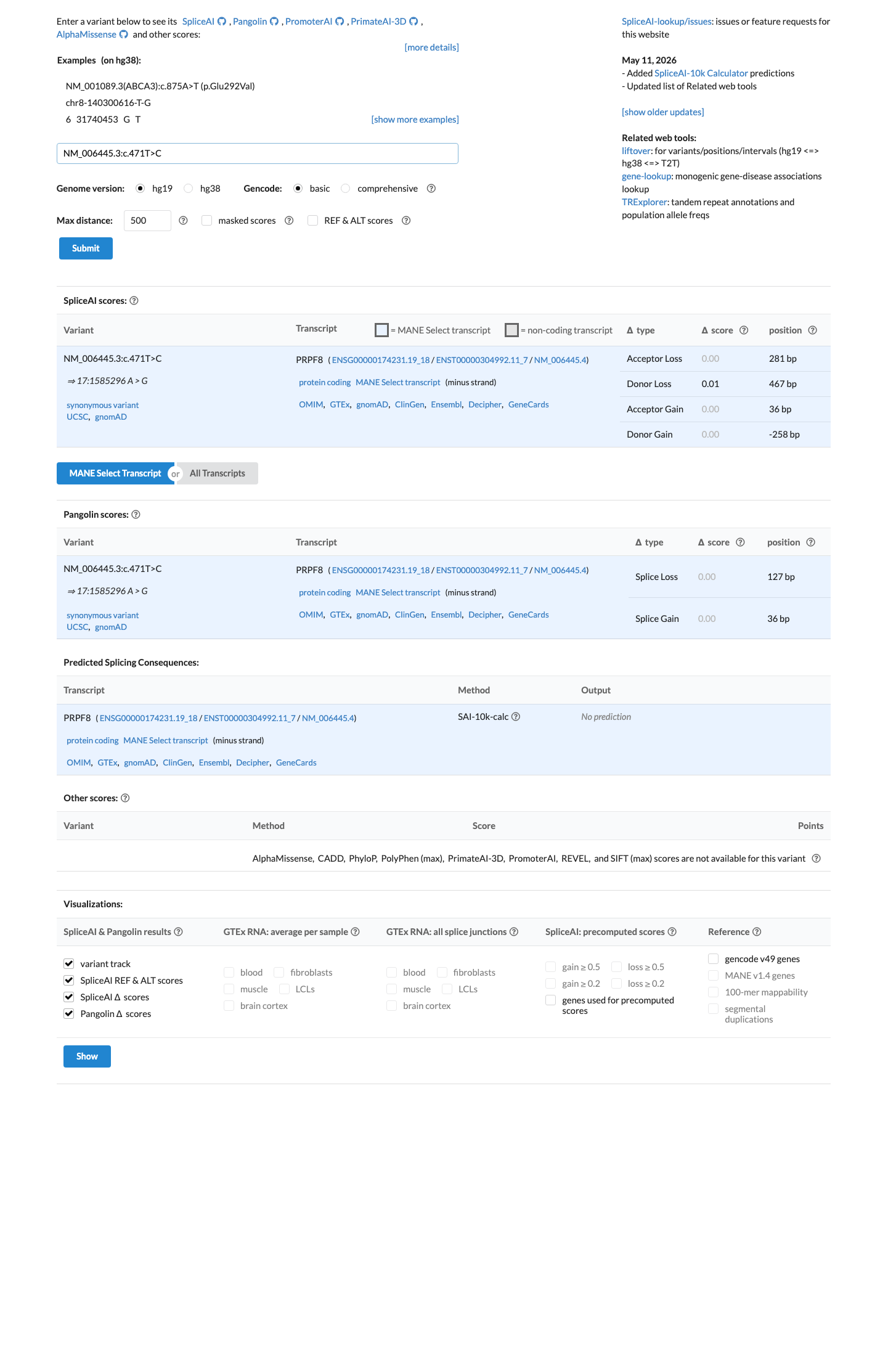
In silico
SpliceAI predicts no significant splice impact for this variant (max delta score = 0.00).
Functional
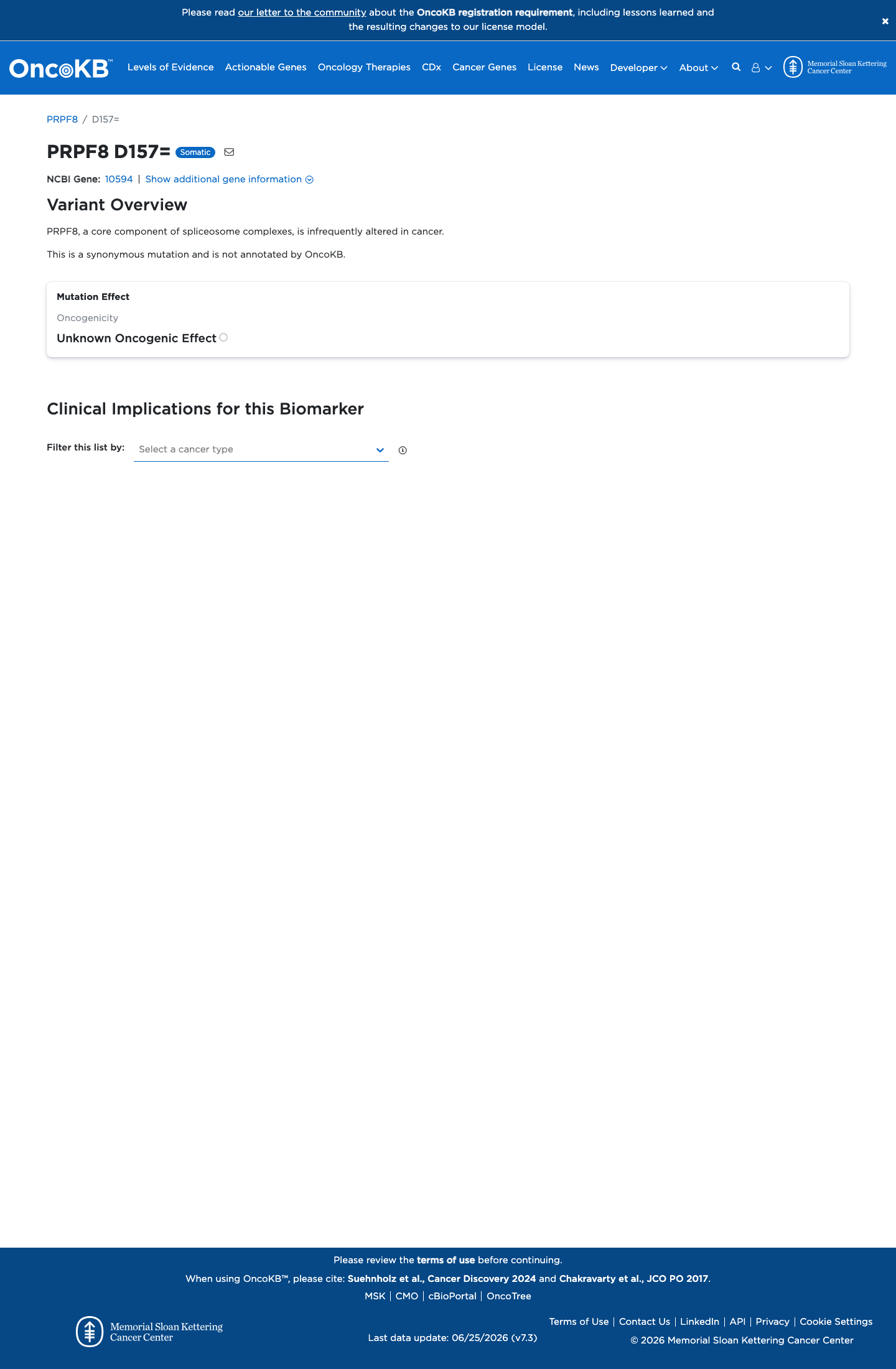
Unknown Oncogenic Effect
OncoKB identified curated literature and non-variant-specific oncogenicity context for review; listed oncogenicity label: Unknown Oncogenic Effect.

COSMIC

Cancer hotspots
Somatic evidence
Not in COSMIC / hotspots
COSMIC
This variant does not lie in a statistically significant hotspot. This variant has not previously been reported in somatic cancers (COSMIC).
Hotspots
This variant does not lie in a statistically significant hotspot.
Sources & reference links
Triaged references · 1 PMID not cited in assessment
28492532 ↗
Sherloc: a comprehensive refinement of the ACMG-AMP variant classification criteria.
CLINVAR