NM_000051.4:c.2689T>A (p.Phe897Ile) in ATM is classified as Likely Benign based on two benign supporting criteria: BS3_Supporting (functional assay data demonstrates retained ATM kinase activity) and BP4_Supporting (REVEL 0.069, SpliceAI max delta 0.02, and six in silico predictors show no deleterious effect).1 No pathogenic criteria were met. The variant is present in gnomAD v4 at low frequency (AF 3.53×10⁻⁵, 57/1,613,938 alleles) but does not meet PM2_Supporting (threshold ≤0.001%). It has been reported in ClinVar as Uncertain Significance (Variation ID 188232, 16 clinical laboratories).2 The variant was observed in one ovarian cancer proband (PMID 29371908) but no segregation data are available. It has been reported in COSMIC (COSV99069668, n=3 somatic observations) but without established oncogenic significance.3
Final classification
Likely Benign
BS3BP4
ATM
c.2689T>A
p.Phe897Ile
This variant
NM_000051.4:c.2689T>A (p.Phe897Ile) in ATM is classified as Likely Benign based on two benign supporting criteria: BS3_Supporting (functional assay data demonstrates retained ATM kinase activity) and BP4_Supporting (REVEL 0.069, SpliceAI max delta 0.02, and six in silico predictors show no deleterious effect).
Richards et.al., 2015 - Combining rules v1.5.0 criteria-combination framework: matched Rule19 (Benign.Supporting >=2) with applied criteria: BS3 supporting, BP4 supporting; maps to Likely Benign.
Classification rationale
BS3BP4
Likely Benign
ATM c.2689T>A
BS3 + BP4
→
Likely Benign
1
vcep_suppl_tables1_pmid_40580951revelspliceai ↗PMID:29371908 ↗
LYFE Sciences is an AI system, and it can make mistakes. Criteria
may be applied incorrectly, sources may be misread, and a confident-looking
classification can still be wrong. Double-check every criterion and
its underlying evidence before relying on any call.
Gene diagram
· NM_000051.4 · variants mapped to exon structure
ATM
NM_000051.4
Fetching transcript structure from UCSC…
Applied criteria · 2 applied · 9 assessed
MetEvidence satisfies this criterion.
Not metEvaluated against available evidence; threshold not reached.
Not assessedApplies in principle, but no evidence was found to evaluate it.
N/ADoesn't apply to this variant type.
Applied · 2
Strength
Supporting
Moderate
Strong
Very strong
BS3
supporting
Benign
Functional assay data from the VCEP supplementary table (PMID 40580951) classifies F897I as 'Functional' with 'Medium-high' confidence, indicating retained ATM kinase activity. Per VCEP HBOP BS3 rules, rescue of an ATM-specific feature (kinase activity) supports BS3_Supporting.
VCEP supplementary table classifies F897I as 'Functional' (combined score 0.108confidence: Medium-high).VCEP-approved kinase assay framework assigns PS3_Supporting/BS3_Supporting strength for single-feature functional readouts.
BP4
supporting
Benign
REVEL score 0.069 is ≤0.249 (VCEP BP4 missense threshold). SpliceAI max delta score 0.02 is ≤0.1 (VCEP BP4 splicing threshold). Additionally, six in silico protein prediction tools showed no deleterious effect for this variant (PMID 29371908, Fig. 2).
REVEL: 0.069 ≤ 0.249.SpliceAI max delta: 0.02 ≤ 0.1.BayesDel: -0.350 (benign prediction).
Assessed · not applied
· 9 not met · 0 not assessed
Pathogenic
PS1
No pathogenic or likely pathogenic missense variant identified at residue Phe897 to serve as a PS1 comparator.
PS3
Functional assay data from the VCEP supplementary table (PMID 40580951) classifies F897I as 'Functional' with 'Medium-high' confidence, indicating retention of ATM kinase activity.
PS4
No case-control study meeting VCEP PS4 thresholds (p≤0.05 AND OR≥2 or lower 95% CI≥1.5) identified for this variant.
PM2
gnomAD v4 allele frequency is 3.53×10⁻⁵ (0.00353%; 57/1,613,938 alleles), exceeding the VCEP PM2_Supporting threshold of ≤0.001%.
PP1
No segregation data available.
PP3
REVEL score 0.069 falls below the VCEP PP3 missense threshold of >0.7333.
Benign
BA1
gnomAD v4 grpmax filtering allele frequency is 3.59×10⁻⁵ (0.00359%), well below the VCEP BA1 threshold of >0.5%.
BS1
gnomAD v4 grpmax filtering allele frequency is 3.59×10⁻⁵ (0.00359%), below the VCEP BS1 threshold of >0.05%.
BP2
No co-occurrence data in trans with a pathogenic ATM variant in Ataxia Telangiectasia probands is available.
N/A · 17
PVS1 · PS2 · PM1 · PM3 · PM4 · PM5 · PM6 · PP2 · PP4 · PP5 · BS2 · BS4 · BP1 · BP3 · BP5 · BP6 · BP7
Research & evidence
Population frequency · supports benign
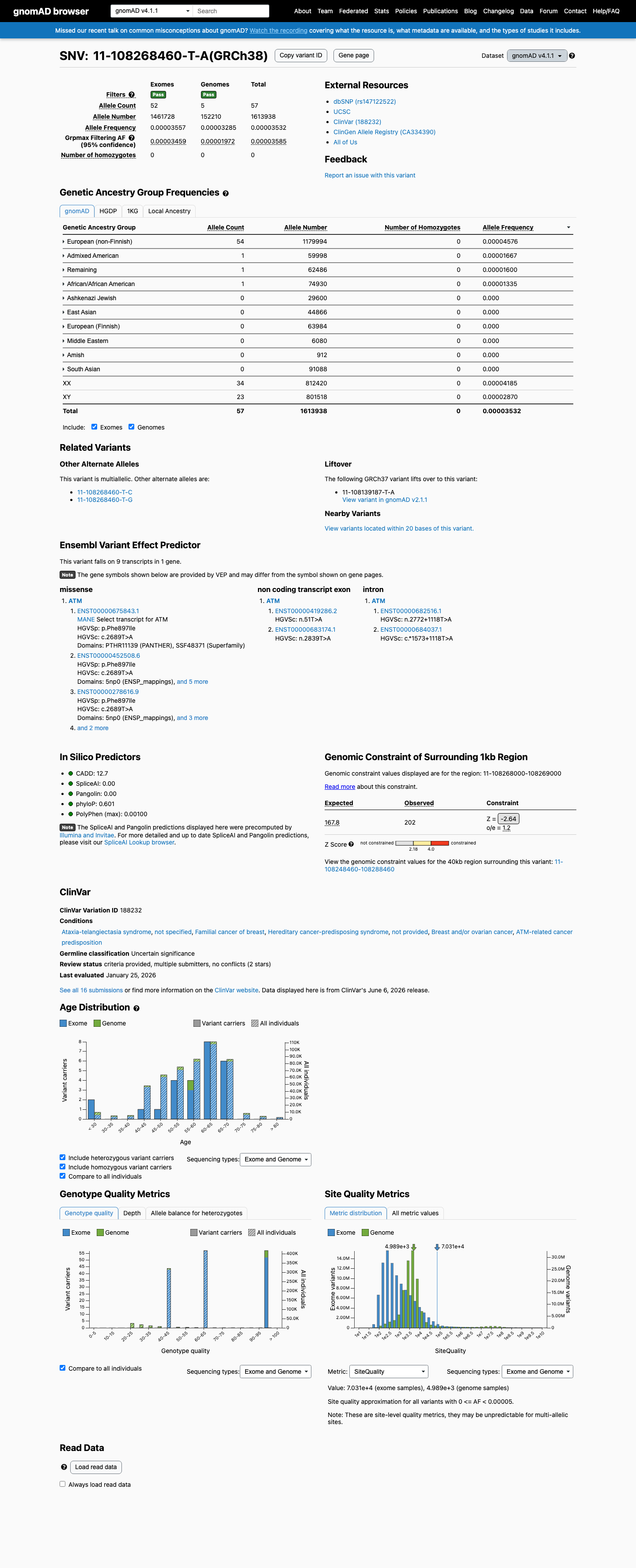
gnomAD v4.1
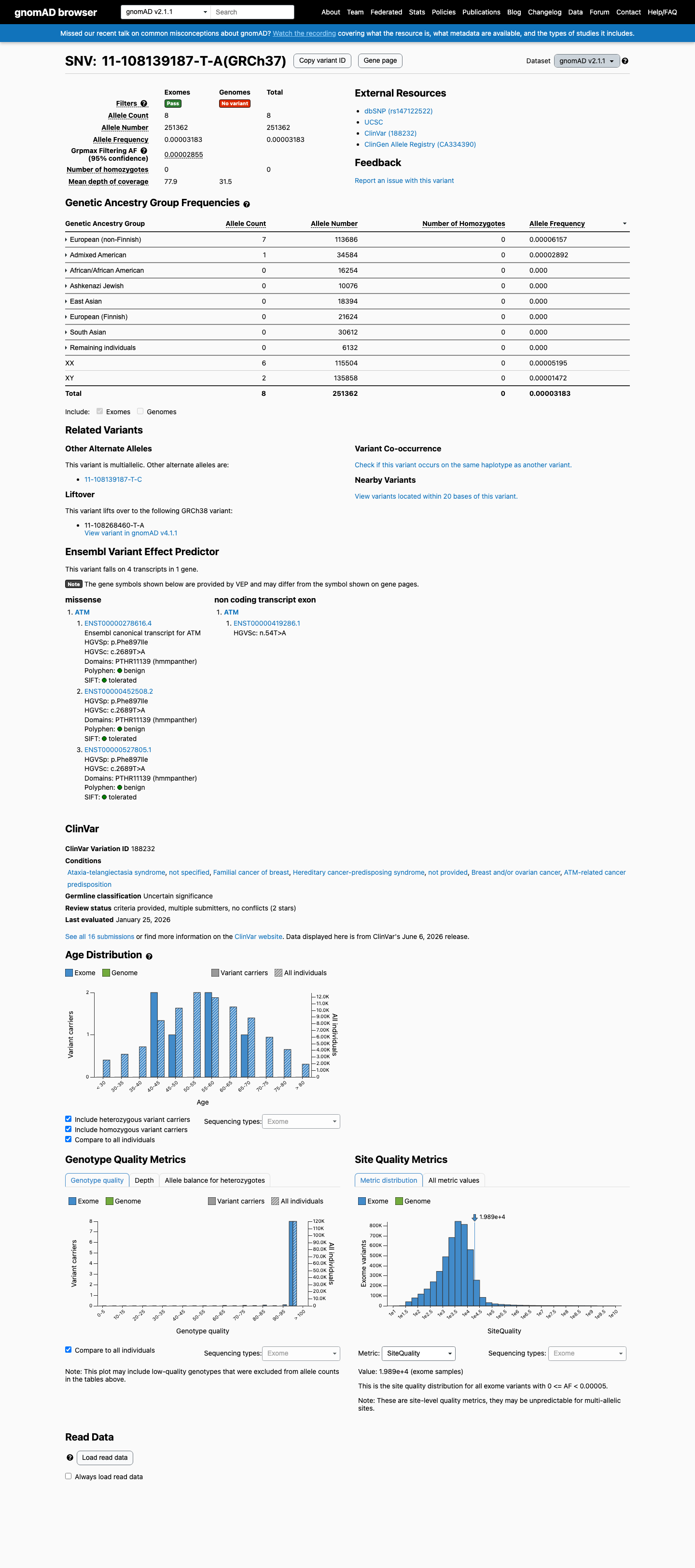
gnomAD v2.1
v4.1
This variant is present in gnomAD v4.1 (AF= 3.53173e-05; MAF= 0.00353%, 57/1613938 alleles, homozygotes = 0) and has highest observed frequency in the European (non-Finnish) population (AF= 4.57629e-05; MAF= 0.00458%, 54/1179994 alleles, homozygotes = 0); grpmax FAF= 3.585e-05.
v2.1
This variant is present in gnomAD v2.1 (AF= 3.18266e-05; MAF= 0.00318%, 8/251362 alleles, homozygotes = 0) and has highest observed frequency in the European (non-Finnish) population (AF= 6.15731e-05; MAF= 0.00616%, 7/113686 alleles, homozygotes = 0); grpmax FAF= 2.855e-05.
🇨🇦 CA
This variant is present in gnomAD-Canada v1.0 (AF= 0.0003256975355553143, 6/18422 alleles, homozygotes = 0).
Allele frequency by ancestry
three datasets · side by side
gnomAD v4.1
0.0035%
· 57 / 1,613,938
0 hom · FAF 0.0036%
0 hom · FAF 0.0036%
European (non-Finnish) 54 / 1,179,994 |
0.0046% |
Admixed American 1 / 59,998 |
0.0017% |
Remaining individuals 1 / 62,486 |
0.0016% |
African/African American 1 / 74,930 |
0.0013% |
+ 6 not observed (European (Finnish), Amish, East Asian, Middle Eastern, South Asian, Ashkenazi Jewish)
gnomAD v2.1
0.0032%
· 8 / 251,362
0 hom · FAF 0.0029%
0 hom · FAF 0.0029%
European (non-Finnish) 7 / 113,686 |
0.0062% |
Admixed American 1 / 34,584 |
0.0029% |
+ 6 not observed (African/African American, Ashkenazi Jewish, East Asian, European (Finnish), Remaining individuals, South Asian)
gnomAD Canada 🇨🇦
0.033%
· 6 / 18,422
0 hom · FAF 0.022%
0 hom · FAF 0.022%
European (non-Finnish) 6 / 11,742 |
0.051% |
+ 8 not observed (African/African American, Latino/Admixed American, Ashkenazi Jewish, East Asian, European (Finnish), Middle Eastern, Remaining individuals, South Asian)

ClinVar
This variant has been reported in ClinVar as Uncertain significance (16 clinical laboratories). (ClinVarID = 188232)
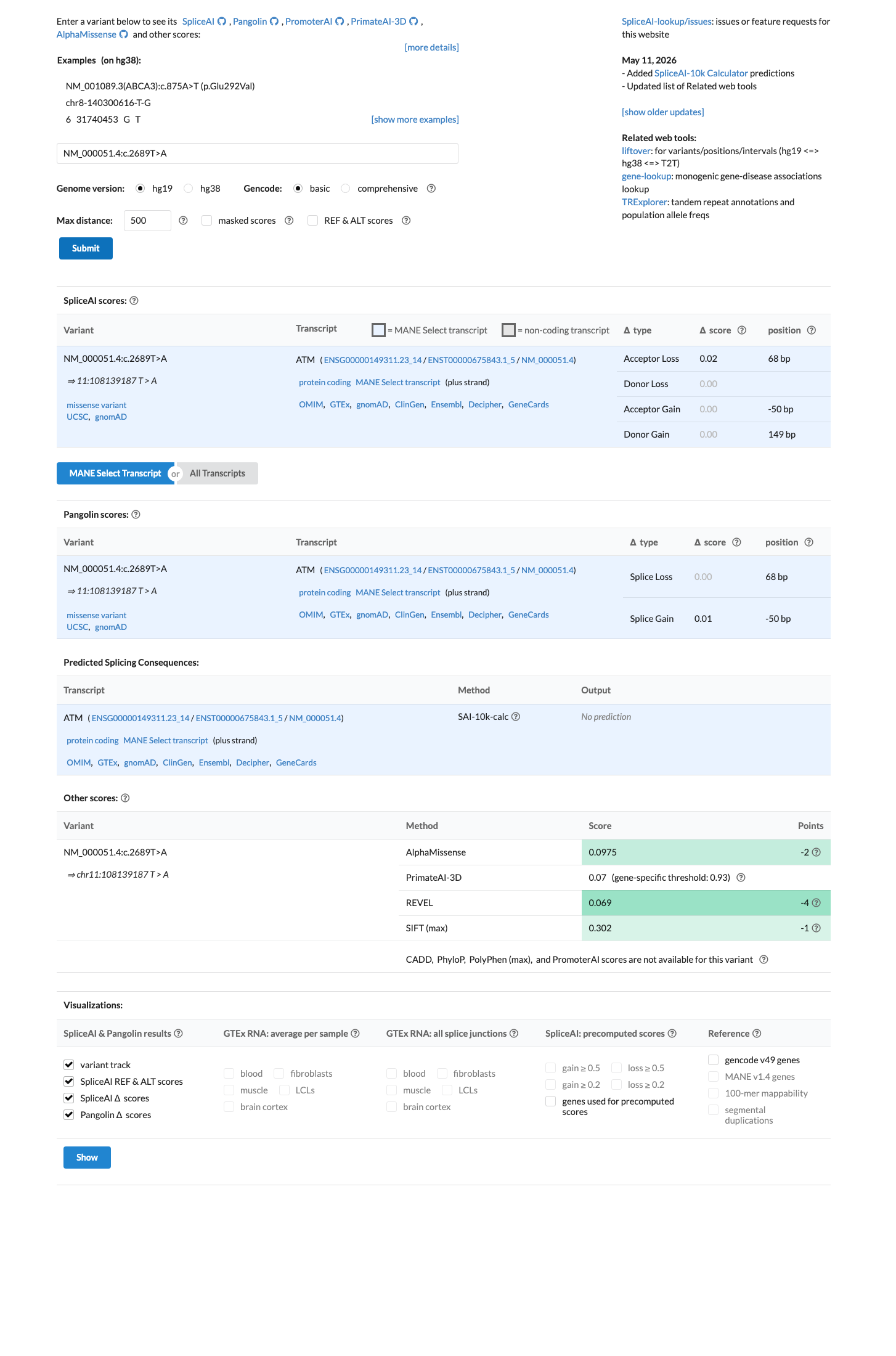
In silico
SpliceAI predicts no significant splice impact for this variant (max delta score = 0.02). REVEL score = 0.069. BayesDel score = -0.350015.
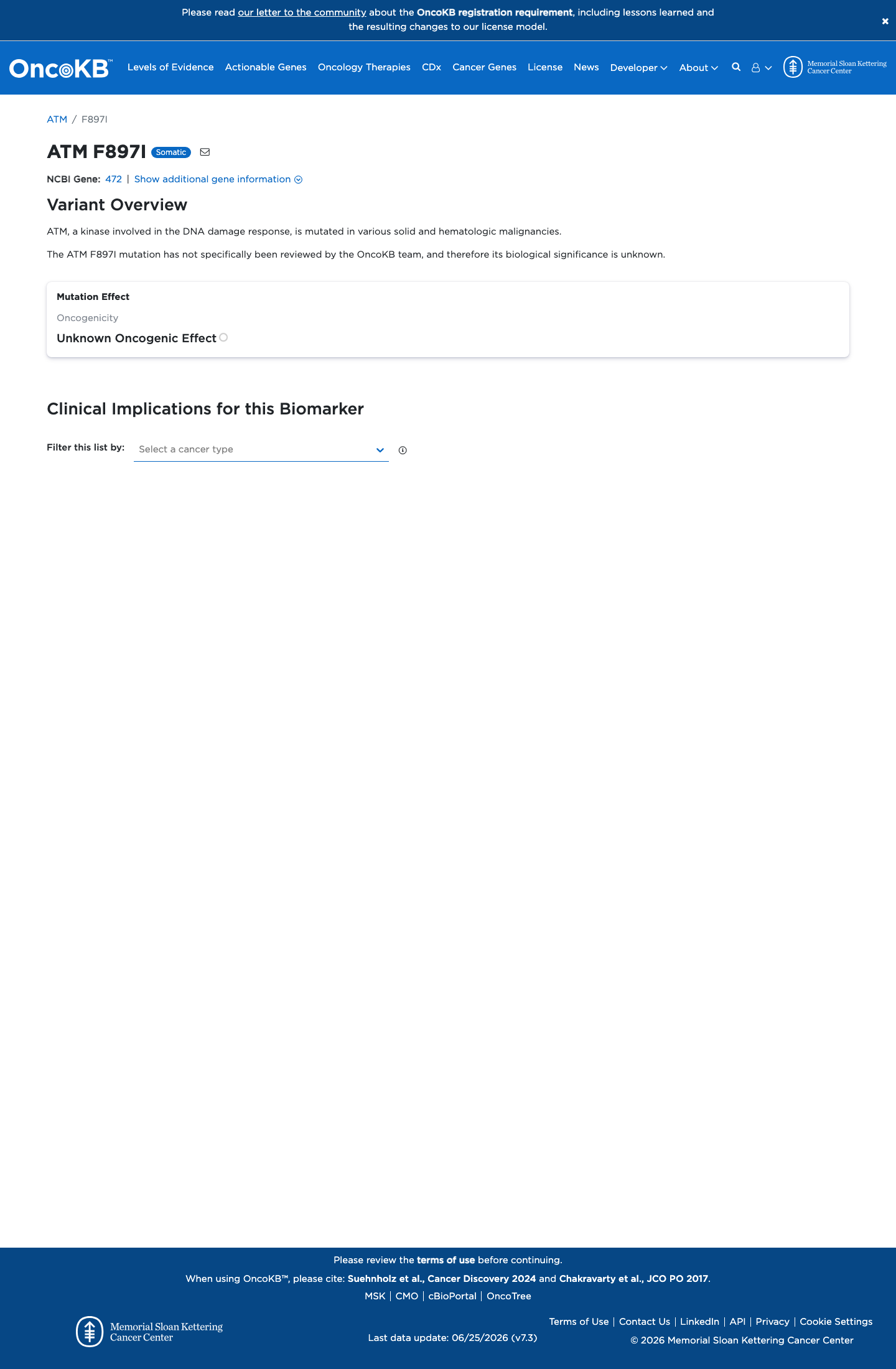
Functional
Unknown Oncogenic Effect
OncoKB did not identify variant-specific reviewed functional evidence for this variant; gene-level curated context is available for reviewer follow-up. ATM, a kinase involved in the DNA damage response, is mutated in various solid and hematologic malignancies.
COSMIC

Cancer hotspots
Somatic evidence
Not in COSMIC / hotspots
COSMIC
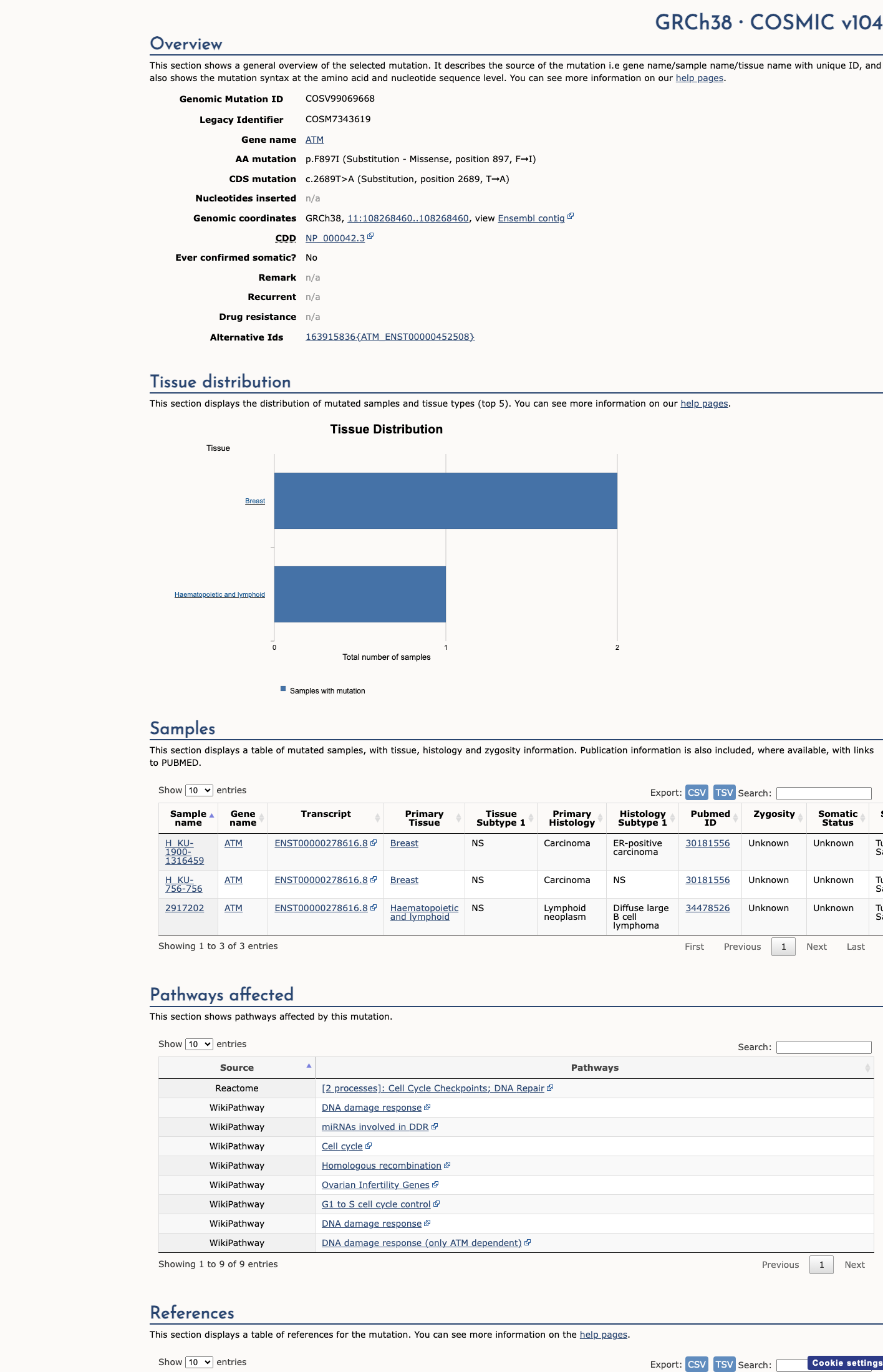
This variant does not lie in a statistically significant hotspot. This variant has previously been reported in somatic cancers (COSMIC; COSV99069668, n = 3 times).
Hotspots
This variant does not lie in a statistically significant hotspot.
Literature · how each cited paper was used
1papers cited
Each card is an audit: what was searched, what was found, whether it names the variant, which criteria it fed, and why. 7 further PMIDs triaged but not cited — see Sources & references.
Genetic variants of prospectively demonstrated phenocopies in BRCA1/2 kindreds.
Searched
c.2689T>Ap.Phe897IleF897I
Found
ATM c.2689T>A (p.Phe897Ile) identified as a variant of unknown significance in a 67-year-old ovarian cancer proband from a BRCA2 c.5217_5223delTTTAAGT family. None of six in silico protein prediction tools (FATHMM, PolyPhen2-HVAR, MutationTaster, MutationAssessor, SIFT, PROVEAN) showed a deleterious effect. The variant had a non-Finnish European ExAC frequency of 4.5×10⁻⁵.
Variant
✓ Names this variant — characterised directly
Applied to
→BP4
met
Why
Variant-specific in silico data confirmed benign computational predictions; referenced in BP4 assessment. Clinical observation in single proband insufficient for PP1 or PS4.
none of the six prediction tools showed deleterious effects for the detected variants in the AXIN2, ATM, RAD51B and MAP3K1 genes (AXIN2 c.2272G > A, ATM c.2689 T > A, RAD51B c.539A > G and c.1063G > A and MAP3K1 c.764A > G)
Location Table 2 (patient 17,161); Results section (in silico analysis paragraph); Figure 2 · full text
Sources & reference links
9Sources
Triaged references · 7 PMIDs not cited in assessment
25741868 ↗
Standards and guidelines for the interpretation of sequence variants: a joint consensus recommendation of the American College of Medical Genetics and Genomics and the Association for Molecular Pathology.
CLINVAR
26467025 ↗
A Standardized DNA Variant Scoring System for Pathogenicity Assessments in Mendelian Disorders.
CLINVAR
28726808 ↗
Prevalence of germ-line mutations in cancer genes among pancreatic cancer patients with a positive family history.
CLINVAR
28779002 ↗
Rare, protein-truncating variants in ATM, CHEK2 and PALB2, but not XRCC2, are associated with increased breast cancer risks.
CLINVAR
34242744 ↗
Customizing local and systemic therapies for women with early breast cancer: the St. Gallen International Consensus Guidelines for treatment of early breast cancer 2021.
CLINVAR
34262154 ↗
Germline ATM variants predispose to melanoma: a joint analysis across the GenoMEL and MelaNostrum consortia.
CLINVAR
17508274 ↗
Risk assessment and genetic counseling for hereditary breast and ovarian cancer: recommendations of the National Society of Genetic Counselors.
CLINVAR