NM_000021.3(PSEN1):c.1234G>A (p.Val412Ile) is extremely rare in population databases, with an allele frequency of 0.00107% in gnomAD v2.1 (3/280,740 alleles) and 0.00143% in gnomAD v4.1 (23/1,613,504 alleles), meeting PM2 at supporting level.1 The variant co-segregates with early-onset frontotemporal dementia in 4 affected individuals across 2 generations in the FUS family (Bernardi et al. 2009, PMID:18314228), meeting PP1 at supporting level. However, incomplete penetrance is noted with 2 cognitively healthy carriers identified at ages 49 and 71 in follow-up (Bernardi et al. 2011, PMID:21297264).2 No variant-specific functional data are available. The in vitro study of 138 PSEN1 pathogenic mutations by Sun et al. (PMID:27930341) did not include p.Val412Ile, as it is currently classified as a variant of uncertain significance.3 In silico predictors are mixed: REVEL score is 0.679, BayesDel is 0.305, and SpliceAI predicts no splicing impact (delta=0.00). The ClinVar submitter LabCorp notes 3 of 5 in silico tools predict a benign effect, precluding application of PP3.4 This variant is classified as Uncertain significance by 3 clinical laboratories in ClinVar (ID: 1318725). No submitter classifies it as pathogenic or likely pathogenic.5 Overall, the evidence for pathogenicity is limited to one supporting criterion (PM2) and one supporting criterion (PP1). With only 2 supporting criteria met and no moderate or strong pathogenic criteria, the variant does not reach the threshold for Likely Pathogenic (which requires 2 supporting + 1 moderate, or variants thereof). The classification remains Uncertain significance.6
Final classification
VUS
PM2PP1
PSEN1
c.1234G>A
p.Val412Ile
This variant
NM_000021.3(PSEN1):c.1234G>A (p.Val412Ile) is extremely rare in population databases, with an allele frequency of 0.00107% in gnomAD v2.1 (3/280,740 alleles) and 0.00143% in gnomAD v4.1 (23/1,613,504 alleles), meeting PM2 at supporting level.
gene-specific framework lacked a usable explicit final combination framework, so generic ACMG/AMP 2015 final-combination rules were applied as fallback; applied criteria: PM2 supporting, PP1 supporting; combination = 2 supporting, which maps to VUS.
Classification rationale
PM2PP1
VUS
PSEN1 c.1234G>A
PM2 + PP1
→
VUS
4
revelbayesdelspliceai ↗
6
generic_acmg_combination_rules
LYFE Sciences is an AI system, and it can make mistakes. Criteria
may be applied incorrectly, sources may be misread, and a confident-looking
classification can still be wrong. Double-check every criterion and
its underlying evidence before relying on any call.
Gene diagram
· NM_000021.3 · variants mapped to exon structure
PSEN1
NM_000021.3
Fetching transcript structure from UCSC…
Applied criteria · 2 applied · 21 assessed
MetEvidence satisfies this criterion.
Not metEvaluated against available evidence; threshold not reached.
Not assessedApplies in principle, but no evidence was found to evaluate it.
N/ADoesn't apply to this variant type.
Applied · 2
Strength
Supporting
Moderate
Strong
Very strong
PM2
supporting
Pathogenic
This variant is extremely rare in population databases, well below the 0.1% PM2 threshold. gnomAD v2.1: 3/280,740 alleles (AF=0.00107%); gnomAD v4.1: 23/1,613,504 alleles (AF=0.00143%); grpmax FAF=2.55e-05. Absent from gnomAD-Canada.
gnomAD v2.1 AF=0.00107% (3/280740)gnomAD v4.1 AF=0.00143% (23/1
PP1
supporting
Pathogenic
The variant co-segregates with early-onset frontotemporal dementia in 4 affected individuals over 2 generations in the FUS family (PMID:18314228). However, incomplete penetrance is noted: 2 cognitively healthy elderly carriers were identified (IV-5 at age 49, III-2 at age 71; PMID:21297264), which tempers the segregation signal.
Co-segregation in 4 affected across 2 generations of FUS family (Bernardi et al. 2009). Two healthy carriers at ages 49 and 71 reported in follow-up (Bernardi et al. 2011)indicating incomplete penetrance.
Assessed · not applied
· 20 not met · 1 not assessed
Pathogenic
PVS1
NM_000021.3:c.1234G>A is a missense variant (p.Val412Ile), not a null variant (nonsense, frameshift, or canonical splice).
PS1
No pathogenic variant at the same nucleotide position (c.1234) has been identified.
PS2
No confirmed de novo occurrence with maternity and paternity confirmation has been reported for this variant.
PS3
No variant-specific functional data are available.
PS4
The variant has been observed in a single family (FUS family) with 4 affected individuals across 2 generations.
PM1
Residue 412 does not lie in a statistically significant mutational hotspot (hotspots residue_significant: false).
PM5
No pathogenic missense variant at the same amino acid residue (Val412) has been identified.
PM6
No de novo observation (with or without confirmed parentage) has been reported for this variant in any reviewed source.
PP2
Insufficient gene-level constraint metrics for PSEN1 available in this case.
PP3
In silico predictors yield mixed results, not meeting the threshold for multiple lines of computational evidence supporting a deleterious effect.
PP4
The proband's phenotype (early-onset frontotemporal dementia) is not highly specific for PSEN1-related disease.
PP5
No reputable source (e.g., clinical laboratory with appropriate quality measures, expert panel, or clinical database) has classified this variant as pathogenic.
Benign
BA1
Allele frequency is far below the 1% BA1 threshold.
BS1
Allele frequency is far below the 0.3% BS1 threshold.
BS2
Two cognitively healthy elderly carriers of PSEN1 p.Val412Ile were observed in the FUS family (ages 49 and 71; PMID:21297264).
BS3
No well-established functional studies demonstrate a benign effect for this specific variant.
BS4
The variant segregates with disease in the FUS family (4 affected carriers).
BP2
Not observed in trans with a known pathogenic PSEN1 variant.
BP4
Computational evidence is mixed and does not provide multiple lines of support for a benign effect.
BP5
No case has been identified where this variant is found in an individual with an alternate definitive molecular cause explaining the phenotype.
BP6
No reputable source classifies this variant as benign.
N/A · 5
PM3 · PM4 · BP1 · BP3 · BP7
Research & evidence
Population frequency
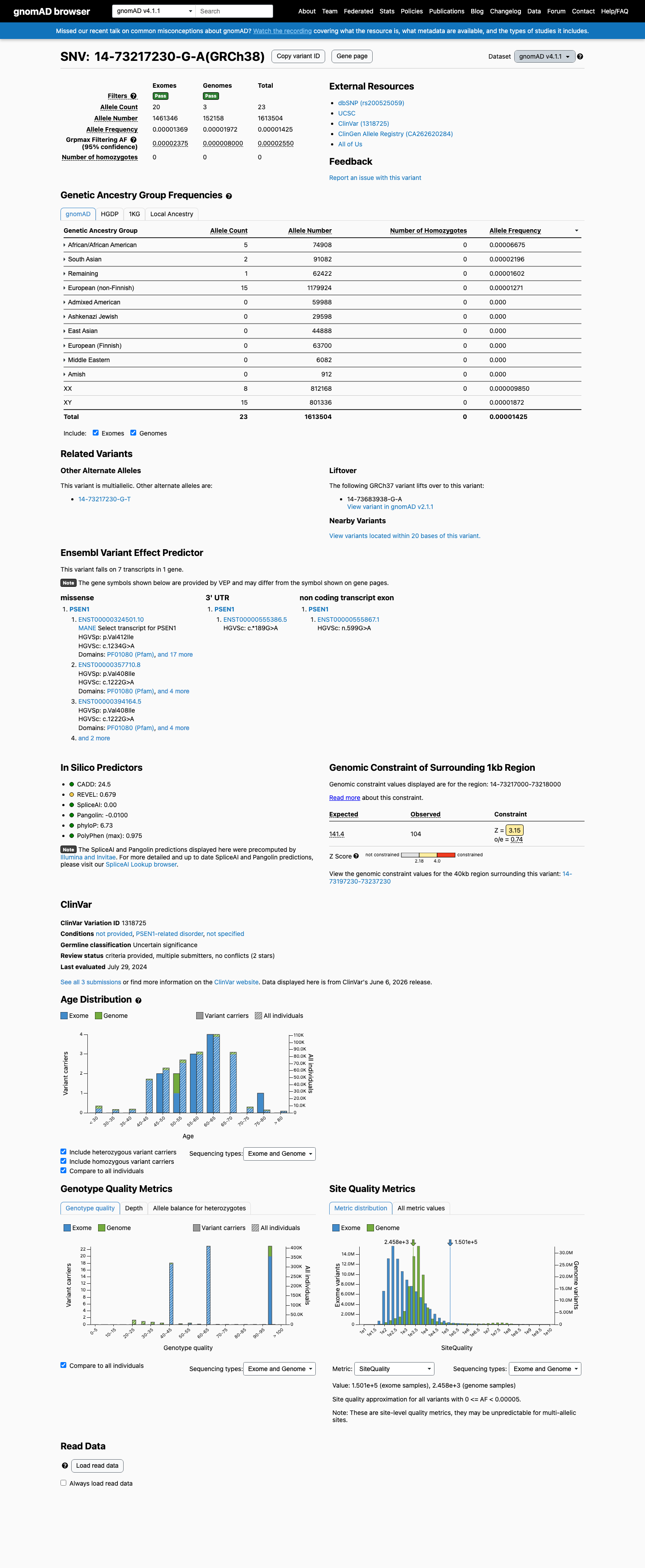
gnomAD v4.1
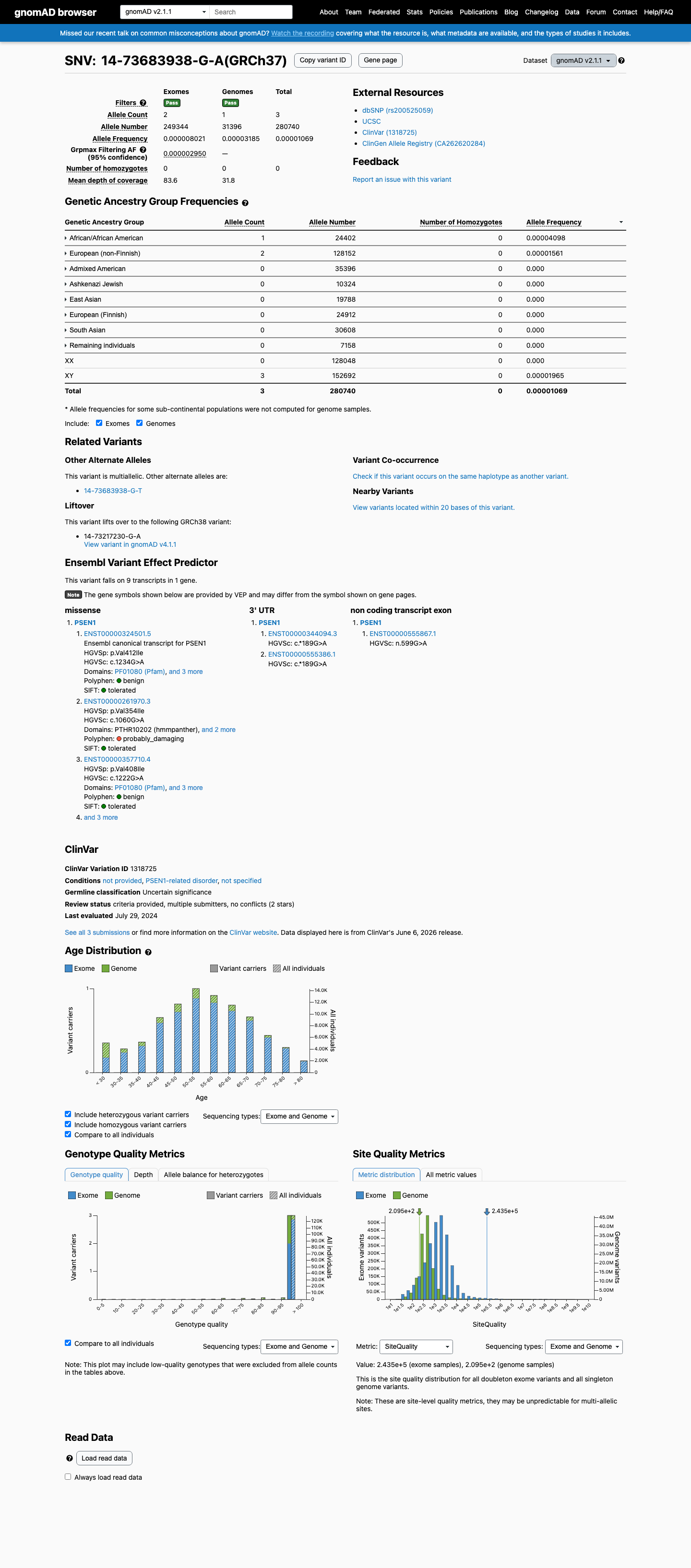
gnomAD v2.1
v4.1
This variant is present in gnomAD v4.1 (AF= 1.42547e-05; MAF= 0.00143%, 23/1613504 alleles, homozygotes = 0) and has highest observed frequency in the African/African American population (AF= 6.67485e-05; MAF= 0.00667%, 5/74908 alleles, homozygotes = 0); grpmax FAF= 2.55e-05.
v2.1
This variant is present in gnomAD v2.1 (AF= 1.0686e-05; MAF= 0.00107%, 3/280740 alleles, homozygotes = 0) and has highest observed frequency in the African/African American population (AF= 4.09802e-05; MAF= 0.00410%, 1/24402 alleles, homozygotes = 0); grpmax FAF= 2.95e-06.
🇨🇦 CA
Absent from gnomAD-Canada v1.0.
Allele frequency by ancestry
three datasets · side by side
gnomAD v4.1
0.0014%
· 23 / 1,613,504
0 hom · FAF 0.0026%
0 hom · FAF 0.0026%
African/African American 5 / 74,908 |
0.0067% |
South Asian 2 / 91,082 |
0.0022% |
Remaining individuals 1 / 62,422 |
0.0016% |
European (non-Finnish) 15 / 1,179,924 |
0.0013% |
+ 6 not observed (Admixed American, European (Finnish), Amish, East Asian, Middle Eastern, Ashkenazi Jewish)
gnomAD v2.1
0.0011%
· 3 / 280,740
0 hom · FAF 0.0003%
0 hom · FAF 0.0003%
African/African American 1 / 24,402 |
0.0041% |
European (non-Finnish) 2 / 128,152 |
0.0016% |
+ 6 not observed (Admixed American, Ashkenazi Jewish, East Asian, European (Finnish), Remaining individuals, South Asian)
gnomAD Canada 🇨🇦
Absent
· 0 / ?
0 hom
0 hom
Not observed in any ancestry group.
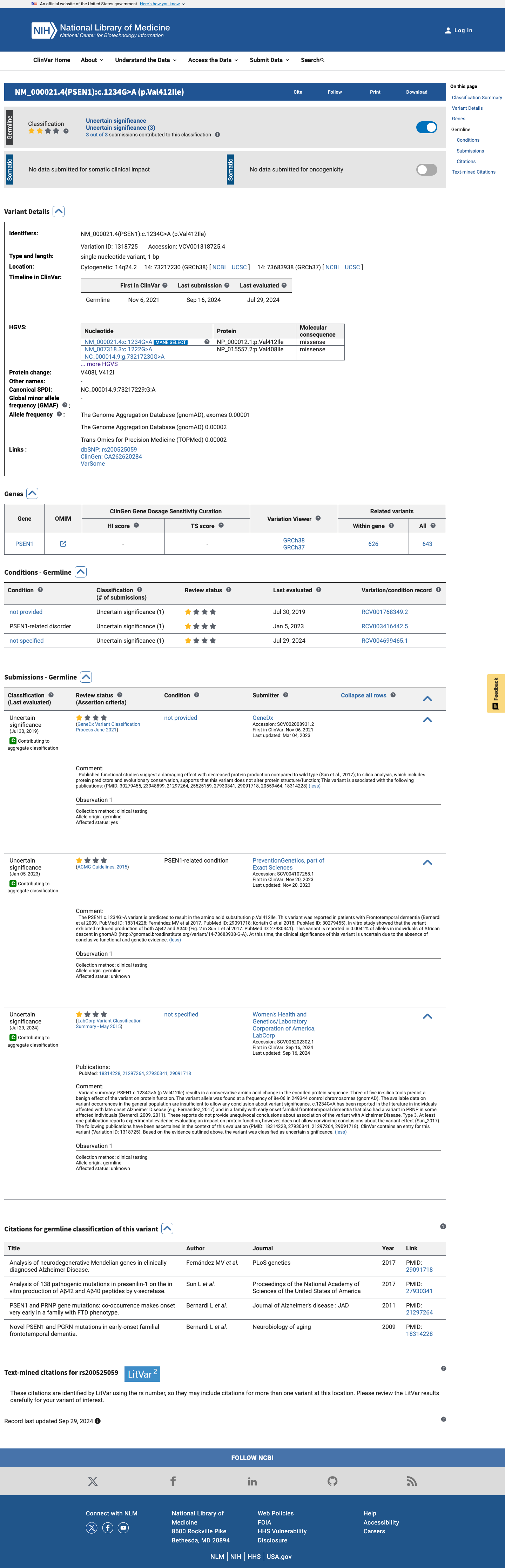
ClinVar
This variant has been reported in ClinVar as Uncertain significance (3 clinical laboratories). (ClinVarID = 1318725)
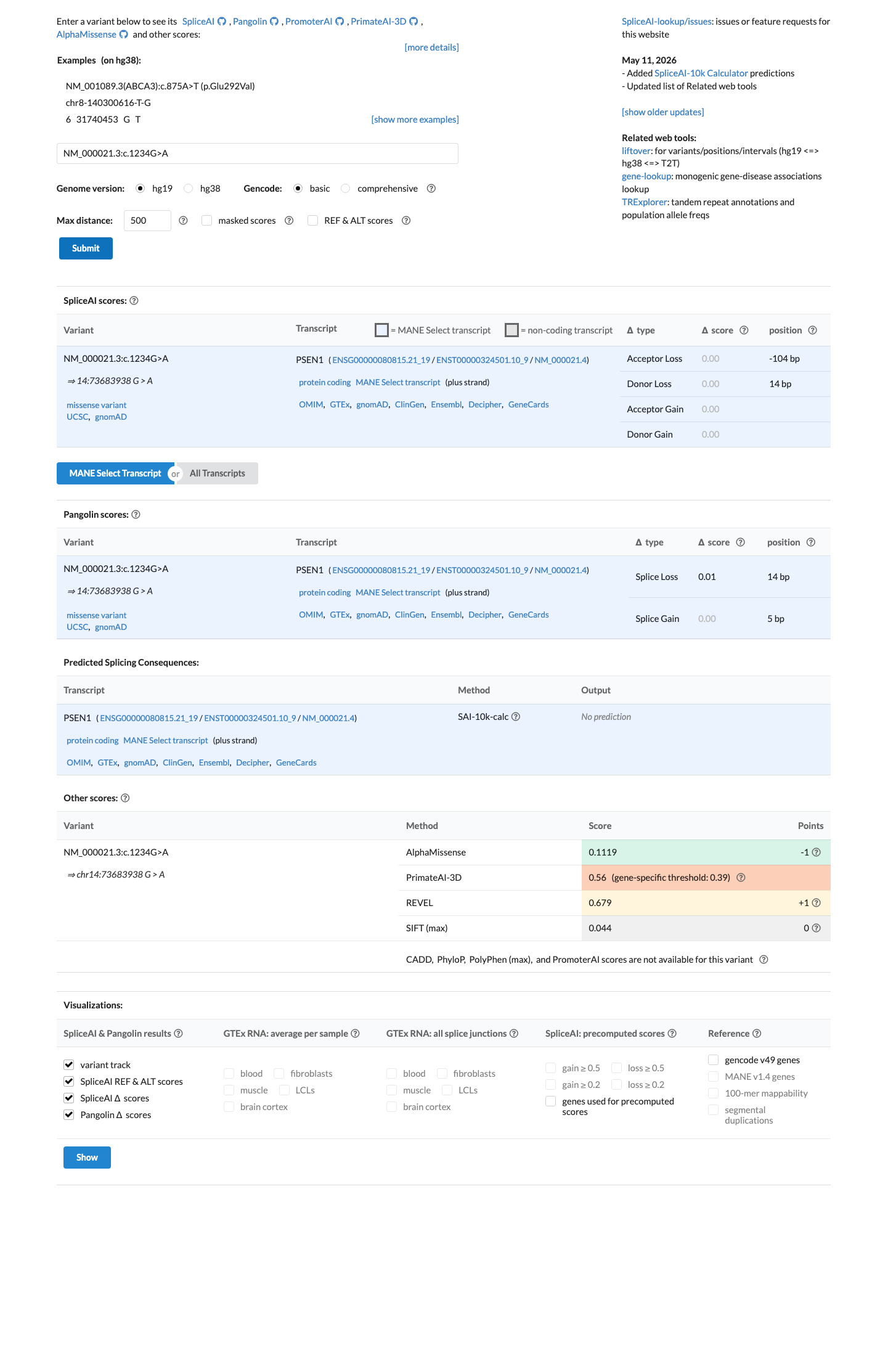
In silico
SpliceAI predicts no significant splice impact for this variant (max delta score = 0.00). REVEL score = 0.679. BayesDel score = 0.305405.
Functional
No data
No calibrated functional assay or RNA evidence was identified for this variant.

COSMIC

Cancer hotspots
Somatic evidence
Not in COSMIC / hotspots
COSMIC
This variant does not lie in a statistically significant hotspot. This variant has not previously been reported in somatic cancers (COSMIC).
Hotspots
This variant does not lie in a statistically significant hotspot.
Literature · how each cited paper was used
2papers cited
Each card is an audit: what was searched, what was found, whether it names the variant, which criteria it fed, and why. 3 further PMIDs triaged but not cited — see Sources & references.
Novel PSEN1 and PGRN mutations in early-onset familial frontotemporal dementia.
Searched
c.1234G>Ap.Val412IleV412IVal412Ilec.1234
Found
Identified PSEN1 Val412Ile as a novel heterozygous mutation in an autosomal dominant early-onset frontotemporal dementia family (FUS pedigree). The proband, a 38-year-old female, developed progressive mood and personality changes at age 30 with subsequent cognitive decline, mutism, myoclonus, and seizures. Four affected individuals across two generations carried the mutation. Mutation was absent from 100 cognitively healthy controls and 100 previously screened familial Alzheimer disease patients.
Variant
✓ Names this variant — characterised directly
Applied to
→PP1
met
Why
Variant confirmed in affected family cohort; segregation data support PP1 at supporting level despite incomplete penetrance noted in follow-up study.
Val412Ile is a heterozygous transition in exon 11 (g.69148G>A according to GenBank accession number AF109907.1; c.1234 according to GenBank accession number NM 000021.2) of the PSEN1 gene in the first position of codon 412, which predicts an aminoacidic substitution from valine to isoleucine and it was detected in a 38-year-old female (FUS family).
Location Abstract; Results, sections 3.1-3.2; Figure 2; Figure 3A pedigree; Discussion · Context DHPLC screening and Sanger sequencing of PSEN1 exons 3-12 in 17 f-EOFTD patients; RFLP and DHPLC for control validation · full text
PSEN1 and PRNP gene mutations: co-occurrence makes onset very early in a family with FTD phenotype.
Searched
c.1234G>Ap.Val412IleV412IVal412Ilec.1234
Found
Follow-up study of the FUS family originally reported in Bernardi et al. 2009. Identified a novel seven extra-repeat PRNP insertional mutation co-occurring with PSEN1 Val412Ile. PSEN1 Val412Ile alone was found in 2 affected and 2 cognitively healthy carriers (ages 49 and 71), demonstrating incomplete penetrance. Double carriers (PSEN1 + PRNP) had very early onset within the third decade. Both mutations showed variable penetrance when present separately.
Variant
✓ Names this variant — characterised directly
Applied to
→PP1
met
Why
Documented incomplete penetrance (2 healthy carriers at ages 49 and 71) which tempers PP1 segregation evidence. Co-occurring PRNP mutation does not explain all affected cases, so BP5 not met.
The PSEN1 Val412Ile mutation, which was previously detected in the three patients [14], was also identified in two additional family members (IV-5, III-2, in this paper).
Location Abstract; Results; Table 1; Figure 1 pedigree; Discussion · Context Bidirectional sequencing of PRNP and PSEN1 genes; APOE genotyping, MAPT haplotype analysis, PRNP M129V polymorphism assessment · full text
Sources & reference links
Triaged references · 3 PMIDs not cited in assessment
25741868 ↗
Standards and guidelines for the interpretation of sequence variants: a joint consensus recommendation of the American College of Medical Genetics and Genomics and the Association for Molecular Pathology.
CLINVAR
27930341 ↗
Analysis of 138 pathogenic mutations in presenilin-1 on the in vitro production of Aβ42 and Aβ40 peptides by γ-secretase.
CLINVAR
29091718 ↗
Analysis of neurodegenerative Mendelian genes in clinically diagnosed Alzheimer Disease.
CLINVAR