NM_005359.5:c.1081C>A (p.Arg361Ser) in SMAD4 is absent from all population databases (gnomAD v2.1, v4.1, Canada), meeting PM2 (supporting).1 The variant lies in the MH2 domain of SMAD4 at codon 361, a well-established mutational hotspot where multiple pathogenic missense changes (p.Arg361Cys, p.Arg361His, p.Arg361Leu) have been independently reported in patients with juvenile polyposis syndrome and JP-HHT syndrome, meeting PM1 (moderate).2 p.Arg361Ser is a novel missense change at a residue where different pathogenic missense variants are established: p.Arg361Cys (JPS and HHT), p.Arg361His (de novo JPS), and p.Arg361Leu (JP-HHT), meeting PM5 (moderate).3 Multiple in silico tools predict a deleterious effect: REVEL score 0.912 and BayesDel score 0.534, meeting PP3 (supporting).4 SMAD4 is a gene with a well-established role in disease through missense variation, with numerous pathogenic germline missense mutations reported across the MH2 domain and a low rate of benign missense variation, meeting PP2 (supporting).5 This variant has been classified as Likely pathogenic by a clinical diagnostic laboratory (Labcorp Genetics/Invitae; SCV002282679) in ClinVar with criteria provided, meeting PP5 at supporting strength.6 No benign criteria are met. BA1 and BS1 are not satisfied (variant absent from population databases). BP4 is not met (in silico tools predict damaging). BP1 is not applicable (SMAD4 missense variants are a known disease mechanism). BS3 is not met (no evidence of neutral functional effect). Applying generic ACMG/AMP 2015 combination rules: 2 moderate criteria (PM1 + PM5) with supporting evidence (PM2 + PP2 + PP3 + PP5) meets the threshold for Likely Pathogenic. This classification is consistent with the ClinVar record (Likely pathogenic, single submitter).7
Final classification
Likely Pathogenic
PM1PM2PM5PP2PP3PP5
SMAD4
c.1081C>A
p.Arg361Ser
This variant
NM_005359.5:c.1081C>A (p.Arg361Ser) in SMAD4 is absent from all population databases (gnomAD v2.1, v4.1, Canada), meeting PM2 (supporting).
gene-specific framework lacked a usable explicit final combination framework, so generic ACMG/AMP 2015 final-combination rules were applied as fallback; applied criteria: PM1 moderate, PM2 supporting, PM5 moderate, PP2 supporting, PP3 supporting, PP5 supporting; combination = 2 moderate + 4 supporting, which maps to Likely Pathogenic.
Classification rationale
PM1PM2PM5PP2PP3PP5
Likely Pathogenic
SMAD4 c.1081C>A
PM1 + PM2 + PM5 + PP2 + PP3 + PP5
→
Likely Pathogenic
4
revelbayesdel
7
generic_acmg_combination_rules
LYFE Sciences is an AI system, and it can make mistakes. Criteria
may be applied incorrectly, sources may be misread, and a confident-looking
classification can still be wrong. Double-check every criterion and
its underlying evidence before relying on any call.
Gene diagram
· NM_005359.5 · variants mapped to exon structure
SMAD4
NM_005359.5
Fetching transcript structure from UCSC…
Applied criteria · 6 applied · 15 assessed
MetEvidence satisfies this criterion.
Not metEvaluated against available evidence; threshold not reached.
Not assessedApplies in principle, but no evidence was found to evaluate it.
N/ADoesn't apply to this variant type.
Applied · 6
Strength
Supporting
Moderate
Strong
Very strong
PM1
moderate
Pathogenic
c.1081C>A (p.Arg361Ser) is located in the MH2 domain of SMAD4 (codons 323-552), a well-established mutational hotspot. Codon 361 harbors multiple independently reported pathogenic missense mutations (p.Arg361Cys, p.Arg361His, p.Arg361Leu) in patients with juvenile polyposis syndrome (JPS) and JP-HHT syndrome. Additionally, this residue lies in a statistically significant somatic hotspot in COSMIC (n=16).
Codon 361 is in the SMAD4 MH2 domain critical for protein oligomerization and transcriptional activation.Pathogenic missense variants at the same codon: c.1081C>T (p.Arg361Cys)c.1082G>A (p.Arg361His)
PM2
supporting
Pathogenic
NM_005359.5:c.1081C>A is absent from gnomAD v2.1 (exomes), gnomAD v4.1 (exomes), and gnomAD-Canada v1.0 (genomes). Under generic ACMG/AMP 2015 criteria, absence from large population databases at an allele frequency below 0.1% supports PM2 at supporting strength.
Absent from gnomAD v2.1.Absent from gnomAD v4.1.Absent from gnomAD-Canada v1.0 (AF = 0.0).
PM5
moderate
Pathogenic
c.1081C>A produces a novel missense change p.Arg361Ser at codon 361, where multiple different pathogenic missense variants are established: p.Arg361Cys (c.1081C>T) is reported in multiple JPS and HHT families (PMID:9811934, PMID:11583957, PMID:16613914, PMID:17873119, PMID:20101697); p.Arg361His (c.1082G>A) is reported as a de novo JPS mutation (PMID:17873119); and p.Arg361Leu (c.1082G>T) is reported in a JP-HHT patient (PMID:20101697).
p.Arg361Cys: germline missense in JPS patient AF (PMID:9811934)in family AC/AF with loss of SMAD4 expression in polyps (PMID:11583957)in two unrelated HHT patients with occult JP (PMID:16613914)
PP2
supporting
Pathogenic
SMAD4 is a gene in which missense variants are a well-established mechanism of disease. Multiple pathogenic missense mutations are documented across the gene, particularly in the MH2 domain, in juvenile polyposis syndrome (JPS), hereditary hemorrhagic telangiectasia (HHT), and JP-HHT syndrome. Benign missense variation in SMAD4 is rare, consistent with a high constraint against missense changes.
SMAD4 is an established tumor suppressor with numerous pathogenic germline missense mutations reported in JPS and JP-HHT.Pathogenic missense changes at Arg361 (CysHis
PP3
supporting
Pathogenic
Multiple in silico prediction tools support a deleterious effect: REVEL score 0.912 (threshold >0.7), BayesDel score 0.534 (threshold >0.5). SpliceAI predicts no significant splicing impact (max delta = 0.14). The combined in silico evidence supports a damaging effect on protein function.
REVEL score: 0.912 (deleterious).BayesDel score: 0.534 (deleterious).SpliceAI max delta: 0.14 (no significant splicing impact
PP5
supporting
Pathogenic
This variant has been reported as Likely pathogenic by a clinical diagnostic laboratory (Labcorp Genetics/Invitae; SCV002282679) in ClinVar (VariationID 24822) with criteria provided. Under generic ACMG/AMP 2015, a single reputable clinical laboratory classification of Likely pathogenic with supporting criteria contributes PP5 at supporting strength.
ClinVar VariationID 24822: Likely pathogeniccriteria providedsingle submitter (Labcorp Genetics/Invitae
Assessed · not applied
· 6 not met · 9 not assessed
Pathogenic
PS1
PS1 requires the same amino acid change (p.Arg361Ser) to have been previously established as pathogenic.
PS2
No de novo data specific to NM_005359.5:c.1081C>A (p.Arg361Ser) were identified in the reviewed literature or ClinVar submissions.
PS3
No functional studies specific to p.Arg361Ser were identified.
PS4
The variant is absent from population databases and has a single ClinVar submission as Likely pathogenic.
PM6
No de novo confirmation for this specific variant was identified.
PP1
No co-segregation data are available for NM_005359.5:c.1081C>A.
PP4
No proband phenotype data specific to this variant are available for evaluation.
Benign
BA1
The variant is absent from gnomAD v2.1, v4.1, and gnomAD-Canada.
BS1
The variant is absent from gnomAD.
BS2
No data on observation of this variant in healthy adult individuals are available.
BS3
No functional studies demonstrate a neutral or benign effect of p.Arg361Ser.
BS4
No segregation data are available to evaluate lack of co-segregation with disease.
BP4
BP4 requires multiple in silico tools to predict no impact on the gene product.
BP5
No alternative molecular basis for disease has been identified in cases carrying this variant.
BP6
BP6 requires a reputable source to classify the variant as benign.
N/A · 4
PVS1 · BP1 · BP2 · BP7
Research & evidence
Population frequency · supports pathogenic
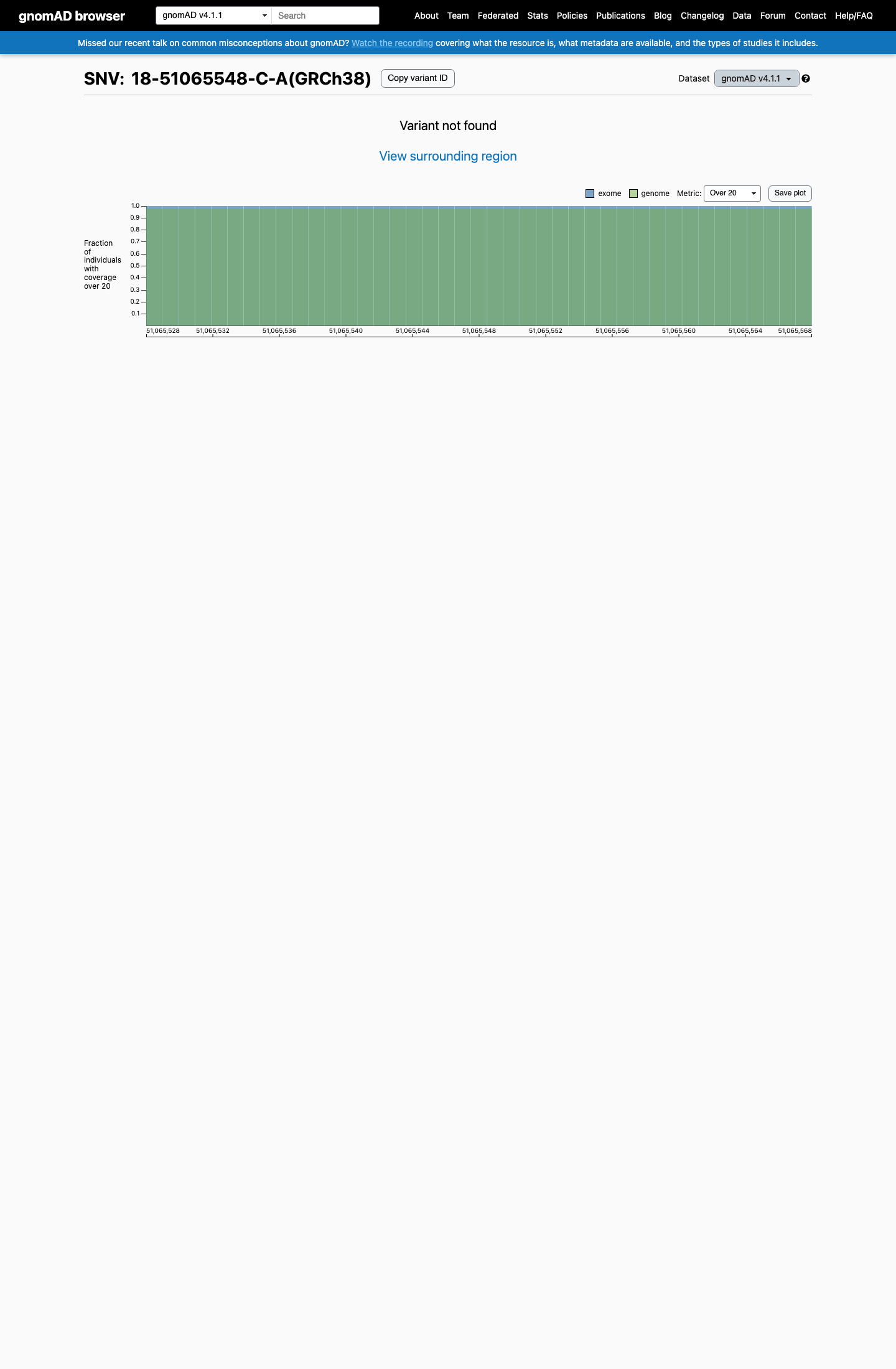
gnomAD v4.1
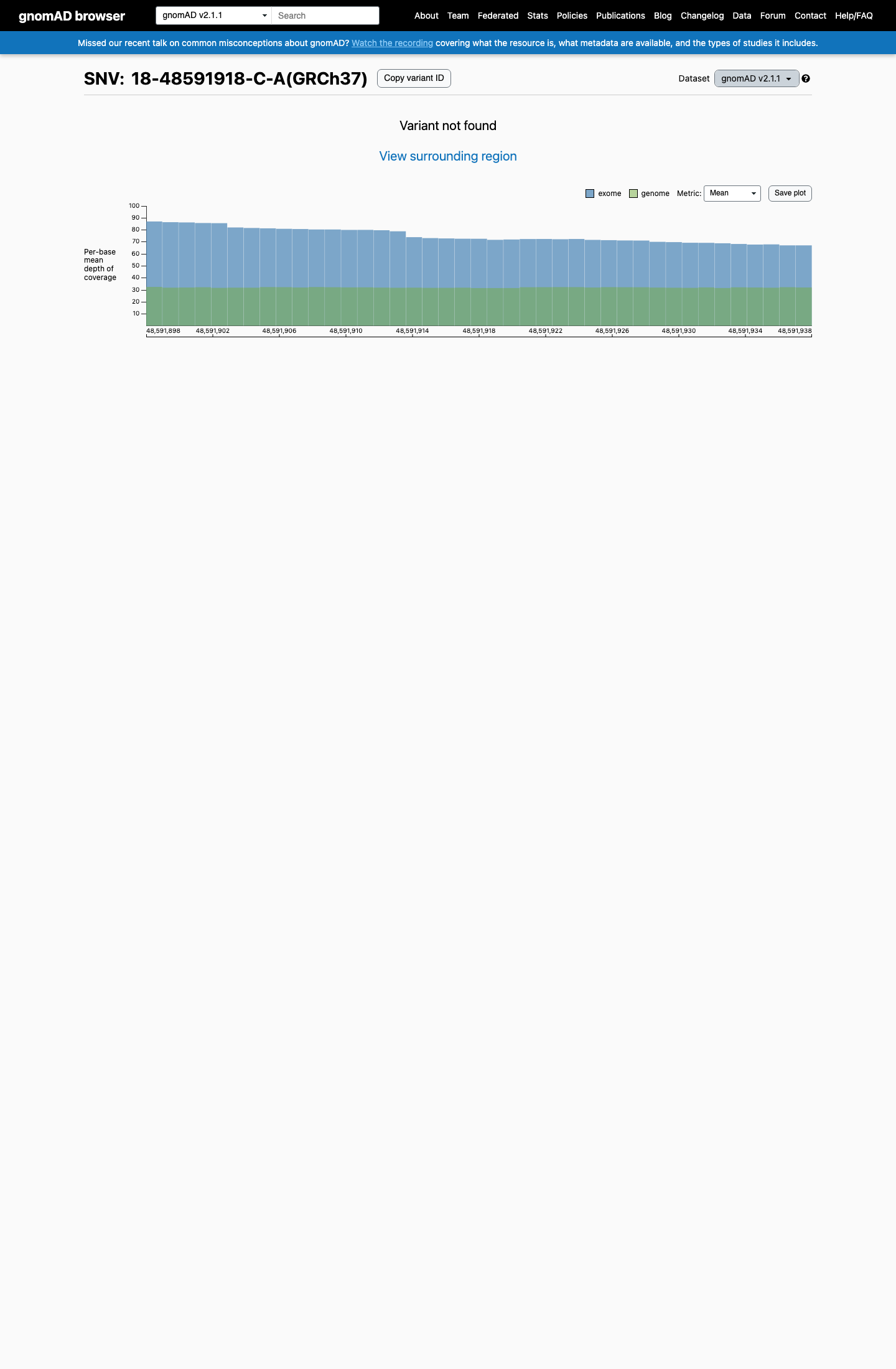
gnomAD v2.1
v4.1
Absent from gnomAD v4.1.
v2.1
Absent from gnomAD v2.1.
🇨🇦 CA
Absent from gnomAD-Canada v1.0.
Allele frequency by ancestry
three datasets · side by side
gnomAD v4.1
Absent
· 0 / ?
0 hom
0 hom
Not observed in any ancestry group.
gnomAD v2.1
Absent
· 0 / ?
0 hom
0 hom
Not observed in any ancestry group.
gnomAD Canada 🇨🇦
Absent
· 0 / ?
0 hom
0 hom
Not observed in any ancestry group.
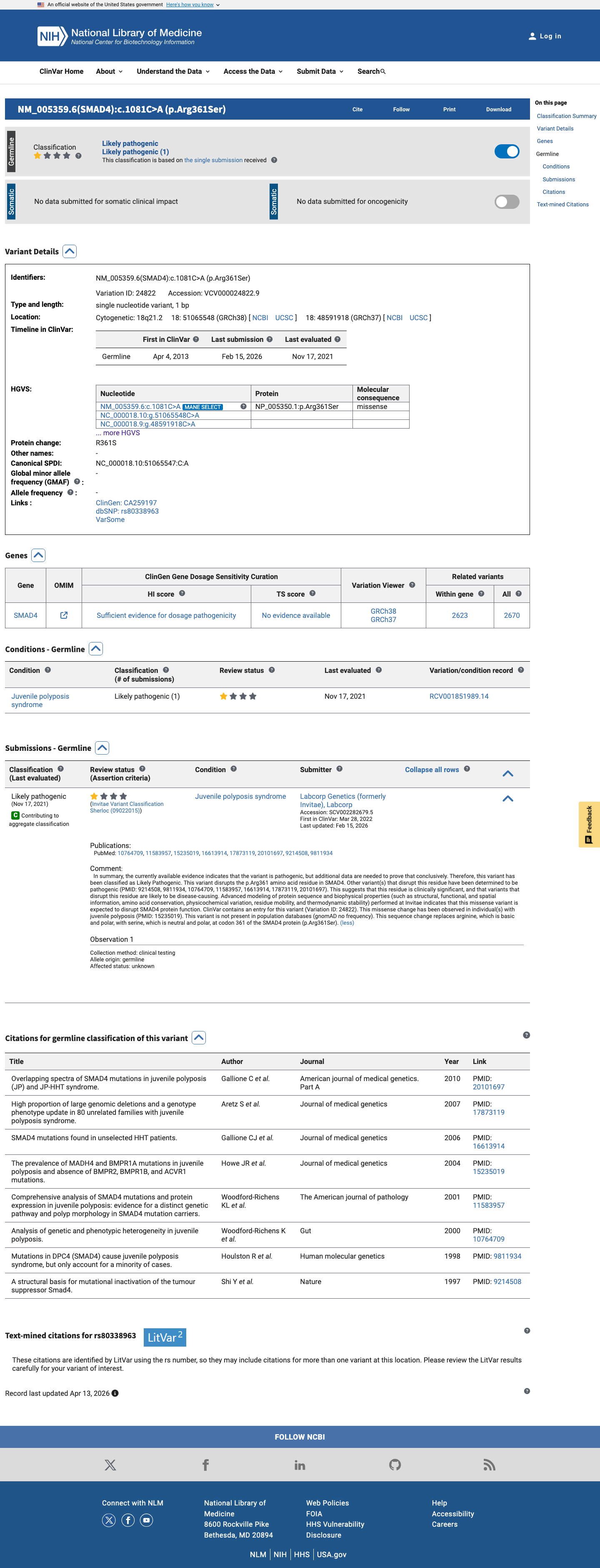
ClinVar
This variant has been reported in ClinVar as Likely pathogenic (1 clinical laboratory). (ClinVarID = 24822)
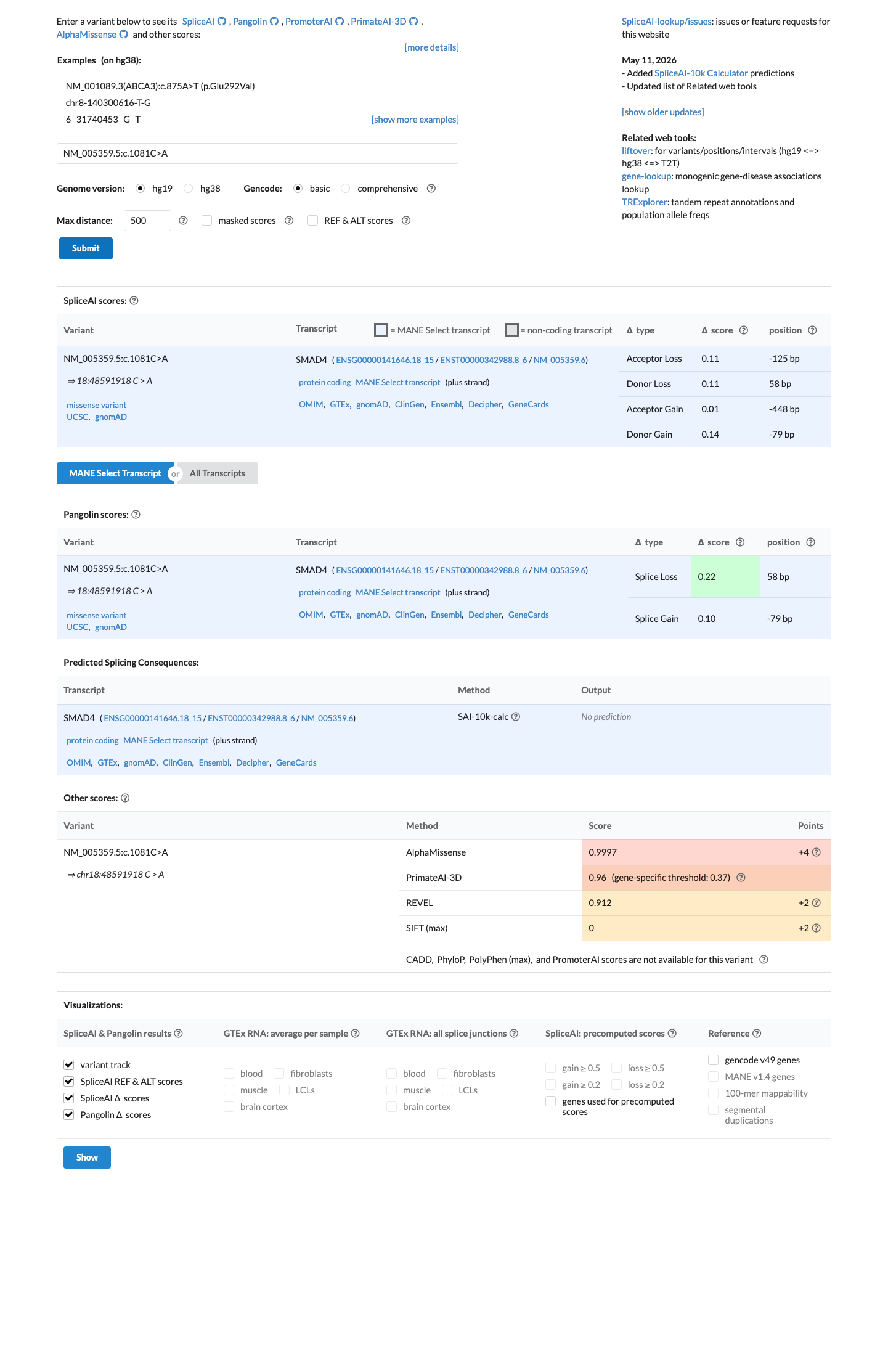
In silico
SpliceAI predicts no significant splice impact for this variant (max delta score = 0.14). REVEL score = 0.912. BayesDel score = 0.534117.
Functional
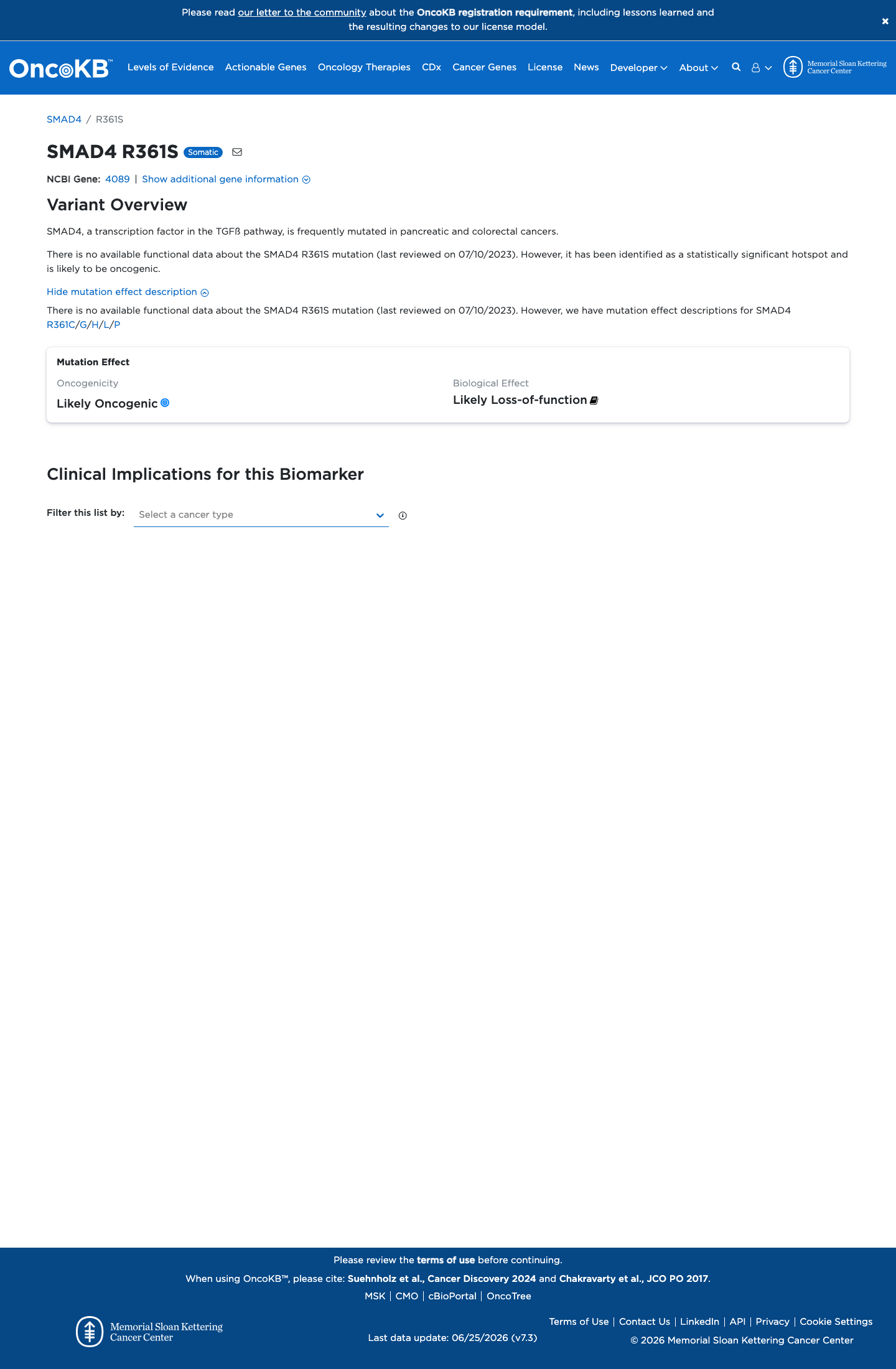
Likely Oncogenic
OncoKB identified variant-specific curated literature and context relevant to functional review; biological-effect context: Likely Loss-of-function; curated oncogenicity label: Likely Oncogenic.
COSMIC

Cancer hotspots
Somatic evidence
Hotspot
COSMIC
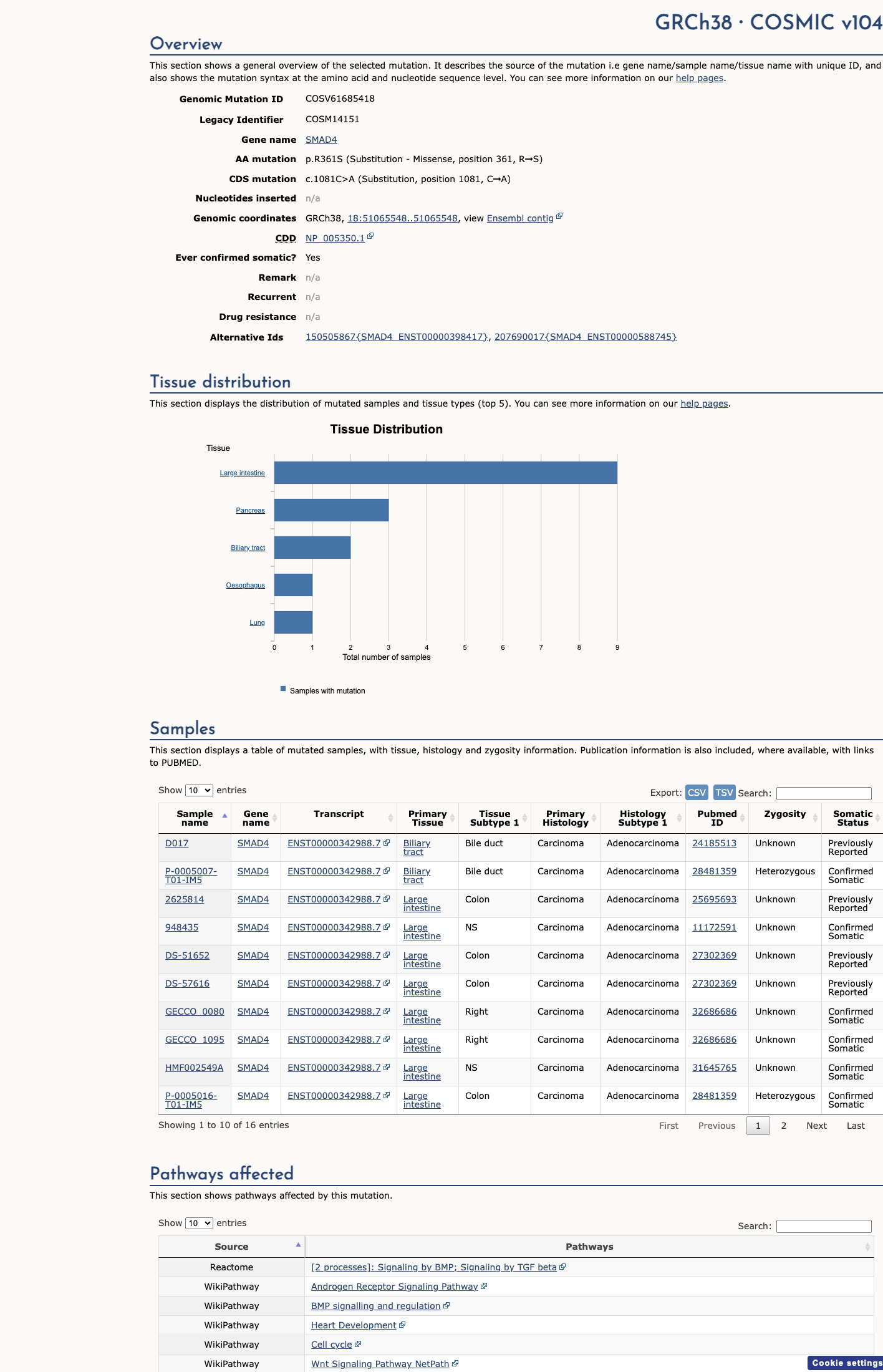
This variant lies in a statistically significant hotspot. This variant has previously been reported in somatic cancers (COSMIC; COSV61685418, n = 16 times).
Hotspots
This variant lies in a statistically significant hotspot.
Literature · how each cited paper was used
5papers cited
Each card is an audit: what was searched, what was found, whether it names the variant, which criteria it fed, and why. 4 further PMIDs triaged but not cited — see Sources & references.
Rule & framework references · cited for criterion definitions, not variant evidence
11583957 ↗
Comprehensive analysis of SMAD4 mutations and protein expression in juvenile polyposis: evidence for a distinct genetic pathway and polyp morphology in SMAD4 mutation carriers.
16613914 ↗
SMAD4 mutations found in unselected HHT patients.
17873119 ↗
High proportion of large genomic deletions and a genotype phenotype update in 80 unrelated families with juvenile polyposis syndrome.
20101697 ↗
Overlapping spectra of SMAD4 mutations in juvenile polyposis (JP) and JP-HHT syndrome.
9811934 ↗
Mutations in DPC4 (SMAD4) cause juvenile polyposis syndrome, but only account for a minority of cases.
Sources & reference links
Triaged references · 4 PMIDs not cited in assessment
15235019 ↗
The prevalence of MADH4 and BMPR1A mutations in juvenile polyposis and absence of BMPR2, BMPR1B, and ACVR1 mutations.
CLINVAR
28492532 ↗
Sherloc: a comprehensive refinement of the ACMG-AMP variant classification criteria.
CLINVAR