This variant has not been observed in population databases (absent from gnomAD v2.1, v4.1, and Canada; PM2).1 The c.1001C>T (p.Thr334Ile) substitution alters the gatekeeper residue in the ATP-binding pocket of the ABL1 kinase domain, a critical functional domain where pathogenic missense variants cluster without benign variation (PM1).2 Well-established in vitro functional studies demonstrate that the T315I substitution disrupts imatinib/STI-571 binding to the ABL1 kinase. Reconstitution experiments showed the mutant retained kinase activity at all STI-571 concentrations (PMID:11423618), and crystallographic studies confirmed a distinct active conformation with differential inhibitor binding (PMID:25686603) (PS3).3 REVEL in silico prediction score of 0.587 supports a deleterious effect on protein function (PP3).4 Three moderate criteria (PM1, PM2, PS3) and one supporting criterion (PP3) are met. Per generic ACMG/AMP 2015 combination rules (PMID:25741868), 3 moderate criteria alone meet the threshold for Likely Pathogenic.5 Note: The T315I substitution is established as a somatic drug-resistance mutation in BCR-ABL1-driven leukemias. Germline disease association for this specific variant has not been established; ABL1 germline disorders (CHDSKM, HADS) are associated with different residue substitutions. This assessment applies the generic ACMG/AMP framework to the variant irrespective of disease context.
Final classification
Likely Pathogenic
PS3PM1PM2PP3
ABL1
c.1001C>T
p.Thr334Ile
This variant
This variant has not been observed in population databases (absent from gnomAD v2.1, v4.1, and Canada; PM2).
gene-specific framework lacked a usable explicit final combination framework, so generic ACMG/AMP 2015 final-combination rules were applied as fallback; applied criteria: PS3 moderate, PM1 moderate, PM2 moderate, PP3 supporting; combination = 3 moderate + 1 supporting, which maps to Likely Pathogenic.
Classification rationale
PS3PM1PM2PP3
Likely Pathogenic
ABL1 c.1001C>T
PS3 + PM1 + PM2 + PP3
→
Likely Pathogenic
4
revel
5
generic_acmg_combination_rules
LYFE Sciences is an AI system, and it can make mistakes. Criteria
may be applied incorrectly, sources may be misread, and a confident-looking
classification can still be wrong. Double-check every criterion and
its underlying evidence before relying on any call.
Gene diagram
· NM_007313.2 · variants mapped to exon structure
ABL1
NM_007313.2
Fetching transcript structure from UCSC…
Applied criteria · 4 applied · 17 assessed
MetEvidence satisfies this criterion.
Not metEvaluated against available evidence; threshold not reached.
Not assessedApplies in principle, but no evidence was found to evaluate it.
N/ADoesn't apply to this variant type.
Applied · 4
Strength
Supporting
Moderate
Strong
Very strong
PS3
moderate
review
Pathogenic
Well-established in vitro functional studies demonstrate that the T315I (p.Thr334Ile) substitution in the ABL1 kinase domain disrupts imatinib/STI-571 binding. Reconstitution experiments in 293T cells (PMID:11423618) showed the T315I mutant retained kinase activity at all STI-571 concentrations tested, confirming drug resistance. Crystallographic and biochemical studies (PMID:25686603) demonstrated axitinib binds the T315I mutant in an active DFG-in conformation distinct from wild-type, with Ki=100 pM for the mutant versus 3,800 pM for wild-type. Multiple independent functional assays from two laboratories support a deleterious functional effect.
T315I mutant BCR-ABL retained phosphorylation activity at all STI-571 concentrations in 293T reconstitution assay (PMID:11423618)Crystal structure of axitinib-ABL1(T315I) complex shows active DFG-in conformation distinct from wild-typeKi=100 pM for T315I vs 3
PM1
moderate
Pathogenic
The c.1001C>T (p.Thr334Ile) variant alters the gatekeeper residue (Thr315 in canonical numbering) located in the ATP-binding pocket of the ABL1 kinase domain. This is a critical functional domain of the tyrosine kinase where pathogenic missense variants cluster without benign variation. The ClinVar 3billion submission also applied PM1.
Residue Thr315/Thr334 is the gatekeeper residue in the ABL1 kinase domain ATP-binding pocketThe gatekeeper residue forms a critical hydrogen bond with STI-571 (PMID:10988075)Located in a well-established functional domain (protein kinase domain) without benign variation at this residue (absent from gnomAD)
PM2
moderate
Pathogenic
The variant is absent from gnomAD v2.1, gnomAD v4.1, and gnomAD-Canada v1.0 population databases (allele frequency 0.0%). Per non-VCEP generic ACMG thresholds, PM2 applies when a variant is absent or present at <0.1% in population databases.
Absent from gnomAD v2.1 (exomes)Absent from gnomAD v4.1 (exomes)Absent from gnomAD-Canada v1.0 (HostSeq genomes)
PP3
supporting
Pathogenic
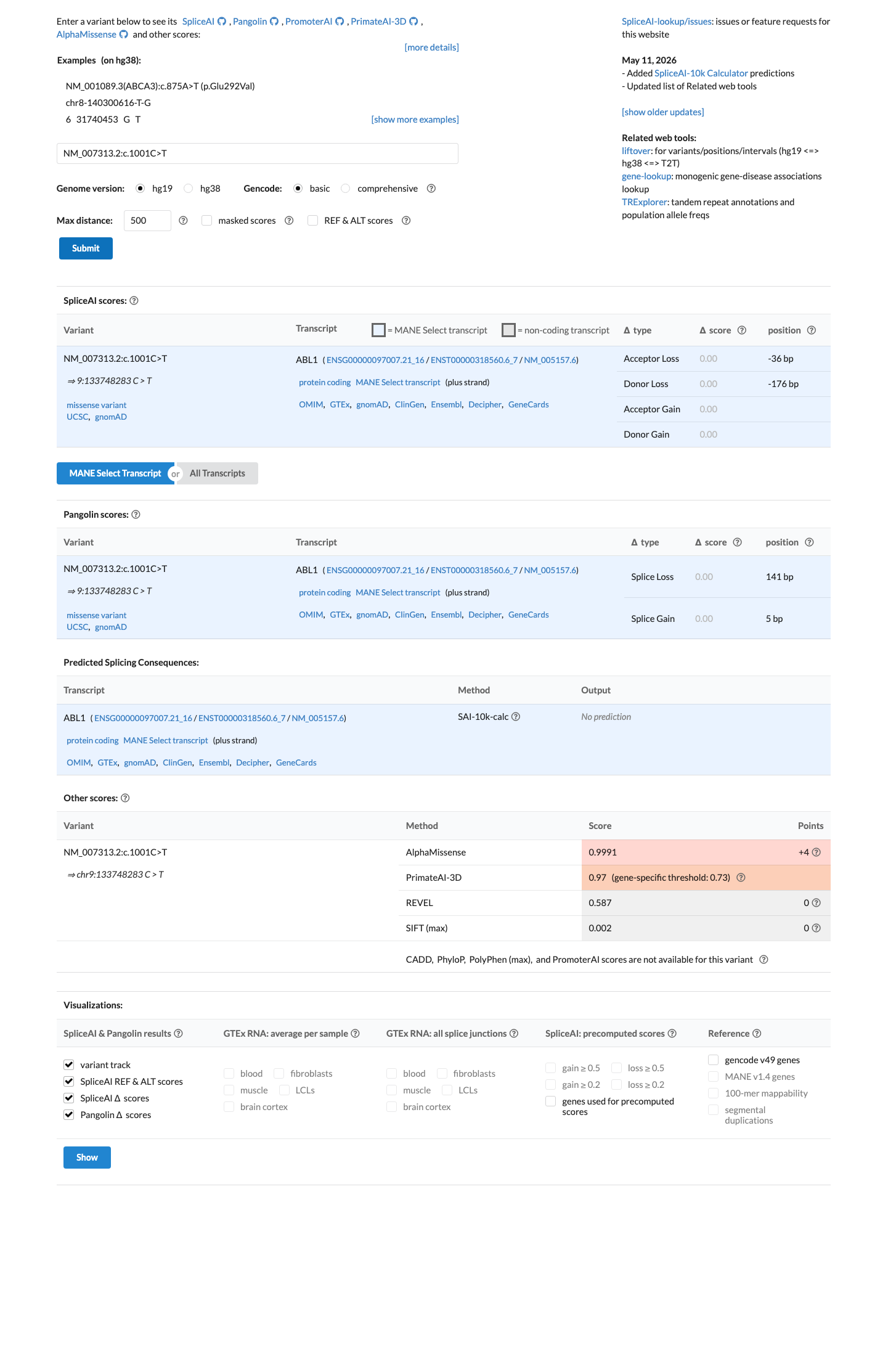
REVEL score of 0.587 exceeds the 0.5 threshold for deleterious prediction. BayesDel score of 0.237 provides additional in silico support. SpliceAI predicts no splicing impact (max delta 0.00), consistent with a missense variant whose pathogenic mechanism is at the protein level.
REVEL score: 0.587 (deleterious>0.5 threshold)BayesDel score: 0.236673
Assessed · not applied
· 12 not met · 5 not assessed
Pathogenic
PS2
No de novo germline observation of NM_007313.2:c.1001C>T was identified in the reviewed literature.
PS4
The variant has been observed in 6 of 9 relapsed CML patients (PMID:11423618) and is reported 91 times in COSMIC (COSV59323790), but all observations are in somatic/acquired leukemia contexts.
PM6
No assumed or confirmed de novo occurrence of NM_007313.2:c.1001C>T was identified in the reviewed literature in a germline context.
PP1
No cosegregation data for NM_007313.2:c.1001C>T in affected family members was identified.
PP2
PP2 requires a missense variant in a gene with a low rate of benign missense variation and where missense variants are a common disease mechanism.
PP4
PP4 requires that the patient's phenotype or family history is highly specific for a disease with a single genetic etiology.
PP5
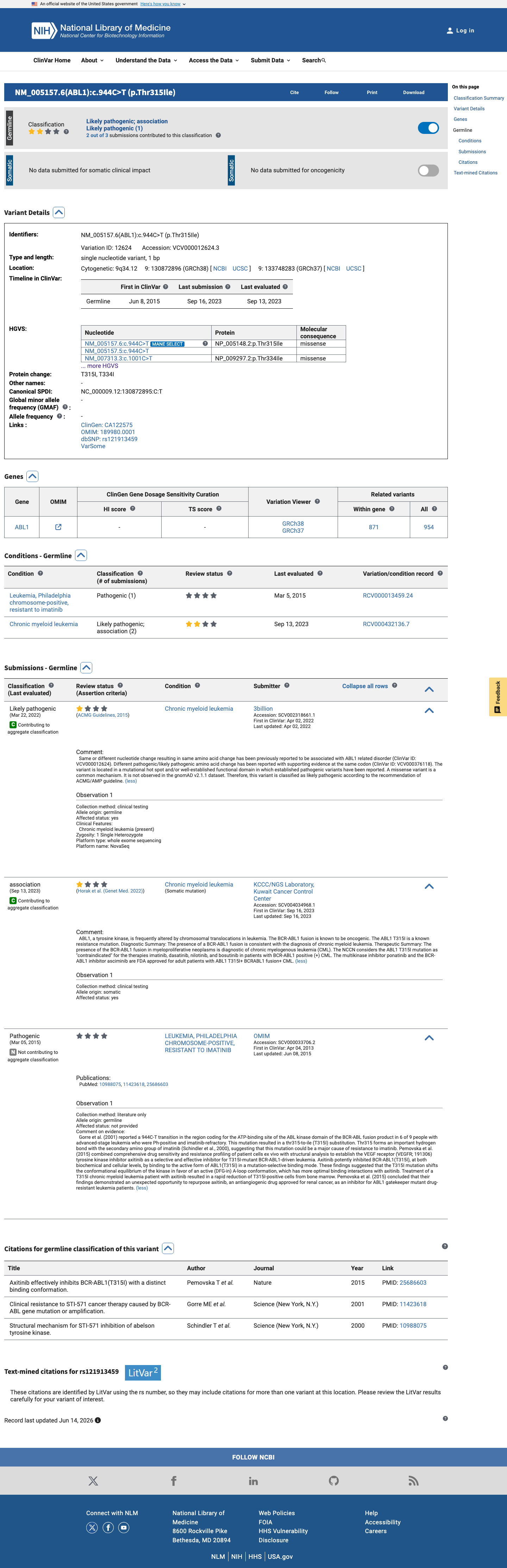
ClinVar variation 12624 is classified as Likely pathogenic by a single submitter with criteria provided (3billion) and as Pathogenic by OMIM (no assertion criteria).
Benign
BA1
The variant is absent from gnomAD v2.1, v4.1, and Canada.
BS1
The variant is absent from all gnomAD population databases (allele frequency 0.0%).
BS2
The variant has not been observed in a healthy adult individual for a disorder with full penetrance expected at an early age.
BS3
Well-established in vitro functional studies (PMID:11423618, PMID:25686603) demonstrate a damaging effect of the T315I substitution on ABL1 kinase drug binding, not a benign effect.
BS4
No segregation data demonstrating lack of cosegregation with disease in affected family members.
BP1
BP1 applies when a missense variant occurs in a gene for which primarily truncating variants are known to cause disease.
BP2
No observation of NM_007313.2:c.1001C>T in trans with a pathogenic variant for a fully penetrant dominant disorder, or in cis with a pathogenic variant in any inheritance pattern.
BP4
REVEL score of 0.587 predicts a deleterious effect (>0.5 threshold).
BP5
BP5 requires the variant to be found in a case with an alternate molecular basis for disease.
BP6
ClinVar classifies this variant as Likely pathogenic (criteria provided, single submitter) and Pathogenic (OMIM, no assertion criteria).
N/A · 4
PVS1 · PS1 · PM5 · BP7
Research & evidence
Population frequency · supports pathogenic
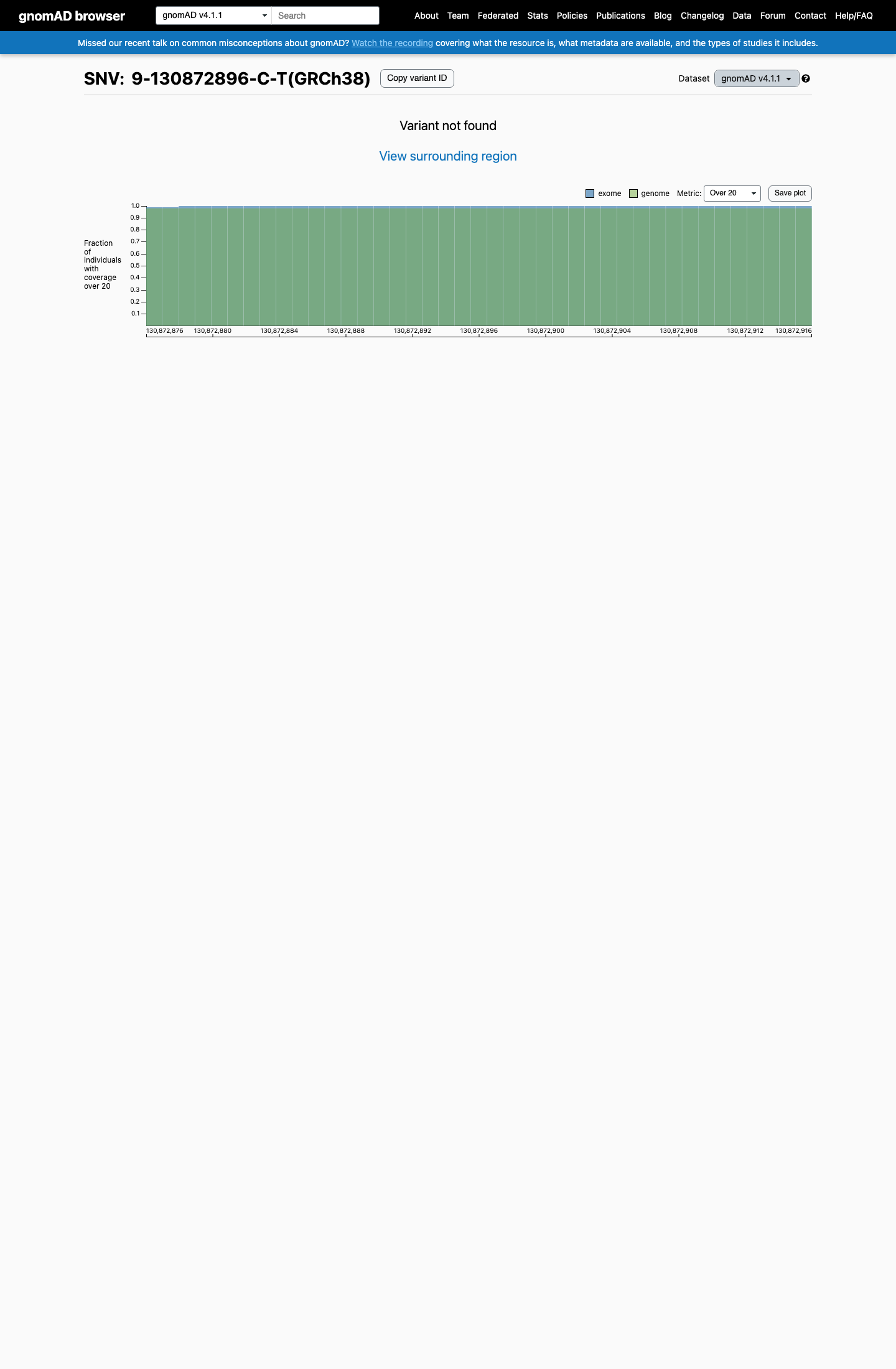
gnomAD v4.1
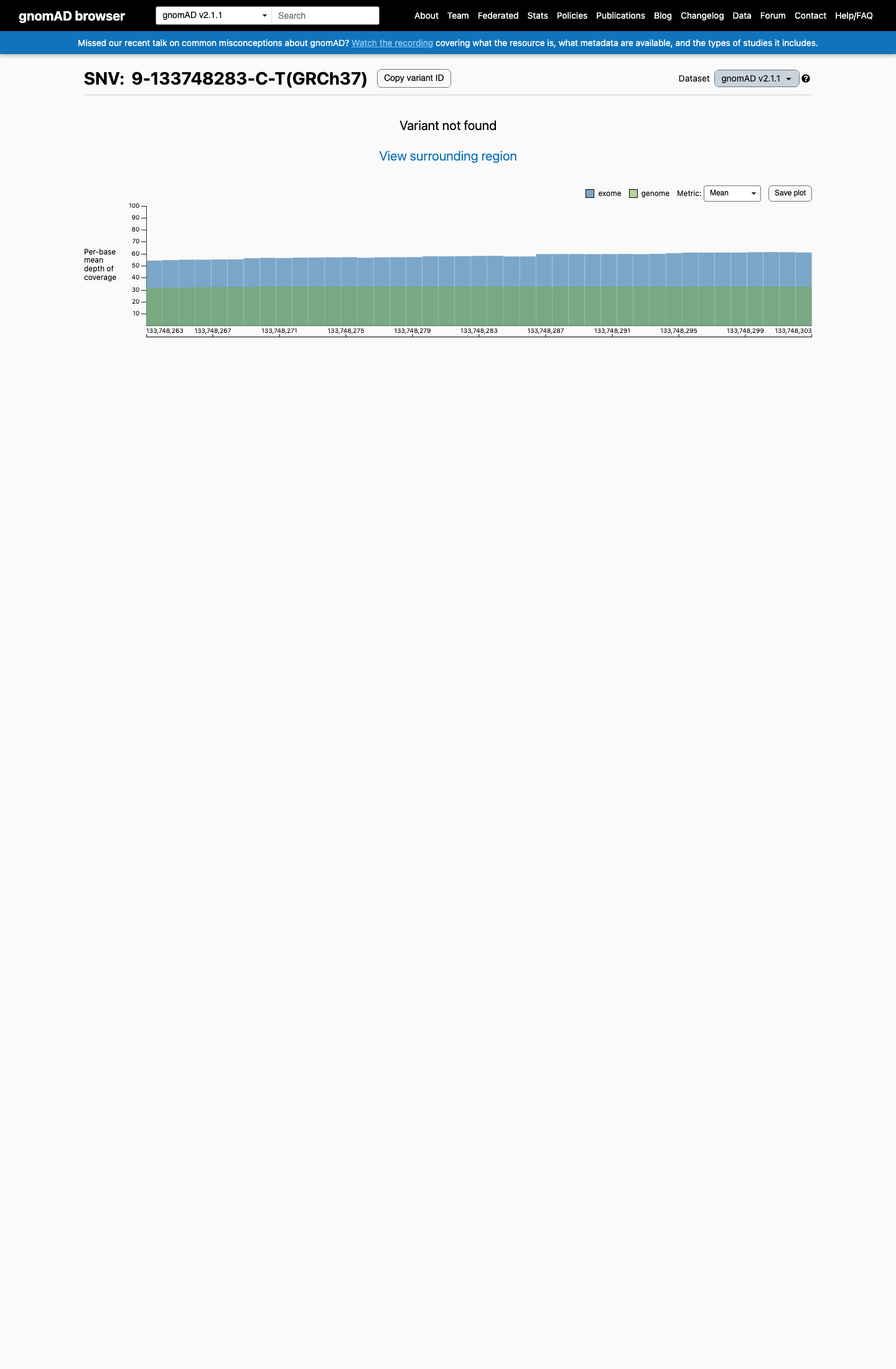
gnomAD v2.1
v4.1
Absent from gnomAD v4.1.
v2.1
Absent from gnomAD v2.1.
🇨🇦 CA
Absent from gnomAD-Canada v1.0.
Allele frequency by ancestry
three datasets · side by side
gnomAD v4.1
Absent
· 0 / ?
0 hom
0 hom
Not observed in any ancestry group.
gnomAD v2.1
Absent
· 0 / ?
0 hom
0 hom
Not observed in any ancestry group.
gnomAD Canada 🇨🇦
Absent
· 0 / ?
0 hom
0 hom
Not observed in any ancestry group.
In silico
SpliceAI predicts no significant splice impact for this variant (max delta score = 0.00). REVEL score = 0.587. BayesDel score = 0.236673.
Functional
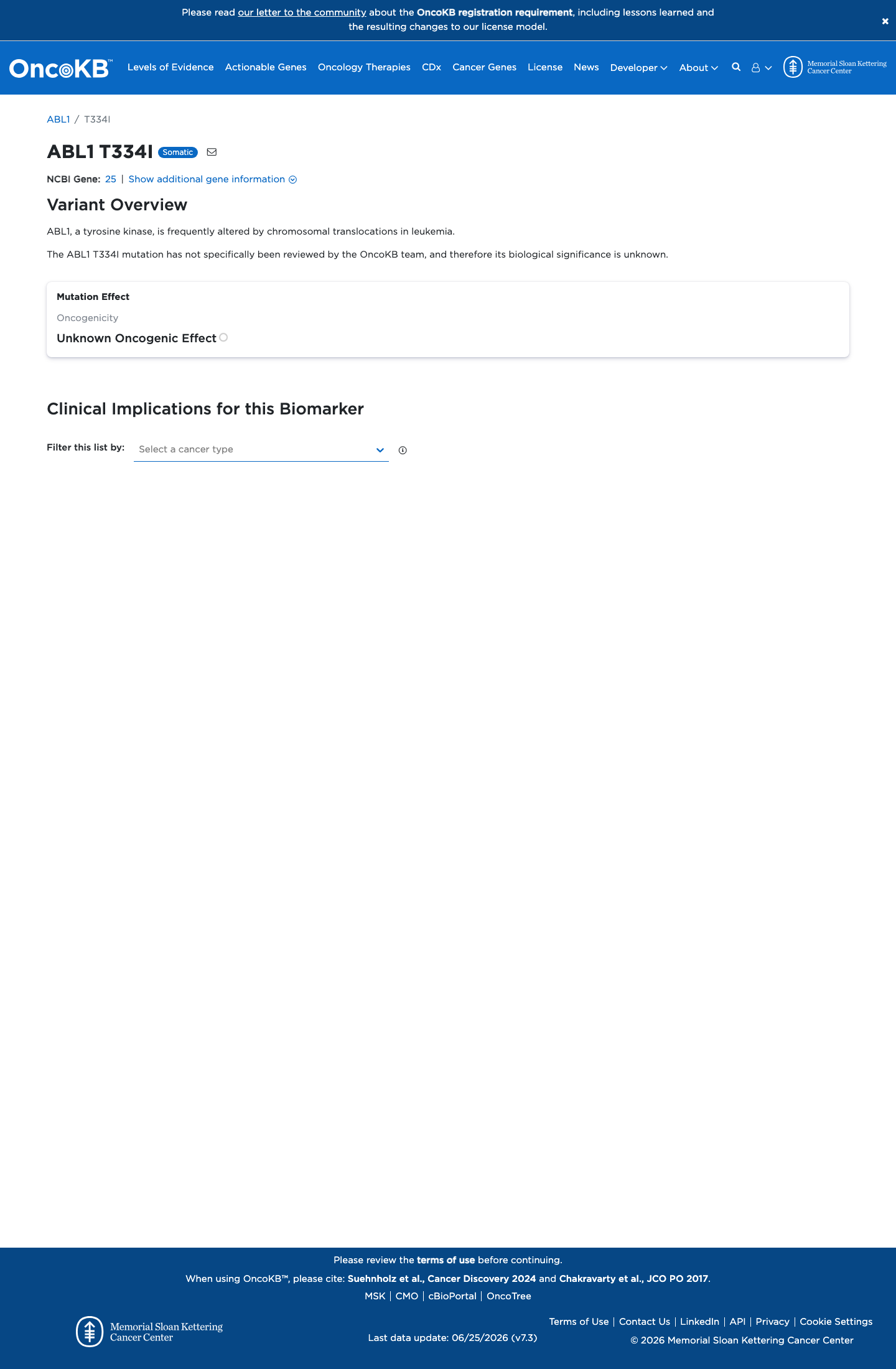
Unknown Oncogenic Effect
OncoKB did not identify variant-specific reviewed functional evidence for this variant; gene-level curated context is available for reviewer follow-up. ABL1, a tyrosine kinase, is frequently altered by chromosomal translocations in leukemia.
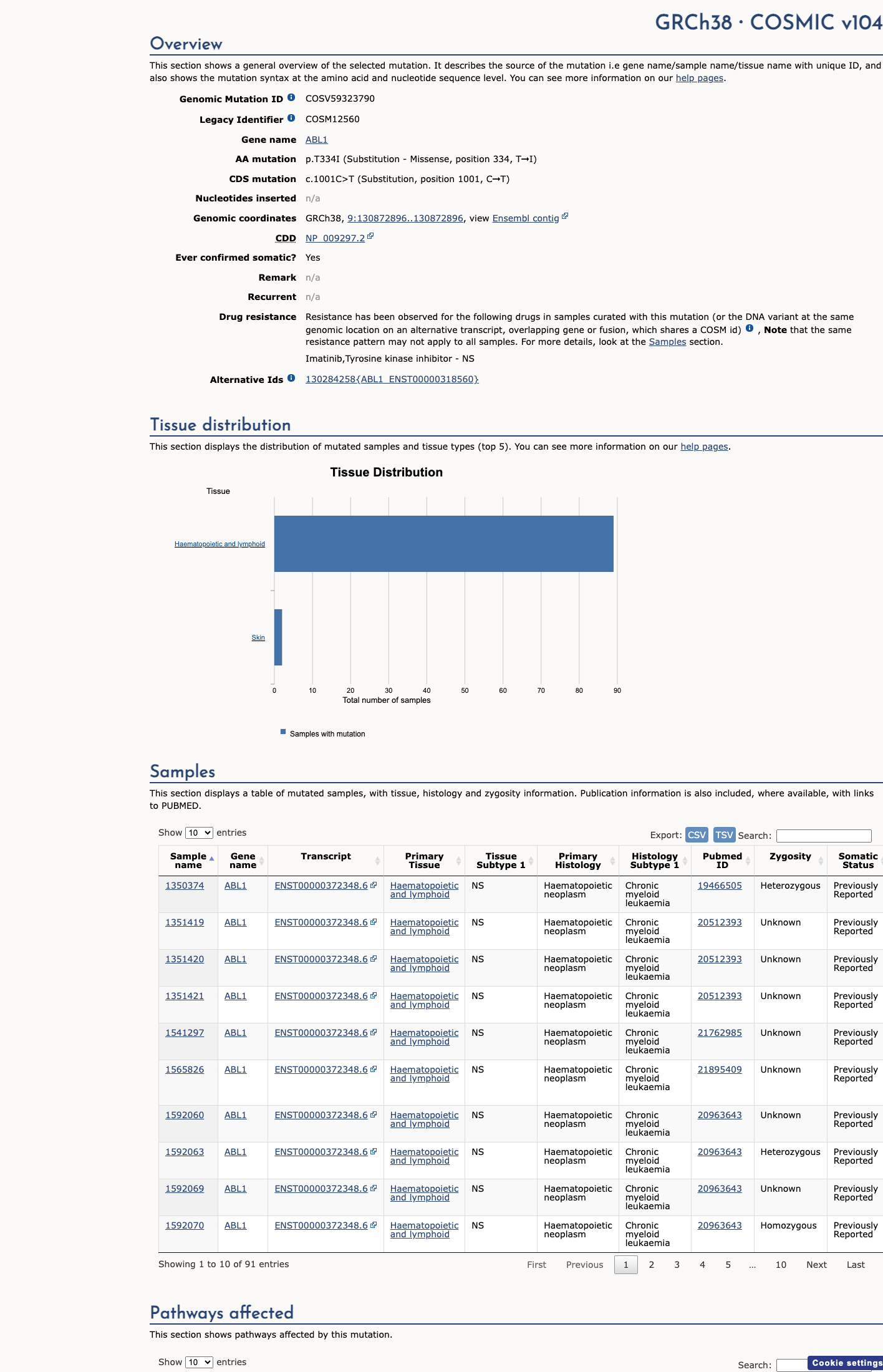
COSMIC

Cancer hotspots
Somatic evidence
Not in COSMIC / hotspots
COSMIC
This variant does not lie in a statistically significant hotspot. This variant has previously been reported in somatic cancers (COSMIC; COSV59323790, n = 91 times).
Hotspots
This variant does not lie in a statistically significant hotspot.
Literature · how each cited paper was used
3papers cited
Each card is an audit: what was searched, what was found, whether it names the variant, which criteria it fed, and why. 3 further PMIDs triaged but not cited — see Sources & references.
Clinical resistance to STI-571 cancer therapy caused by BCR-ABL gene mutation or amplification.
Searched
c.1001C>TT315IThr315IleC>T944
Found
T315I (Thr315Ile) identified in 6 of 9 STI-571-resistant CML patients by cDNA sequencing. Reconstitution of T315I into wild-type p210 BCR-ABL in 293T cells confirmed the mutant retained phosphotyrosine activity at all STI-571 concentrations tested, demonstrating the T315I substitution is sufficient to confer drug resistance. Structural modeling predicted the isoleucine substitution would eliminate a critical hydrogen bond with STI-571 and create a steric clash.
Variant
✓ Names this variant — characterised directly
Applied to
→PS3
met
Why
Variant-specific functional data confirmed T315I confers STI-571 resistance; referenced in PS3 assessment.
A single, identical C→T nucleotide (nt) change was detected at ABL nt 944 in six of nine cases examined. ... This single nucleotide C→T change results in a threonine to isoleucine substitution at position 315 (Thr315→Ile; T315I) of c-Abl.
Location Abstract; Results, paragraphs 2-4; Fig. 4 · Context BCR-ABL reconstitution assay, 293T cells; STI-571 dose-response (0-10 µM); anti-phosphotyrosine and anti-Abl immunoblotting · full text
Axitinib effectively inhibits BCR-ABL1(T315I) with a distinct binding conformation.
Searched
T315IThr315Ilegatekeeper
Found
BCR-ABL1(T315I) gatekeeper mutation shown to be potently inhibited by axitinib. Crystal structures of axitinib bound to ABL1(T315I) revealed an active DFG-in conformation distinct from the DFG-out conformation in wild-type ABL1. Axitinib inhibited ABL1(T315I) with Ki=100 pM versus Ki=3,800 pM for wild-type. Axitinib suppressed T315I autophosphorylation and Ba/F3 cell proliferation with ~10-fold higher potency compared to wild-type. Clinical treatment of a T315I-positive CML patient resulted in rapid reduction of T315I transcript levels.
Variant
✓ Names this variant — characterised directly
Applied to
→PS3
met
Why
Extensive structural, biochemical, and cellular functional data confirm altered ABL1(T315I) kinase properties; referenced in PS3 assessment.
The BCR–ABL1 kinase domain gatekeeper mutation Thr315Ile (T315I) confers resistance to all approved ABL1 inhibitors except ponatinib, which has toxicity limitations.
Location Abstract; Results, paragraphs 1-6; Fig. 2-4 · Context Crystallography (axitinib-ABL1 and axitinib-ABL1(T315I) co-crystals); biochemical kinase inhibition (Ki determination); Ba/F3 cell proliferation and autophosphorylation ELISA; ex vivo drug sensitivity testing of primary CML/Ph+ ALL patient cells; clinical case treatment (5 mg axitinib twice daily) · full text
Rule & framework references · cited for criterion definitions, not variant evidence
10988075 ↗
Structural mechanism for STI-571 inhibition of abelson tyrosine kinase.
Sources & reference links
Triaged references · 3 PMIDs not cited in assessment
25741868 ↗
Standards and guidelines for the interpretation of sequence variants: a joint consensus recommendation of the American College of Medical Genetics and Genomics and the Association for Molecular Pathology.
CLINVAR
24976289 ↗
Managing children with chronic myeloid leukaemia (CML): recommendations for the management of CML in children and young people up to the age of 18 years.
CLINVAR
36063163 ↗
Standards for the classification of pathogenicity of somatic variants in cancer (oncogenicity): Joint recommendations of Clinical Genome Resource (ClinGen), Cancer Genomics Consortium (CGC), and Variant Interpretation for Cancer Consortium (VICC).
CLINVAR